Back to Work After a Layoff or Career Break: The Analyst's 60 Day Plan
Written by Ahmed at Analyst Engineering, a Senior Technical Business Analyst with 10+ years in banking and payments delivery.
Key takeaways
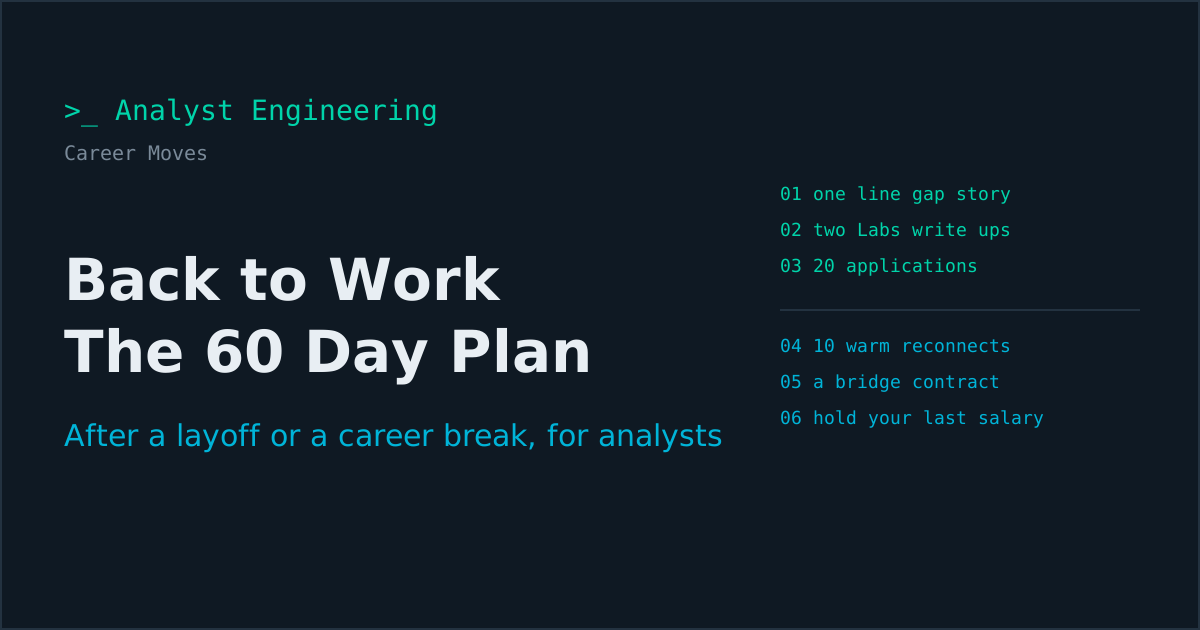
- An analyst returning after a layoff or career break can run a focused 60 day plan: a one sentence gap explanation, a refreshed CV, 2 portfolio pieces, 20 targeted applications, and 10 warm reconnects.
- A career gap needs one factual sentence and a pivot to current skills; long explanations signal that the candidate thinks the gap is a problem.
- The 2026 analyst market has fewer junior postings and more AI-driven reshuffles, but analysts who combine domain knowledge with visible technical proof still get hired.
- Returners often accept 5 to 10 percent below their last salary; anchoring on the posted band rather than on the gap, and adding technical proof that moves you toward the technical BA band, avoids most of that discount.
- A short contract can bridge a gap and end it: a US business analyst contract typically pays US$55 to US$80 an hour and a UK one £350 to £550 a day.
An analyst returning after a layoff or a career break can get back to work with a focused 60 day plan: explain the gap in one factual sentence, refresh the CV, build 2 portfolio pieces, send 20 targeted applications, and make 10 warm reconnects. The 2026 market is harder than it was, with fewer junior postings and AI-driven reshuffles of delivery teams, but analysts who pair domain knowledge with visible technical proof still get hired, often without the 5 to 10 percent pay discount returners tend to accept.
The week after a round of layoffs on a payments program I worked on, I got four messages from people who had been cut. Three of them sent long explanations of what had happened, who had decided it, and why it was unfair. One sent three lines: her role had been cut, she was looking for a senior BA role in payments, and could we talk for 15 minutes about which teams were hiring. I introduced her to two hiring managers that afternoon. She had an offer in five weeks.
The other three were just as good at the job. The difference was that she had turned the layoff into a plan on day one, and made it easy for people to help. That is the whole point of a 60 day plan. Interviews after a gap test the same things as always plus one: whether you can talk about the gap without flinching. The BA and Technical BA Interview Guide covers the questions interviewers ask, what each one tests, and how to answer from real work, including the hard ones.
What does getting back to work as an analyst actually look like in 2026?
Getting back to work in 2026 looks like a shorter, more targeted search than the last one you ran. The market changed in two ways. Junior and generalist postings dropped as teams reshuffled around AI tools, so broad applications convert worse than they used to. And hiring managers now ask for proof of current skill, because a two year old CV cannot show how someone works with AI assistants or API-first delivery.
Analysts still win in this market with two things: domain knowledge that AI tools do not have (how chargebacks actually flow, why a claims rule exists) and visible technical proof (a query, an API review, a test design). Is business analysis a safe career with AI? covers which roles are exposed and which moves hedge.
| Before the gap | What returners are asked for in 2026 |
|---|---|
| Stories and specs written by hand | Stories and specs drafted with an AI assistant, then reviewed and owned by the analyst |
| Jira and Confluence used manually | Jira and Confluence connected to AI through MCP (Model Context Protocol) on some teams |
| API work left to developers | Analysts reading OpenAPI contracts and sending requests in Postman or Bruno |
| Test cases written from the spec | Test design from rules, with AI generating candidates and the analyst choosing the oracle |
| A CV listing responsibilities | A CV plus two recent artifacts that show how you work now |
How much should a returning analyst expect to earn?
A returning analyst should expect the same band as someone at their level without a gap, and should not discount themselves by default. Indicative 2026 base salaries for permanent roles in large cities, excluding bonus:
| Role and level | US (USD) | Canada (CAD) | UK, London (GBP) | Eurozone (EUR) |
|---|---|---|---|---|
| Business analyst, senior | 110k to 135k | 90k to 110k | 55k to 72k | 60k to 75k |
| Technical BA, senior | 125k to 155k | 100k to 125k | 65k to 85k | 65k to 82k |
| QA analyst, mid | 72k to 92k | 62k to 80k | 36k to 48k | 42k to 52k |
| QA analyst, senior | 90k to 115k | 78k to 98k | 48k to 62k | 52k to 65k |
Returners often accept 5 to 10 percent below their last salary. On a US$130k senior BA salary, that is US$117k to US$124k, a loss of up to US$13k a year that compounds into every future raise. Three habits avoid it. Anchor on the posted band, not on your last number or your gap. Do not volunteer the gap as a reason for flexibility. And add technical proof, because the senior technical BA band starts where the senior BA band tops out: a BA who moves to technical BA at the same level usually gains 10 to 20 percent. How to become a technical business analyst is the six month version of that, and how analysts negotiate an offer has the scripts.
To verify a band, use posted ranges: New York City and New York State, California, Colorado, Washington, Illinois, and several other US states require them; British Columbia (since November 2023) and Ontario (since January 1, 2026, for employers with 25 or more employees) require expected pay in public postings; the EU Pay Transparency Directive requires pay information before interview as member states implement it. In the UK, use ITJobsWatch. The Robert Half, Hays, and Michael Page annual guides are good cross-checks, and two former colleagues one level up can tell you more than any guide.
How do you explain a layoff or a career gap in one sentence?
You explain a gap with one factual sentence and a pivot to current work. The interviewer’s real question is not “why the gap?” but “are your skills current, and is anything wrong?”. Answer both in under 20 seconds.
“My role was cut in March when the company closed its lending product; since then I have refreshed my API testing and completed two practice investigations I can walk you through.”
“I took three years out to care for a family member. That is resolved, I am back full time, and I have spent the last two months catching up on AI-assisted test design.”
Do not apologize, do not give medical details, and do not explain the company’s strategy. The longer the explanation, the more the interviewer thinks the gap is a problem.
What do you say when an interviewer asks “why were you let go?”
You state the business reason, keep it impersonal, and move forward. Layoffs in 2026 are common enough that no reasonable interviewer treats one as a signal about you.
“The company cut about a third of product and delivery roles when funding tightened, including my whole team. I’m proud of what we shipped, especially the dispute workflow that cut manual reviews in half. I’m looking for a team working on payments at scale.”
If performance was part of it, say so in one sentence, add what you do differently now, and pivot. Never criticize the former employer.
How do you reconnect with your network after a layoff?
You reconnect with short, specific messages that make it easy to help. Ten warm reconnects beat a hundred cold applications. Warm means someone who has worked with you and would recognize your name.
“Hi Sam, hope the migration went live cleanly. My role at [company] was cut last month and I’m looking for a senior BA role in payments or cards. Would you have 15 minutes next week to tell me which teams at your bank are hiring? No pressure if the timing is bad.”
Three rules: say what you want in one line, ask for information, not a job, and follow up once after a week.
How do you handle the money after a layoff?
You handle it by knowing your runway, reading your severance terms, and treating a contract as a bridge.
Severance. Read the agreement before signing, and have an employment lawyer check any release, non-compete, or clause that ties payments to not working. Severance rules differ widely between the US, Canada, the UK, and the EU. Ask whether it is paid as a lump sum or as salary continuation, because that decides the next point.
Negotiating a start date. With a lump sum, a start date a few weeks out is effectively extra income. With salary continuation that stops when you start a new job, the calculation changes. Either way, a new employer usually accepts two to four weeks.
A contract to bridge. A US business analyst contract typically pays US$55 to US$80 an hour, a technical BA US$70 to US$110; in the UK, £350 to £550 a day for a BA. A three to six month contract ends the gap and restores a current reference. Do not treat a bridge rate as your long-run price: a senior technical analyst replacing a US$130k salary needs a floor around US$80 to US$100 an hour for contracting to work over the long run. Going contract as an analyst has the math in four markets.
What changed in analyst work while you were away?
Three things changed most in the last two years, and interviewers will probe all three.
AI assistants in everyday analyst work. Drafting stories and acceptance criteria, summarizing workshops, generating test ideas, and reviewing specs for gaps. AI for analysts: start here is the orientation, and an AI workflow for business analysts shows the full working loop.
MCP. The Model Context Protocol lets an assistant read Jira, Confluence, and other tools directly. Some teams now expect analysts to know how that works and where the guardrails sit; MCP for analysts covers the read-only first approach.
API-first delivery. More analysts read OpenAPI contracts and send requests themselves. Reading an API contract and the API testing guide close that gap quickly.
If you want one resource for the AI part, The AI-Powered Analyst covers using AI across analyst work, from elicitation to testing, which is exactly what interviewers now ask returners about.
What does a successful return look like?
The cases below are composites of moves I have watched on delivery teams, with details changed. Pay sits inside the 2026 indicative bands.
Case 1: a senior BA laid off from a US fintech
Rachel was a senior BA on disputes and chargebacks at a New York fintech on US$130k when the company cut a third of product and delivery. She had 12 weeks of severance. She sent 10 reconnect messages in week one, finished Investigate a Duplicate Refund and Validate an Event Flow as portfolio pieces, and sent 20 targeted applications, all in payments. On day 38 she took a four month W-2 contract through an agency at US$75 an hour as a bridge. In month six she landed a senior technical BA role at a bank at US$135k, above her last salary, because the two technical write-ups moved her into the technical BA band. What she would do differently: skip the first two weeks of generic applications, which produced nothing.
Case 2: a UK QA analyst returning after three years of caregiving
Gareth was a mid QA analyst in London on £44k before he took three years out to care for a parent. His worry was that manual testing had moved on without him. He spent four weeks on API testing with Bruno, a free API client, and on AI-assisted test design, and finished two Labs missions. His gap sentence was one line. He sent 20 applications and made 10 reconnects, one of which led to a mid QA role at an insurer at £47k after 11 weeks, above his previous salary and still inside the £36k to £48k band. What he would do differently: stop apologizing for the gap in his first two interviews, which he believes cost him one offer.
What is the 60 day plan to get back to work?
Each step produces an artifact. Weeks overlap by design.
- Days 1 to 7: money and story. Read the severance terms, calculate runway, write the one sentence gap explanation. Artifact: a runway sheet and the gap sentence.
- Days 8 to 14: refresh the CV and LinkedIn. Rewrite the top third around your target role and recent proof. Artifact: a two page CV; the CV rewrite guide has before and after bullets.
- Days 8 to 30: 10 warm reconnects. Two messages a day until you reach 10, then follow up once. Artifact: a tracker with 10 names, dates, and outcomes.
- Days 15 to 35: 2 portfolio pieces. Pick two missions in the Labs or the Become a Technical Analyst track. A free account saves your progress and unlocks the solutions. Artifact: two one page write-ups, presented as in the analyst portfolio guide.
- Days 20 to 50: 20 targeted applications. Only roles where your domain counts, each with a tailored top third of the CV. Artifact: 20 applications logged with the posted band.
- Days 40 to 60: interviews and offer. Practice the gap sentence, the “why were you let go?” answer, and one case exercise. Artifact: an offer, or a signed bridge contract and a pipeline of three active processes.
For the week by week structure of the search itself, with message templates that get replies, Land Your First Job works for returners as well as first-timers.
What mistakes stall a return to work?
- Applying everywhere in week one. Broad applications convert poorly in 2026 and burn the energy you need for targeted ones.
- Telling the whole story. A three paragraph gap explanation reads as unresolved.
- Waiting to feel current before applying. Apply from day 20 with one portfolio piece; interviews show you what to refresh next.
- Discounting yourself first. Saying “I’m flexible on salary given the gap” hands away 5 to 10 percent.
- Ignoring AI in interviews. Returners who cannot describe how they would use an assistant in analyst work look out of date, whatever their experience.
The takeaway
Getting back to work after a layoff or a career break is a 60 day project with concrete outputs: a one sentence gap explanation, a refreshed CV, 2 portfolio pieces, 20 targeted applications, and 10 warm reconnects. Refresh the three things that changed (AI tools, MCP, API-first delivery), use a contract as a bridge if it comes first, and anchor on the posted band rather than your gap.
Start with The BA and Technical BA Interview Guide for the questions returners face. If you want help with the gap story, the CV, or an offer, book a 1:1 Tech BA Coaching Call. The free downloads are a quick first refresh, and everything else is at The Tech BA Toolkit. More on the role lives in the Business Analyst hub and the QA Analyst hub.
Ahmed is a Senior Technical Business Analyst with 10+ years in banking and payments. He builds practical guides and tools for analysts at The Tech BA Toolkit.
Tags: Business Analysis, Job Search, Career Break, Quality Assurance, Career Growth
About the author
Analyst Engineering is written by Ahmed, a Senior Technical Business Analyst with 10+ years of banking and payments delivery experience: ISO 20022 and SWIFT messaging, payments API integration, Kafka event validation, and production support. Every article comes from real delivery work, and each one is reviewed and updated as tools and standards change.
Related articles
- Going Contract as an Analyst: Day Rates, Structures, and the Math in Four Markets Analyst contract rates in 2026 for the US, Canada, UK, and eurozone, the structures (1099, CCPC, IR35, portage), and the floor-rate math behind real take-home.
- How Analysts Negotiate a Raise or an Offer: Scripts, Evidence, and Numbers How analysts negotiate an offer or a raise: word-for-word scripts, an evidence file with numbers, timing, non-salary items, and US, Canada, UK, and EU norms.
- Rewriting Your CV for an Analyst Role Change: Before and After Bullets That Get Interviews Rewrite your CV for an analyst role change: bullets as artifact plus outcome plus number, before and after pairs, ATS rules, and CV norms in four markets.
- Is Business Analysis a Safe Career With AI? Which Roles Are Exposed and Which Moves Hedge Is business analysis safe from AI? Which BA tasks AI already does, which it cannot, the roles most exposed, and the five career moves that hedge, with 2026 pay.
Go deeper on this
Not ready to buy? The free downloads are a no-cost place to start, and every article here stays free.
Free account
Practice on the Labs, keep your progress
A free account, no password: an email link signs you in. It saves your steps and self-assessments on the Labs, shows your missions on a dashboard, unlocks the solutions, and, if you tick the box, sends you new missions and articles when they ship.
Your email is used to sign you in. Nothing else, unless you ask. Privacy.