How to Become a Technical Business Analyst: The Six Month Plan and the Pay Jump
Written by Ahmed at Analyst Engineering, a Senior Technical Business Analyst with 10+ years in banking and payments delivery.
Key takeaways
- A business analyst becomes a technical business analyst by building four skills on a live project: SQL, API contracts, production logs, and scripting. Six months is enough when each month ends with an artifact.
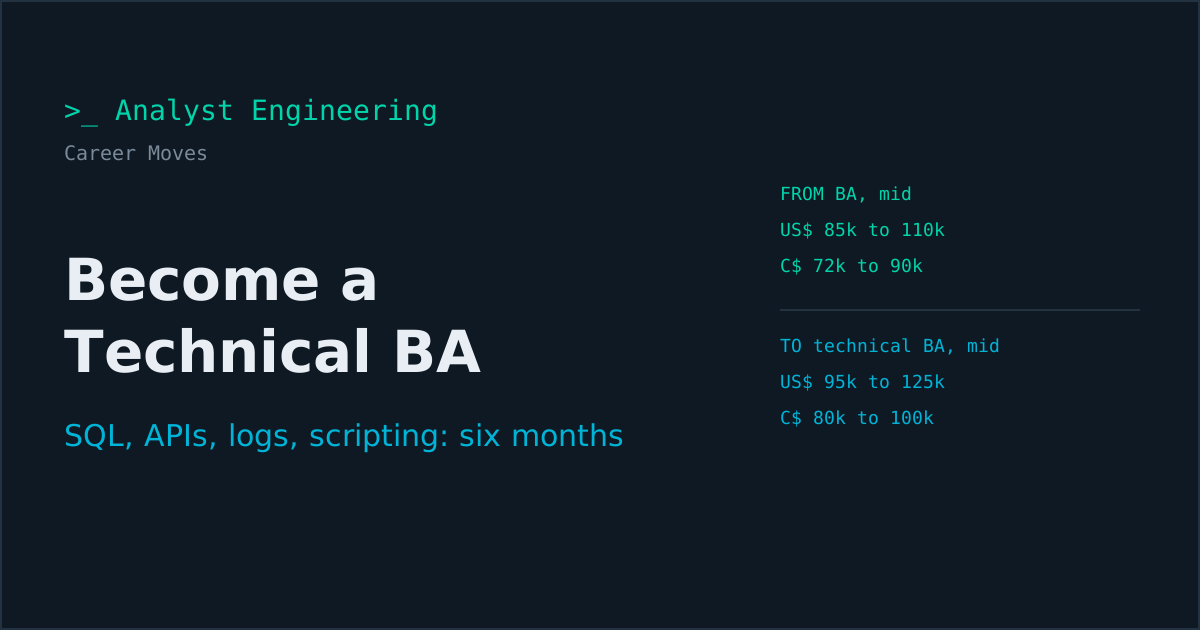
- At the same level, a technical BA earns about 10 to 20 percent more than a BA. In a large US city in 2026, a mid BA earns about US$85k to US$110k base and a mid technical BA about US$95k to US$125k.
- The technical BA title follows evidence, not certificates: a query notebook, an API collection, a transaction trace, and a script that runs a real check are what hiring managers and promotion panels ask to see.
- Learning tools without applying them to your own system is the most common reason the move stalls; a course certificate proves attendance, an artifact from your project proves capability.
- When an employer will not re-title a BA who already does technical BA work, moving employer is usually the faster route to the pay band.
To become a technical business analyst, build four skills on your current project over about six months: SQL, API contracts, production logs, and scripting. Each month ends with an artifact, and the artifacts are what earn the title. At the same level, a technical BA earns about 10 to 20 percent more than a BA: in a large US city in 2026, a mid business analyst earns about US$85k to US$110k base and a mid technical BA about US$95k to US$125k. The title follows the evidence, never the course certificate.
Last year I sat on the interview panel for a technical BA seat on a payments team. Two finalists. The first had a strong CV with an SQL course, a Postman course, and a Python bootcamp listed under training. The second had fewer lines but brought a one-page trace of a failed transfer from her current job: the correlation identifier, the four services it crossed, the log line where the status went wrong, and the query she ran to find the other 37 payments with the same defect. We hired the second candidate in the debrief, in under five minutes.
That gap, between knowing the tools and having used them on a real system, is the whole move. This article is the plan and the pay; the conceptual difference between the two roles is in Business Analyst vs Technical Business Analyst. If you want the skills themselves in one place first, Tech Skills Guide for BAs covers reading code, SQL, APIs, and delivery tools so you can contribute beyond requirements.
What changes day to day when a BA becomes a technical BA?
The role changes from describing behaviour to verifying it against the running system. You still write requirements, run refinement, and own UAT. The difference is that you check your own work in the database, the API, and the logs instead of waiting for a developer to check it for you.
| Situation | Business analyst | Technical business analyst |
|---|---|---|
| New field requested | Writes the rule | Writes the rule, checks the contract carries the field, queries current values in production |
| Defect raised in UAT | Reproduces it in the UI | Reproduces it through the API, reads the logs, names the failing component |
| Test data needed | Asks the developers | Queries for it and hands QA the records |
| Integration design | Attends the meeting | Reviews the OpenAPI contract and the sequence before the meeting |
| Production incident | Waits for the root cause | Traces the transaction by correlation identifier |
| Weekly manual check | Does it by hand | Scripts it and shares the script |
The right-hand column is what hiring managers mean when a job ad says “hands-on”. None of it requires writing production code.
How much more does a technical business analyst earn?
A technical BA earns about 10 to 20 percent more than a BA at the same level, and the gap widens at senior level. The table shows indicative 2026 base salary for permanent roles in large cities, excluding bonus and equity.
| Role and level | US (USD) | Canada (CAD) | UK (GBP) | Eurozone (EUR) |
|---|---|---|---|---|
| Business analyst, mid | 85k to 110k | 72k to 90k | 42k to 55k | 48k to 60k |
| Technical BA, mid | 95k to 125k | 80k to 100k | 50k to 65k | 52k to 65k |
| Business analyst, senior | 110k to 135k | 90k to 110k | 55k to 72k | 60k to 75k |
| Technical BA, senior | 125k to 155k | 100k to 125k | 65k to 85k | 65k to 82k |
| Technical BA, lead or principal | 150k to 180k | 120k to 145k | 80k to 100k | 78k to 95k |
US figures are major metros; New York, Chicago, Boston, and the Bay Area sit at or above the top of each band, and smaller metros run 10 to 20 percent lower. UK figures are London; outside London is roughly 15 to 20 percent lower. Banking and capital markets in New York or London typically add 10 to 20 percent on top.
The honest reading: the move rarely costs money, because you are adding skills to the same seat. The premium comes from two places. First, the technical BA band itself. Second, the contract market, where the gap is wider: a US technical BA bills about US$70 to US$110 an hour against US$55 to US$80 for a BA, and in Canada about C$75 to C$110 against C$60 to C$85, usually through a corporation. A senior Canadian technical BA replacing a C$110k salary has a floor around C$80 to C$95 an hour, and the math works from about C$90. Going contract as an analyst runs that math in four markets.
To verify, read posted ranges where the law requires them: New York City and New York State, California, Colorado, Washington, Illinois, and several other US states; British Columbia since November 2023 and Ontario since January 1, 2026 for employers with 25 or more employees; and EU countries as member states implement the Pay Transparency Directive (EU) 2023/970. In the UK, ITJobsWatch shows permanent and contract rates for “technical business analyst” as a keyword. The annual Robert Half, Hays, and Michael Page salary guides and Levels.fyi for tech employers are useful cross-checks. Then ask two people one level above you what their band is.
What is the six month plan to become a technical business analyst?
One skill a month, applied to the system you already work on, with one artifact per month. Before month one, request read-only database access and log access; the access request is the first blocker for most BAs, and it takes weeks in a bank.
- Month 1, SQL: answer ten of your own questions. Every time you would have asked a developer “how many records have X”, write the query yourself. Start with SQL for analysts. Artifact: a query notebook with ten entries, each holding the question, the query, the answer, and the decision it changed. SQL for Business Analysts is the companion for this month.
- Month 2, APIs: build a Bruno collection for your system. Read the contract first with reading an API contract and, if the format is new, your first time reading an OpenAPI contract. Then build the collection with your first collection in Bruno and Postman. Artifact: a collection with environments, the happy path, three negative requests, and a list of gaps between the contract and the requirements. The APIs for analysts hub groups everything else you need.
- Month 3, logs: trace one transaction. Pick a real failed or delayed transaction and follow it through every service by its correlation identifier, using reading production logs. Artifact: a one-page trace with timestamps, components, the failing line, and a sequence diagram.
- Month 4, scripting: automate one check in Python. Choose a check you do by hand every week, such as comparing a file against the database or polling a status. Scripting checks in Python has the patterns. Artifact: a script and a short README that a colleague can run.
- Month 5, Git: review one pull request. Clone the repository, read a change linked to your story, and comment on whether it meets the requirement, using Git for analysts. Artifact: a pull request review with at least one comment a developer acted on.
- Month 6, package the evidence and ask. Score yourself on the technical analyst skill matrix, check the gaps against the roadmap, and build a two-page evidence pack from the five artifacts with confidential details removed. Artifact: the pack, a salary figure, and either a conversation with your manager or five targeted applications.
If your project does not give you a live API or log access, the Become a Technical Analyst track is the portfolio centerpiece: three missions on one fictional payments system, from analyzing a payment API through validating an event flow to investigating a duplicate refund. The write-ups are exactly the artifacts from months two and three. A free account saves your progress and unlocks the solutions. The analyst who can send an API request explains why the hands-on part matters so much in interviews.
What does the move look like in real cases?
The cases below are composites of moves I have watched on delivery teams, with details changed. Pay figures are base salary for permanent roles.
Sophie, a BA at an insurer in Montréal
Sophie had six years of BA experience on a claims platform and was paid C$85k, below the senior BA band of C$90k to C$110k. During an integration with a new payments provider, she followed the plan almost exactly: a query notebook on claims data, a Bruno collection for the provider API, a trace of a claim payment that silently failed, and a Python script that reconciled daily claim payments against the provider’s report. It took seven months. She was promoted internally to technical BA at C$102k, at the low end of the senior technical BA band of C$100k to C$125k. Part of that 20 percent jump was the band; part was correcting an underpayment she only noticed once she checked posted ranges.
What she would do differently: start with logs. The claim payment trace got her more visibility in one week than two months of SQL, because it happened during an incident.
James, a BA in London banking
James was a senior BA on £58k at a bank, inside the senior BA band of £55k to £72k. Over eight months he built an API collection for the payment initiation service, wrote the SQL checks the team used in regression, and traced two production incidents. His employer agreed he was doing technical BA work but would not change the title outside the annual cycle. He applied out and joined another bank as a senior technical BA on £72k, inside the senior technical BA band of £65k to £85k.
What he would do differently: stop waiting. He spent three months hoping for an out-of-cycle review. Once the evidence pack existed, applying out was a two-month process.
Keisha, a BA at a payments processor in Atlanta
Keisha was a mid BA on US$92k. In five months she completed an SQL course, a Postman course, and a Python course, then interviewed for two technical BA roles and failed both on the same question: “Show me something you built on your current system.” She had nothing. She restarted with the plan above, one applied artifact per month on her own merchant onboarding project, and four months later landed a mid technical BA role at US$108k, inside the band of US$95k to US$125k. Eleven months in total.
What she would do differently: apply each tool the week she learned it. The courses were not wasted, but they were worth nothing at interview until they touched her own system.
How do you actually get the technical BA title?
You get the title by making the evidence impossible to ignore, then asking for it with a number. There are three routes, and most people need two of them.
How do you get promoted to technical BA internally?
Build the case before the review cycle, not during it. Bring the evidence pack, one line on business impact per artifact (hours saved by the script, defects caught before UAT, incident time shortened), the posted range for technical BA roles in your city, and a specific figure. Ask your manager what the title requires, in writing, and close the gaps they name. Changing role inside your company covers the timing, and how analysts negotiate a raise or an offer has the scripts.
What do technical BA job ads actually ask for?
Search for “technical business analyst” together with “API”, “SQL”, or your domain. The phrases that recur in real ads tell you what the interview will test:
- “Strong SQL skills, able to write complex queries to analyse and validate data”
- “Experience with REST APIs, JSON, and tools such as Postman”
- “Able to read and interpret API specifications (OpenAPI or Swagger)”
- “Comfortable investigating issues using logs (Splunk, Kibana, or Datadog)”
- “Exposure to Python or scripting is an advantage”
- “Experience with integration and messaging (Kafka, MQ)”
- “Work closely with developers and QA to ensure requirements are testable”
Each line maps to a month in the plan. Put the artifact that proves it next to the line in your CV.
What interview questions will a technical BA be asked?
Expect a mix of hands-on and scenario questions. These come up in almost every technical BA loop I have run or sat on:
- Write a query that finds customers with more than one active account.
- This API call returned a 422. What do you check first, and in what order?
- A customer says a payment left their account but never arrived. Walk me through your investigation. How a technical BA investigates a failed payment is the model answer.
- What is the difference between a 401 and a 403, and why does it matter for requirements?
- How would you test that a POST request is safe to retry?
- Show me an artifact you built on your current system, and tell me what changed because of it.
The last question decides most interviews. If you want every guide and template pack behind this plan in one purchase, including the SQL and API material, the Complete Tech BA Bundle is the one-stop option.
What mistakes stall the move to technical BA?
- Learning tools without applying them. Courses produce certificates; your own system produces evidence. Apply each tool within a week.
- Trying to learn everything. Kubernetes, Java, and cloud certifications are not on the path. SQL, APIs, logs, scripting, and Git are.
- Doing the work invisibly. If you trace an incident and nobody sees the trace, it did not happen. Share artifacts in refinement, triage, and incident reviews.
- Overclaiming at interview. A technical BA verifies and explains; you are not a developer. Saying “I can build that” invites a coding test you did not prepare for.
- Skipping the access request. No database or log access means no artifacts. Ask in week one.
- Asking for the title without a number. Bring the posted range and a figure, or the conversation ends at “let’s see at year end”.
- Staying where the title never comes. If one full review cycle passes with evidence on the table and no change, apply out.
The takeaway
Becoming a technical business analyst is a six month project, not a career reset. SQL, API contracts, logs, and scripting, applied to your own system with one artifact a month, produce the evidence that earns the title and a 10 to 20 percent pay jump at the same level. Score yourself on the skill matrix, pick the first gap, and start this week. If the next step after technical BA interests you, the complete map of analyst career moves, how to show confidential work in an analyst portfolio, and the move from technical analyst to software developer show where each route leads, alongside career paths.
For the technical skills in one guide, start with Tech Skills Guide for BAs. If you want your evidence pack or CV reviewed before you ask for the title, book a 1:1 Tech BA Coaching Call. The free downloads are a no-cost starting point, and everything else is at The Tech BA Toolkit. More on the role lives in the Business Analyst hub.
Ahmed is a Senior Technical Business Analyst with 10+ years in banking and payments. He builds practical guides and tools for analysts at The Tech BA Toolkit.
Tags: Business Analysis, Technical Skills, Career Growth, APIs, SQL
About the author
Analyst Engineering is written by Ahmed, a Senior Technical Business Analyst with 10+ years of banking and payments delivery experience: ISO 20022 and SWIFT messaging, payments API integration, Kafka event validation, and production support. Every article comes from real delivery work, and each one is reviewed and updated as tools and standards change.
Related articles
- Business Analyst vs Technical Business Analyst: The Difference Is Verification A business analyst describes intended behavior; a technical BA verifies it against the running system. What separates the roles and how to cross the gap.
- The Analyst Portfolio: How to Show Work When Your Work Is Confidential How to build an analyst portfolio when your real work is confidential: 3 to 5 pieces, public or synthetic data, the right pieces per role, and a 5 minute pitch.
- Changing Role Inside Your Company: The Cheapest Career Move an Analyst Can Make An internal move is the cheapest analyst career change: 3 to 9 months, usually no pay cut. The step plan, the move proposal, and how to ask for a regrade.
- How Analysts Negotiate a Raise or an Offer: Scripts, Evidence, and Numbers How analysts negotiate an offer or a raise: word-for-word scripts, an evidence file with numbers, timing, non-salary items, and US, Canada, UK, and EU norms.
Go deeper on this
Not ready to buy? The free downloads are a no-cost place to start, and every article here stays free.
Free account
Practice on the Labs, keep your progress
A free account, no password: an email link signs you in. It saves your steps and self-assessments on the Labs, shows your missions on a dashboard, unlocks the solutions, and, if you tick the box, sends you new missions and articles when they ship.
Your email is used to sign you in. Nothing else, unless you ask. Privacy.