Rewriting Your CV for an Analyst Role Change: Before and After Bullets That Get Interviews
Written by Ahmed at Analyst Engineering, a Senior Technical Business Analyst with 10+ years in banking and payments delivery.
Key takeaways
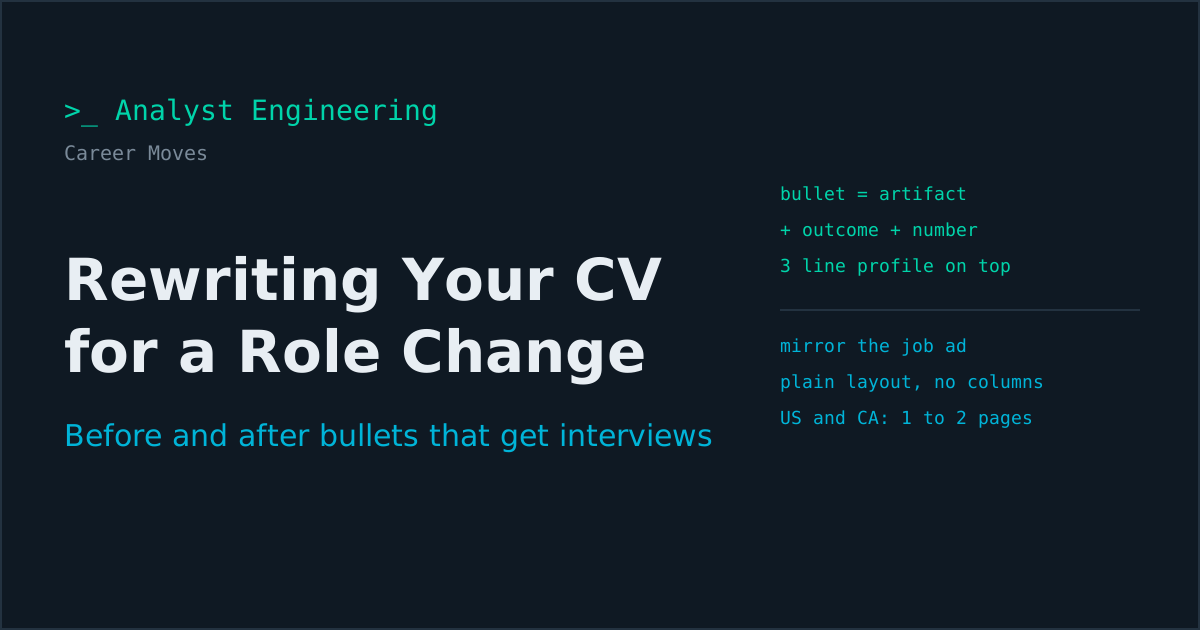
- A CV for an analyst role change works when every bullet is rewritten as artifact plus outcome plus number, not as a list of responsibilities.
- The first three lines of the CV should be a profile that names the target role, the domain you bring, and the two or three skills the job ad asks for.
- Mirror the job ad's vocabulary where it is true: if the ad says acceptance criteria and UAT, those exact words should appear in bullets that prove them.
- Applicant tracking systems read plain, single column CVs with standard headings reliably; tables, text boxes, and two column layouts are where parsing fails.
- The job title in your profile decides which band you are screened for: a mid technical business analyst in Canada sits around C$80k to C$100k, against C$72k to C$90k for a mid business analyst.
A CV for an analyst role change gets interviews when every bullet is rewritten as artifact plus outcome plus number, when the vocabulary mirrors the target job ad, and when the top of page one carries a three line profile naming the target role. Recruiters often screen a CV in under 60 seconds, and a switcher’s CV is read for one thing: evidence that you have already done pieces of the new job. Responsibilities from the old job are not evidence.
Last year I screened about 40 CVs for a mid technical BA role on a payments team. One came from a service desk team lead, and the first bullet read “Responsible for handling escalated tickets for the payments platform.” I nearly moved on. Three bullets down, buried: “Wrote the triage guide the L2 team now uses for failed card payments.” That line was the whole case for hiring him, and it was in the wrong place, in the wrong words, with no number.
We interviewed him because I happened to read that far. Most screeners would not. For week-by-week templates that get a reply, including indirect-experience examples for switchers, Land Your First Job runs from job search to day 90.
What changes when you rewrite a CV for a role change?
Three things change: what a bullet contains, what sits at the top, and whose vocabulary you use.
| Old CV habit | Role change CV |
|---|---|
| Bullets list responsibilities | Bullets show artifact, outcome, number |
| Opens with a summary of your career | Opens with a 3 line profile naming the target role |
| Uses your industry’s words | Uses the job ad’s words, where true |
| Lists every tool you have touched | Lists the tools the ad names, in one Skills line |
| Job titles reframed or inflated | Job titles exact; the bullets do the reframing |
What is the artifact plus outcome plus number formula?
Every bullet names a thing you produced, what changed because of it, and a number that sizes the change. “Handled payment exceptions” has none of the three. “Documented the five most frequent failed payment causes; two became fixes that cut exceptions by 20 percent” has all three. If you cannot find a number, use scale: people, teams, volume, frequency, or time saved.
What does a three line profile look like?
A profile names the target role, the domain you bring, and the skills the ad asks for, in three lines:
Business analyst moving from payments operations, with four years investigating failed payments at a retail bank. Writes process maps, SQL investigations, and acceptance criteria that developers build from. Targeting BA roles in payments and banking platforms.
That is the whole profile. No adjectives like “passionate” or “results-driven”.
What do before and after bullets look like for each starting point?
The pairs below cover the most common starting points. Each “after” is true only if you did it; the point is the shape, not the content.
| Starting point | Before | After |
|---|---|---|
| Teacher | Taught mathematics to five classes of 30 students | Rewrote the Year 10 assessment rubric with 6 colleagues as testable criteria; marking disputes fell from 14 to 3 a term |
| Nurse | Responsible for patient care on a 28 bed ward | Mapped the medication handover between shifts, found 3 re-keying points, and wrote a checklist adopted on 4 wards; missed doses fell by about a third |
| Operations | Handled payment exceptions and investigations | Investigated about 60 failed payments a week with SQL; documented the top 5 causes, 2 of which became fixes that cut exceptions by 20 percent |
| Developer | Developed microservices in Java and Spring Boot | Wrote the API contract and acceptance criteria for a refunds service used by 3 teams before building it; zero contract defects in UAT |
| QA analyst | Executed test cases and logged defects in Jira | Derived 140 test cases from the fee rules with decision tables, found 11 requirement gaps before build, and cut UAT defects from 38 to 9 |
| Project manager | Managed delivery of a CRM migration | Ran scope workshops with 5 business units, wrote the fit-gap analysis for 120 requirements, and got sign-off in 4 weeks instead of 8 |
| Data analyst | Built Tableau dashboards for the sales team | Traced a 4 percent revenue mismatch between CRM and finance reports to a wrong join key; wrote the rule that became the source of truth for 3 reports |
| BA to technical BA | Gathered requirements and wrote user stories | Reviewed an OpenAPI contract against 40 business rules, logged 12 gaps (2 severity 1), and validated the fixes in Postman before sprint 1 |
Notice what the “after” column does for the developer and the BA moving to technical BA. The developer’s bullet stops describing code and starts describing scope and decisions, which is what a BA hiring manager is buying. The BA’s bullet adds the contract, the count, and the tool, which is what separates the two roles in BA versus technical BA.
How do you mirror the job ad without keyword stuffing?
Take five job ads for the role you want and list the nouns that repeat: “elicitation”, “user stories”, “acceptance criteria”, “stakeholders”, “SQL”, “REST APIs”, “UAT”, “process mapping”. Each term that is true for you should appear once, inside a bullet that proves it. A term that appears only in a Skills list proves nothing; a term that appears three times in one section reads as stuffing.
If a term repeats in every ad and you cannot evidence it, that is a skill gap, not a wording problem. The technical analyst skill matrix shows which of the 25 skills you already have and where to build the rest.
Will an applicant tracking system reject my CV?
An applicant tracking system (ATS) rarely rejects a CV on its own; it fails to read it, and a recruiter searching by keyword never sees you. The rules that keep a CV readable:
- Plain, single column layout. No tables, text boxes, columns, or graphics in the CV itself. Skill bars and icons parse as nothing.
- Standard headings. Profile, Experience, Skills, Education, Certifications. Not “My Journey”.
- Contact details in the body, not in the document header or footer.
- Keywords from the ad, spelled as the ad spells them (“Jira”, not “JIRA tickets tool”).
- PDF or DOCX. A text-based PDF parses in most modern systems; send DOCX when the portal asks for it. Never send a PDF exported as an image.
The test: copy all the text of your CV into a plain text editor. If the order is scrambled there, it is scrambled for the ATS.
How long should a CV be in the US, Canada, the UK, and Europe?
Length and personal details vary by market, and getting them wrong marks you as not local.
| Market | Length | Photo | Personal details | Notes |
|---|---|---|---|---|
| US | 1 to 2 pages | No | No date of birth or marital status | Called a resume |
| Canada | 1 to 2 pages | No | No date of birth | Québec: French CV expected by many employers; bilingual candidates often send both |
| UK | 2 pages | No | No date of birth | Called a CV |
| France, Germany | 1 to 2 pages | Common, optional | Often included, optional | Check local norms and the employer’s guidance |
In Québec, state your languages honestly with a level (“French: professional working proficiency”) rather than “bilingual” if you are not. The full picture for relocating analysts is in restarting your analyst career in a new country.
Which pay band does your CV put you in?
The title in your profile decides which role, and which band, you are screened against. Indicative figures below.
| Role (base salary) | US (USD) | Canada (CAD) | UK (GBP) | Eurozone (EUR) |
|---|---|---|---|---|
| Business analyst, junior | 65k to 85k | 58k to 72k | 32k to 42k | 38k to 48k |
| Business analyst, mid | 85k to 110k | 72k to 90k | 42k to 55k | 48k to 60k |
| Technical BA, mid | 95k to 125k | 80k to 100k | 50k to 65k | 52k to 65k |
| Technical BA, senior | 125k to 155k | 100k to 125k | 65k to 85k | 65k to 82k |
Base salary, permanent, large city, 2026, indicative (US major metros; Toronto, Montréal, Vancouver, Calgary; London; Paris, Amsterdam, Frankfurt, Dublin).
The honest reading: technical BA pays roughly 10 to 20 percent above BA at the same level, so a profile that names it is worth writing, but only if your bullets carry SQL, API, and data evidence. For a switcher from support, where pay is about US$40k to US$55k or £24k to £32k, a junior BA offer is a raise. For a nurse at US$80k to US$110k or a senior developer, the first analyst offer is often a short-term cut; say so to yourself before you apply, not after the offer.
To verify, check posted ranges where pay transparency laws apply (New York, California, Colorado, Washington, Illinois, and other US states; British Columbia; Ontario since January 1, 2026, for employers with 25 or more employees; EU member states as they implement Directive (EU) 2023/970), ITJobsWatch in the UK, the Robert Half, Hays, and Michael Page salary guides, Levels.fyi, and two people one level above you.
What should a switcher write in the LinkedIn headline and About section?
The headline names the target role first, the bridge second, and two or three skills third: “Business Analyst, from payments operations to delivery, SQL, process mapping, UAT”. Recruiters search by role title, so “Customer Support Team Lead” will not surface in a BA search.
The About section tells the move in four short paragraphs: what you did and in which domain; two things you built that look like analyst work, with numbers; the role you are targeting; and where to see the work. Put your portfolio in Featured. If you do not have portfolio pieces yet, the Analyst Engineering Labs give you three on a fictional payments platform, from a gap register on a payments API to an incident report; a free account saves progress and unlocks the solutions. How to shape them for a CV link is in the analyst portfolio.
A CV only gets you into the room. What each interview question is really testing, and how to answer it from real work, is in the BA and Technical BA Interview Guide.
What do real CV rewrites look like?
The cases below are composites of moves I have watched on delivery teams, with details changed.
Jordan: a service desk team lead in Calgary
Jordan led a service desk team at a utility’s IT department in Calgary on C$52k. His CV opened with “Customer-focused team lead with 7 years of experience” and every bullet began “Responsible for”. After the rewrite:
- Profile: “Business analyst moving from IT service management, with 7 years triaging incidents on billing and payment systems. Writes process maps, triage runbooks, and acceptance criteria. Targeting junior BA roles in utilities and banking.”
- Before: “Responsible for escalations to L2.” After: “Wrote the triage guide for billing failures used by 12 agents; escalations to L2 fell from about 90 to 55 a month.”
- Before: “Participated in UAT for the new billing portal.” After: “Wrote and ran 45 UAT scenarios for the billing portal release; found 6 defects, 2 of which blocked go-live.”
The rewrite took two weeks, and he added two Lab write-ups over the following ten. He landed a junior BA role at an energy retailer at C$66k, a raise of about 27 percent. What he would do differently: put the UAT bullet first from day one, because every interviewer asked about it.
Luca: a senior developer in Amsterdam moving to technical BA
Luca was a senior Java developer at a payments company in Amsterdam on €80k, targeting senior technical BA roles. His CV opened with a 30 item tech stack, and recruiters kept sending him developer roles. The rewrite moved the stack into one Skills line, changed the profile to name “senior technical business analyst”, and reframed each bullet around scope and decisions: the contract he negotiated with three consuming teams, the edge cases he found in a refund rule, the incident he diagnosed and wrote up. His LinkedIn headline still said “Senior Java Developer” for a month, and recruiters kept reading that first.
After six weeks he accepted a senior technical BA role at a payment service provider at €78k, a cut of about 2.5 percent, which matches how small the developer to BA gap is in Europe compared with the US. What he would do differently: change the LinkedIn headline on the same day as the CV. His route is covered in depth in from developer to business analyst.
How do you rewrite your CV in two weeks?
Two focused weeks produce a CV, a LinkedIn profile, and a first batch of tailored applications.
- Days 1 and 2: collect the vocabulary. Save five job ads for the target role and list the terms that repeat. Artifact: a keyword sheet of 15 to 20 terms, each marked “evidenced” or “gap”.
- Day 3: write the profile. Three lines, target role first. Artifact: the profile, read aloud once.
- Days 4 to 7: build a bullet bank. Rewrite every past bullet as artifact plus outcome plus number. Artifact: 20 to 30 bullets you can pick from per application.
- Days 8 and 9: build the ATS-safe master. Single column, standard headings, contact details in the body. Artifact: a DOCX and a text-based PDF that pass the plain text test.
- Day 10: update LinkedIn. Headline, About, and Featured with your portfolio. Artifact: a profile that surfaces in a search for the target title.
- Days 11 to 14: tailor and send. Pick the six strongest bullets per ad. Artifact: 10 applications and a tracker. If fewer than one in ten get a reply after 20 applications, rewrite the profile and the top three bullets.
What mistakes stall a role change CV?
- Inflating the previous job title. “Business analyst” over a support role fails the reference check. Keep the title exact and let the bullets reframe it.
- A functional CV with no dates. Recruiters read it as hiding something. Keep reverse chronological order.
- Every tool you have touched. Twenty tools with no evidence reads as noise. List the ad’s tools you can prove.
- One CV for every ad. The bullet bank exists so each application takes 20 minutes, not two hours.
- A technical BA profile without technical bullets. It gets you interviews you will fail at the SQL exercise.
- Designer templates. Two columns and icons look good and parse badly.
The takeaway
Rewrite every bullet as artifact plus outcome plus number, open with a three line profile that names the target role, and mirror the job ad where it is true. Keep the layout plain enough for an ATS to read, follow the norms of the market you are applying in, and make LinkedIn say the same thing. Then prepare for the conversation the CV earns, starting with interviewing as a career changer, and check the full switching route in how to switch careers into business analysis or the career paths page. For the first round of question-by-question preparation, the BA Interview Prep Pack covers Q&A, case studies, and the artifacts to bring.
For the week-by-week plan and templates that get a reply, start with Land Your First Job. To have your CV and profile rewritten with you line by line, book a 1:1 Tech BA Coaching Call. Grab the free downloads, or browse everything at The Tech BA Toolkit. More on the craft itself lives in the Business Analyst hub.
Ahmed is a Senior Technical Business Analyst with 10+ years in banking and payments. He builds practical guides and tools for analysts at The Tech BA Toolkit.
Tags: Career Growth, Business Analysis, CV Writing, Career Change, Job Search
About the author
Analyst Engineering is written by Ahmed, a Senior Technical Business Analyst with 10+ years of banking and payments delivery experience: ISO 20022 and SWIFT messaging, payments API integration, Kafka event validation, and production support. Every article comes from real delivery work, and each one is reviewed and updated as tools and standards change.
Related articles
- The Analyst Portfolio: How to Show Work When Your Work Is Confidential How to build an analyst portfolio when your real work is confidential: 3 to 5 pieces, public or synthetic data, the right pieces per role, and a 5 minute pitch.
- Interviewing as a Career Changer: How to Answer "Why the Switch?" and the Case Exercise How career changers pass analyst interviews: scripts for why the switch and no experience, the seven common case exercises, STAR stories, and the pay question.
- How to Switch Careers Into Business Analysis in 2026 (From Teaching, Nursing, Retail, and Support) Switching into business analysis from teaching, nursing, retail, or support: the real timeline, first-role pay by country, the pay cut, and the tech kit.
- From Developer to Business Analyst: Trading Code for Scope Without Losing Your Edge Moving from software developer to business analyst: the real pay cut, why technical BA or systems analyst is the better target, what transfers, and a plan.
Go deeper on this
Not ready to buy? The free downloads are a no-cost place to start, and every article here stays free.
Free account
Practice on the Labs, keep your progress
A free account, no password: an email link signs you in. It saves your steps and self-assessments on the Labs, shows your missions on a dashboard, unlocks the solutions, and, if you tick the box, sends you new missions and articles when they ship.
Your email is used to sign you in. Nothing else, unless you ask. Privacy.