The Analyst Portfolio: How to Show Work When Your Work Is Confidential
Written by Ahmed at Analyst Engineering, a Senior Technical Business Analyst with 10+ years in banking and payments delivery.
Key takeaways
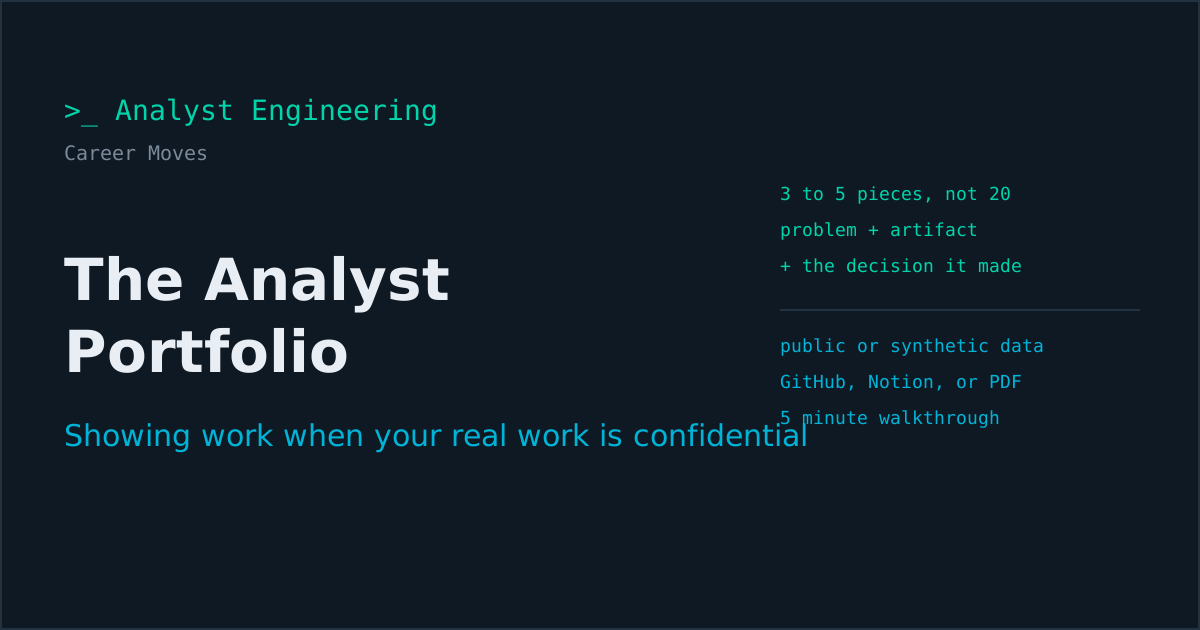
- An analyst portfolio needs 3 to 5 pieces, not 20, and each piece must show the problem, the artifact you produced, and the decision it enabled.
- Build every portfolio piece on public APIs, fictional systems, or synthetic data. Redacting a real spec is not sanitising it; rebuilding the thinking on a different system is.
- The right pieces depend on the target role: a business analyst shows a spec, a process map, and a prioritisation decision; a QA analyst shows a test design derived from a rule and a CI run.
- A portfolio does not move you into a higher pay band on its own, but it is the fastest way for a career changer to get to the interview, and it can decide junior band versus low mid band.
- Present each piece in a 5 minute walk-through: one minute on the problem, two on the artifact, one on the decision, and one on what you would do differently.
An analyst portfolio is 3 to 5 pieces of work, not 20, and each piece shows three things: the problem, the artifact you produced, and the decision that artifact enabled. When your real work is confidential, build every piece on public APIs, a fictional system, or synthetic data, keeping the reasoning and changing everything recognisable. A hiring manager gives each piece about five minutes, and those five minutes must prove you can do the work on day one.
The last time I hired a mid technical analyst for a payments team, two candidates brought portfolios. The first sent a 60 page PDF of every diagram they had drawn in four years, client logos half covered by black boxes. I stopped at page four. The second sent three pages: a gap register against a public payments API, a SQL query that found duplicate refunds in generated data, and a short incident write-up. Each opened with the problem and ended with the decision. We spent 20 minutes of the interview on them.
The second candidate did not have better experience. They had better evidence, built without putting a previous employer at risk. To calibrate the level of detail a reviewer expects, the BA Deliverables Template Pack holds 20 real deliverables (specs, test cases, process maps) from banking projects.
What should an analyst portfolio contain?
An analyst portfolio should contain 3 to 5 pieces, each built around one problem, one artifact, and one decision. Twenty pieces tell the reviewer you cannot choose. Every piece follows the same structure:
- The problem. Two or three sentences, as a delivery team would state it: “The integration team was about to build against a refunds API whose contract disagreed with the rules on partial refunds.”
- The artifact. The gap register, the query and its result, the test design, or the diagram, in full or as a representative extract.
- The decision it enabled. “The API team fixed three contract gaps before integration, including an idempotency gap that would have allowed duplicate refunds.”
Almost everyone leaves out the third part. An artifact without a decision is decoration.
Which portfolio pieces should you build for your target role?
The right pieces depend on the target role, because each role is hired on different evidence.
| Piece | What it proves | Time to build | Target role |
|---|---|---|---|
| Functional spec with acceptance criteria | You turn a vague request into something buildable | 8 to 12 hours | Business analyst |
| Process map with exceptions | You see the unhappy paths, not only the happy one | 4 to 6 hours | Business analyst |
| Prioritisation decision (MoSCoW with trade-offs) | You can say no, in writing, with reasons | 3 to 5 hours | Business analyst |
| API gap register | You find what breaks integration before it is built | 6 to 10 hours | Technical BA |
| SQL investigation | You can answer a question from data yourself | 5 to 8 hours | Technical BA, data-leaning BA |
| Bruno collection with tests | You can call, chain, and assert on real APIs | 6 to 10 hours | Technical BA, QA analyst |
| Test design derived from a rule | You test the requirement, not the implementation | 5 to 8 hours | QA analyst |
| Public CI run of an API suite | Your tests run unattended and report results | 8 to 12 hours | QA analyst moving to SDET (software development engineer in test) |
| System context diagram | You know where the system’s edges and owners are | 3 to 5 hours | Systems analyst |
| Sequence diagram with failure paths | You understand timing, retries, and callers | 4 to 6 hours | Systems analyst |
| Integration failure analysis | You explain why a flow broke and how to recover | 6 to 10 hours | Systems analyst, technical BA |
What should a business analyst portfolio show?
A business analyst portfolio should show a spec that goes from a one-line request to something a developer can build, a process map with exceptions, and a prioritisation decision. The last one impresses senior reviewers most: eight backlog items, a MoSCoW prioritisation with the reason for every Won’t, and the stakeholder objection you anticipated.
What should a technical business analyst portfolio show?
A technical business analyst portfolio should show an API gap register, a SQL investigation, and a Bruno collection, the three things a technical business analyst is paid for over a BA: reading contracts, querying data, and exercising a system. Structure the collection as in building a first API collection in Bruno and Postman, with secrets kept out of the repository.
What should a QA analyst portfolio show?
A QA analyst portfolio should show a test design derived from a written rule, with boundaries and negative cases, and a CI run of that suite: a GitHub Actions workflow that runs the Bruno CLI or Newman and publishes a JUnit report, as in running API tests in CI.
What should a systems analyst portfolio show?
A systems analyst portfolio should show a system context diagram, a sequence diagram with the timeout and retry path, and an integration failure analysis that reasons from a symptom to the broken link.
How do you build portfolio pieces when your real work is confidential?
You build them on systems you are allowed to show: a fictional system, a public API, or synthetic data. There are three sources, in order of how fast they produce a credible piece.
Can the Labs give you portfolio pieces?
Yes. Each mission in the Analyst Engineering Labs ends with a portfolio-grade deliverable on a fictional payments platform, Northline Pay, so nothing belongs to an employer:
- Mission 01: Analyze the Payments API produces a gap register: where the contract, requirements, samples, and rules disagree, with severity.
- Mission 02: Validate an Event Flow produces an event-flow diagnosis: where the payment stopped across Kafka topics, the evidence, and the replay plan.
- Mission 03: Investigate a Duplicate Refund produces an incident report: the timeline, the root cause chain, the blast radius query, and the fixes.
Done in order, they form the Become a Technical Analyst track: three pieces that tell one story about one system. A free account saves your progress and unlocks the solutions. Write your deliverable before opening the solution, then add a short “what I missed” section: reviewers trust candidates who show their own gaps.
Which public APIs make good portfolio material?
The Stripe sandbox and the GitHub REST API: well documented, free, and familiar to every interviewer. Stripe’s test mode lets you create PaymentIntents and trigger declines with test cards; the GitHub API gives you pagination, rate limits, and error codes to test.
For the teardown format, copy the Stripe PaymentIntents API review: a score on the 12 checks of the Review Scorecard, then the findings a team would have to own. It shows judgment on a system the interviewer can check.
How do you sanitise real work safely?
You do not redact real work; you rebuild the reasoning on a different system. Redaction fails because the structure, vocabulary, and numbers still identify the source. Apply the same rules as the guardrails for using AI on a regulated team, because the risk is identical: data crossing a boundary it should not.
What never leaves, even “anonymised”:
- Client, bank, vendor, and internal system names, including codenames.
- Real fees, thresholds, limits, and volumes.
- Customer data, including masked account numbers and sample messages.
- Security controls and architecture specifics.
- Incident details that match a public outage.
- Document metadata: author and company fields.
What you keep is the shape: the kind of gap, the question you asked, the structure of the decision. Read your contract’s confidentiality clause first. My test: if a former colleague could recognise the system, it is not sanitised.
Where should you host an analyst portfolio?
Host it in one of three places. A public GitHub repository with a Markdown README suits technical BA, QA, and systems analyst roles, because it proves you can use Git. A Notion page suits BA and product-leaning roles. A PDF under 10 pages suits every role and is what you attach when a recruiter asks. Link it from your CV header and LinkedIn Featured.
Does a portfolio change what you get paid?
A portfolio does not change the pay bands, but it changes where a career changer’s first offer lands, and it often gets them the interview.
| Junior role (0 to 2 years) | US (USD) | Canada (CAD) | UK (GBP) | Eurozone (EUR) |
|---|---|---|---|---|
| Business analyst | 65k to 85k | 58k to 72k | 32k to 42k | 38k to 48k |
| Technical BA | 75k to 95k | 65k to 80k | 38k to 48k | 42k to 52k |
| QA analyst | 55k to 72k | 50k to 62k | 28k to 36k | 34k to 42k |
| SDET / automation engineer | 80k to 100k | 70k to 85k | 40k to 50k | 45k to 55k |
| Systems analyst | 70k to 90k | 62k to 78k | 35k to 45k | 40k to 50k |
Base salary, permanent, large city, 2026, indicative (US major metros; Toronto, Montréal, Vancouver, Calgary; London; Paris, Amsterdam, Frankfurt, Dublin).
The honest reading: a career changer from a well-paid field usually lands in the junior band and takes a short-term cut. Where domain expertise transfers, strong pieces can push the offer to the top of that band or into the low mid band. The bigger jumps come from the role: technical BA pays roughly 10 to 20 percent above BA, and QA to SDET at the same level is worth 25 to 40 percent.
To verify, check posted ranges where pay transparency laws apply (New York, California, Colorado, Washington, Illinois, and other US states; British Columbia; Ontario since January 1, 2026, for employers with 25 or more employees; EU member states as they implement Directive (EU) 2023/970), ITJobsWatch in the UK, the Robert Half, Hays, and Michael Page salary guides, Levels.fyi, and two people one level above you. The full breakdown is in the analyst salary guide for 2026.
What does a portfolio look like in real moves?
The cases below are composites of moves I have watched on delivery teams, with details changed.
Maya: a teacher in Toronto who landed a junior BA offer with three Lab write-ups
Maya taught secondary mathematics in Toronto for nine years at about C$84k. She did the three missions of the technical analyst track over 12 weeks at six hours a week, rewrote each deliverable as a two page write-up, and added a process map of the refund flow because she was targeting BA roles. A payments company hired her as a junior BA at C$71k, a cut of about 15 percent she accepted as the price of entry. What she would do differently: apply from week 6 with two pieces, because the first interviews taught her more than the third write-up.
Tom: a QA analyst in London who got an SDET interview from a public CI run
Tom was a mid QA analyst at an insurer in London on £44k. Over five weeks he built a Bruno collection of about 40 requests against the GitHub REST API, with tests derived from documented rules (pagination links, rate limit headers, 404 rather than 403 for a private repository when unauthenticated), running nightly in GitHub Actions with a JUnit report. A fintech recruiter found it through his LinkedIn Featured section. He landed a mid SDET role at £55k, a 25 percent increase. What he would do differently: document how he handled flaky tests, because the interviewer spent ten minutes on exactly that.
Dana: a senior BA in Chicago who sanitised a real spec badly, then did it right
Dana was a senior BA at a bank in Chicago on US$122k, targeting senior technical BA roles. Her first portfolio used a real spec with the bank’s name replaced, but it kept an internal platform codename in a sequence diagram, real fee thresholds in a decision table, and her employer’s name in the document properties. An interviewer at a competitor recognised the codename, the process stopped, and she had breached her confidentiality clause. She rebuilt from scratch: the same spec structure on Northline Pay, a Stripe teardown scored on the Review Scorecard, and a SQL investigation on generated data. Four months later she accepted a senior technical BA role at US$138k. What she would do differently: start from a fictional system on day one.
How do you build an analyst portfolio in six weeks?
Three pieces take about six weeks at five to eight hours a week.
- Week 1: choose the pieces. Read five job ads for the target role and pick three pieces from the table that match their vocabulary. Artifact: a one page plan with each piece, what it proves, and its data source.
- Weeks 2 and 3: the Lab piece. Complete the closest Lab mission, write the deliverable before opening the solution, then add “what I missed”. Artifact: a two page write-up.
- Weeks 3 and 4: the public API piece. A teardown or a collection against the Stripe sandbox or the GitHub API. Artifact: a scored teardown or a repository with a README.
- Week 5: the role-specific piece. A process map, a prioritisation decision, a CI run, or a context diagram. Artifact: the piece with its problem and decision paragraphs.
- Week 6: package and rehearse. Write the index, export the PDF, and record a 5 minute walk-through per piece. Artifact: a portfolio link on your CV and LinkedIn.
If the QA route is yours, API Testing and QA Mastery for BAs covers deriving API tests from rules, which is exactly what the test design piece has to show.
How do you present a portfolio in an interview?
Present each piece as a 5 minute walk-through, then go deeper where the interviewer points.
- Minute 1: the problem. Who needed what, and what was at risk.
- Minutes 2 and 3: the artifact. One screen, not ten. Walk through one finding in detail.
- Minute 4: the decision. What the team could now decide, and what it would have cost without it.
- Minute 5: what you would do differently. This is where seniority shows.
Rehearse it with a timer. The case exercises that often replace a walk-through are covered in interviewing as a career changer. For Q&A, case studies, and a list of artifacts to bring, the BA Interview Prep Pack is built for a first BA role.
What mistakes make a portfolio hurt more than help?
- Too many pieces. Twenty pieces signal you cannot prioritise, the core analyst skill.
- Artifacts with no decision, and only happy paths. A BPMN diagram with no “so what” and no exceptions reads as tool practice.
- Redacted real work. Black boxes over logos tell the reviewer you take risks with confidential material, and they will assume you would do it with theirs.
- Tool tutorials. A tutorial collection proves you can follow a tutorial. Add a rule you tested and a finding you made.
- Pieces for the wrong role. Match the ad, not your last job.
The takeaway
A portfolio is three to five pieces, each showing the problem, the artifact, and the decision, built on a fictional system, a public API, or synthetic data, never on a redacted real document. Choose the pieces the target role is hired on and rehearse a 5 minute walk-through for each. Put the link on the CV as in rewriting your CV for an analyst role change, find your gaps with the technical analyst skill matrix, and see the wider map in analyst career moves and on the career paths page.
For 20 finished deliverables to calibrate your own against, start with the BA Deliverables Template Pack. To have your pieces and walk-through reviewed before an interview, book a 1:1 Tech BA Coaching Call. Grab the free downloads, or browse everything at The Tech BA Toolkit. More on the business analyst side of the craft lives in the Business Analyst hub.
Ahmed is a Senior Technical Business Analyst with 10+ years in banking and payments. He builds practical guides and tools for analysts at The Tech BA Toolkit.
Tags: Career Growth, Business Analysis, Portfolio, Testing, Interviews
About the author
Analyst Engineering is written by Ahmed, a Senior Technical Business Analyst with 10+ years of banking and payments delivery experience: ISO 20022 and SWIFT messaging, payments API integration, Kafka event validation, and production support. Every article comes from real delivery work, and each one is reviewed and updated as tools and standards change.
Related articles
- Rewriting Your CV for an Analyst Role Change: Before and After Bullets That Get Interviews Rewrite your CV for an analyst role change: bullets as artifact plus outcome plus number, before and after pairs, ATS rules, and CV norms in four markets.
- Interviewing as a Career Changer: How to Answer "Why the Switch?" and the Case Exercise How career changers pass analyst interviews: scripts for why the switch and no experience, the seven common case exercises, STAR stories, and the pay question.
- How to Switch Careers Into Business Analysis in 2026 (From Teaching, Nursing, Retail, and Support) Switching into business analysis from teaching, nursing, retail, or support: the real timeline, first-role pay by country, the pay cut, and the tech kit.
- How to Become a Technical Business Analyst: The Six Month Plan and the Pay Jump How to become a technical business analyst: SQL, APIs, logs, and scripting in six months on your project, one artifact a month, and a 10 to 20 percent pay jump.
Go deeper on this
Not ready to buy? The free downloads are a no-cost place to start, and every article here stays free.
Free account
Practice on the Labs, keep your progress
A free account, no password: an email link signs you in. It saves your steps and self-assessments on the Labs, shows your missions on a dashboard, unlocks the solutions, and, if you tick the box, sends you new missions and articles when they ship.
Your email is used to sign you in. Nothing else, unless you ask. Privacy.