Is Business Analysis a Safe Career With AI? Which Roles Are Exposed and Which Moves Hedge
Written by Ahmed at Analyst Engineering, a Senior Technical Business Analyst with 10+ years in banking and payments delivery.
Key takeaways
- The documentation-only business analyst is exposed to AI; the analyst who verifies systems, owns decisions, and specifies and tests AI systems is in more demand, not less.
- AI already drafts user stories, summarises workshops, and produces first-cut test cases in minutes, but it does not decide scope, verify behaviour against the running system, carry accountability, or navigate stakeholder politics.
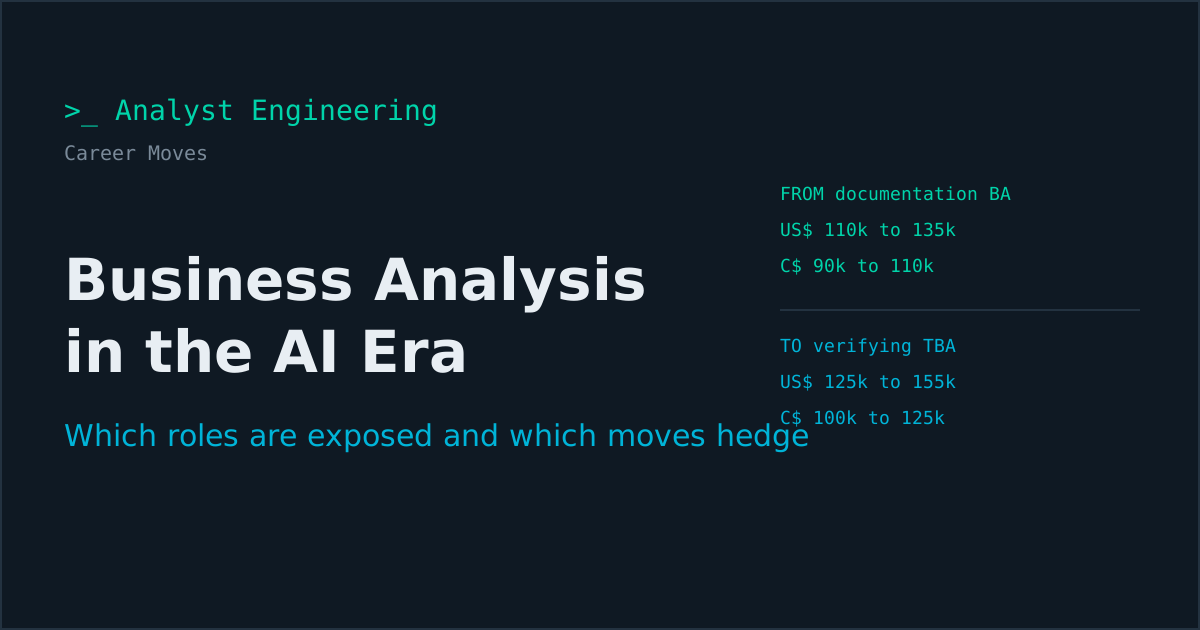
- The strongest hedge for a business analyst is the technical BA route, which pays roughly 10 to 20 percent more at the same level: US$125k to US$155k base for a senior technical BA in major US cities in 2026.
- Roles that add AI evaluation and technical verification to analysis are sitting at the top of their bands in the offers I see, because few analysts can yet write acceptance criteria for a non-deterministic system.
- Analysts who refuse AI tools do not protect their role; they hand the drafting speed to a colleague and keep only the part of the job most likely to be cut.
Business analysis is a safe career with AI for analysts who verify systems, own decisions, and specify and test AI systems, and an exposed one for analysts whose output is documentation alone. AI already drafts user stories, summarises workshops, and produces first-cut test cases in minutes; it does not decide scope, verify behaviour against the running system, carry accountability, or navigate stakeholder politics. The strongest hedge is the technical BA route, which pays roughly 10 to 20 percent more at the same level: US$125k to US$155k base for a senior technical BA in major US cities in 2026, indicative.
Earlier this year a delivery lead on a payments programme showed me a set of user stories an assistant had produced from a workshop transcript in about four minutes. Eleven stories, acceptance criteria included, formatted for Jira. Then he asked the question I now hear in every team: “What do I need the BA for?”
My answer was the three stories that were wrong. The transcript had captured what the operations lead said about returned payments, and she had described the process as she believed it ran. The system did something else, which anyone who had queried the returns table would have known. The model wrote down the belief fluently. The analyst’s job is to find the gap between belief and system, and then get a decision on it. That is the part to build a career on. If your employer has not decided how analysts may use AI yet, The AI-Powered Analyst covers the workflow, the boundaries, and the case to make to your manager.
Which business analyst tasks can AI already do?
AI already does the tasks where the output is text derived from other text, and it does them fast enough to change staffing. The table below is how I rate exposure on the teams I work with.
| Analyst task | AI exposure | Why | What the analyst still owns |
|---|---|---|---|
| Drafting user stories from transcripts | High | Text in, text out, fast and fluent | Checking each story against the real system and the real rule |
| Summarising workshops and meetings | High | Summarisation is a core model strength | Deciding which open question matters and chasing it |
| First-cut test cases | High | Models enumerate cases well from a clear rule | The oracle: what “correct” means, and the negative cases that matter |
| Formatting specs and Confluence pages | High | Pure transformation | Nothing much; let it go |
| Acceptance criteria | Medium | Good drafts, but subtle errors are costly | Boundaries, failure paths, and sign-off |
| Data mapping and impact analysis | Medium | Drafts well from schemas | Proving the mapping with real data |
| Deciding scope and priorities | Low | Needs authority, context, and trade-offs | All of it |
| Verifying behaviour against the running system | Low | Needs access, judgment, and evidence | Queries, API calls, logs, and the finding |
| Accountability for sign-off and go/no-go | Low | A model cannot be accountable | All of it |
| Stakeholder negotiation and politics | Low | Human trust and history | All of it |
| Specifying and evaluating AI systems | Low, and growing | New work created by AI itself | Acceptance criteria, evaluation sets, guardrails |
Read the right-hand column for the low rows. That is where the job is moving.
Which business analyst roles are most exposed to AI?
The most exposed role is the documentation-only BA: the analyst whose main output is meeting notes, stories, and specifications written from what stakeholders said, without checking the system. That role was already under pressure from offshoring and product-led teams; AI removes most of its remaining cost advantage. Teams I have seen restructure in 2025 and 2026 kept fewer of these roles and asked the remaining analysts to review AI drafts instead of writing them.
Less exposed are three kinds of analyst: the technical BA who verifies behaviour (the distinction in Business Analyst vs Technical Business Analyst), the domain specialist whose knowledge of payments, insurance, or healthcare rules catches errors a model writes confidently, and the analyst who owns decisions with stakeholders.
How much do business analysts who hedge against AI earn?
Business analysts who move toward verification, AI systems, or client-facing technical work earn more than documentation-focused BAs at the same level, and the gap is visible in every market.
| Role (base salary) | US (USD) | Canada (CAD) | UK, London (GBP) | Eurozone (EUR) |
|---|---|---|---|---|
| Senior business analyst | 110k to 135k | 90k to 110k | 55k to 72k | 60k to 75k |
| Senior technical BA | 125k to 155k | 100k to 125k | 65k to 85k | 65k to 82k |
| Lead or principal technical BA | 150k to 180k | 120k to 145k | 80k to 100k | 78k to 95k |
| Senior product manager | 140k to 180k | 115k to 150k | 75k to 100k | 70k to 90k |
| Forward deployed engineer (mid to senior) | 150k to 220k plus equity | 120k to 170k | 90k to 140k | 80k to 120k |
Base salary, permanent, large city, 2026, indicative, excluding bonus and equity unless stated. US means major metros; smaller metros run 10 to 20 percent lower. UK means London.
The pay signal worth noting is an observation, not a statistic: roles that add AI evaluation and technical verification to analysis are sitting at the top of their bands in the offers and postings I see, because few analysts can yet write acceptance criteria for a non-deterministic system. The move from BA to technical BA at the same level is worth roughly 10 to 20 percent on its own.
To verify: read posted ranges in pay transparency jurisdictions (several US states including New York, California, Colorado, Washington, and Illinois; British Columbia; Ontario since January 1, 2026 for employers with 25 or more employees; EU member states as they implement Directive (EU) 2023/970), check ITJobsWatch in the UK for keywords like “AI evaluation” or “technical business analyst”, compare the Robert Half, Hays, and Michael Page guides, and use Levels.fyi for tech companies with equity. The full breakdown is in Analyst Salaries in 2026.
Which career moves hedge a business analyst against AI?
Five moves hedge a BA career against AI, ranked here by how reliably they protect and pay.
- Technical BA. Verification against real systems is the hardest part of analysis to automate. Learn SQL, API testing, log reading, and test design. How to Become a Technical Business Analyst is the six month plan.
- Domain depth. A model writes the wrong reason code confidently; a payments analyst catches it. The Highest Paying Domains for Business Analysts ranks where depth pays most.
- AI system analysis. Someone has to specify and test AI features: acceptance criteria for AI systems that tolerate non-deterministic output, retrieval specifications for RAG (retrieval-augmented generation), evaluation sets, and guardrails. The field notes in Why Acceptance Criteria Failed on an AI Project show what goes wrong without it.
- Forward deployed or solutions work. Client-facing technical roles that configure and prove AI products at customer sites. From Technical Analyst to Forward Deployed or Solutions Engineer maps it.
- Product. Owning outcomes rather than documents, through product owner to product manager. Business Analyst to Product Manager covers the route and the pay.
Moves 1 and 3 combine well: a technical BA who can evaluate an AI system is the profile I see hiring managers struggle most to find.
What do real BA careers in the AI era look like?
The cases below are composites of moves I have watched on delivery teams, with details changed.
Nadia, BA in Toronto: documentation role cut, rebuilt as a technical BA
Nadia was a senior BA at a Toronto insurer on C$95k, and most of her week went to writing requirements documents and meeting notes. In a 2025 restructuring, the team adopted AI drafting and cut two of five BA roles, including hers. She spent five months learning SQL, testing APIs in Bruno, and working through a structured set of verification exercises, and built a small portfolio of findings. She landed a technical BA role on a bank’s payments team at C$98k, inside the mid technical BA band: roughly flat on pay, but in a role with a longer runway. What she would do differently: start the technical work a year earlier, while still employed, when the restructuring rumours began.
James, senior BA in London: from requirements to AI evaluation lead
James was a senior BA at a London bank on £65k, assigned to a customer service assistant built on a language model. The first release failed UAT because the acceptance criteria demanded exact answers. He rewrote them as bounds and rubrics, built an evaluation set of 400 real customer questions with graded answers, and ran it on every prompt and model change. Within 18 months he was the programme’s AI evaluation lead at £88k, inside the lead technical BA band. What he would do differently: document the evaluation method as a reusable standard from the first month, which would have made the promotion case obvious sooner.
Rick, senior BA in Phoenix: ignored AI and lost ground
Rick was a senior BA in Phoenix on US$115k, known for thorough documentation. He treated AI tools as a fad and refused to use them. His team adopted AI drafting, cut BA headcount from five to three, and kept the analysts who could review drafts fast and verify against the system. Rick was let go, searched for seven months, and accepted a mid-level BA role at US$92k. What he would do differently: use the tools early, let them take the drafting, and spend the saved time learning to verify.
What should a business analyst do in the next 90 days?
Each step produces an artifact you can show.
- Days 1 to 15: use AI on your real work, safely. Start with AI for Analysts: Start Here and set your boundaries with the AI guardrails for analysts. Artifact: a one-page personal AI policy.
- Days 16 to 30: move drafting to AI. Adopt the flows in the AI-augmented analyst workflow: transcript to draft spec, negative test matrix, test data. The prompts I use for those flows are in The Tech BA Prompt Toolkit. Artifact: hours saved per week, measured.
- Days 31 to 60: spend the saved time on verification. Work through the Become a Technical Analyst track, three missions on a realistic payments system; a free account saves your progress and unlocks the solutions. Artifact: your mission findings.
- Days 61 to 75: specify one AI feature. Write acceptance criteria and a 50 question evaluation set for an AI feature at work or a public one. Artifact: the criteria and the set.
- Days 76 to 90: try an agent. Read AI Agents for Analysts and automate one repetitive check. Artifact: the agent, its guardrails, and a before and after time.
If you are an experienced analyst with deep domain knowledge and no interest in becoming technical, AI for the Non-Technical Senior Analyst takes you from a chat window to agent mode in the vocabulary of the work you already do.
What mistakes leave business analysts exposed to AI?
- Refusing the tools. You keep the slow part of the job and hand the fast part to a colleague.
- Trusting the tools. Shipping AI drafts unchecked turns you into the documentation-only BA with a faster keyboard.
- Competing on document volume. Volume is the one thing a model always wins.
- Pasting confidential data into public tools. One incident ends the conversation about AI on your team, and possibly your role.
- Waiting for your employer to train you. Most will not, and the restructuring arrives first.
- Learning AI without learning verification. Prompting skill without the ability to check output is not a hedge.
The takeaway
Business analysis is safe for analysts who verify, decide, and evaluate, and exposed for analysts who only document. Hand the drafting to AI, spend the saved time on verification and domain depth, and learn to specify and test AI systems, which is new work that did not exist three years ago. The AI for Analysts hub collects every guide on the tools, and Career Paths maps where each hedge leads.
To use AI on real analyst work within your company’s rules, start with The AI-Powered Analyst. If you want help choosing your hedge and planning it, book a 1:1 Tech BA Coaching Call. The free downloads are a good first step, everything else is in The Tech BA Toolkit, and more on the role lives in the Business Analyst hub.
Ahmed is a Senior Technical Business Analyst with 10+ years in banking and payments. He builds practical guides and tools for analysts at The Tech BA Toolkit.
Tags: Business Analysis, Artificial Intelligence, Career Growth, Technical BA, Salary
About the author
Analyst Engineering is written by Ahmed, a Senior Technical Business Analyst with 10+ years of banking and payments delivery experience: ISO 20022 and SWIFT messaging, payments API integration, Kafka event validation, and production support. Every article comes from real delivery work, and each one is reviewed and updated as tools and standards change.
Related articles
- How to Become a Technical Business Analyst: The Six Month Plan and the Pay Jump How to become a technical business analyst: SQL, APIs, logs, and scripting in six months on your project, one artifact a month, and a 10 to 20 percent pay jump.
- From Technical Analyst to Forward Deployed or Solutions Engineer: The Client-Facing Technical Route Technical analyst to forward deployed engineer, solutions engineer, or implementation consultant: what each does, 2026 pay, skills that transfer, and the gap.
- The Highest Paying Domains for Business Analysts: Where Domain Knowledge Becomes Pay The domains that pay business analysts most in 2026, from payments and capital markets to ERP and healthcare IT: why each pays, the premium, how to break in.
- Business Analyst to Product Manager: The Real Route Through Product Owner Most BAs reach product manager through product owner. What changes, what it pays in four markets, the skills to add, and a six month plan with artifacts.
Go deeper on this
Not ready to buy? The free downloads are a no-cost place to start, and every article here stays free.
Free account
Practice on the Labs, keep your progress
A free account, no password: an email link signs you in. It saves your steps and self-assessments on the Labs, shows your missions on a dashboard, unlocks the solutions, and, if you tick the box, sends you new missions and articles when they ship.
Your email is used to sign you in. Nothing else, unless you ask. Privacy.