Going Contract as an Analyst: Day Rates, Structures, and the Math in Four Markets
Written by Ahmed at Analyst Engineering, a Senior Technical Business Analyst with 10+ years in banking and payments delivery.
Key takeaways
- Contracting raises an analyst's gross by 40 to 70 percent on paper, but after bench time, benefits, pension, and tax the take-home gap is much smaller.
- A contract rate is the output of a take-home calculation: salary to replace, plus benefits you now fund, plus extra payroll tax, plus overhead, divided by 43 to 44 billable weeks.
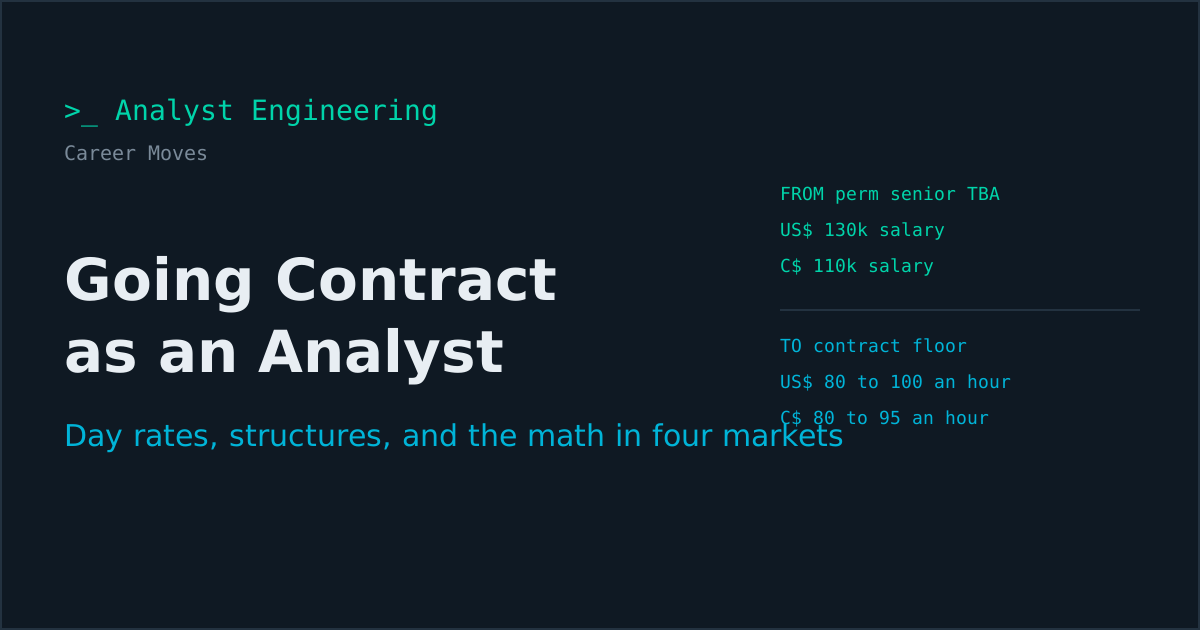
- A senior Canadian technical analyst replacing a C$110k salary has a floor around C$80 to C$95 an hour, and a senior US technical analyst replacing US$130k has a floor around US$80 to US$100.
- In the UK, the same day rate produces a very different take-home inside and outside IR35, so the status determination matters as much as the rate.
- Contracting is a poor move for junior analysts, for analysts without domain depth, and in a down market, because clients pay contract rates only for people who are productive in week one.
Going contract as an analyst raises your gross by 40 to 70 percent on paper, but the take-home gap is much smaller once you pay for bench time, benefits, pension, and tax. The rate is the output of a take-home calculation, not a number you pick: a senior Canadian technical analyst replacing a C$110k salary has a floor around C$80 to C$95 an hour, and a senior US technical analyst replacing US$130k has a floor around US$80 to US$100. Everything here is general information, not tax or legal advice; talk to an accountant in your market before you sign anything.
The first time an agency asked me for my rate, I had already incorporated in Canada and thought I had done the math. I had not. I divided my old salary by 2,080 hours, added a margin that felt generous, and said a number. In month five the programme paused for six weeks while funding was re-approved, and I learned what every contractor learns once: the salary you replace is paid 52 weeks a year, and the rate you bill is paid only for the weeks you work.
The contracts that held their rate through that pause were the payments specialists’. Domain depth is what keeps a contract rate at the top of the table and keeps you off the bench; the route into banking and payments, including the domain knowledge that unlocks premium pay, is what I wrote up in Break Into Banking.
What actually changes when an analyst goes from permanent to contract?
Everything the employer used to absorb becomes your cost or your risk, and in exchange you are paid more per day worked.
| Permanent | Contract | |
|---|---|---|
| Pay | Salary, 52 weeks a year | Rate, only for days billed |
| Holidays and sickness | Paid | Unpaid; you price them in |
| Benefits and pension match | Employer funded | You fund them |
| Gaps between roles | Rare, severance if cut | Bench time, often 4 to 12 weeks a year |
| Tax structure | Payroll, simple | Depends on structure: company, umbrella, 1099, portage |
| What the client expects | Growth over time | Productive in week one |
| Work you get | Strategic, long-term | Delivery-critical, often late-stage programmes |
The last two rows decide who should contract. A contract client is buying a known outcome now, not potential.
What are analyst contract rates in 2026?
Indicative 2026 contract rates run from US$55 to US$110 an hour in the US and from £350 to £700 a day in the UK, with technical BAs at the upper end.
| Market | Business analyst | Technical BA | Notes |
|---|---|---|---|
| US | US$55 to US$80 an hour | US$70 to US$110 an hour | W-2 via agency at the low end, 1099 or corp-to-corp at the high end |
| Canada | C$60 to C$85 an hour | C$75 to C$110 an hour | Incorporated (CCPC) is the norm |
| UK | £350 to £550 a day | £450 to £700 a day | London banking up to about £750; IR35 (UK off-payroll rules) status changes take-home heavily |
| Eurozone | €450 to €650 a day (France TJM) | €550 to €800 a day | Paris finance up to about €850; Netherlands and Germany often hourly, €65 to €110 |
Contract and freelance, 2026, indicative. For comparison, the permanent base salary for a senior technical BA (large city, 2026, indicative) is US$125k to US$155k, C$100k to C$125k, £65k to £85k, or €65k to €82k. The gross uplift from permanent to contract is 40 to 70 percent on paper and much less in take-home.
To verify: ITJobsWatch shows UK contract day rates by skill keyword and is the best public source for that market. Robert Half, Hays, and Michael Page publish contract rates in their annual guides. Agencies will tell you the client’s budget if you ask directly, and two contractors already on the programme will tell you more. For permanent comparisons, use posted ranges in pay transparency jurisdictions (several US states, British Columbia, Ontario since January 1, 2026, and EU member states as they implement Directive (EU) 2023/970) and the full Analyst Salaries in 2026 guide.
How do you calculate your contract floor rate?
Your floor rate is the hourly rate at which your take-home equals the permanent package you are giving up. Here is the worked calculation for a senior technical analyst in Canada and in the US.
| Line | Canada (replacing C$110k) | US (replacing US$130k) |
|---|---|---|
| Salary to replace | C$110,000 | US$130,000 |
| Benefits and retirement match you now fund | about C$10,000 to C$14,000 | health insurance and 401(k) match, about US$12,000 to US$20,000 |
| Extra payroll or self-employment tax | both halves of Canada Pension Plan (CPP) contributions if you pay yourself salary, about C$4,000 to C$5,000 | second half of Social Security and Medicare, about US$9,000 to US$10,000 as a sole proprietor, less with an S corp |
| Overhead: accountant, insurance, equipment, software | about C$8,000 to C$9,000 | about US$6,000 to US$12,000 |
| Total to fund | about C$132,000 to C$138,000 | about US$157,000 to US$172,000 |
| Tax on what you take out | roughly integrates with salary tax; retained earnings deferred at the small business rate | depends on structure and state |
| Billable weeks | 43 to 44 | 43 to 44 |
| Billable hours | about 1,500 to 1,650 (35 to 37.5 hour weeks) | about 1,720 to 1,760 (40 hour weeks) |
| Floor rate | about C$80 to C$92 an hour | about US$89 to US$100 an hour (1099); mid to high US$80s with an S corp |
Indicative figures for illustration, general information only.
Read it this way: in Canada the math starts working from about C$90 an hour and keeps working well past C$110. In the US it works from about US$85 an hour with an S corp election and well past US$100. Below the floor you are paying for the privilege of contracting.
Why 43 to 44 weeks: 52 weeks minus 3 to 4 weeks of holiday, a week or two of public holidays and sickness, and 2 to 4 weeks of bench between contracts. A good year beats it. A bad year, like the London case below, does not come close.
Which contracting structure fits each market?
The structure decides how much of the rate you keep, and it is the part to take to an accountant before the first invoice.
How do analysts contract in the US?
US analysts contract in four ways. W-2 through an agency: the agency is your employer, withholds tax, and sometimes offers benefits; rates sit at the low end. 1099: you are an independent contractor and pay self-employment tax on top of income tax; classification tests (the IRS test and, in California, the stricter ABC test) apply. Corp-to-corp: your own company invoices the agency or client, which many large clients prefer to 1099. LLC with an S corp election: you pay yourself a reasonable salary and take the rest as distributions, which reduces self-employment tax and is why the math at US$100 and above works well.
How do analysts contract in Canada?
Most Canadian analysts contract through their own Canadian-controlled private corporation (CCPC). The small business deduction taxes active business income at a low corporate rate, which is a deferral on money you leave in the company, not a saving on money you take out. The main risk is the Personal Services Business (PSB) rule: if you would reasonably be an employee of the client but for the corporation, you lose the small business deduction and most expenses. A single-client, agency-placed, full-time contract carries that risk, so talk to an accountant about contract terms, equipment, and client mix. Register for GST/HST once taxable revenue passes C$30,000 over four consecutive quarters (and QST in Québec).
How do analysts contract in the UK?
UK analysts contract through a limited company or an umbrella company, and IR35 (the off-payroll working rules) decides which works. Medium and large clients issue a status determination statement. Outside IR35, your limited company invoices, pays corporation tax, and pays you through salary and dividends. Inside IR35, tax and National Insurance are deducted as if you were employed, usually through an umbrella company that also takes employer’s National Insurance and holiday pay out of the same rate. The same £600 a day produces a much lower take-home inside than outside, so compare offers on take-home, not rate.
How do analysts contract in France, the Netherlands, and Germany?
In France, the two common routes are a SASU (a single-shareholder company) and portage salarial, where a portage company invoices the client and employs you, keeping unemployment rights; day rates are quoted as a TJM (taux journalier moyen). In the Netherlands, independent contractors work as ZZP (zelfstandige zonder personeel), and since the tax authority resumed enforcing the rules against false self-employment in 2025, many clients now route contractors through payroll or secondment firms. In Germany, clients worry about Scheinselbstständigkeit (false self-employment) and often contract only through agencies. In all three, the rules move, so check current guidance and ask an accountant.
What do real permanent-to-contract moves look like?
The cases below are composites of moves I have watched on delivery teams, with details changed.
Sanjay, senior technical BA in Toronto: incorporating at C$95 an hour
Sanjay was a senior technical BA at a Toronto bank on C$112k base. He built a floor-rate sheet like the one above, found his floor at about C$88, and took an agency contract on a payments modernisation programme at C$95 an hour through his new CCPC. He billed 42 weeks in the first year, about C$150,000, paid himself a salary close to his old one, and left the rest in the company. What he would do differently: have the accountant review the contract for PSB risk before signing, not after, and keep six months of expenses as a cash buffer from day one.
Oliver, senior BA in London: outside IR35 at £600 a day, three months on the bench
Oliver was a permanent senior BA at a London bank on £68k with a strong payments data background. He took an outside IR35 contract, billed under a technical BA title, at £600 a day. The contract ended early when the programme was re-scoped, and it took him three months to land the next one. He billed about 170 days that year, roughly £102,000 gross through his company, against the £132,000 he had planned on. Still ahead of his permanent package, but not by the margin he had budgeted. What he would do differently: build a network of three agencies before the first contract ended and start looking eight weeks before any end date.
Camille, technical BA in Paris: portage salarial at €650 a day
Camille was a senior technical BA at a Paris bank on €72k. She was not ready to run a company, so she chose portage salarial and a TJM of €650 on a securities settlement programme. The portage company took its management fee and social contributions, which in France typically leaves roughly half of billed revenue as net salary before income tax, but she kept employee status and unemployment rights. Over about 200 billed days her net came out ahead of her old net salary, with less administration than a SASU. What she would do differently: ask two portage companies for a written simulation before choosing.
How do analysts find contract roles?
Analysts find contracts through agencies, through preferred supplier lists, and through their own network. Large banks and insurers buy contractors only through a short preferred supplier list (PSL) of agencies, so the agency that holds the PSL position for a client is the door, and knowing which agencies hold which clients is half the job. Your network is the other half: former managers and delivery leads hire contractors they have seen work. Direct engagements happen but are rarer, usually after you have delivered for that client once.
What wins contracts is evidence of immediate productivity: named systems, message types, tools, and a technical verification track record. The skills clients test for in a TBA contract interview (SQL, reading an API contract, logs) are what I cover in The Technical Skills Guide for BAs, and the Become a Technical Analyst track in the Labs gives you three missions on a realistic payments system to practise on; a free account saves your progress and unlocks the solutions.
How do you prepare to go contract in 90 days?
Each step ends with something concrete you can check.
- Weeks 1 to 2: build your floor-rate sheet. Use the table above with your own numbers. Artifact: a floor rate and a target rate 10 to 20 percent above it.
- Weeks 3 to 4: talk to an accountant. Choose the structure for your market (CCPC, S corp, limited company, SASU or portage). Artifact: a written structure decision and the list of registrations you need.
- Weeks 5 to 6: build the cash buffer. Aim for three to six months of personal expenses. Artifact: the buffer in a separate account.
- Weeks 7 to 8: map the agencies. Find which agencies hold PSL positions at the five clients you want. Artifact: a list of named recruiters, one per client.
- Weeks 9 to 10: rewrite your CV for contract. Lead with systems, domain, and outcomes, not responsibilities. Rewriting Your CV for an Analyst Role Change has the before and after bullets. Artifact: a two-page contract CV.
- Weeks 11 to 12: price and negotiate. Quote your target, never below your floor. How Analysts Negotiate a Raise or an Offer has the scripts. Artifact: a signed contract you have had reviewed.
When is contracting a bad idea for an analyst?
- You are junior. Clients pay contract rates for people who need no ramp-up. Junior contract roles barely exist.
- You have no domain depth. Generalist BA contracts are the first cut when budgets tighten. The Highest Paying Domains for Business Analysts shows where depth protects rates.
- The market is down. Bench time of three months or more wipes out the premium; check how long current contractors are taking to find roles.
- You need a mortgage soon. Many lenders want two years of self-employed income history.
- You are pricing from salary divided by 2,080. That number is below your floor every time.
- You never compared employer types. A consultancy or a bank may pay more permanently than you think; Bank, Consultancy, Product Company, or Public Sector? covers the trade-offs.
The takeaway
Contracting is a pricing problem before it is a career move. Build the floor rate from the package you give up and 43 to 44 billable weeks, choose the structure with an accountant, and contract only when your domain depth and technical verification make you productive in week one. Done that way, the math works: from about C$90 an hour in Canada, and from about US$85 in the US with an S corp. This is general information, not tax or legal advice.
For the domain depth that keeps contract rates at the top of the table, start with Break Into Banking. If you want a second pair of eyes on a contract offer or your floor-rate sheet, book a 1:1 Tech BA Coaching Call. Pick up the free downloads, browse The Tech BA Toolkit, and find more on the role in the Business Analyst hub.
Ahmed is a Senior Technical Business Analyst with 10+ years in banking and payments. He builds practical guides and tools for analysts at The Tech BA Toolkit.
Tags: Business Analysis, Contracting, Salary, Career Growth, Banking
About the author
Analyst Engineering is written by Ahmed, a Senior Technical Business Analyst with 10+ years of banking and payments delivery experience: ISO 20022 and SWIFT messaging, payments API integration, Kafka event validation, and production support. Every article comes from real delivery work, and each one is reviewed and updated as tools and standards change.
Related articles
- Bank, Consultancy, Product Company, or Public Sector? How Employer Type Shapes Analyst Pay How employer type shapes analyst pay: banks, Big Four and boutique consultancies, outsourcers, SaaS, fintech, and public sector on pay, bonus, and security.
- How Analysts Negotiate a Raise or an Offer: Scripts, Evidence, and Numbers How analysts negotiate an offer or a raise: word-for-word scripts, an evidence file with numbers, timing, non-salary items, and US, Canada, UK, and EU norms.
- The Highest Paying Domains for Business Analysts: Where Domain Knowledge Becomes Pay The domains that pay business analysts most in 2026, from payments and capital markets to ERP and healthcare IT: why each pays, the premium, how to break in.
- Analyst Salaries in 2026: Realistic Pay by Role, Level, and Country Realistic 2026 analyst pay by role and level in the US, Canada, UK, and Eurozone: BA, technical BA, QA, SDET, data, architecture, product, and contract rates.
Go deeper on this
Not ready to buy? The free downloads are a no-cost place to start, and every article here stays free.
Free account
Practice on the Labs, keep your progress
A free account, no password: an email link signs you in. It saves your steps and self-assessments on the Labs, shows your missions on a dashboard, unlocks the solutions, and, if you tick the box, sends you new missions and articles when they ship.
Your email is used to sign you in. Nothing else, unless you ask. Privacy.