The AI-Augmented Analyst Workflow: Five Flows That Actually Ship
Written by Ahmed at Analyst Engineering, a Senior Technical Business Analyst with 10+ years in banking and payments delivery.
Key takeaways
- AI speeds up analyst work only where the task is high-volume transformation of text you already own: transcripts into drafts, specs into test matrices, contracts into diffs. It does not speed up judgment.
- Every productive AI flow starts with a context pack: the spec, the contract, the data dictionary, and the glossary pasted or attached as grounding. Without grounding, the model invents plausible field names and you spend longer correcting than writing.
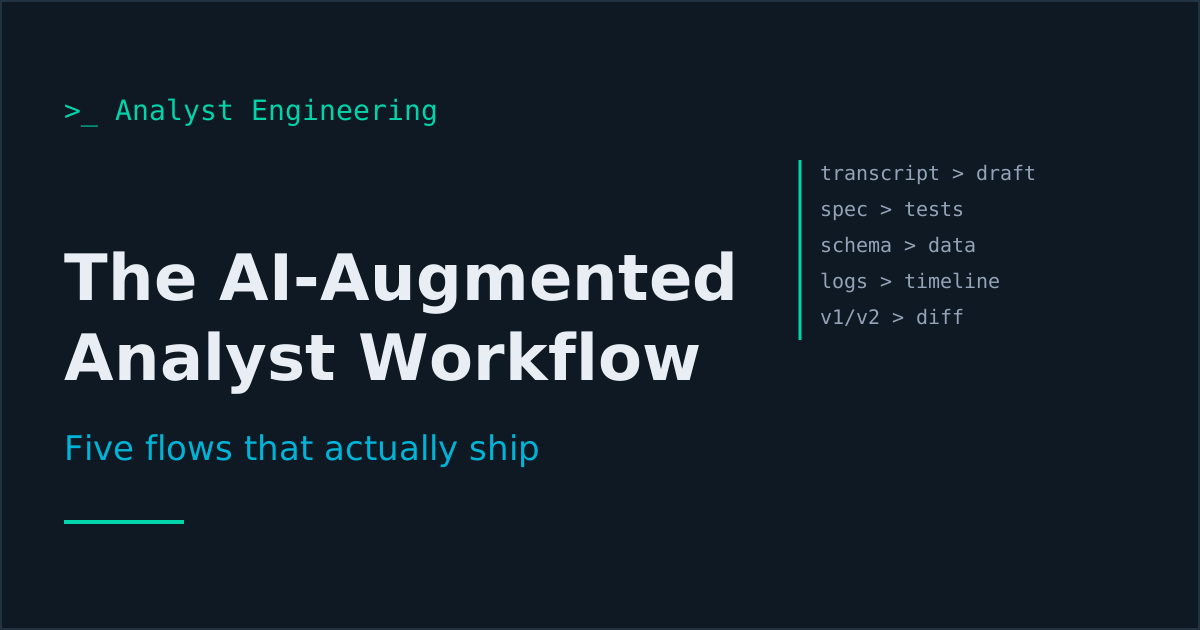
- The five flows that pay back immediately are transcript to draft requirements, spec to negative test matrix, schema to test data, log bundle to incident narrative, and contract version to redlined diff.
- The analyst stays accountable for every artifact. AI produces the first draft at 70 percent; the remaining 30 percent is the domain knowledge that makes the artifact correct, and that part is not delegable.
- Measure the flow, not the novelty: track draft cycle time, the number of review comments on your specs, and defects escaping to UAT. If those numbers do not move, the flow is theatre.
AI earns its place in analyst delivery in five specific flows: transcript to draft requirements, spec to negative test matrix, schema to test data, log bundle to incident narrative, and contract version to redlined diff. Each one is high-volume text transformation over documents you already own. Everything else is still judgment, and judgment is your job.
The AI-augmented analyst workflow is not “ask a chatbot for requirements.” It is a small set of flows where a language model transforms text you already own into an artifact you already know how to review, with the grounding documents attached every time. Five flows cover most of the real gain: turning a meeting transcript into a structured draft of requirements, expanding a functional spec into a negative test matrix, generating valid and invalid payloads from a schema, compressing a log bundle into an incident narrative, and diffing two versions of an API contract into an impact list. Those are tasks where the work is mechanical, the volume is high, and you can verify the output against a real system in minutes.
I have watched analysts on payments programmes go two ways with this. One group pastes a vague question into an assistant, gets three paragraphs of consultancy filler about “stakeholder alignment,” concludes the whole thing is overhyped, and stops. The other group builds a repeatable flow with grounding attached, and cuts the time from workshop to issued draft spec from three days to half a day. The difference is not the model. It is whether you gave it the contract, the data dictionary, and an example of the output you wanted. The prompt-level mechanics of doing that consistently are what I packaged into The Technical BA Prompt Toolkit, but the flows themselves are below.
Why do most analyst AI attempts fail?
Most attempts fail because the analyst asks for domain knowledge instead of asking for a transformation. A language model does not know your payment engine’s status values, your bank’s rejection taxonomy, or the fact that your settlement batch cuts at 15:30 local time. Ask it to “write requirements for payment status handling” and it will produce something that reads like a credible spec and contains field names that do not exist in your system. That output is worse than nothing, because it costs you review time and it can leak a fabricated rule into a real document.
The fix is grounding. Before you ask for anything, assemble a context pack:
- The current functional spec or the section of it you are changing.
- The API contract, message schema, or interface definition (an OpenAPI file, an ISO 20022 message definition, a Kafka Avro schema).
- The data dictionary for the fields in scope, so names and types are taken, not invented.
- A glossary of domain terms your organization uses, including the ones used inconsistently.
- One worked example of the output format you want, even a short one.
With the pack attached, the request changes shape. You are no longer asking “what should the requirements be.” You are asking “restructure this transcript into this template, using only field names from the attached dictionary, and list anything the transcript leaves undefined.” That is a transformation, and transformations are what these models are genuinely good at.
The second failure mode is accepting the output. A generated artifact is a plausible reconstruction, not evidence. I treat every AI draft as a junior analyst’s first attempt: useful structure, real gaps, and at least one confidently wrong statement per page. You verify, the same way you would verify a colleague’s draft before your name goes on it.
Flow 1: Transcript to draft requirements
The flow: record the workshop, get a transcript, attach the transcript plus your context pack, and ask for the transcript restructured into your requirements template with an explicit open-questions list.
What makes this work is the open-questions list. Anything the transcript does not settle must be surfaced rather than smoothed over. The instruction I use is blunt: every requirement must trace to a specific statement in the transcript, and anything not stated goes into an “undefined” section rather than being filled in from general knowledge.
The output is a draft with the shape of your template, the vocabulary of your organization, and a list of the twelve things nobody actually decided in the room. That list is the real prize. It is the agenda for your next session, and it is the part an analyst would normally spend an evening reconstructing from memory.
What you still do yourself: decide which of those twelve matter, chase the right people, resolve the two stakeholders who contradicted each other, and rewrite the acceptance criteria so they are testable. The move from loose business intent to precise, buildable behavior is the core analyst skill, and it is the one I break down step by step in From Vague BR to Functional Requirements. The AI gets you to the starting line faster; it does not run the race.
Flow 2: Spec to negative test matrix
The flow: attach the functional spec section and the message schema, then ask for every field to be enumerated with its constraints and, for each constraint, the invalid value that violates it and the expected system response.
This is the highest-yield flow I know, because negative test design is exhaustive, boring, and exactly where humans skip rows. Given a schema with 40 fields, a model will patiently produce the missing-mandatory-field case, the wrong-format case, the too-long case, the wrong-enumeration case, and the wrong-type case for each one. On a pacs.008 credit transfer that is several hundred candidate cases in a minute.
Your job is the column the model cannot fill: the expected system response. Whether a malformed creditor agent identifier produces a rejection with a specific ISO 20022 reason code, a technical rejection at the schema gate, or a repair queue item is a property of your implementation, not of the schema. So the flow is: model generates the input space, you fill the expected behavior from the spec, and you delete the cases your gateway makes impossible.
I go deeper on designing the unhappy path in negative test design, and the broader discipline of provable test coverage in payment testing. Run the flow once on a message you know well and you will see immediately which rows you have been quietly omitting for years.
Flow 3: Schema to test data
The flow: attach the schema and the constraints, then ask for a set of payloads: one canonical valid message, one valid message that exercises every optional element, and one invalid message per constraint, each labeled with the constraint it breaks.
Test data is the bottleneck nobody budgets for. On an ISO 20022 migration the tester needs dozens of structurally valid messages differing in one field at a time, and hand-editing XML is how a week disappears. Generating them from the schema, then validating the generated files against the real schema before use, turns that week into an afternoon.
Two rules keep this safe. First, never use production data as the seed. Ask for synthetic values that match the format, and keep real customer names, account numbers, and addresses out of any prompt. Second, validate mechanically. Generated XML or JSON is not trustworthy until a schema validator has accepted it, so the flow always ends with a validation step you run locally, not with the model asserting the file is valid. That handoff from generated artifact to automated check is the same pattern I use for event validation in Automate Kafka Validation with Postman.
Flow 4: Log bundle to incident narrative
The flow: during an incident, pull the logs for one failing transaction across the services it touched, strip anything sensitive, attach them, and ask for a timeline: what happened, in what order, at which component, with the exact error strings quoted.
The value here is speed of comprehension under pressure. A single failed payment can produce a few hundred log lines across an API gateway, an orchestrator, a sanctions screening service, and a payment engine, each with a different timestamp format. Turning that into “request accepted at 09:14:02, screening timed out after 30 seconds at 09:14:33, orchestrator retried twice, engine rejected as duplicate” is mechanical work, and getting it in twenty seconds changes what you can do in the next five minutes of a bridge call.
The hard constraint is that every claim in the narrative must quote a log line. I ask for the timeline with the source line beside each step, then I check the three steps that matter. A narrative without quoted evidence is a story, and you do not put a story in an incident channel. The manual version of this skill, which you still need because it is how you catch the model being wrong, is in reading production logs and how a technical BA investigates a failed payment.
Flow 5: Contract version to redlined diff
The flow: attach two versions of an API contract or message definition and ask for a structured change list, classified by impact: breaking, additive, and cosmetic, with the affected consumers named from your own integration list.
This is where I have seen the most avoided pain. A provider ships version 2 of an OpenAPI specification, the release note says “minor improvements,” and buried in 4,000 lines is a field that moved from optional to required and an enumeration that gained two values. Hand-diffing a specification file is possible and miserable; a structured diff classified by impact takes a minute and gives you an impact assessment you can send to three teams before lunch.
Note the two halves again. The classification of breaking versus additive comes from the contract, which the model can read. The named consumer impact comes from your knowledge of who calls what, which you supply. If you are not yet fluent in reading these files unaided, start with reading an API contract, and for building the documentation side of the same skill there is API Documentation from Scratch.
What stays human in an AI-augmented workflow?
Five things, and they are the five that define the role.
Prioritization. Deciding that the repair queue matters more this quarter than the reporting extract is a business judgment with political weight. No model has the standing to make it.
Conflict resolution. When the operations lead and the product owner describe incompatible behavior, the work is a conversation, not a synthesis of both positions into a paragraph that satisfies neither.
Verification. Any statement about how the system behaves must be checked against the system. You test it, query it, or read the code. This is the non-negotiable one, and it is why technical fluency matters more in an AI-assisted team, not less: your only defense against confident nonsense is knowing how to check. The full map of those skills is in The Technical Skills Guide for BAs.
Sign-off. Your name on the document means you stand behind it. Provenance does not dilute accountability.
Data judgment. What goes into a prompt leaves your boundary. Customer names, account identifiers, transaction references, and staff details do not go into a general assistant. Mask first, and know your organization’s approved tooling before you paste anything.
How do you know the flow is working?
Measure delivery, not novelty. Three numbers tell you the truth:
| Metric | What it tells you | Direction if the flow works |
|---|---|---|
| Days from workshop to issued draft spec | Whether AI is compressing the drafting bottleneck | Down |
| Clarification comments from devs and testers per spec | Whether the draft is actually clearer or just faster | Down |
| UAT defects traced to missing or ambiguous requirements | Whether coverage improved or you shipped generated gaps | Down |
If the first number falls and the other two rise, you are producing documents faster and defects faster with them. That is the failure pattern to watch for, and it usually means grounding is missing or review is being skipped because the output reads well. Output that reads well is precisely the risk: fluency is not accuracy, and a polished paragraph containing an invented status code will sail through a review that a clumsy one would not.
The analysts who are getting real leverage here are not the ones with the best prompts. They are the ones who already had strong artifacts, a clear template, and the technical ability to verify, and who pointed a fast text transformer at the boring 70 percent. If your specs were vague before, AI will make you vague at higher speed.
The takeaway
The AI-augmented analyst workflow is five flows, not a philosophy: transcript to draft requirements, spec to negative test matrix, schema to test data, log bundle to incident narrative, and contract version to redlined diff. Each one is a transformation of documents you already own, run with a context pack attached, and finished by a human who verifies against the real system.
Build the context pack first, run one flow end to end this week, and measure the three delivery numbers. Then extend. If you want the prompt patterns and the template library that these flows depend on, they are in The Technical BA Prompt Toolkit and Real-World BA Deliverables, or browse everything at The Tech BA Toolkit.
Ahmed is a Senior Technical Business Analyst with 10+ years in banking and payments. He builds practical guides and tools for analysts at The Tech BA Toolkit.
Tags: Business Analysis, Artificial Intelligence, Productivity, Requirements, Payments
About the author
Analyst Engineering is written by Ahmed, a Senior Technical Business Analyst with 10+ years of banking and payments delivery experience: ISO 20022 and SWIFT messaging, payments API integration, Kafka event validation, and production support. Every article comes from real delivery work, and each one is reviewed and updated as tools and standards change.
Related articles
- Prompt Patterns for Requirements Work: Six Patterns I Reuse Weekly Six reusable prompt patterns for requirements work: grounded extraction, format contract, adversarial review, gap interrogation, traceability, testability.
- The Analyst's Second Brain: Notes That Answer Questions Months Later How to build a second brain as a technical analyst: a plain-Markdown knowledge base, organized by system and decision, that answers questions months later.
- Automating the Analyst Workflow: What to Script First Which analyst tasks to automate first, ranked by payback: environment checks, test data setup, reconciliation, contract validation, ticket evidence.
- AI Agents for Analysts: When an Agent Beats a Prompt When an AI agent beats a single prompt for analyst work, what tools it needs, where the guardrails go, and the three agent flows worth building first.
Newsletter
Subscribe
Practical, no-fluff playbooks for technical analysts who analyze, code, test, and support. New articles straight to your inbox.
No spam. Unsubscribe anytime.