How Analysts Negotiate a Raise or an Offer: Scripts, Evidence, and Numbers
Written by Ahmed at Analyst Engineering, a Senior Technical Business Analyst with 10+ years in banking and payments delivery.
Key takeaways
- An offer and a raise are two different negotiations: at the offer your number resets and the budget is flexible, while a raise is paid from a budget that was set months earlier.
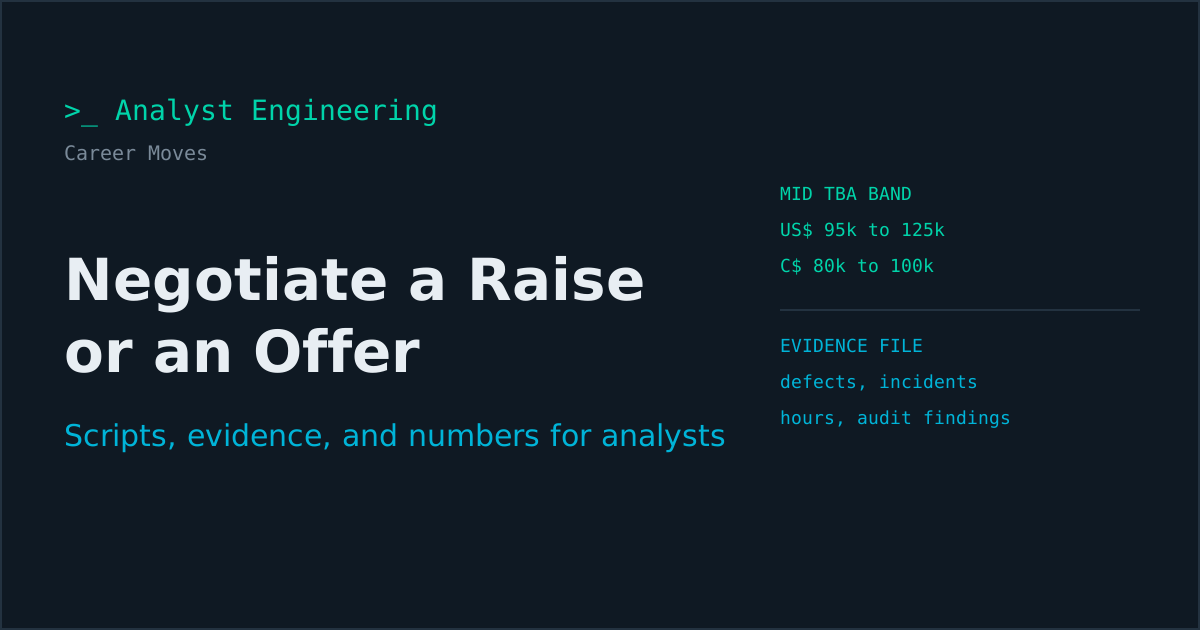
- The room to negotiate is the band: a mid technical BA in a large US city sits between US$95k and US$125k base, so the difference between accepting and countering can be worth US$30k a year.
- Analysts negotiate with an evidence file, not adjectives: defects prevented, incidents shortened, hours automated, and audit findings closed, each with a number.
- Ask for a raise before the budget is set, usually two to three months before the fiscal year starts, and within a few weeks of a visible win.
- When the answer is 'there is no budget', negotiate the criteria and the date for a level change in writing, plus the non-salary items that come from a different budget.
Analysts negotiate best with evidence, not adjectives: a file of numbers (defects prevented, incidents shortened, hours automated, audit findings closed) mapped to the band for the role. Treat an offer and a raise as two separate games. At the offer your number resets, and the room is the band itself: a mid technical BA in a large US city sits between US$95k and US$125k base, so countering can be worth US$30k a year. At a raise the budget was set months earlier, so timing and a level change matter more than the number you ask for.
I have sat on hiring panels where two candidates for the same technical BA seat interviewed equally well. One said “I’m flexible on salary” at the screen and was offered at the bottom of the band. The other named a researched band, asked which level the role was budgeted at, and sent a four line counter with three numbers from her last project. She signed near the top of the same band. Nothing about their skills explained the gap; the negotiation did.
Most analysts I coach are good at evidence in their day job and terrible at using it for themselves. The negotiation is decided mostly in the interview, when the panel decides whether you are mid or senior, which is why the BA and Technical BA Interview Guide is where I would start: what each question tests and how to answer from real work.
What is the difference between negotiating an offer and a raise?
An offer negotiation resets your number against a flexible hiring budget; a raise negotiation asks for a share of a budget that was fixed months ago. They need different playbooks.
| Negotiating an offer | Negotiating a raise | |
|---|---|---|
| Budget | Hiring budget, flexible within the band | Merit pool set before the fiscal year |
| Your leverage | They have chosen you and restarting costs weeks | Replacement cost and your track record |
| Best timing | After the verbal offer, before you sign | Before the budget is set, after a visible win |
| What moves most | Base, level, signing bonus | Level change, title, then base |
| Main risk | Low: offers are rarely withdrawn over a polite counter | Medium: a badly timed ask gets a “not this year” |
How much room is there to negotiate?
The room is the band for your role and level. Indicative 2026 base salary, permanent roles, large cities, excluding bonus and equity:
| Role and level | US (USD) | Canada (CAD) | UK (GBP) | Eurozone (EUR) |
|---|---|---|---|---|
| Business analyst, mid | 85k to 110k | 72k to 90k | 42k to 55k | 48k to 60k |
| Business analyst, senior | 110k to 135k | 90k to 110k | 55k to 72k | 60k to 75k |
| Technical BA, mid | 95k to 125k | 80k to 100k | 50k to 65k | 52k to 65k |
| Technical BA, senior | 125k to 155k | 100k to 125k | 65k to 85k | 65k to 82k |
| Business analyst, lead | 130k to 160k | 105k to 130k | 70k to 90k | 72k to 90k |
Two readings matter. The spread inside one band is about 20 to 30 percent, which is what an offer negotiation plays for. The gap between mid and senior is larger still, which is why a level change is worth more than any annual raise. From my side of hiring panels, most offers land in the lower 60 percent of a posted range unless the candidate negotiates with evidence. Verify the band before you negotiate: posted ranges in pay transparency jurisdictions (New York, California, Colorado, Washington, Illinois, British Columbia, and Ontario since January 1, 2026 for employers with 25 or more employees), the annual Robert Half, Hays, and Michael Page guides, ITJobsWatch in the UK, Levels.fyi for companies with equity, and two people one level above you. The full tables are in the analyst salary guide.
Playbook 1: how do you negotiate a job offer?
What do you say when the recruiter asks “What are your salary expectations?”
Anchor to the band and your scope, never to your current salary. With a posted range:
“I’ve seen the posted range of US$95k to US$125k. Given what we discussed, owning the API testing and the ISO 20022 mapping, I’d expect to be in the upper half of it. Can you tell me which level the role is budgeted at?”
Without a posted range:
“I’d like to understand the level first. For senior technical BA roles in banking in Toronto I’m seeing C$110k to C$125k base. Is that aligned with your budget for this role?”
If they push for your current salary, answer: “I’d rather focus on the value of this role. What is the band?” Several US states and cities prohibit employers from asking salary history, and nothing obliges you to volunteer it anywhere.
What does the counter email say?
Send it within 48 hours of the verbal offer, in writing, to the person who made it.
Subject: Offer for Senior Technical BA
Hi Dana, thank you for the offer; I’m excited about the payments platform work. Based on the scope we discussed and my last two years (I led the API contract review that cut integration defects from 41 to 9, and automated the reconciliation checks that saved the team about 12 hours a week), I’d like to ask for a base of US$145k. If we can get there, I’m ready to sign this week. Happy to talk it through.
Three elements do the work: one number, two pieces of evidence, and a signal that you will close.
What if they say the offer is final?
“I understand the base is fixed. Could we look at the level, a signing bonus, or a six month review against agreed criteria instead?”
Then stop talking. A final base often hides a flexible signing bonus, which comes from a different budget line.
Playbook 2: how do you negotiate a raise?
How do you open the raise meeting?
Book a dedicated 30 minutes, not the end of a one-to-one, and send a one-page evidence summary the day before.
“I’d like to talk about my level and pay. Over the last year I’ve been doing senior scope: I own the interface specifications for three integrations, the defects we caught in design review dropped production incidents on the settlement flow from six to one, and I closed two audit findings. The senior band here is C$90k to C$110k and I’m at C$88k. I’d like to move to senior at C$100k in this cycle. What would you need from me to support that?”
What do you say when the answer is “there is no budget”?
“I understand. Can we agree on two things: the specific criteria for the senior level, and the date of the next budget decision? If I meet the criteria by then, I’d like us to agree now that the change happens. In the meantime, could we look at the title, a certification budget, or an extra remote day?”
Follow up by email the same afternoon: “Thanks for today. To confirm, we agreed that…” An agreement that only exists in a meeting does not survive a reorganisation.
When is the best time to ask for a raise?
Ask two to three months before the fiscal year starts, when managers are building next year’s budget, and within a few weeks of a visible win such as a clean go-live or a closed audit finding. The annual review itself is usually too late: by then the merit pool is allocated and your manager is distributing, not requesting.
What goes in an analyst’s evidence file?
An evidence file (a brag document) is a running list of outcomes with numbers and the artifact behind each. Update it monthly.
| Category | Example entry | Artifact behind it |
|---|---|---|
| Defects prevented | 27 requirement gaps caught in refinement before build on the pacs.008 migration | Gap log, decision tables |
| Incidents shortened | Cut diagnosis of a failed payment incident from about 5 hours to 40 minutes with log queries | Runbook, log analysis |
| Hours automated | Scripted daily reconciliation checks, saving about 12 hours a week | Script, Python checks |
| Audit findings closed | Closed 2 findings on missing traceability | Traceability matrix |
| Dates protected | Found an API contract break 3 weeks before go-live | Contract review |
If your file is thin because you have no measurable artifacts yet, build them. The Labs are missions set in a realistic payments system that produce write-ups you can reference; a free account saves your progress and unlocks the worked solutions. And if you want every guide and template pack I use to produce those deliverables at work, the Complete Tech BA Bundle has them in one purchase.
What can you negotiate besides salary?
Non-salary items often come from budgets your manager controls more freely than base pay:
- Level and title. The most valuable item: it moves the band your future raises are calculated from.
- Remote days. One extra day a week is worth real money in commuting and time.
- Training budget for a course, conference, or tools.
- Certification cost, such as CBAP, ISTQB, or a cloud certification, plus study days. Check which pay off first in certifications ranked by return.
- Signing bonus, especially to replace a bonus you forfeit by leaving.
- Review date. A six month review against written criteria instead of twelve.
How do negotiation norms differ in the US, Canada, the UK, and Europe?
US and Canada. A polite counter is expected in the US, and offers are rarely withdrawn over one. Ranges are posted in many states and several jurisdictions prohibit salary history questions. Canadian negotiation is usually quieter: one counter is normal, a second is pushing. At Canadian banks, compare the whole package, including bonus target, pension or group RRSP (registered retirement savings plan) matching, and benefits, because base bands are tighter than in the US.
UK. Notice periods of one month for mid roles and three months for senior roles are common, so a new employer is buying a future start date. Negotiate the start date and, where needed, a buyout of notice. Expect a counteroffer from your current employer when you resign; decide in advance what would make you stay, because deciding in the moment rarely goes well.
France and the Eurozone. Salaries are quoted as gross annual (brut annuel in France), so always compare gross with gross. Some countries and collective agreements pay a 13th month, and in Spain and Italy often a 14th, so ask how the annual figure is split. The Netherlands adds a statutory holiday allowance of at least 8 percent. In France, collective agreements (Syntec for IT consultancies, for example) set minimum pay by classification, so negotiate the classification level as well as the number. Notice for managers and professionals (cadres) is often three months.
What does a successful negotiation look like?
The cases below are composites of moves I have watched on delivery teams, with details changed.
Maya: countering an offer in Chicago
Maya was a mid technical BA at a Chicago insurer on US$98k with four years of experience. A fintech offered her US$100k, the bottom of the US$95k to US$125k mid band, after she had said “I’m flexible” at the screen. She spent an evening on her evidence file, then sent a counter at US$120k citing an API contract review that cut integration defects by three quarters and a SQL investigation that closed a recurring reconciliation break. The fintech came back at US$112k, a signing bonus to cover the bonus she forfeited, and a paid certification. Before: US$100k offered. After: US$112k base, 12 percent higher. What she would do differently: name a band at the screen instead of saying “flexible”.
Aisha: a raise without budget in Toronto
Aisha was a senior BA at a Toronto insurer on C$92k, near the bottom of the C$90k to C$110k senior band, while running requirements for the claims platform. She opened her raise meeting in October, two months before budgets were set, with an evidence file: 31 requirement gaps caught before build, two audit findings closed, and about 6 hours a week of reporting automated. Her manager said there was no budget. She used the criteria script and got written criteria and a January review date, plus a certification budget. In January she moved to C$104k, higher in the same band. Before: C$92k. After: C$104k, a 13 percent increase. What she would do differently: start the evidence file on day one, not in September.
What is a six week negotiation plan?
- Week 1: benchmark. Find your band and the next one up. Artifact: a pay sheet with three sources.
- Weeks 1 to 2: build the evidence file. Go back twelve months. Artifact: five entries with numbers and artifacts, like the table above.
- Week 2: map your scope to a level. Use the Technical Analyst Skill Matrix to show where you already work at the next level, and the career paths to name that level. Artifact: a one-page level case.
- Week 3: write the scripts. Adapt the openers above to your numbers and say them aloud twice. Artifact: your scripts on one page.
- Week 4: time the ask. For a raise, book the meeting before the budget cycle; for an offer, wait for the verbal offer. Artifact: a calendar invite.
- Weeks 5 to 6: negotiate and confirm in writing. Artifact: the follow-up email or the signed offer.
What mistakes cost analysts money in a negotiation?
- Naming your current salary. It anchors the offer to your past, not to the role.
- Saying “I’m flexible”. Recruiters hear “the bottom of the band”.
- Negotiating on need. Rent and childcare are real, but budgets are approved on value.
- Countering by phone only. Put the number and the evidence in writing.
- Asking for a raise at the annual review. The pool is already allocated.
- Accepting “no budget” without a date. Without criteria and a date in writing, next year looks the same.
- Threatening to leave without an offer. Only mention an offer you have and would accept.
The takeaway
Negotiation for analysts is evidence work: know the band, bring numbers, and ask at the right moment. At the offer, counter once in writing with two or three results. At a raise, ask before the budget is set, aim for a level change, and turn “no budget” into criteria and a date. Other moves that raise your band are in the Analyst Career Moves map, including employer type and changing role inside your company.
To walk into the interview that sets your level ready, use the BA and Technical BA Interview Guide. If you want to rehearse a counter or a raise meeting with someone who has sat on the other side, book a 1:1 Tech BA Coaching Call. The free downloads are a good start, and everything else is at The Tech BA Toolkit. More on the role lives in the Business Analyst hub.
Ahmed is a Senior Technical Business Analyst with 10+ years in banking and payments. He builds practical guides and tools for analysts at The Tech BA Toolkit.
Tags: Business Analysis, Salary, Negotiation, Career Growth, Technical Analysis
About the author
Analyst Engineering is written by Ahmed, a Senior Technical Business Analyst with 10+ years of banking and payments delivery experience: ISO 20022 and SWIFT messaging, payments API integration, Kafka event validation, and production support. Every article comes from real delivery work, and each one is reviewed and updated as tools and standards change.
Related articles
- Analyst Salaries in 2026: Realistic Pay by Role, Level, and Country Realistic 2026 analyst pay by role and level in the US, Canada, UK, and Eurozone: BA, technical BA, QA, SDET, data, architecture, product, and contract rates.
- Bank, Consultancy, Product Company, or Public Sector? How Employer Type Shapes Analyst Pay How employer type shapes analyst pay: banks, Big Four and boutique consultancies, outsourcers, SaaS, fintech, and public sector on pay, bonus, and security.
- Changing Role Inside Your Company: The Cheapest Career Move an Analyst Can Make An internal move is the cheapest analyst career change: 3 to 9 months, usually no pay cut. The step plan, the move proposal, and how to ask for a regrade.
- Interviewing as a Career Changer: How to Answer "Why the Switch?" and the Case Exercise How career changers pass analyst interviews: scripts for why the switch and no experience, the seven common case exercises, STAR stories, and the pay question.
Go deeper on this
Not ready to buy? The free downloads are a no-cost place to start, and every article here stays free.
Free account
Practice on the Labs, keep your progress
A free account, no password: an email link signs you in. It saves your steps and self-assessments on the Labs, shows your missions on a dashboard, unlocks the solutions, and, if you tick the box, sends you new missions and articles when they ship.
Your email is used to sign you in. Nothing else, unless you ask. Privacy.