Becoming a Business Analyst at 40 or 50: Your First Career Is the Advantage
Written by Ahmed at Analyst Engineering, a Senior Technical Business Analyst with 10+ years in banking and payments delivery.
Key takeaways
- Age is an asset in a business analyst career change when you target the domain you already know; the real risk is entering at the junior band and competing with 24 year olds on their terms.
- Mid-career switchers enter at the mid band through domain-led roles: functional analyst on your industry's software, subject matter expert to BA inside your employer, or implementation consultant for a vendor in your field.
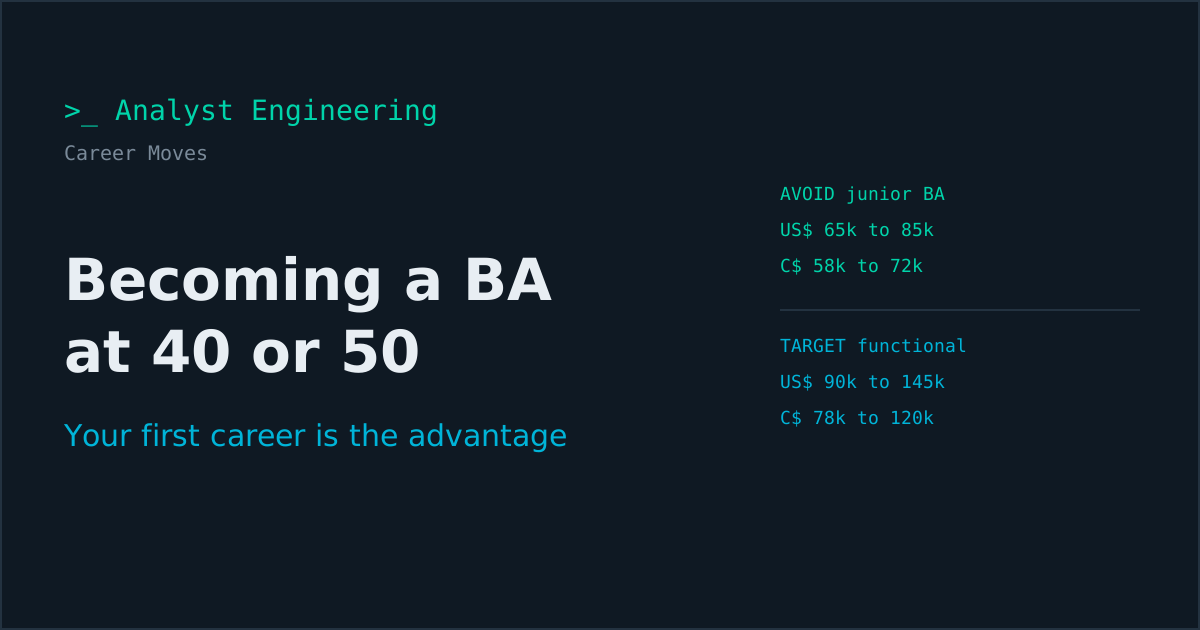
- A functional analyst in 2026 earns about US$90k to US$145k, C$78k to C$120k, or £48k to £78k in London, against US$65k to US$85k for a junior BA, so the entry route decides the pay more than the job title.
- The cheapest switch at 40 or 50 is an internal move: your employer already trusts your judgment, and a secondment into a systems team costs you neither income nor pension.
- Ageism is real and mostly shows up as doubts about tech fluency and energy; a two page CV, a current portfolio, and fluent use of Jira, SQL, and AI tools answer both before anyone asks.
Becoming a business analyst at 40 or 50 works best when you target the domain you already know, because there your first career counts as expertise and you can enter at the mid band rather than the junior one. The real risk is not age. It is applying to generic junior roles that pay US$65k to US$85k or C$58k to C$72k in 2026, when a domain-led functional analyst role in your own industry pays about US$90k to US$145k or C$78k to C$120k (base salary, permanent, large city, indicative).
The best functional analyst I worked with on a card disputes platform was 51. She had spent twenty years in chargeback operations before she ever opened Jira. In her second week she stopped a release that every developer and tester had signed off: the new flow reset the dispute clock when a merchant uploaded a second document, which would have quietly pushed hundreds of cases past the scheme deadline. Nobody else on the team knew that rule existed. She knew it because she had paid for it in write-offs years earlier.
That is the argument for a mid-career switch in one scene. Delivery teams are full of people who can write a user story; they are short of people who know what the story will break. The switchers I have seen struggle at 45 are the ones who hid that knowledge to look like a generic analyst. If you want the step by step job search around this move, with indirect-experience examples and templates, Land Your First Job covers career changers as well as graduates.
What does a business analyst career change at 40 or 50 actually look like?
A mid-career switch into business analysis looks like moving from running a process to changing the system that runs it, usually in the same industry. The day to day becomes workshops, process maps, functional specs, acceptance criteria, test cases, and defect triage. The subject matter stays the same: claims, shipments, ledgers, patients, payments.
The entry route decides the band. The table maps common first careers to the analyst role that values them most.
| First career | The role that values it | Entry band (US / Canada) |
|---|---|---|
| Insurance claims manager | Functional analyst on a claims platform (Guidewire, Duck Creek, or in-house) | Functional analyst: US$90k to US$145k, C$78k to C$120k |
| Military or civilian logistics officer | Systems analyst on warehouse, transport, or supply chain systems | Mid systems analyst: US$90k to US$115k, C$78k to C$98k |
| Accountant | Finance systems BA or ERP functional consultant (SAP, Oracle, Workday) | Functional analyst: US$90k to US$145k, C$78k to C$120k |
| Bank operations manager | Payments or operations BA | Mid BA: US$85k to US$110k, C$72k to C$90k |
| Nurse manager or clinical lead | Clinical systems analyst on an electronic health record | Mid systems analyst: US$90k to US$115k, C$78k to C$98k |
| Retail or hospitality area manager | Functional analyst on point of sale, inventory, or property management systems | Mid BA: US$85k to US$110k, C$72k to C$90k |
There are three doors into those roles, and all three avoid the junior band.
Subject matter expert to BA. Every large project borrows people from operations as subject matter experts. Volunteer for the next one, write the test scenarios, attend refinement, and ask to stay on as a BA when it goes live. This is the route with the lowest risk because you keep your salary and your employer.
Functional analyst on your industry’s software. Employers running a claims platform, an ERP, or a warehouse management system hire functional analysts who understand both the configuration and the business. They prize domain first. Read what a functional analyst does and how fit-gap analysis works, because fit-gap is the core artifact of this role.
Implementation consultant for a vendor. Software vendors selling into your industry need people who can sit with a client’s operations team and configure the product to their process. Your credibility with clients is the product. The role travels more and sits close to the functional analyst band.
How much does a mid-career business analyst earn in 2026?
A mid-career switcher who enters through the domain usually earns the mid BA band or the functional analyst band; one who enters through a generic junior posting earns the junior band. Indicative 2026 base salaries, permanent roles, large cities:
| Role and level | US (USD) | Canada (CAD) | UK, London (GBP) | Eurozone (EUR) |
|---|---|---|---|---|
| Business analyst, junior | 65k to 85k | 58k to 72k | 32k to 42k | 38k to 48k |
| Business analyst, mid | 85k to 110k | 72k to 90k | 42k to 55k | 48k to 60k |
| Functional analyst, mid to senior | 90k to 145k | 78k to 120k | 48k to 78k | 52k to 80k |
| Systems analyst, mid | 90k to 115k | 78k to 98k | 45k to 58k | 50k to 62k |
The honest reading: a junior BA offer at US$75k against a functional analyst offer at US$110k is a US$35k difference in the first year, and it comes almost entirely from the entry route, not from skill. SAP, Oracle, Salesforce, and Workday certified functional specialists sit 10 to 20 percent above the functional band, which is why an accountant who adds an ERP certification can do better than break even. An experienced accountant on about US$65k to US$90k, or C$65k to C$85k, often gains. A senior manager on a higher salary usually takes a short-term cut and should know that before the first interview.
To verify the band in your city, read posted ranges: New York City and New York State, California, Colorado, Washington, Illinois, and several other US states require them in job ads; British Columbia (since November 2023) and Ontario (since January 1, 2026, for employers with 25 or more employees) require expected pay in public postings; the EU Pay Transparency Directive requires pay information before interview as member states implement it. In the UK, check ITJobsWatch by skill keyword. The annual Robert Half, Hays, and Michael Page guides are good cross-checks, and so is asking two people one level above the role what the band is. The full table by role is in the 2026 analyst salary guide, and the highest paying domains for analysts shows where your domain sits.
How do you deal with ageism when changing careers at 40 or 50?
You deal with ageism by answering the unspoken doubts with evidence before anyone raises them. In my experience on hiring panels, age bias rarely sounds like age. It sounds like “not sure about the tech side”, “might struggle with the pace”, or “would they take direction from a younger lead?”. Each has a specific answer.
- CV length and dates. Two pages. Detail the last 12 to 15 years and compress earlier roles into one line each. Remove graduation years; nobody needs them to assess you. Do not hide your experience, just stop making the reader count it. Rewriting your CV for a role change has before and after bullets.
- Tech fluency signals. Name current tools in context: “wrote acceptance criteria in Jira for the claims intake redesign”, “queried the claims table in SQL to size the backlog”. Mention one thing you did with an AI assistant last month. Vagueness about tools reads as age; specifics read as current.
- A recent portfolio piece. One artifact dated this year beats twenty years of experience described in the past tense.
- Energy in interviews. Talk about what you are learning now. Ask about the team’s delivery cadence and tooling. Show curiosity about the younger lead’s approach instead of explaining how you did it in 2009.
- Reporting to someone younger. Say it before they wonder: “I have reported to leads younger than me on the last project; what I bring is the domain, what I want from the lead is the delivery context.”
The AI signal matters more at this age than any other, because it is the fastest way to look current. AI for the Non-Technical Senior Analyst is written for experienced people who are strong on the business and want to use AI in analyst work without pretending to be engineers. For the free starting point, read AI for analysts: start here.
How do you pay for a career change at 40 or 50?
You pay for it by not stopping your income until you have to. Most mid-career switchers have a mortgage, dependants, and a pension they cannot pause. The finances that work in practice follow three rules.
Internal moves first. A subject matter expert secondment or a transfer into your employer’s systems team keeps salary, pension, seniority, and trust. It is the cheapest career move there is, and changing role inside your company explains how to ask for it.
Retrain while employed. 8 to 10 hours a week for 6 to 9 months covers the vocabulary, the minimum technical kit, and two portfolio pieces. Evenings and one weekend morning is realistic; quitting to study full time is almost never necessary for this role.
Runway before any external move. Hold six months of fixed costs in cash before you resign for an external role. A new employer’s probation period, a contract that ends early, or a hiring freeze in month two are normal events, not bad luck.
If you are in banking or want to be, domain knowledge there adds pay faster than anywhere else: banking and capital markets roles in New York or London typically pay 10 to 20 percent above the bands. Break Into Banking is the complete route into banking and payments analysis, including the domain knowledge that unlocks that premium.
What does a successful mid-career switch into business analysis look like?
The cases below are composites of moves I have watched on delivery teams, with details changed. Pay sits inside the 2026 indicative bands.
Case 1: a 47 year old claims manager becoming a functional analyst
Karen managed a property claims team of 14 at an insurer in Chicago, on a manager’s salary that already sat inside the functional analyst band, so her goal was a lateral move, not a raise. When the insurer began replacing its claims system, she volunteered as a subject matter expert. Over eight months she wrote 60 test scenarios from real claim types, documented the fit-gap for the first notice of loss screens, and learned enough SQL to reconcile migrated claims. She moved into a functional analyst role on the new claims platform at US$112k, with no change of employer or pension. What she would do differently: ask for the analyst title in writing at the start of the project, not the end, so the eight months counted as analyst experience on her CV.
Case 2: a 52 year old military logistics officer moving into supply chain systems analysis
David retired from the army after 28 years, the last ten in logistics planning, and settled near Chicago with a service pension that covered his runway. Civilian recruiters did not know what to do with his CV. He spent five months translating it: “managed theater distribution” became “owned inventory and transport processes across 9 sites and 3 systems”. He finished two Labs missions, wrote a process map of a cross-dock flow, and learned the basics of warehouse management system configuration. He landed a systems analyst role at a third-party logistics company at US$98k, in the mid band. What he would do differently: stop applying to program manager roles in month one, where he was competing with certified project managers, and go straight to systems roles where his planning experience was rare.
Case 3: a 44 year old accountant becoming a finance systems BA
Sophie was a mid-level accountant in Toronto on about C$82k, and the person her controller asked whenever month-end close broke. She took seven months. She learned the ERP’s general ledger configuration, wrote a spec for an intercompany reconciliation rule, and documented the close checklist as a process with its three manual workarounds. She moved to a finance systems business analyst role on an ERP program at C$92k, above the mid BA band because the program treated her as a functional specialist. What she would do differently: take the vendor’s functional certification before applying, which would have put her in the 10 to 20 percent premium band from the first offer.
What is the plan for a business analyst career change at 40 or 50?
This plan assumes you keep your job and give it 8 to 10 hours a week. Each step produces an artifact.
- Weeks 1 to 4: name your domain and your door. Decide which of the three doors you will try first (internal, functional analyst, implementation consultant). Artifact: a list of 15 target employers and the software each one runs.
- Weeks 5 to 8: translate your career. Rewrite your five strongest achievements as analyst work: process, rule, exception, test, outcome. Artifact: a two page CV with no graduation years.
- Weeks 9 to 16: the technical kit. SQL basics (SQL for analysts), reading an API (what an API is), Jira stories with acceptance criteria, and one functional specification. Artifact: one query, one API summary, one spec.
- Weeks 17 to 24: portfolio and proof. Finish two missions in the Labs, starting with the Become a Technical Analyst track; a free account saves your progress and unlocks the practitioner solutions. Add one artifact from your own domain. Artifact: a portfolio page with three pieces, described in the analyst portfolio guide.
- Weeks 25 to 36: applications and conversations. Ask internally first, then apply to 3 to 5 domain-led roles a week and hold 2 conversations a week with analysts in your target employers. Artifact: a tracker with at least 30 applications and 20 conversations.
- At offer: hold the band. Know the functional or mid band before the first call and negotiate from it. Artifact: a one page note with the band, your evidence, and your walk-away number.
Check your starting point with the technical analyst skill matrix before step 3 and again after step 4.
What mistakes stall a career change at 40 or 50?
- Applying for junior BA roles. You compete with graduates on the skills they have and you do not, and you ignore the skills you have and they do not.
- Hiding the domain. A CV that says “stakeholder management” instead of “ran the claims authority matrix for 14 adjusters” throws away the only reason to hire you at mid band.
- Resigning before the move is real. A runway you did not need is cheap; a runway you needed and did not have ends the switch.
- Chasing certifications first. A certificate without an artifact rarely moves a mid-career CV. Certify after you have a target role, and pick the one that role asks for.
- Treating tech fluency as optional. You do not need to code, but “I’m not technical” in an interview at 50 is the phrase that confirms every bias in the room.
The takeaway
A business analyst career change at 40 or 50 works when your first career is the qualification. Target the domain you know, enter through a subject matter expert role, a functional analyst role, or a vendor implementation role, and you land at the mid band or the functional band, not the junior one. Answer ageism with evidence: two pages, current tools, a recent artifact, and curiosity. Keep your income while you retrain and try the internal move first.
For the week by week job search, start with Land Your First Job. If you want an experienced eye on your target role and CV, book a 1:1 Tech BA Coaching Call. The free downloads are a good first portfolio step, and everything else is at The Tech BA Toolkit. For the switch from outside tech more generally, read how to switch careers into business analysis, and find more on the role in the Business Analyst hub.
Ahmed is a Senior Technical Business Analyst with 10+ years in banking and payments. He builds practical guides and tools for analysts at The Tech BA Toolkit.
Tags: Business Analysis, Career Change, Functional Analysis, Career Growth, Salary
About the author
Analyst Engineering is written by Ahmed, a Senior Technical Business Analyst with 10+ years of banking and payments delivery experience: ISO 20022 and SWIFT messaging, payments API integration, Kafka event validation, and production support. Every article comes from real delivery work, and each one is reviewed and updated as tools and standards change.
Related articles
- How to Switch Careers Into Business Analysis in 2026 (From Teaching, Nursing, Retail, and Support) Switching into business analysis from teaching, nursing, retail, or support: the real timeline, first-role pay by country, the pay cut, and the tech kit.
- Changing Role Inside Your Company: The Cheapest Career Move an Analyst Can Make An internal move is the cheapest analyst career change: 3 to 9 months, usually no pay cut. The step plan, the move proposal, and how to ask for a regrade.
- The Highest Paying Domains for Business Analysts: Where Domain Knowledge Becomes Pay The domains that pay business analysts most in 2026, from payments and capital markets to ERP and healthcare IT: why each pays, the premium, how to break in.
- Rewriting Your CV for an Analyst Role Change: Before and After Bullets That Get Interviews Rewrite your CV for an analyst role change: bullets as artifact plus outcome plus number, before and after pairs, ATS rules, and CV norms in four markets.
Go deeper on this
Not ready to buy? The free downloads are a no-cost place to start, and every article here stays free.
Free account
Practice on the Labs, keep your progress
A free account, no password: an email link signs you in. It saves your steps and self-assessments on the Labs, shows your missions on a dashboard, unlocks the solutions, and, if you tick the box, sends you new missions and articles when they ship.
Your email is used to sign you in. Nothing else, unless you ask. Privacy.