The Highest Paying Domains for Business Analysts: Where Domain Knowledge Becomes Pay
Written by Ahmed at Analyst Engineering, a Senior Technical Business Analyst with 10+ years in banking and payments delivery.
Key takeaways
- The domains that pay business analysts most combine four things: regulation, money or safety at risk, knowledge that takes years to acquire, and migration deadlines that cannot move.
- Payments and banking technology and capital markets sit at the top because banking in New York or London typically adds 10 to 20 percent to already high technical BA bands.
- Certified SAP, Oracle, Salesforce, and Workday functional specialists typically sit 10 to 20 percent above the functional analyst band, which runs US$90k to US$145k in major US cities in 2026.
- Domain knowledge moves a business analyst toward the top of their band; domain knowledge plus technical depth moves them into a higher band, which is the real multiplier.
- The cheapest way into a premium domain is an adjacent role inside it, such as payments operations, claims systems support, or an ERP super user, rather than a cold application for a specialist analyst role.
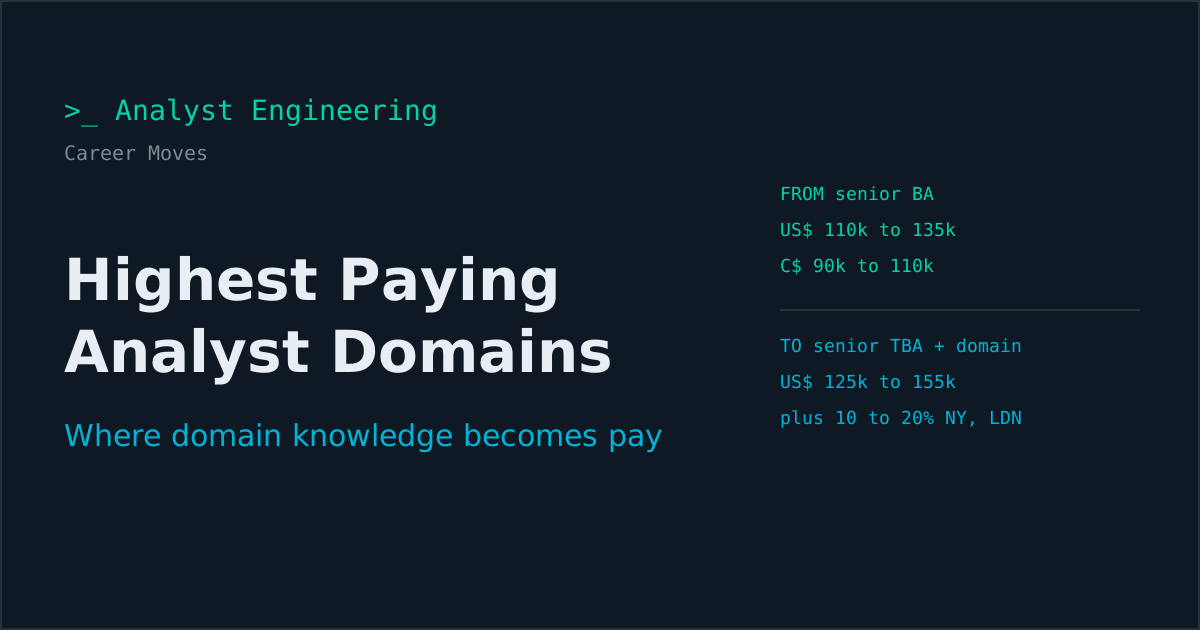
The highest paying domains for business analysts in 2026 are payments and banking technology, capital markets, ERP migrations, insurance platforms, and healthcare IT, because each combines regulation, money or safety at risk, scarce knowledge, and deadlines that cannot move. Domain knowledge moves you toward the top of your band; domain plus technical depth moves you into a higher one. A senior technical BA in a major US city earns an indicative US$125k to US$155k base, against US$110k to US$135k for a generalist senior BA, and banking in New York or London typically adds another 10 to 20 percent.
I once hired for an ISO 20022 migration team and interviewed two senior analysts in the same week. The first was the stronger facilitator. The second, asked what happens when a pacs.008 arrives with a structured address the downstream core banking system cannot store, answered in two minutes with the truncation risk, the screening impact, and the test cases she would write. We offered the second analyst the top of the band and would have gone higher.
That is domain knowledge becoming pay: not a better certificate, but two years of knowing where payments break. If you want the full route into banking and payments, including the domain knowledge that unlocks that premium, I wrote it down in Break Into Banking.
Why do some domains pay business analysts more?
Some domains pay business analysts more because a wrong requirement costs more there, and fewer analysts can write the right one. Four drivers explain almost every premium I have seen:
- Regulation. Analysts who turn a rule into testable behaviour are paid for the fines they prevent.
- Money or safety at risk. A payments defect moves real money; a clinical data defect can harm a patient. Error costs set the budget for analysis.
- Scarce knowledge. ISO 20022 messages, trade lifecycles, Guidewire data models, FHIR resources: each takes a year or two of delivery to learn.
- Migration deadlines. A fixed cutover or end of support forces firms to buy knowledge instead of training it.
Where all four stack, pay follows.
Which domains pay business analysts the most?
This ranking is my practitioner read from hiring, interviewing, and contracting, tied to the 2026 bands on this site. It is not a survey.
| Rank | Domain | Why it pays | Typical premium | Domain knowledge to acquire |
|---|---|---|---|---|
| 1 | Payments and banking technology | Regulation, money at risk, ISO 20022 and real-time deadlines | Top of the band or above; New York or London banking adds 10 to 20 percent | ISO 20022 (pain, pacs, camt), one real-time scheme, fraud and screening |
| 2 | Capital markets and trading | Regulatory reporting, trade risk, front office pace | Top of the band or above, same New York or London uplift | Trade lifecycle, FIX messaging, risk measures, transaction reporting |
| 3 | ERP (SAP S/4HANA, Workday, Salesforce) | Migration deadlines, certification scarcity | Certified specialists 10 to 20 percent above the functional band | One platform’s modules, configuration, data migration |
| 4 | AI and data platforms | New, scarce verification skills | Top of the band when the role includes evaluation and technical verification | Evaluation, retrieval, data lineage, guardrails |
| 5 | Insurance (Guidewire, Duck Creek) | Platform replacement programmes, actuarial and regulatory rules | Upper half of the band; top with platform experience | Policy, claims, and billing lifecycles, one platform’s data model |
| 6 | Healthcare IT | Clinical safety, interoperability regulation | Upper half of the band; top with FHIR and integration skills | HL7 v2, FHIR, one electronic health record (EHR) such as Epic in the US |
| 7 | Government and defence | Security clearance narrows the candidate pool | Mid band base, but steadier demand and less competition for cleared analysts | Procurement, accessibility and security standards |
| 8 | Energy and utilities | Grid and metering regulation, market settlement | Mid to upper half of the band | Metering data flows, market settlement, asset management |
| 9 | Telecom | Large billing and network system estates | Mid band | Billing and support systems, order to activate |
| 10 | E-commerce and SaaS | Speed, product focus | Mid band base, sometimes offset by equity | Product analytics, subscription billing, experimentation |
Why do payments and banking technology pay the most?
Payments pays the most because every driver stacks. The SWIFT MT to ISO 20022 coexistence period for cross-border payments ended in November 2025, domestic high-value systems have moved or are moving, real-time schemes (FedNow and RTP in the US, SEPA Instant in the eurozone, Faster Payments in the UK) run 24/7, and fraud rules such as UK reimbursement for authorised push payment scams and the EU’s Verification of Payee obligation keep generating change. The knowledge to acquire: the ISO 20022 architecture, how MT messages map to ISO 20022, one scheme in depth (for example the ten second rule in SEPA Instant), and end to end payment testing. The ISO 20022 hub collects the rest. How to break in: payments operations or a bank’s change team, then the analyst role.
Why does capital markets pay analysts so well?
Capital markets pays well because trading errors are expensive and regulatory reporting is relentless: MiFID II and EMIR transaction reporting in Europe and the UK, the US move to T+1 settlement in 2024 with the UK and EU following, and market risk rules that reshape risk systems. Front office analysts sit closest to revenue and are paid accordingly. The knowledge: the trade lifecycle from order to settlement, the Financial Information eXchange (FIX) protocol, reference data, and one product family in depth (equities, fixed income, or derivatives). How to break in: trade support or regulatory reporting, which has the most openings.
Why do ERP functional analysts earn a premium?
ERP functional analysts earn a premium because platform certification is scarce and migration deadlines are fixed: SAP ends mainstream maintenance for ECC at the end of 2027, which drives S/4HANA programmes everywhere, and Workday and Salesforce implementations run continuously. The functional analyst band is wide (US$90k to US$145k in major US cities) and certified SAP, Oracle, Salesforce, and Workday specialists typically sit 10 to 20 percent above it. The knowledge: one platform’s modules (finance, procurement, HR, or sales), its configuration model, and data migration. A fit-gap analysis is the core artifact of every ERP programme. How to break in: become the key user on your team’s implementation, then certify. What Is a Functional Analyst? describes the role.
What about insurance, healthcare, and government?
Insurance pays the upper half of the band because core platform replacements (Guidewire PolicyCenter, ClaimCenter, and BillingCenter, or Duck Creek) take years and need analysts who understand policy, claims, and billing rules; IFRS 17 reporting added a finance layer in Europe and Canada. Healthcare IT pays the upper half, and the top for analysts who can work with HL7 v2 messages and FHIR (Fast Healthcare Interoperability Resources) APIs, which US patient access and payer interoperability rules made unavoidable; Epic experience is a filter in US hospital systems. Government and defence rarely pay above mid band on base, but a security clearance (Secret in the US, SC or DV in the UK, Secret in Canada) removes most of the competition and makes demand steadier.
What about energy, telecom, SaaS, and AI platforms?
Energy and utilities pay mid to upper band for analysts who know metering data and market settlement. Telecom pays mid band; the knowledge is less scarce. E-commerce and SaaS pay mid band base, sometimes offset by equity at product companies. AI and data platforms are the newest premium: roles that add evaluation and technical verification of AI systems are sitting at the top of their bands in the postings and offers I see, which Is Business Analysis a Safe Career With AI? covers in detail.
How much more do domain specialists earn?
Domain specialists earn more by moving to the top of their band first, then by moving to a higher band when technical depth is added. These are the bands that matter for domain moves.
| Role (base salary) | US (USD) | Canada (CAD) | UK, London (GBP) | Eurozone (EUR) |
|---|---|---|---|---|
| Senior business analyst | 110k to 135k | 90k to 110k | 55k to 72k | 60k to 75k |
| Senior technical BA | 125k to 155k | 100k to 125k | 65k to 85k | 65k to 82k |
| Lead or principal technical BA | 150k to 180k | 120k to 145k | 80k to 100k | 78k to 95k |
| Functional analyst or ERP consultant (mid to senior) | 90k to 145k | 78k to 120k | 48k to 78k | 52k to 80k |
Base salary, permanent, large city, 2026, indicative. Bonus and equity are excluded. Banking and capital markets in New York or London typically add 10 to 20 percent to these bands. Certified SAP, Oracle, Salesforce, and Workday specialists sit 10 to 20 percent above the functional band. Outside London, UK pay is roughly 15 to 20 percent lower; smaller US metros are 10 to 20 percent lower.
Two honest notes. A domain move is often flat or a small cut in year one, because you enter at the level your domain knowledge supports. And the premium compounds: two years in payments is worth more at the next move than two more years as a generalist.
To verify: check posted ranges where pay transparency laws apply (New York, California, Colorado, Washington, Illinois, and other US states; British Columbia and, since January 1, 2026, Ontario for employers with 25 or more employees; EU member states as they implement Directive (EU) 2023/970). In the UK, ITJobsWatch shows rates by keyword, including domain terms like “ISO 20022” or “Guidewire”. The Robert Half, Hays, and Michael Page guides break pay down by sector. Then ask two people one level above you in the target domain. The full role list is in Analyst Salaries in 2026, and Bank, Consultancy, Product Company, or Public Sector? explains how employer type shifts the same role.
Why is domain plus technical depth the multiplier?
Domain knowledge tells you what the system should do; technical depth lets you prove what it actually does, and the market pays most for analysts who can do both. A generalist senior BA in Canada sits at C$90k to C$110k. Add payments knowledge and you move to the top of that band. Add SQL, API testing, and log reading on top and you qualify for the senior technical BA band, C$100k to C$125k, where payments knowledge again pushes you toward the top.
In practice the combination looks like this: you know a returned SEPA payment should carry a reason code, and you can query the database to show that 3 percent of returns last month were booked without one. Neither half alone gets that finding. Score yourself on the technical analyst skill matrix to see which half is weaker. If it is the technical half, The Technical Skills Guide for BAs covers reading code, SQL, APIs, and delivery tools at the depth an analyst needs, and How to Become a Technical Business Analyst is the six month plan.
What do real moves into premium domains look like?
The cases below are composites of moves I have watched on delivery teams, with details changed.
Daniel, generalist BA in Toronto: into payments, about 18 percent more in two years
Daniel was a mid-level BA at a Toronto retailer on C$84k, working on loyalty features. He spent four months learning ISO 20022 message structure and wrote a sample test case set for a pacs.008 credit transfer to prove it. He took a lateral move to a bank’s payments change team at C$88k, worked two years on a real-time payments programme, added SQL and API testing, and was retitled technical BA at C$99k, inside the mid technical BA band and about 18 percent above where he started. What he would do differently: learn SQL before the move, not after; he spent six months asking developers to run queries he could have written.
Aoife, BA in Dublin: Salesforce functional analyst
Aoife was a mid-level BA at a Dublin software company on €55k when the internal Salesforce rollout landed on her desk. She became the key user, then earned the Salesforce Administrator and Sales Cloud Consultant certifications over 12 months. She moved to a functional analyst role at a Salesforce implementation partner at €68k, inside the functional band, with a clear path higher as she added certifications. What she would do differently: document configuration decisions from day one instead of reconstructing them for interviews.
Karen, healthcare BA in Minneapolis: FHIR as the lever
Karen was a mid-level BA at a health insurer in Minneapolis on US$95k, writing requirements for member portal features. A payer interoperability programme needed someone who could read FHIR resources. She learned the core resources (Patient, Coverage, ExplanationOfBenefit), tested a public FHIR sandbox in Postman, and wrote the mapping specification from the claims system to FHIR. Within a year she moved to a technical BA role on an interoperability team at US$120k, inside the mid technical BA band. What she would do differently: start the Postman practice before volunteering, since the first month on the programme was steep.
How do you break into a high paying domain in six months?
Break in through an adjacent role inside the domain, with one artifact that proves you already think in it.
- Month 1: pick one domain and one standard. Payments and ISO 20022, insurance and one platform, healthcare and FHIR, ERP and one module. Artifact: a one-page domain glossary in your own words.
- Month 2: learn the lifecycle. Payment from initiation to reconciliation, policy from quote to renewal, claim from notice to settlement. Artifact: a sequence diagram of the lifecycle.
- Month 3: build a domain artifact. A test case set for a pacs.008, a fit-gap for a claims change, a FHIR mapping. Artifact: the document, with your reasoning.
- Month 4: add the technical half. Practise on a realistic payments system in Mission 01: Analyze the Payments API, part of the Labs; a free account saves your progress and unlocks the solutions. Artifact: your mission findings.
- Month 5: target adjacent roles. Payments operations, trade support, claims systems, ERP super user, vendor analyst roles. Artifact: a CV rewritten around domain evidence.
- Month 6: interview with the artifact. Bring it and walk through it. Artifact: an offer, or a clear list of the two gaps interviews exposed.
What mistakes keep analysts out of premium domains?
- Collecting domain vocabulary without an artifact. Knowing that pacs.008 exists does not pass an interview. Writing its test cases does.
- Applying cold to specialist roles. Senior payments analyst roles screen for scheme experience. Adjacent roles do not.
- Picking a domain for pay alone. If reconciliation or claims rules bore you, the premium will not survive five years.
- Stopping at domain. Domain alone tops out at the top of the BA band. The next band needs technical depth.
- Certifying before touching the platform. An ERP certificate without implementation hours is common and does not command the premium.
The takeaway
The highest paying domains for business analysts are the ones where a wrong requirement costs the most and few people can write the right one: payments, capital markets, ERP, insurance, and healthcare IT lead in 2026. Domain moves you to the top of your band; domain plus technical depth moves you up a band. Enter through an adjacent role, bring an artifact, and expect the premium to compound over two to three years. The other routes are mapped on Career Paths. If contracting is your next thought, Going Contract as an Analyst shows how domain depth sets day rates, and Which Analyst Certifications Are Worth It? covers which credentials help in each domain.
For the complete route into the best paid domain I know, start with Break Into Banking. If you want help choosing a domain and planning the move, book a 1:1 Tech BA Coaching Call. Grab the free downloads, browse everything at The Tech BA Toolkit, and find more on the role in the Business Analyst hub.
Ahmed is a Senior Technical Business Analyst with 10+ years in banking and payments. He builds practical guides and tools for analysts at The Tech BA Toolkit.
Tags: Business Analysis, Payments, Career Growth, Salary, Domain Knowledge
About the author
Analyst Engineering is written by Ahmed, a Senior Technical Business Analyst with 10+ years of banking and payments delivery experience: ISO 20022 and SWIFT messaging, payments API integration, Kafka event validation, and production support. Every article comes from real delivery work, and each one is reviewed and updated as tools and standards change.
Related articles
- Bank, Consultancy, Product Company, or Public Sector? How Employer Type Shapes Analyst Pay How employer type shapes analyst pay: banks, Big Four and boutique consultancies, outsourcers, SaaS, fintech, and public sector on pay, bonus, and security.
- Which Analyst Certifications Are Worth It? CBAP, CCBA, ISTQB, PSPO, and Cloud, Ranked by Return Which analyst certifications are worth it in 2026: CBAP, CCBA, ISTQB, PSPO, SAFe, cloud, data, and domain credentials ranked by career return for each role.
- How to Become a Technical Business Analyst: The Six Month Plan and the Pay Jump How to become a technical business analyst: SQL, APIs, logs, and scripting in six months on your project, one artifact a month, and a 10 to 20 percent pay jump.
- Analyst Salaries in 2026: Realistic Pay by Role, Level, and Country Realistic 2026 analyst pay by role and level in the US, Canada, UK, and Eurozone: BA, technical BA, QA, SDET, data, architecture, product, and contract rates.
Go deeper on this
Not ready to buy? The free downloads are a no-cost place to start, and every article here stays free.
Free account
Practice on the Labs, keep your progress
A free account, no password: an email link signs you in. It saves your steps and self-assessments on the Labs, shows your missions on a dashboard, unlocks the solutions, and, if you tick the box, sends you new missions and articles when they ship.
Your email is used to sign you in. Nothing else, unless you ask. Privacy.