How to Switch Careers Into Business Analysis in 2026 (From Teaching, Nursing, Retail, and Support)
Written by Ahmed at Analyst Engineering, a Senior Technical Business Analyst with 10+ years in banking and payments delivery.
Key takeaways
- Most people switching into business analysis from outside tech need 6 to 12 months of deliberate work to land a first role, and the fastest route is a BA role in the industry they already know.
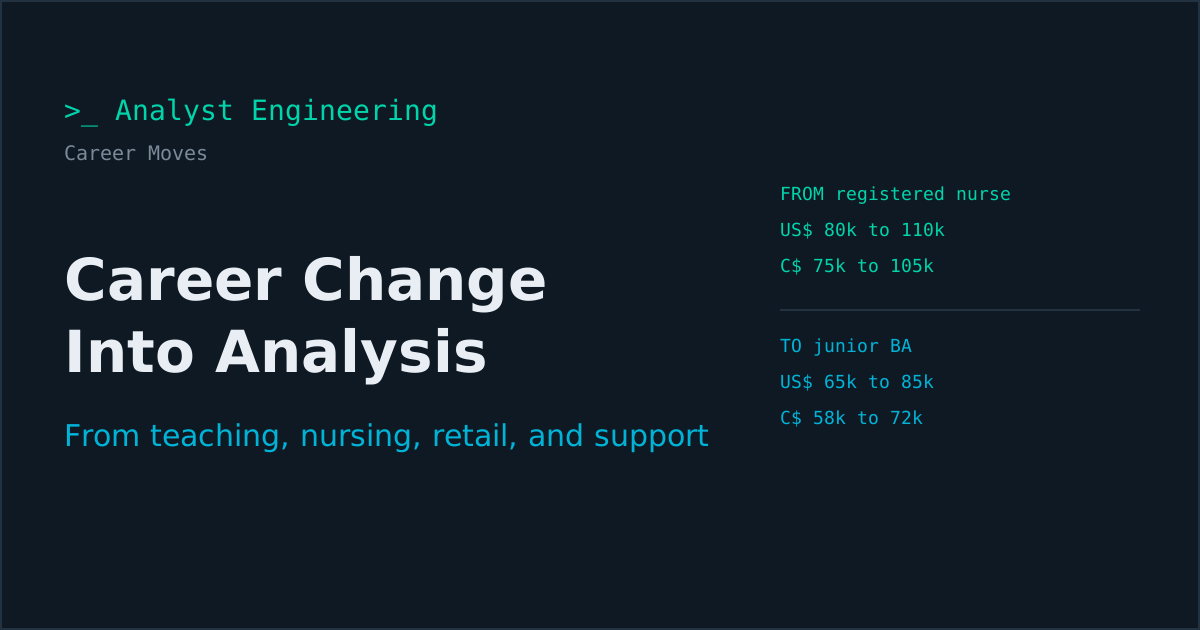
- A career changer usually enters the junior BA band (US$65k to US$85k, C$58k to C$72k, £32k to £42k in 2026), or the low mid band when the old domain transfers directly, such as a nurse moving into health tech.
- A teacher who writes learning outcomes already writes acceptance criteria; a nurse who runs handovers and incident reports already does structured elicitation and root cause work; the job is to show it in analyst vocabulary.
- Experienced professionals from well-paid fields usually take a short-term cut: a US nurse on US$95k who lands a junior BA role at US$75k typically needs 2 to 4 years to recover the difference.
- The minimum technical kit for a switcher is SQL basics, reading an API contract, working in Jira, writing a functional spec, and writing a test case, each with one artifact to show.
Most people who switch into business analysis from teaching, nursing, retail management, or customer support need 6 to 12 months of deliberate work to land a first role, and they usually start in the junior business analyst band: US$65k to US$85k, C$58k to C$72k, or £32k to £42k in 2026 (base salary, permanent, large city, indicative). When the old domain transfers directly, such as a nurse joining a health tech vendor, the first offer can land in the low mid band. The best entry point is almost never a generic BA job. It is a business analyst role in the industry you already know, where your first career counts as experience.
A few years ago I sat on an interview panel for a junior BA role on a bank’s client onboarding team. Of six shortlisted candidates, the one who got the offer had spent eight years running the front desk and reservations team of a large hotel. When we asked how she would handle a stakeholder who kept changing the requirement, she walked us through how she had rebuilt the group booking process after three double-booked conferences: the old steps, the failure, the rule she wrote, the check she added, and the number of incidents the following quarter. That is requirements analysis, root cause, and acceptance testing, told in hotel vocabulary.
The candidates who lost lacked evidence and translation, not ability. Career changers bring more real experience than new graduates, and most hide it behind apologetic CVs. If you want the week-by-week version of the job search itself, with indirect-experience examples and message templates that get replies, I wrote Land Your First Job for exactly this situation. This article is the map around it.
What does the move into business analysis actually look like?
The move looks like trading a job where you execute a process for a job where you define, change, and test the process, usually inside software. A business analyst spends the week eliciting what people need, writing it down precisely enough that a developer can build it and a tester can check it, and then proving it works before it reaches real users. The artifacts are user stories, acceptance criteria, process maps, functional specs, test cases, and defect reports.
Your first career already produced most of those, under different names. The table below is the translation I use when I coach switchers.
| Previous career | Transferable skills, named concretely | Best-fit analyst domain | First-role pay band (US / Canada) |
|---|---|---|---|
| Teacher | Writes learning outcomes (the same shape as acceptance criteria); plans units into lessons (backlog and sequencing); runs parent and department meetings (stakeholder management); grades against rubrics (test oracles) | Edtech, learning platforms, school board or ministry IT, public sector | Junior BA: US$65k to US$85k, C$58k to C$72k |
| Registered nurse | Runs structured handovers (SBAR is a requirements format); writes incident reports (root cause and timeline); charts in an electronic health record daily (knows the system as a power user) | Health tech, EHR vendors, hospital IT, clinical systems | Low mid BA: US$85k to US$110k, C$72k to C$90k |
| Retail or hospitality store manager | Owns a P&L; runs stock, rota, and cash-up processes; handles point of sale failures; trains staff on procedures | Retail systems, point of sale, supply chain, hospitality platforms | Junior BA: US$65k to US$85k, C$58k to C$72k |
| Customer support or service desk | Triages defects; writes reproduction steps; knows the product’s edge cases better than most of engineering; reads logs and admin screens | SaaS product teams, often the same company | Junior BA: US$65k to US$85k, C$58k to C$72k |
Only one row lands above junior by default, and it is the one where the domain is scarce and hard to teach. Nobody teaches a developer in three weeks what medication reconciliation looks like at shift change. Domain is the lever.
Day to day, you lose the immediate feedback of a classroom, a ward, or a shop floor. Work runs in two-week sprints and decisions happen in writing. If you want to know which analyst hat fits you, read what a functional analyst does and the difference between a BA and a technical BA, then check the career paths map.
How much does a career changer earn in a first business analyst role?
A career changer usually earns the junior business analyst band in the first role, and the low mid band when the domain transfers directly. The table shows indicative 2026 base salaries for permanent roles in large cities, excluding bonus.
| Role and level | US (USD) | Canada (CAD) | UK, London (GBP) | Eurozone (EUR) |
|---|---|---|---|---|
| Business analyst, junior | 65k to 85k | 58k to 72k | 32k to 42k | 38k to 48k |
| Business analyst, mid | 85k to 110k | 72k to 90k | 42k to 55k | 48k to 60k |
| Systems analyst, junior | 70k to 90k | 62k to 78k | 35k to 45k | 40k to 50k |
| QA analyst, junior | 55k to 72k | 50k to 62k | 28k to 36k | 34k to 42k |
Now set those against where people start. A customer support agent on about US$40k to US$55k, or £24k to £32k in the UK, gains immediately. A retail or hospitality manager on about US$50k to US$75k, or C$45k to C$65k, roughly breaks even and gains within two years. Teachers and nurses are where the honest conversation starts.
To verify these numbers for your own city, use posted ranges: New York City and New York State, California, Colorado, Washington, Illinois, and several other US states require ranges in job ads; British Columbia (since November 2023) and Ontario (since January 1, 2026, for employers with 25 or more employees) require expected pay in public postings; and the EU Pay Transparency Directive requires pay information before interview as member states implement it. In the UK, ITJobsWatch shows rates by skill keyword. The annual Robert Half, Hays, and Michael Page salary guides are useful cross-checks, and so is asking two people one level above you what their band is. The full picture by role is in the 2026 analyst salary guide.
Will I take a pay cut switching from nursing or teaching into business analysis?
Yes, most experienced nurses and senior teachers take a short-term cut, and it is better to plan for it than to discover it at offer stage. A US registered nurse on about US$95k who lands a junior BA role at US$75k gives up about US$20k, a little over 20 percent. The recovery path is the mid BA band (US$85k to US$110k) after roughly three years, or faster through the technical route: a mid technical BA earns US$95k to US$125k. Realistically, a nurse who pushes technical skills recovers the gap in 2 to 4 years.
Nurses can shorten this: health tech vendors and hospital IT teams value clinical judgment enough to hire into the low mid band, which removes most of the gap on day one. Target them first.
Teachers near the top of the Ontario scale, close to C$100k, face the steepest drop: the junior BA band is C$58k to C$72k, and senior BA pay of C$90k to C$110k takes most people five years or more to reach. Add the value of a defined benefit pension, and for a senior teacher the switch is a career and quality-of-life decision, not a pay decision, for the first several years. Early-career teachers, or US teachers on about US$50k to US$70k, face a much smaller gap or none. Public sector BA roles can soften the pension loss.
What is the minimum technical kit for a career changer?
The minimum technical kit is five things, each with one artifact you can show in an interview. You do not need to code. You do need to stop being afraid of the systems your future colleagues use.
- SQL basics. SELECT, WHERE, JOIN, GROUP BY, and one window function. Artifact: a query that answers a real business question on a public dataset. Start with SQL for analysts.
- Reading an API. Know what an endpoint, a request, a response, and a status code are, and read one OpenAPI contract end to end. Artifact: a one-page summary of an API’s fields and error cases. Start with what an API is and reading an OpenAPI contract for the first time.
- Jira. Write a user story with acceptance criteria, link it to an epic, and move it through a board. Artifact: three stories for one small feature. Refinement for analysts and user story vs specification show what good looks like.
- A spec. Turn a one-line request into a functional specification with rules, data, and exceptions. Artifact: a two to four page spec. Use the functional specification template and business requirement to functional spec.
- A test case. Write positive, negative, and boundary cases for one rule. Artifact: a table of ten test cases. User acceptance testing is the right starting point for a BA.
Score yourself before and after with the technical analyst skill matrix or the interactive roadmap.
How do you build a business analyst portfolio with no BA experience?
You build it by doing realistic analyst work on a realistic system and keeping the artifacts. That is what the Labs are for: missions set in a fictional payments company, Northline Pay, where you read the API, find the gaps, and write findings the way a working analyst would. Start with the Become a Technical Analyst track, or go straight to Analyze the Payments API. A free account saves your progress and unlocks the solutions, so you can compare your findings with a practitioner’s. Two finished missions plus one artifact from your old domain make a portfolio. The analyst portfolio guide shows how to present it.
What does a successful switch into business analysis look like?
The cases below are composites of moves I have watched on delivery teams and in coaching, with details changed. The pay figures are placed inside the 2026 indicative bands.
Case 1: a secondary school teacher in Ontario moving into edtech
Nadia taught mathematics in a Toronto-area secondary school on about C$92k. She had led her department’s rollout of a new learning management system and quietly became the person every colleague asked. Over nine months, at about eight hours a week, she wrote a functional spec for a gradebook feature she wished existed, a set of 15 test cases for its late-submission rule, and finished two Labs missions. She landed a business analyst role at a learning platform vendor at C$74k, in the low mid band because the vendor valued her classroom knowledge. That was a C$18k cut plus a pension she had to replace herself. What she would do differently: ask her school board’s IT team for a secondment first, which would have given her a BA title and a reference without the cut.
Case 2: a nurse in London moving into health tech
Tom was a Band 6 ward nurse in a London hospital on about £40k, and a super-user for the trust’s electronic patient record. He took ten months, mostly because of shift patterns. He learned SQL basics, documented the discharge workflow as a process map with the three places it broke, and wrote acceptance criteria for a fix. He landed a clinical business analyst role at a health tech supplier at £44k, in the low mid band, a small gain. What he would do differently: start with the trust’s own digital team, who were hiring clinical analysts and would have accepted his super-user work as experience from day one.
Case 3: a support agent moving into a SaaS BA role in the US
Marcus worked tier 2 support for a B2B software company in Austin on about US$48k. He already triaged defects and wrote reproduction steps developers trusted. In seven months he learned to read the product’s API documentation, wrote three user stories with acceptance criteria for problems he saw weekly in tickets, and shadowed refinement sessions. He moved internally into a junior business analyst role at US$72k, a gain of US$24k. What he would do differently: tell his manager about the goal in month one, not month five, because the internal route only opened once someone knew he wanted it. Changing role inside your company covers how to ask.
What is the month by month plan to switch into business analysis?
This plan assumes 8 to 10 hours a week alongside your current job. Each step ends with an artifact, because artifacts are what interviews run on.
- Month 1: choose the target domain. Pick the industry you know and list 20 employers in it that hire analysts. Artifact: a spreadsheet of employers, roles, and the vocabulary their job ads use.
- Month 2: translate your experience. Rewrite five achievements from your first career in analyst language (process, rule, exception, test, outcome). Artifact: a draft CV using before and after bullets for a role change.
- Months 3 and 4: the minimum technical kit. Work through the five items above. Artifact: one SQL query, one API summary, and three user stories.
- Months 5 and 6: the portfolio. Finish two Labs missions and write one spec plus one test case table from your old domain. Artifact: a portfolio page with three pieces.
- Months 7 and 8: applications and conversations. Send 5 targeted applications a week and ask for 2 conversations a week with analysts in your target domain. Artifact: a tracker with at least 30 applications and 15 conversations.
- Months 9 to 12: interviews and offer. Prepare your “why the switch” answer and a case exercise. Artifact: a written two-minute story for each of your three strongest achievements.
For step 6, the BA Interview Prep Pack gives you first-role questions with model answers, case studies, and the artifacts to bring, and interviewing as a career changer covers the “why the switch?” question in depth.
What mistakes stall a career change into business analysis?
- Applying to generic BA roles first. A generic posting has 300 applicants with analyst titles. Your domain is your only unfair advantage, so spend it where it counts.
- Collecting courses instead of artifacts. Three certificates and no spec lose to one spec. Hiring managers ask “show me something you wrote.”
- Apologizing for your background. “I know I don’t have BA experience, but…” tells the panel how to score you. Lead with the handover process you redesigned, not the job title you did not have.
- Hiding the pay conversation. Nurses and senior teachers who do not know the junior band walk into offers they resent. Know the number before the first call.
- Skipping the internal route. Your current employer almost certainly has a systems or digital team. A secondment there is the cheapest possible first analyst role.
If you are still deciding whether business analysis is the right destination at all, What Is a Business Analyst covers what the job involves day to day, the skills it rewards, and the paths out of it, which is the part most switchers never ask about. For people switching in later in life, becoming a business analyst at 40 or 50 covers entering above the junior band.
The takeaway
A career change into business analysis takes 6 to 12 months for most people, lands in the junior band or the low mid band, and works best in the industry you already know. Teachers, nurses, store managers, and support agents already do analyst work under other names: learning outcomes, handovers, incident reports, process ownership, defect triage. The switch is mostly translation plus a minimum technical kit plus two or three artifacts that prove it. Be honest about the pay: support and retail usually gain, nurses and senior teachers usually take a cut that takes 2 to 4 years or more to recover.
For the job search itself, week by week, start with Land Your First Job. If you want someone to pressure-test your plan, your CV, or your target domain, book a 1:1 Tech BA Coaching Call. Grab the free downloads to start your portfolio, or browse everything at The Tech BA Toolkit. More on the role itself lives in the Business Analyst hub.
Ahmed is a Senior Technical Business Analyst with 10+ years in banking and payments. He builds practical guides and tools for analysts at The Tech BA Toolkit.
Tags: Business Analysis, Career Change, Career Growth, Salary, Health Tech
About the author
Analyst Engineering is written by Ahmed, a Senior Technical Business Analyst with 10+ years of banking and payments delivery experience: ISO 20022 and SWIFT messaging, payments API integration, Kafka event validation, and production support. Every article comes from real delivery work, and each one is reviewed and updated as tools and standards change.
Related articles
- Becoming a Business Analyst at 40 or 50: Your First Career Is the Advantage A business analyst career change at 40 or 50 works when you target your own domain and enter at mid band: the roles that value experience, ageism, and money.
- From Operations or Production Support to Business Analyst: The Most Reliable Route In How to move from operations, production support, or the service desk into a business analyst or technical BA role: what transfers, the plan, and real pay.
- The Analyst Portfolio: How to Show Work When Your Work Is Confidential How to build an analyst portfolio when your real work is confidential: 3 to 5 pieces, public or synthetic data, the right pieces per role, and a 5 minute pitch.
- Interviewing as a Career Changer: How to Answer "Why the Switch?" and the Case Exercise How career changers pass analyst interviews: scripts for why the switch and no experience, the seven common case exercises, STAR stories, and the pay question.
Go deeper on this
Not ready to buy? The free downloads are a no-cost place to start, and every article here stays free.
Free account
Practice on the Labs, keep your progress
A free account, no password: an email link signs you in. It saves your steps and self-assessments on the Labs, shows your missions on a dashboard, unlocks the solutions, and, if you tick the box, sends you new missions and articles when they ship.
Your email is used to sign you in. Nothing else, unless you ask. Privacy.