Changing Role Inside Your Company: The Cheapest Career Move an Analyst Can Make
Written by Ahmed at Analyst Engineering, a Senior Technical Business Analyst with 10+ years in banking and payments delivery.
Key takeaways
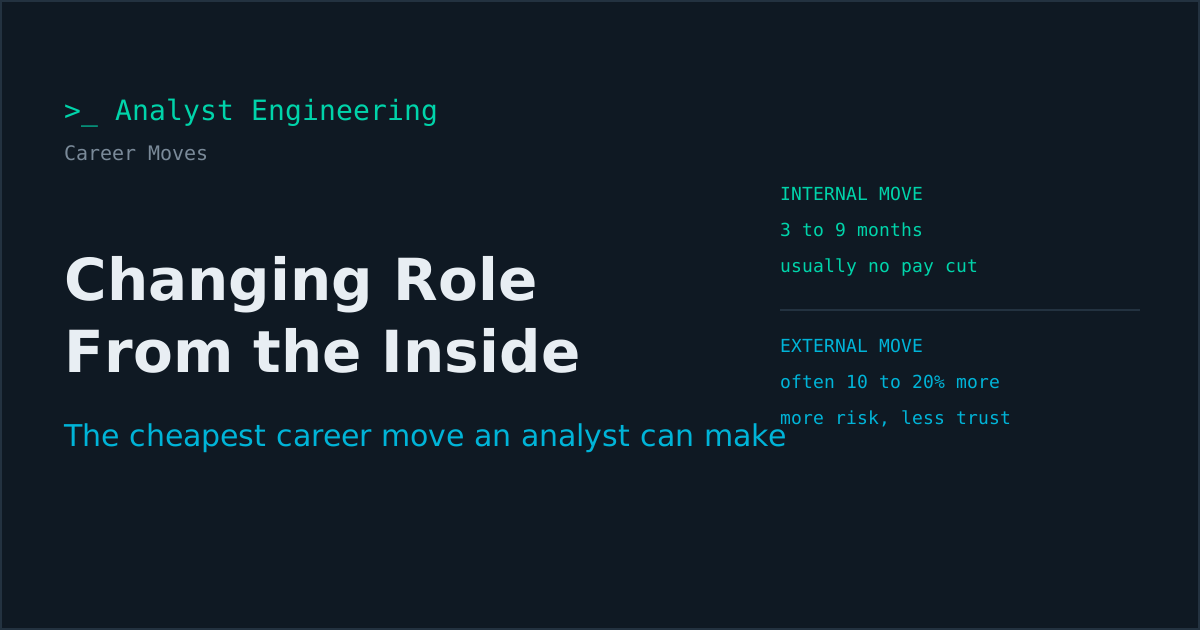
- An internal move is the cheapest career move an analyst can make: trust carries over, there is usually no pay cut, and it typically takes 3 to 9 months.
- Most internal moves stall for three reasons: no sponsor in the target team, no written case, and a current manager with every incentive to keep you.
- The fastest internal move starts with a 10 percent stretch: a piece of the target team's work, done in the open, with your manager's written agreement.
- Internal moves often come with a smaller raise than external ones, and external moves often pay 10 to 20 percent more; ask for a regrade to the new role's band rather than a lateral transfer.
- Put the move in writing as a proposal with four parts: the role, the evidence, the backfill plan, and the date.
Changing role inside your current company is the cheapest career move an analyst can make: trust carries over, there is usually no pay cut, and it typically takes 3 to 9 months. The common paths are operations to BA, QA to BA, BA to technical BA, BA to product owner, and developer to technical BA. Most internal moves stall for three reasons: no sponsor in the target team, no written case, and a current manager with every incentive to keep you where you are.
At a bank I worked with, an operations analyst spent a year answering developers’ questions in the defect channel. She knew which payment rules the code got wrong before QA did. In March, the delivery lead told me, “We should get her on the team.” She started as a BA in November. Nobody opposed it. Nobody wrote it down either, so every step waited for someone to remember.
Eight months is not a disaster, but three of them were pure waiting, and that is the part this article removes. The work that makes an internal move obvious is a visible piece of the target team’s job, and for a move toward delivery that usually means SQL, APIs, and reading code. The Tech Skills Guide for BAs covers those practical skills for contributing beyond requirements.
What does an internal move actually look like?
An internal move keeps your employer, your domain, and your network, and changes your team, your artifacts, and your manager. What carries over is large; the gap is usually one or two skills.
| From, to | What carries over | The gap to close | Typical time |
|---|---|---|---|
| Operations to BA | Domain, the real failures, the people | Specs, user stories, facilitation | 6 to 9 months |
| QA to BA | Rules, test cases, defect history | Elicitation, scope decisions | 3 to 6 months |
| BA to technical BA | Stakeholders, domain | SQL, APIs, logs | 4 to 9 months |
| BA to product owner | Backlog, stakeholders | Owning priority and outcomes | 3 to 6 months |
| Developer to technical BA | The system, the code | Elicitation, writing for business readers | 3 to 6 months |
Day to day, the change is who you write for. An operations analyst stops resolving the failure and starts specifying the fix. A QA analyst stops testing the rule and starts deciding it with the business, which is the shift described in working with QA from the other side. A BA moving to technical BA starts investigating a failed payment directly in logs and data instead of asking a developer to. The partnership habits in working with developers matter in every one of these moves.
Why do most internal moves stall?
Most internal moves stall for three reasons, and none of them is skill.
- No sponsor. Nobody in the target team is willing to say “I want this person” in the room where headcount is decided. Interest is not sponsorship.
- No written case. The move lives in corridor conversations. Nobody can forward it, approve it, or put a date on it.
- The current manager’s incentive. Your manager loses a performer and gains a backfill problem. Even a supportive manager will find a reason to wait until after the next release, and the release after that.
Two structural rules also slow things down: many companies require 12 months in role before an internal transfer, and many require the target role to be posted internally even when everyone knows who will get it. Ask HR for the internal mobility policy on day one, not in month six.
What do you do if your manager blocks the move?
Ask for a decision date and the condition that would unblock it, in writing: “If the release ships in May, can we agree the move for June 1?” A manager who agrees to a date is managing a transition. A manager who will not name one is telling you the answer, and at that point the evidence you built is worth as much outside the company as inside it.
How much does an internal move pay compared with an external one?
An internal move usually protects your current salary, but it often comes with a smaller raise than an external move, and sometimes none when it is processed as a lateral transfer. The target bands below are what you negotiate against.
| Role, mid level (base salary) | US (USD) | Canada (CAD) | UK (GBP) | Eurozone (EUR) |
|---|---|---|---|---|
| QA analyst | 72k to 92k | 62k to 80k | 36k to 48k | 42k to 52k |
| Business analyst | 85k to 110k | 72k to 90k | 42k to 55k | 48k to 60k |
| Technical BA | 95k to 125k | 80k to 100k | 50k to 65k | 52k to 65k |
| Product owner | 95k to 125k | 85k to 105k | 50k to 65k | 52k to 65k |
Base salary, permanent, large city, 2026, indicative (US major metros; Toronto, Montréal, Vancouver, Calgary; London; Paris, Amsterdam, Frankfurt, Dublin). A bank or payments operations analyst typically starts at about US$55k to US$75k, C$50k to C$70k, or £28k to £40k.
The honest reading: QA to BA and operations to BA usually move you into a higher band, so there is real money to claim. BA to technical BA at the same level is typically worth 10 to 20 percent. BA to product owner is roughly flat to 10 percent. External moves often pay 10 to 20 percent more than internal ones, because a new employer must outbid your current salary; internal moves carry less risk, keep your pension and any unvested equity, and let a weak first quarter be forgiven. Decide which you are optimising for before you start, not when the offer arrives.
Should you move internally or externally?
Compare the two on the same five lines before you commit to either.
| Factor | Internal move | External move |
|---|---|---|
| Pay | Smaller raise, sometimes none | Often 10 to 20 percent more |
| Risk | Low: trust and reputation carry over | Higher: probation, new domain, new people |
| Speed | 3 to 9 months, set by headcount and backfill | 2 to 4 months of search, set by the market |
| Pension and equity | Kept, vesting continues | Unvested equity usually lost |
| Learning | New role, same system | New role and new system at once |
If the pay gap is small and the sponsor is real, the internal route usually wins. If you are underpaid against the band already, an external offer is often the only way to reset.
How do you ask for a regrade instead of a lateral transfer?
Ask for the new role’s band by name, with evidence, before you accept the move:
I am moving into the business analyst role, which sits in band 6 in our framework. I have been doing that work for four months at 10 percent of my time, and the BA lead has reviewed it. I am asking to move into band 6 with the move, rather than transferring laterally and waiting for the next cycle.
The full scripts for raises and offers are in how analysts negotiate a raise or an offer.
To verify, check posted ranges where pay transparency laws apply (New York, California, Colorado, Washington, Illinois, and other US states; British Columbia; Ontario since January 1, 2026, for employers with 25 or more employees; EU member states as they implement Directive (EU) 2023/970), ITJobsWatch in the UK, the Robert Half, Hays, and Michael Page salary guides, Levels.fyi, and two people one level above you. Internally, ask HR for the band document for the target role.
How do you plan an internal move step by step?
A planned internal move takes about six months, and every step produces something you can show.
- Weeks 1 and 2: find the gap the target team has. Look for work nobody owns: break analysis nobody writes up, acceptance criteria nobody reviews, production issues nobody traces. Artifact: a one page note naming the gap and what it costs.
- Weeks 3 and 4: agree a 10 percent stretch with your manager. Half a day a week on that gap, with a review date. Artifact: an email confirming the scope and the date.
- Months 2 to 4: do the work in the open. Produce one real deliverable for the target team: a spec, a test design, a SQL investigation, a failure analysis. Artifact: the deliverable, reviewed by the target team lead.
- Month 4: get a sponsor. Ask the target team lead directly whether they would take you. Artifact: a yes, and their agreement to name you when headcount is discussed.
- Month 5: write the move proposal. Use the template below, and walk your manager through it before anyone else sees it. Artifact: the proposal.
- Month 5 or 6: negotiate the level and pay. Ask for the regrade. Artifact: a written confirmation of band and salary.
- Months 6 to 9: transition. Hand over with a backfill plan, and stay reachable for your old team for a month. Artifact: a handover document and a start date.
If your current job gives you no piece of the target team’s work to borrow, the Analyst Engineering Labs are a safe substitute: the duplicate refund investigation produces an incident report of exactly the kind a technical BA team needs, and the Become a Technical Analyst track gives you three. A free account saves your progress and unlocks the solutions.
What goes in a move proposal?
A move proposal is one page with four parts: the role, the evidence, the backfill plan, and the date.
Move proposal: [Name], [current role] to [target role]

Role:     [Target role, team, band], sponsored by [target team lead]
Evidence: [2 or 3 deliverables from the stretch, each with the decision it enabled]
          [Feedback from the target team lead]
Backfill: [Who covers my current work, what I hand over, how long I stay reachable]
Date:     [Proposed start date, and a date for the decision]
The backfill section is the one that gets moves approved, because it answers your manager’s real objection before they raise it.
Internal moves often still include an interview with the target team, and people who treat it as a formality fail it. For what each analyst interview question tests and how to answer it from real work, the BA and Technical BA Interview Guide is the preparation I recommend.
What does an internal move look like in real cases?
The cases below are composites of moves I have watched on delivery teams, with details changed.
Sophie: an operations analyst at a Montréal bank who moved to BA
Sophie was a payments operations analyst at a bank in Montréal on C$62k. The bank was redesigning how it reconciled its camt.053 statements, and nobody on the project could categorise the breaks. She agreed half a day a week with her manager, wrote the break categories and the matching rules (the work described in reconciliation design), and the project’s BA lead reviewed and adopted them. Seven months after the first conversation she started as a BA at C$74k, a raise of about 19 percent. What she would do differently: get the stretch agreement in an email in week one, because her manager forgot it twice during month-end.
Callum: a QA analyst in Edinburgh who moved to BA
Callum was a mid QA analyst at an insurer in Edinburgh on £38k, where pay runs about 15 to 20 percent under London. He started writing acceptance criteria for the BA team whose stories he tested, and the BA lead became his sponsor within three months. The first offer was a lateral transfer at £39k. He asked HR for the BA band document, showed four months of reviewed criteria, and moved at £43k, a raise of about 13 percent. The whole move took five months. What he would do differently: ask for the band document at the start. His path is the one covered in from QA tester to business analyst.
Rachel: a BA in Denver whose manager blocked the move
Rachel was a mid BA at a health insurer in Denver on US$96k, aiming for the integration team as a technical BA. She mapped two partner APIs over four months as a stretch, and the integration lead wanted her. Her manager postponed the move twice, citing a release each time. She took the evidence to the market instead and accepted a mid technical BA role at a fintech at US$114k, about 19 percent more. What she would do differently: write a decision date into the move proposal, so that “not yet” had an end.
What mistakes stall an internal move?
- Asking for the transfer before doing the work. Ask for the stretch; the transfer follows the evidence.
- Going around your manager. It turns a reluctant manager into an opponent. Show them the proposal first.
- Mistaking interest for sponsorship. “You would be great on our team” is not a yes in a headcount meeting.
- Accepting a lateral transfer without asking. If the new band is higher, ask for it at the move, not next cycle.
- No backfill plan. Your manager’s objection is the gap you leave. Solve it for them.
- No end date. If “after the release” happens twice, test the external market.
The takeaway
An internal move is the cheapest career move an analyst can make, but only when it is run like a project: find the gap the target team has, do a piece of their work in the open with your manager’s agreement, get a sponsor, write the proposal, and ask for the regrade. The route-specific plans are in from operations to business analyst and how to become a technical business analyst, with the production support skills for analysts that make operations people valuable on delivery teams. The wider map is on the career paths page.
For the SQL, API, and code-reading skills that make your stretch work count, start with The Tech Skills Guide for BAs. To work through your move proposal and regrade request with me, book a 1:1 Tech BA Coaching Call. Grab the free downloads, or browse everything at The Tech BA Toolkit. More on the craft lives in the Business Analyst hub.
Ahmed is a Senior Technical Business Analyst with 10+ years in banking and payments. He builds practical guides and tools for analysts at The Tech BA Toolkit.
Tags: Career Growth, Business Analysis, Internal Mobility, Salary Negotiation, Banking
About the author
Analyst Engineering is written by Ahmed, a Senior Technical Business Analyst with 10+ years of banking and payments delivery experience: ISO 20022 and SWIFT messaging, payments API integration, Kafka event validation, and production support. Every article comes from real delivery work, and each one is reviewed and updated as tools and standards change.
Related articles
- From Operations or Production Support to Business Analyst: The Most Reliable Route In How to move from operations, production support, or the service desk into a business analyst or technical BA role: what transfers, the plan, and real pay.
- From QA Tester to Business Analyst: You Already Do Half the Job How QA testers become business analysts: what transfers, the elicitation and scope gap, a six month plan, real cases, and the typical 10 to 25 percent raise.
- How to Become a Technical Business Analyst: The Six Month Plan and the Pay Jump How to become a technical business analyst: SQL, APIs, logs, and scripting in six months on your project, one artifact a month, and a 10 to 20 percent pay jump.
- How Analysts Negotiate a Raise or an Offer: Scripts, Evidence, and Numbers How analysts negotiate an offer or a raise: word-for-word scripts, an evidence file with numbers, timing, non-salary items, and US, Canada, UK, and EU norms.
Go deeper on this
Not ready to buy? The free downloads are a no-cost place to start, and every article here stays free.
Free account
Practice on the Labs, keep your progress
A free account, no password: an email link signs you in. It saves your steps and self-assessments on the Labs, shows your missions on a dashboard, unlocks the solutions, and, if you tick the box, sends you new missions and articles when they ship.
Your email is used to sign you in. Nothing else, unless you ask. Privacy.