Analyst Salaries in 2026: Realistic Pay by Role, Level, and Country
Written by Ahmed at Analyst Engineering, a Senior Technical Business Analyst with 10+ years in banking and payments delivery.
Key takeaways
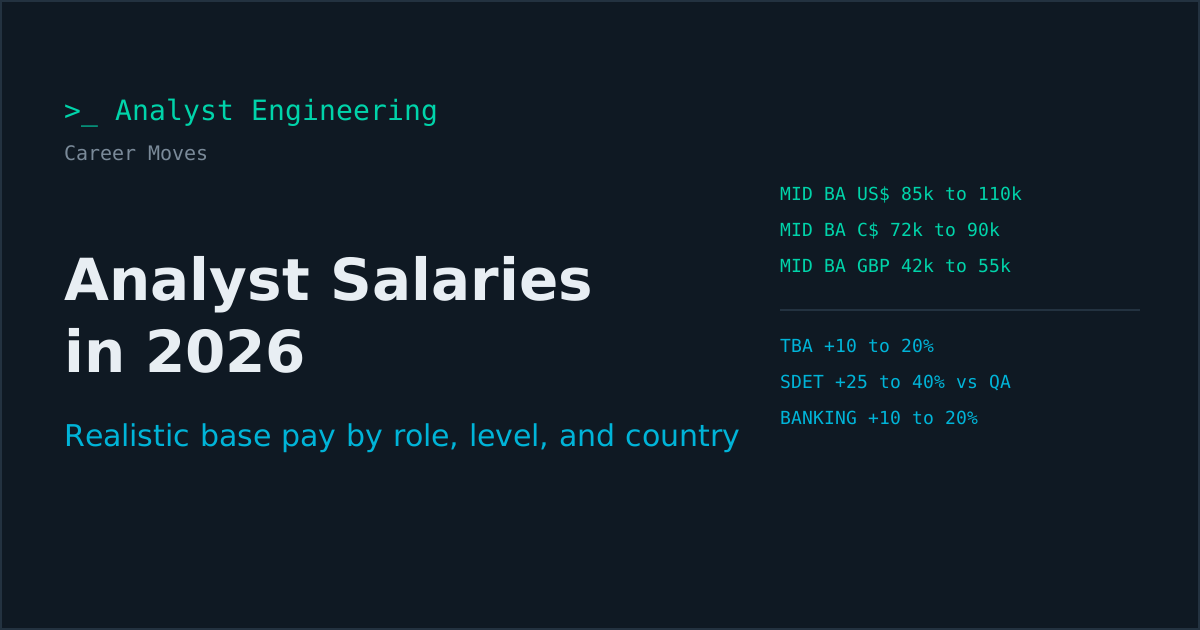
- A mid level business analyst in a large city earns an indicative 2026 base salary of about US$85k to US$110k in the US, C$72k to C$90k in Canada, £42k to £55k in London, and €48k to €60k in the Eurozone.
- Technical business analysts earn about 10 to 20 percent more than business analysts at the same level, and SDETs earn about 25 to 40 percent more than manual QA analysts.
- Banking and capital markets in New York or London typically add 10 to 20 percent to the analyst bands; smaller US metros sit 10 to 20 percent lower, and UK roles outside London roughly 15 to 20 percent lower.
- In my experience most offers land in the lower 60 percent of a posted salary range unless the candidate negotiates with evidence.
- The biggest lever inside a band is being hired or recalibrated at the right level: the gap between a mid and a senior band is larger than any annual raise.
A mid level business analyst in a large city earns an indicative 2026 base salary of about US$85k to US$110k in the US, C$72k to C$90k in Canada, £42k to £55k in London, and €48k to €60k in the Eurozone. Technical BAs earn 10 to 20 percent more at the same level, SDETs earn 25 to 40 percent more than manual QA analysts, and banking in New York or London adds 10 to 20 percent. Where you land inside a band depends on domain, city, employer type, and technical depth more than on years of experience.
About once a month someone sends me an offer and asks whether it is fair. The last one was a technical BA in Montréal with five years in payments, offered C$82k. The mid technical BA band in Canada is C$80k to C$100k, so the offer was inside the band and still wrong: they had led the API testing on an Interac integration and could show it. They went back with that evidence and signed at C$94k.
Where you land in a band is mostly decided in the interview, when the hiring manager decides whether you are mid or senior. That is why I wrote the BA and Technical BA Interview Guide: what each question tests and how to answer from real work. This page is the pay reference for the Analyst Career Moves series.
How should you read these salary numbers?
Every figure is an indicative 2026 base salary, permanent role, large city, excluding bonus, equity, and benefits. These are the bands I use when coaching and interviewing, cross-checked against posted ranges and published guides.
- US: major metros; New York, Chicago, Boston, and the Bay Area at or above the top; smaller metros 10 to 20 percent lower.
- Canada: Toronto, Montréal, Vancouver, and Calgary.
- UK: London; elsewhere roughly 15 to 20 percent lower.
- Eurozone: Paris, Amsterdam, Frankfurt, Dublin; Germany, the Netherlands, and Ireland in the upper half, France, Spain, and Italy in the lower half.
- Levels: junior 0 to 2 years, mid 3 to 5, senior 6 to 10, lead 10+. Scope matters more than years; the career paths show each rung.
- Banking: capital markets and banking in New York or London typically add 10 to 20 percent.
How much do business, technical, functional, and systems analysts earn?
| Role | US (USD) | Canada (CAD) | UK (GBP) | Eurozone (EUR) |
|---|---|---|---|---|
| BA, junior | 65k to 85k | 58k to 72k | 32k to 42k | 38k to 48k |
| BA, mid | 85k to 110k | 72k to 90k | 42k to 55k | 48k to 60k |
| BA, senior | 110k to 135k | 90k to 110k | 55k to 72k | 60k to 75k |
| TBA, junior | 75k to 95k | 65k to 80k | 38k to 48k | 42k to 52k |
| TBA, mid | 95k to 125k | 80k to 100k | 50k to 65k | 52k to 65k |
| TBA, senior | 125k to 155k | 100k to 125k | 65k to 85k | 65k to 82k |
| Functional / ERP, mid to senior | 90k to 145k | 78k to 120k | 48k to 78k | 52k to 80k |
| Systems, junior | 70k to 90k | 62k to 78k | 35k to 45k | 40k to 50k |
| Systems, mid | 90k to 115k | 78k to 98k | 45k to 58k | 50k to 62k |
| Systems, senior | 115k to 140k | 98k to 120k | 58k to 75k | 62k to 78k |
Certified SAP, Oracle, Salesforce, and Workday specialists sit 10 to 20 percent above the functional band. BA to technical BA is worth 10 to 20 percent at the same level: see How to Become a Technical Business Analyst.
How much do QA analysts and SDETs earn?
| Role | US (USD) | Canada (CAD) | UK (GBP) | Eurozone (EUR) |
|---|---|---|---|---|
| QA, junior | 55k to 72k | 50k to 62k | 28k to 36k | 34k to 42k |
| QA, mid | 72k to 92k | 62k to 80k | 36k to 48k | 42k to 52k |
| QA, senior | 90k to 115k | 78k to 98k | 48k to 62k | 52k to 65k |
| QA lead | 110k to 135k | 95k to 115k | 60k to 78k | 62k to 78k |
| SDET, junior | 80k to 100k | 70k to 85k | 40k to 50k | 45k to 55k |
| SDET, mid | 100k to 130k | 85k to 110k | 50k to 65k | 55k to 68k |
| SDET, senior | 130k to 160k | 105k to 130k | 65k to 85k | 68k to 85k |
| Test architect | 155k to 190k | 125k to 150k | 80k to 100k | 80k to 100k |
Manual QA to SDET (software development engineer in test) is the largest skill premium here, 25 to 40 percent: see QA Analyst to Automation Engineer.
How much do data analysts and analytics engineers earn?
| Role | US (USD) | Canada (CAD) | UK (GBP) | Eurozone (EUR) |
|---|---|---|---|---|
| Data analyst, junior | 60k to 78k | 55k to 68k | 30k to 40k | 38k to 46k |
| Data analyst, mid | 78k to 100k | 68k to 85k | 40k to 52k | 46k to 58k |
| Data analyst, senior | 100k to 125k | 85k to 105k | 52k to 68k | 58k to 72k |
| Analytics eng., junior | 90k to 110k | 75k to 90k | 45k to 55k | 48k to 58k |
| Analytics eng., mid | 110k to 140k | 90k to 115k | 55k to 70k | 58k to 72k |
| Analytics eng., senior | 140k to 170k | 110k to 135k | 70k to 90k | 72k to 88k |
| Data engineer, mid to senior | 120k to 175k | 95k to 140k | 60k to 95k | 60k to 90k |
| Data architect | 155k to 200k | 130k to 160k | 90k to 120k | 85k to 110k |
Data analyst to analytics engineer is worth 20 to 40 percent: see From Analyst to Analytics Engineer.
How much do developers and architects earn?
| Role | US (USD) | Canada (CAD) | UK (GBP) | Eurozone (EUR) |
|---|---|---|---|---|
| Developer (non big tech), junior | 85k to 110k | 75k to 95k | 40k to 55k | 45k to 55k |
| Developer, mid | 110k to 145k | 95k to 125k | 55k to 75k | 55k to 70k |
| Developer, senior | 140k to 180k | 120k to 155k | 75k to 100k | 70k to 90k |
| Staff or principal engineer | 170k to 210k | 145k to 180k | 95k to 125k | 85k to 110k |
| Big tech senior, total comp | 250k to 450k | 180k to 300k | 120k to 220k | 110k to 200k |
| Solutions architect, first role | 130k to 160k | 115k to 145k | 70k to 90k | 70k to 90k |
| Solutions architect, senior | 150k to 190k | 140k to 175k | 85k to 115k | 85k to 110k |
| Enterprise architect | 170k to 220k | 150k to 190k | 95k to 130k | 90k to 120k |
The big tech row is total compensation, the only row that is not base. Senior systems analyst to solutions architect is worth 15 to 25 percent (what it requires); whether to become a developer is in Technical Analyst to Software Developer.
How much do product owners, product managers, and delivery roles earn?
| Role | US (USD) | Canada (CAD) | UK (GBP) | Eurozone (EUR) |
|---|---|---|---|---|
| Product owner, mid | 95k to 125k | 85k to 105k | 50k to 65k | 52k to 65k |
| Product owner, senior | 120k to 150k | 100k to 125k | 62k to 80k | 62k to 78k |
| Product manager, mid | 110k to 140k | 95k to 120k | 55k to 75k | 55k to 70k |
| Product manager, senior | 140k to 180k | 115k to 150k | 75k to 100k | 70k to 90k |
| Group or lead product manager | 170k to 220k | 145k to 180k | 95k to 125k | 85k to 110k |
| Delivery manager, mid | 90k to 120k | 85k to 110k | 50k to 65k | 50k to 65k |
| Delivery manager, senior | 115k to 150k | 105k to 135k | 65k to 85k | 62k to 80k |
| Scrum master or agile coach | 95k to 130k | 85k to 115k | 50k to 70k | 50k to 68k |
How much do analyst leads and heads of business analysis earn?
| Role | US (USD) | Canada (CAD) | UK (GBP) | Eurozone (EUR) |
|---|---|---|---|---|
| Lead business analyst | 130k to 160k | 105k to 130k | 70k to 90k | 72k to 90k |
| Lead or principal technical BA | 150k to 180k | 120k to 145k | 80k to 100k | 78k to 95k |
| Head of business analysis | 150k to 190k | 130k to 165k | 85k to 115k | 85k to 110k |
| Business architect, senior | 130k to 165k | 110k to 140k | 70k to 95k | 70k to 90k |
| Change lead, senior | 100k to 140k | 90k to 120k | 55k to 80k | 55k to 75k |
How much do client-facing technical roles earn?
| Role, mid to senior | US (USD) | Canada (CAD) | UK (GBP) | Eurozone (EUR) |
|---|---|---|---|---|
| Forward deployed engineer | base 150k to 220k plus equity | base 120k to 170k | base 90k to 140k | base 80k to 120k |
| Solutions or sales engineer (pre-sales) | base 110k to 160k, OTE 140k to 200k | base 95k to 130k | base 60k to 90k plus variable | base 60k to 85k plus variable |
OTE is on-target earnings, base plus variable at quota. The route: Technical Analyst to Forward Deployed or Solutions Engineer.
What do contract analysts charge in 2026?
| Market | Business analyst | Technical BA | Notes |
|---|---|---|---|
| US | US$55 to US$80 an hour | US$70 to US$110 an hour | W-2 via agency at the low end, 1099 or corp-to-corp at the high end |
| Canada | C$60 to C$85 an hour | C$75 to C$110 an hour | Incorporated (CCPC, Canadian-controlled private corporation) is the norm; watch the Personal Services Business rules |
| UK | £350 to £550 a day | £450 to £700 a day | London banking up to about £750; inside vs outside IR35 changes take-home heavily |
| Eurozone | €450 to €650 a day | €550 to €800 a day | Paris finance up to about €850; Netherlands and Germany often €65 to €110 an hour; France via portage salarial or SASU |
A senior technical BA replacing a C$110k salary has a floor around C$80 to C$95 an hour; replacing US$130k needs about US$80 to US$100. Permanent to contract grosses up 40 to 70 percent on paper, much less after bench time, benefits, and tax: Going Contract as an Analyst.
What moves you up or down within a band?
Six factors decide where you sit inside a band. Years of experience is not one of them.
| Factor | Pushes toward the top | Pushes toward the bottom |
|---|---|---|
| Domain | Payments, capital markets, regulatory reporting, health data | Generic internal tools |
| City | New York, London, Bay Area, Toronto | Smaller metros, outside London |
| Employer type | Banks, product companies, specialist boutiques | IT services and outsourcers, early startups (base) |
| Technical depth | You query, test, and read contracts yourself | You hand every technical question to a developer |
| Regulated industry | Banking, insurance, pharma, where errors cost fines | Unregulated internal projects |
| Remote policy | Onsite or hybrid in a premium city | Fully remote roles priced to a national or cheaper band |
Employer type also changes bonus, pension, and security: see How Employer Type Shapes Analyst Pay and the highest paying domains.
How do you read a posted salary range?
A posted range is the employer’s band for the role, not your offer. Pay transparency laws now publish ranges in many markets: New York City and New York State, California, Colorado, Washington, Illinois, and several other US states require ranges in job ads; British Columbia has required expected pay in public postings since November 2023, and Ontario since January 1, 2026 for employers with 25 or more employees. The EU Pay Transparency Directive (EU) 2023/970 had a transposition deadline of 7 June 2026 and requires pay information to applicants before interview, as member states implement it.
From my side of hiring panels, most offers land in the lower 60 percent of a posted range unless the candidate negotiates with evidence. On US$95k to US$125k, offers cluster between US$95k and about US$113k; the top is kept for people who clearly exceed the level. A range wider than about 40 percent usually spans two levels: ask which level is budgeted before naming a number.
What moves you from the bottom of your band to the top?
These are the levers I have seen work, roughly in order of size.
- Get the level right. Being hired or recalibrated as senior instead of mid is worth more than years of annual raises. Level is decided on scope: what you own and what breaks without you.
- Show technical depth with artifacts. A SQL investigation or an API contract review beats a certificate. The Labs give you missions that produce exactly that; a free account saves progress and unlocks the solutions.
- Own a premium domain. Payments and ISO 20022 knowledge is the most reliable premium I know. Break Into Banking covers the route into banking and payments as a BA, including the domain knowledge that unlocks premium pay.
- Negotiate at the offer, not the review. The offer resets your number; raises move in small steps. Scripts: How Analysts Negotiate a Raise or an Offer.
- Change employer type. The same senior TBA sits at the bottom at an outsourcer and the top at a bank.
- Keep an evidence file. Defects prevented, incidents shortened, hours automated, audit findings closed, each with a number.
Who found out they were underpaid, and how did they fix it?
The cases below are composites of moves I have watched on delivery teams, with details changed.
Olivia: a senior systems analyst paid as mid in Calgary
Olivia was a systems analyst at an energy company in Calgary on C$80k, titled mid after seven years. She ran integration design reviews, which is senior scope; the senior band is C$98k to C$120k. She spent six weeks on an evidence file (twelve interface specifications, three defects caught in design review, one outage shortened by her log analysis) and asked for a level recalibration before the budget cycle, not a raise. She was moved to senior at C$100k, a 25 percent increase. What she would do differently: benchmark every year instead of every seven.
Thomas: a technical BA stuck at an IT services firm in Paris
Thomas was a technical BA placed by an IT services firm at a Paris bank on €52k, with six years in payments. The senior technical BA band is €65k to €82k, with France in the lower half, but his employer’s grid priced him as mid. He anonymised three artifacts (a pacs.008 test case set, a reconciliation specification, an API review), interviewed directly with two banks, and joined one at €66k, a 27 percent rise. What he would do differently: move two years earlier.
How do you benchmark your own pay in four weeks?
- Week 1: define your real role. Write your scope in five lines, score it against the Technical Analyst Skill Matrix, and map it to a role and level in the tables above. Artifact: a one-page role statement.
- Week 1: collect posted ranges. Save ten postings from pay transparency jurisdictions. Artifact: a sheet with bottom, top, and midpoint.
- Week 2: check published sources. The annual Robert Half, Hays, and Michael Page guides; ITJobsWatch in the UK for rates by skill keyword; Levels.fyi for companies with equity. Artifact: three reference points.
- Week 3: ask two people one level above you what the band is. Artifact: two private data points.
- Week 4: place yourself. Artifact: a one-line gap statement, such as “senior scope, mid pay, C$18k below the senior floor.”
What mistakes distort salary comparisons?
- Comparing your base to someone’s total comp. Big tech and fintech numbers often include equity.
- Comparing a contract rate to a salary. C$95 an hour is not C$197k a year after bench time, benefits, and tax.
- Benchmarking your title instead of your scope. Titles vary wildly; scope does not.
- Trusting one source. One posting or one friend is an anecdote; three sources are a band.
- Ignoring currency and tax when comparing a US remote offer with a local one.
The takeaway
Analyst pay in 2026 is predictable once you know the band: a mid BA earns about US$85k to US$110k, C$72k to C$90k, £42k to £55k, or €48k to €60k base in a large city, and level, technical depth, domain, and employer type decide where you sit. If the gap is structural, the moves that close it fastest are to technical BA, SDET, and analytics engineer.
To be placed at the right level in your next interview, start with the BA and Technical BA Interview Guide. To have someone read your offer or evidence file with you, book a 1:1 Tech BA Coaching Call. The free downloads are a good first step, and everything else is at The Tech BA Toolkit. More on the role itself lives in the Business Analyst hub.
Ahmed is a Senior Technical Business Analyst with 10+ years in banking and payments. He builds practical guides and tools for analysts at The Tech BA Toolkit.
Tags: Business Analysis, Salary, Career Growth, QA, Technical Analysis
About the author
Analyst Engineering is written by Ahmed, a Senior Technical Business Analyst with 10+ years of banking and payments delivery experience: ISO 20022 and SWIFT messaging, payments API integration, Kafka event validation, and production support. Every article comes from real delivery work, and each one is reviewed and updated as tools and standards change.
Related articles
- How Analysts Negotiate a Raise or an Offer: Scripts, Evidence, and Numbers How analysts negotiate an offer or a raise: word-for-word scripts, an evidence file with numbers, timing, non-salary items, and US, Canada, UK, and EU norms.
- Bank, Consultancy, Product Company, or Public Sector? How Employer Type Shapes Analyst Pay How employer type shapes analyst pay: banks, Big Four and boutique consultancies, outsourcers, SaaS, fintech, and public sector on pay, bonus, and security.
- Going Contract as an Analyst: Day Rates, Structures, and the Math in Four Markets Analyst contract rates in 2026 for the US, Canada, UK, and eurozone, the structures (1099, CCPC, IR35, portage), and the floor-rate math behind real take-home.
- The Highest Paying Domains for Business Analysts: Where Domain Knowledge Becomes Pay The domains that pay business analysts most in 2026, from payments and capital markets to ERP and healthcare IT: why each pays, the premium, how to break in.
Go deeper on this
Not ready to buy? The free downloads are a no-cost place to start, and every article here stays free.
Free account
Practice on the Labs, keep your progress
A free account, no password: an email link signs you in. It saves your steps and self-assessments on the Labs, shows your missions on a dashboard, unlocks the solutions, and, if you tick the box, sends you new missions and articles when they ship.
Your email is used to sign you in. Nothing else, unless you ask. Privacy.