Business Analyst to Product Manager: The Real Route Through Product Owner
Written by Ahmed at Analyst Engineering, a Senior Technical Business Analyst with 10+ years in banking and payments delivery.
Key takeaways
- Most business analysts reach product manager through the product owner seat, because product owner roles are filled internally from people the delivery team already trusts.
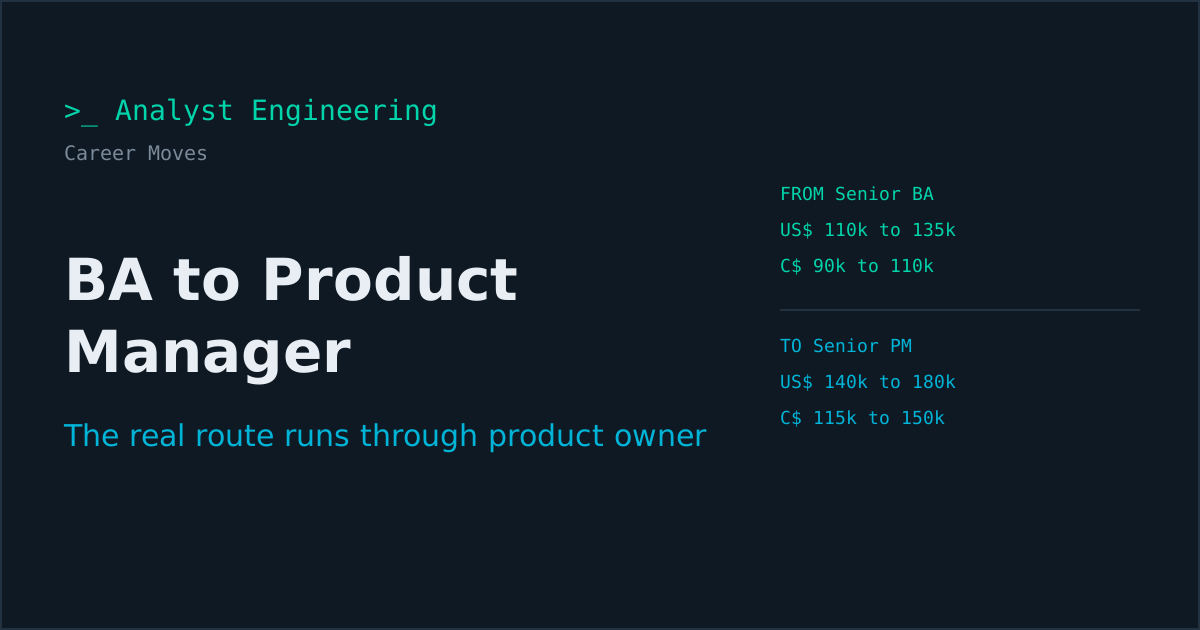
- Moving from senior business analyst to product owner is roughly flat to plus 10 percent on base pay; the premium arrives later, when a senior product manager role pays 15 to 30 percent above the senior BA band.
- The move from business analyst to product manager is a move from describing to deciding: you become accountable for what gets built, in what order, and whether it changed the outcome it was meant to change.
- A business analyst who wants to become a product manager needs evidence of five things a BA job rarely asks for: saying no, owning an outcome metric, running discovery, telling a roadmap story, and reasoning about money.
- Technical fluency, precision, and testing discipline stay a real edge in product roles: a product manager who can read an API contract and write acceptance criteria makes better trade-off calls and loses fewer sprints to ambiguity.
Most business analysts who become product managers get there through the product owner seat, not directly. Moving from senior business analyst to product owner is roughly flat to plus 10 percent on base pay, and the gain comes later: a senior product manager role pays 15 to 30 percent above the senior BA band over time. The real jump is not the title or the money. It is moving from describing what the business wants to deciding what gets built, and being accountable for the priority and the outcome.
Years ago, in refinement for a card disputes project, a product owner I worked with pushed my fourteen user stories back across the table and asked which three I would cut if we lost a developer next sprint. I had written every one of those stories carefully. I had no view on which mattered least, because nobody had ever made me own that question. She picked three in under a minute, explained why in two sentences, and the stakeholders accepted it.
That question is the whole move. The analysts I have watched cross into product learned to answer it before anyone gave them the title, and they kept what most product people lack: the ability to turn a vague request into something a developer can build without guessing. That discipline is the core of From Vague BR to Functional Requirements, and it is still worth having on the day you start deciding instead of describing.
What does the move from business analyst to product manager actually look like?
The move from business analyst to product manager changes what you are accountable for, not only what you produce. A business analyst is accountable for a correct and complete description of what is needed. A product owner is accountable for the order in which one team builds things. A product manager is accountable for which problems the product solves, for whom, and whether solving them changed a number the business cares about.
The accountability split between the analyst seat and the product owner seat is covered in detail in Functional Analyst vs Product Owner. This article is about the route, the pay, and the plan.
| Dimension | Business analyst | Product owner | Product manager |
|---|---|---|---|
| Core question | What exactly is needed? | What does this team build next? | Which problem is worth solving, and why now? |
| Accountable for | Complete, testable requirements | Backlog order and acceptance | Outcomes: adoption, revenue, cost, risk |
| Main artifacts | Specs, stories, process maps, test scenarios | Ordered backlog, sprint goals, acceptance decisions | Strategy one-pagers, roadmap, metric reports |
| Who you say no to | Rarely anyone; you flag and escalate | Stakeholders asking for scope this sprint | Executives, sales, and your own favourite ideas |
| Time horizon | This release | This sprint to this quarter | This quarter to next year |
| Success looks like | Nobody had to ask what you meant | The team shipped the most valuable thing | The metric moved and you can say why |
Why do most business analysts go through product owner first?
Most business analysts go through product owner first because product owner roles are filled from inside the delivery team, which already trusts the BA. In banks and insurers the product owner is often a delivery-side seat attached to one squad. Product manager roles are hired on outcome evidence, a metric you moved or a launch you owned, and the product owner seat is where you earn it. In product companies the product manager title often covers both seats, so an internal move straight to product manager is realistic.
What must a business analyst add to become a product manager?
A business analyst must add five things that a BA job rarely asks for. Each one is a behaviour you can practise in your current role before anyone changes your title.
How do you learn to say no as a business analyst?
You learn to say no by ranking, in writing, with a reason. Order the backlog you know best, write one sentence for each of the top five, and keep a “not now” list for the rest. The MoSCoW method is a starting vocabulary, but product people rarely say “Won’t”. They say “not this quarter, because the dispute backlog costs us more in chargebacks than this feature earns”. A no with a cost attached is the one stakeholders accept.
What is the difference between an output metric and an outcome metric?
An output metric counts what the team shipped; an outcome metric measures what changed because of it. “We delivered 42 stories” is output. “Card disputes escalated to manual review dropped from 22 percent to 13 percent in eight weeks” is outcome. Product managers are judged on the second kind. Define one outcome metric for a feature you work on: name, formula, data source, baseline, target, and review date. If you can pull the baseline yourself with SQL, you are already ahead of most product candidates.
What does product discovery add to requirements elicitation?
Product discovery asks what people did, not what they want. Elicitation collects requirements for something already decided; discovery tests whether it should be built at all. The core tools are short user interviews built on past behaviour (“tell me about the last time you disputed a transaction”), and cheap experiments: a fake door button that measures clicks, a concierge test where a person does manually what the feature would automate, or a two-variant test on an existing screen.
What is a roadmap and trade-off narrative?
A roadmap narrative explains, in a paragraph an executive can repeat, what the product will do next and what it will not do. The most useful format I have seen is Now, Next, Later with one sentence of reasoning per item, plus an explicit list of what was considered and dropped. The trade-off sentence is the part BAs skip: “we are doing X before Y because X removes a regulatory risk with a deadline, and Y only improves conversion”.
What commercial awareness does a product manager need?
A product manager needs to reason about money: revenue per customer, cost to serve, the cost of a manual workaround, pricing, and the cost of compliance. In a bank that means knowing that a payment repair handled by operations costs real money per item and that reducing repairs is a business case. You need a number, even a rough one, next to every priority call.
What does a business analyst keep as an edge in product management?
A business analyst keeps three real advantages: technical fluency, precision, and testing discipline. A product manager who can read an API contract, check data with a query, and write acceptance criteria that hold up makes better feasibility calls and loses fewer sprints to ambiguity. The difference between a user story and a specification stays useful: you will write fewer specs, but you will know when a story needs one. Decision tables are how you settle a stakeholder argument about rules in ten minutes instead of three meetings.
If you want portfolio evidence of the technical half, the missions in the Labs are built for it: analyze a payment API and produce the findings a product person would need before committing to a date. A free account saves your progress and unlocks the solutions to compare against.
How much does a product manager earn compared with a business analyst?
A senior product manager earns roughly 15 to 30 percent more than a senior business analyst, but the first step through product owner is usually flat. The table shows indicative 2026 base salary for permanent roles in large cities, excluding bonus and equity.
| Role | US (USD) | Canada (CAD) | UK (GBP) | Eurozone (EUR) |
|---|---|---|---|---|
| Business analyst, senior | 110k to 135k | 90k to 110k | 55k to 72k | 60k to 75k |
| Product owner, mid | 95k to 125k | 85k to 105k | 50k to 65k | 52k to 65k |
| Product owner, senior | 120k to 150k | 100k to 125k | 62k to 80k | 62k to 78k |
| Product manager, mid | 110k to 140k | 95k to 120k | 55k to 75k | 55k to 70k |
| Product manager, senior | 140k to 180k | 115k to 150k | 75k to 100k | 70k to 90k |
| Group or lead product manager | 170k to 220k | 145k to 180k | 95k to 125k | 85k to 110k |
Read the table honestly. A senior BA earning US$130k who takes a mid product owner role at US$110k to US$125k is taking a short-term cut, which is common because banks often grade product owners on the analyst grid. A senior BA who lands a senior product owner seat is roughly flat to plus 10 percent. The premium comes from the product manager ladder: senior product manager, then group product manager at US$170k to US$220k, and in product companies from equity, which this table excludes.
US figures are major metros (New York, Chicago, Boston, and the Bay Area at or above the top of each band); UK figures are London. Verify before you negotiate: posted ranges in pay transparency jurisdictions (New York, California, Colorado, Washington, Illinois, British Columbia, Ontario since January 1, 2026, and EU countries as member states implement the Pay Transparency Directive), ITJobsWatch in the UK, the annual Robert Half, Hays, and Michael Page guides, Levels.fyi for equity, and two people one level above you. The cross-role picture is in the analyst salary guide for 2026.
What do real moves from business analyst to product manager look like?
The cases below are composites of moves I have watched on delivery teams, with details changed. Pay is base salary, permanent, large city, 2026, indicative.
How did a bank business analyst in Toronto become a product owner?
Nadia was a senior business analyst at a Toronto bank on the mobile banking payments stream, earning C$98k. When the squad’s product owner went on leave, she asked to run the backlog for the Interac e-Transfer limits feature for three months instead of just writing its stories. She defined one metric (share of limit increase requests completed in the app without a call to the contact centre), baselined it with a query against the request log, and ran six short interviews with contact centre agents and customers.
It took nine months from that first backlog to the offer. She landed a product owner role on the mobile team at C$106k, about plus 8 percent. What she would do differently: ask for a metric-owning task a year earlier instead of waiting for someone’s leave to create the opening.
How did a SaaS business analyst in London move into product management internally?
Tom was a mid-level business analyst at a London B2B software company selling billing software, earning £54k. He volunteered to run discovery for an invoice reconciliation feature: eight customer interviews, a synthesis that killed half the original scope, and a one-page strategy the head of product used in a quarterly review. He then owned the churn rate of the targeted segment.
It took fourteen months, including one failed application. He moved internally to a mid product manager role at £64k, about plus 18 percent. What he would do differently: learn the pricing model and revenue per customer in month one. In his first product review the head of product asked for the revenue at risk, and he had no number.
Why did a product owner in Chicago go back to business analysis?
Maria was a senior product owner at a Chicago insurer on US$138k. She joined an early-stage fintech as senior product manager on a US$148k base plus options. There was no analyst, no QA, and a founder who rewrote the roadmap monthly. She spent her time writing specs and testing releases without the authority the title implied. After eleven months the company cut half its staff.
She went back to senior technical BA work as an incorporated consultant, billing US$95 an hour corp-to-corp. For a senior US technical analyst replacing a US$130k salary the floor is around US$80 to US$100 an hour, so US$95 clears it, and about 1,650 billed hours a year grosses roughly US$157k before benefits, bench time, and tax. What she would do differently: test the product manager seat at a company with an actual product organization, not a single founder. The contracting math is in Going Contract as an Analyst.
What is a realistic plan to move from business analyst to product manager?
A realistic plan takes six to twelve months and produces one artifact a month that a hiring manager can read, all inside your current BA role.
- Month 1: own a small backlog. Ask your product owner for one feature area of 10 to 20 items. Artifact: an ordered backlog with a one-sentence rationale for each of the top five and a written “not now” list. If your team runs on Jira, Jira for Business Analysts covers the boards, filters, and hierarchy that make a backlog you own readable to others.
- Month 2: define a success metric and baseline it. Artifact: a one-page metric definition with name, formula, data source, baseline, target, and review date, and the query that produced the baseline.
- Month 3: run five discovery interviews. Artifact: an interview guide built on past behaviour, plus a synthesis page with quotes, patterns, and one opportunity statement. The AI-Powered Analyst covers using AI across analyst work, including turning raw notes into a synthesis you then check line by line.
- Month 4: write a one-page strategy for a feature. Artifact: problem, who has it, evidence, the metric, options considered, what you will not do, and the main risk.
- Month 5: run refinement and a release decision as the decider. Use refinement that actually refines and a defensible go/no-go call. Artifact: a decision log with each call, the reason, and who agreed.
- Month 6: report the outcome. Artifact: a metric report 30 to 60 days after release: did it move, why or why not, and what you would do next. Then rewrite your CV around these six artifacts with before and after bullets.
What mistakes stall the move from business analyst to product manager?
- Waiting for the title before behaving like the role. Nobody promotes a BA into product management on potential. They promote the BA who was already ranking the backlog.
- Reporting output as outcome. “Delivered on time” is a delivery claim. Product interviews want the number that moved.
- Treating discovery as elicitation with a new name. Asking stakeholders what they want produces a wish list. Asking users what they did last time produces evidence.
- Dropping the technical edge. Product people who cannot read an API contract get owned by whoever can.
- Applying for product manager jobs at product companies with no metric evidence. Get the product owner seat and one outcome report first.
- Taking a product title at a company with no product organization. You will do the analyst job without the analyst’s protection, as Maria did.
If you are unsure product is your direction, compare the routes on the career paths page and score yourself on the technical analyst skill matrix or the roadmap first. Some analysts who want leadership find delivery management or the manager versus principal fork fits better.
The takeaway
Business analyst to product manager is a real and common route, and it almost always runs through product owner. The first step is roughly flat on pay; the premium comes at senior product manager and above. What gets you across is not a certificate or a new title on LinkedIn. It is six artifacts that prove you can decide: a ranked backlog, a metric, discovery notes, a strategy page, a decision log, and an outcome report. Keep your precision and technical fluency; they make your decisions better.
For the precision half that product people often lack, start with From Vague BR to Functional Requirements. If you want a second pair of eyes on your plan or your CV, book a 1:1 Tech BA Coaching Call. The free downloads are a no-cost starting point, and everything else is in The Tech BA Toolkit. More on the analyst side of this route lives in the Business Analyst hub.
Ahmed is a Senior Technical Business Analyst with 10+ years in banking and payments. He builds practical guides and tools for analysts at The Tech BA Toolkit.
Tags: Business Analysis, Product Management, Product Owner, Career Growth, Banking
About the author
Analyst Engineering is written by Ahmed, a Senior Technical Business Analyst with 10+ years of banking and payments delivery experience: ISO 20022 and SWIFT messaging, payments API integration, Kafka event validation, and production support. Every article comes from real delivery work, and each one is reviewed and updated as tools and standards change.
Related articles
- Functional Analyst vs Product Owner: Correct Behavior vs Valuable Priority A functional analyst is accountable for exact system behavior; a product owner for what gets built and in what order. The split, and which seat fits you.
- Changing Role Inside Your Company: The Cheapest Career Move an Analyst Can Make An internal move is the cheapest analyst career change: 3 to 9 months, usually no pay cut. The step plan, the move proposal, and how to ask for a regrade.
- Lead the Team or Stay Technical? Head of Business Analysis vs Principal Analyst Head of business analysis or principal analyst? What each does all day, pay in four markets, how to trial management, and how to create a principal track.
- Business Analyst to Delivery Manager or Scrum Master: The Less Technical Leadership Route BA to delivery manager, project manager, or scrum master: what transfers, what is new, pay in four markets, and why delivery manager is the durable target.
Go deeper on this
Not ready to buy? The free downloads are a no-cost place to start, and every article here stays free.
Free account
Practice on the Labs, keep your progress
A free account, no password: an email link signs you in. It saves your steps and self-assessments on the Labs, shows your missions on a dashboard, unlocks the solutions, and, if you tick the box, sends you new missions and articles when they ship.
Your email is used to sign you in. Nothing else, unless you ask. Privacy.