From Technical Analyst to Forward Deployed or Solutions Engineer: The Client-Facing Technical Route
Written by Ahmed at Analyst Engineering, a Senior Technical Business Analyst with 10+ years in banking and payments delivery.
Key takeaways
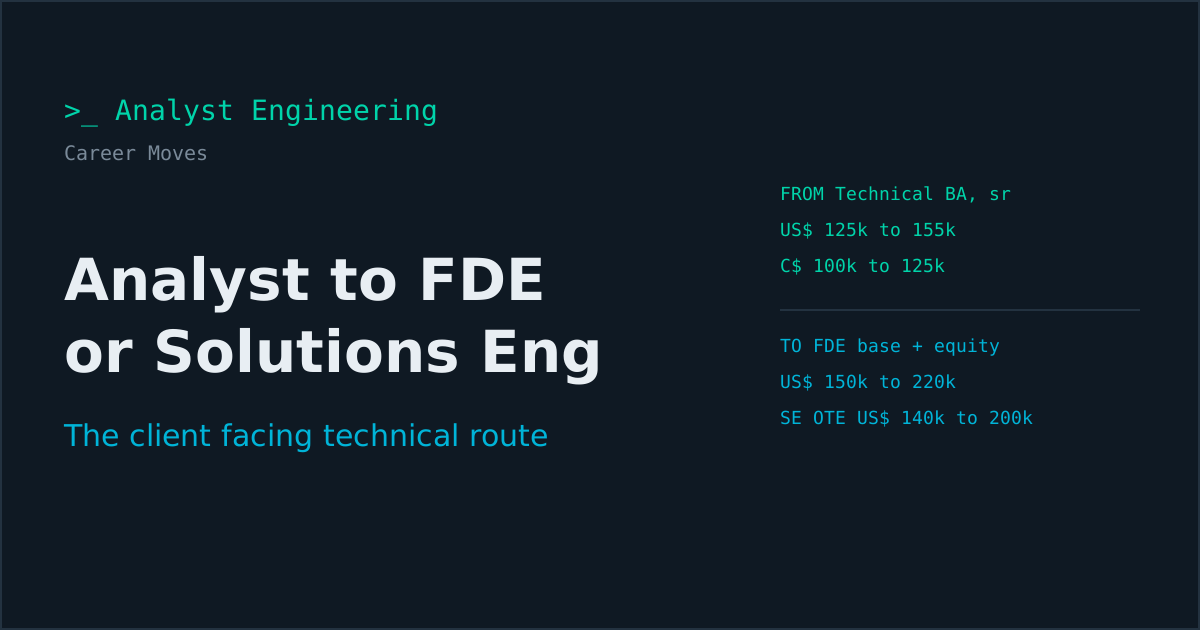
- Forward deployed engineer is the best paid client-facing technical route for analysts: indicative 2026 US base salary of US$150k to US$220k plus equity, against US$125k to US$155k for a senior technical BA.
- A solutions engineer in pre-sales earns an indicative US$110k to US$160k base in the US, with on-target earnings of US$140k to US$200k that depend on the sales team hitting quota.
- Discovery, API analysis, data work, demos, and translating between business and engineering transfer directly from technical analysis to client-facing technical roles.
- The gap between a technical analyst and a forward deployed engineer is writing production-grade integration code quickly, fluency with AI tooling such as MCP, RAG, and agents, and working under direct customer pressure.
- Implementation or integration consulting at a software company is the lowest risk bridge from technical analyst to forward deployed engineer, because it builds customer delivery experience at a similar pay level.
The client-facing technical route takes a technical analyst into one of three roles: forward deployed engineer (FDE), solutions engineer in pre-sales, or implementation and integration consultant. It is the best paid route for analysts who like customers and code together: an FDE earns an indicative US$150k to US$220k base plus equity in the US, and a solutions engineer US$110k to US$160k base with on-target earnings of US$140k to US$200k. Discovery, APIs, data, demos, and stakeholder translation transfer directly. The gap is writing production-grade integration code quickly, AI tooling such as MCP, RAG, and agents, travel and customer pressure, and, for solutions engineers, a quota.
A few years ago I sat in a vendor evaluation for a real-time payments gateway. The vendor’s solutions engineer was a former technical BA from a bank. Within twenty minutes she had rebuilt our demo in Postman against our own test scenarios, including a duplicate submission and a timeout, and answered our architect’s question about idempotency keys by showing the response header rather than a slide. We chose that vendor. Walking out, our head of payments said the product was fine but the engineer had closed it.
That is the whole role in one meeting: analysis, APIs, and a demo, delivered to a customer who can say no. I mapped the route from technical BA in The Forward Deployed Engineer Career Guide, which covers the role, the pay, the transferable skills, and the gap in detail.
What does the move to a client-facing technical role actually look like?
The move puts a customer, not an internal product owner, at the other end of your work, and adds code or sales pressure depending on which role you pick. The four roles below sit on one spectrum from pure delivery to pure sales support.
| Dimension | Technical BA | Implementation consultant | Solutions engineer (pre-sales) | Forward deployed engineer |
|---|---|---|---|---|
| Who you serve | Your own delivery team | A client configuring your product | A prospect deciding whether to buy | A customer deploying your product |
| Main output | Specs, analysis, test evidence | Configured product, migrated data, trained users | Demos, proofs of concept, answered questionnaires | Working integrations and custom code in production |
| Code | Scripts, queries, API tests | Configuration, mappings, some scripting | Demo code and API collections | Production-grade code, daily |
| Measured on | Rework avoided, quality | Go-live on time, adoption | Deals won, technical win rate | Customer outcome, time to value |
| Pressure | Sprint and release | Client go-live date | Quarter end and quota | Customer watching, often on-site |
| Travel | Rare | Moderate | Moderate | Often heavy |
| Pay shape | Base | Base, sometimes bonus | Base plus variable | Base plus equity |
What does a forward deployed engineer do on a Tuesday?
A forward deployed engineer spends Tuesday making the product work inside one customer’s systems. A realistic day: a stand-up with the customer’s engineering team, two hours debugging why the product’s connector fails against their single sign-on configuration, a Python job that pulls their case history from a data warehouse into the product, an evaluation run showing that the agent now answers 81 percent of the test questions correctly instead of 72, and a note to the product team about a missing API that three customers have now needed. At AI companies, most of that code connects models to customer data and tools.
What does a solutions engineer do on a Tuesday?
A solutions engineer spends Tuesday helping a sales team win specific deals. A realistic day: two discovery calls with prospects, a demo rebuilt around one prospect’s refund flow, a proof of concept environment set up with sample data, forty questions answered on a security questionnaire, a call with the account executive about whether a deal is technically qualified, and a Postman or Bruno collection sent to a prospect’s developers so they can try the API themselves. On-target earnings (OTE, the base plus the variable paid if the team hits quota) make the quarter end feel different from any sprint.
What does an implementation or integration consultant do on a Tuesday?
An implementation consultant spends Tuesday taking a signed customer from contract to go-live. A realistic day: a configuration workshop, a field mapping session for a data migration, triage of defects raised in the client’s user acceptance testing, and a status report with a red item nobody wants to own. It is the closest of the three to technical BA work, which is why it is the most common bridge.
How much do forward deployed and solutions engineers earn?
Forward deployed engineers earn the most of the three, solutions engineers earn a base close to a senior technical BA plus variable pay, and implementation consultants are usually paid on or near the technical BA band at the same level. The figures below are indicative 2026 base salary, permanent roles, large cities.
| Role | US (USD) | Canada (CAD) | UK, London (GBP) | Eurozone (EUR) |
|---|---|---|---|---|
| Technical BA, senior | 125k to 155k | 100k to 125k | 65k to 85k | 65k to 82k |
| Solutions engineer, mid to senior | base 110k to 160k, OTE 140k to 200k | base 95k to 130k | base 60k to 90k plus variable | base 60k to 85k plus variable |
| Forward deployed engineer, mid to senior | base 150k to 220k plus equity | base 120k to 170k | base 90k to 140k | base 80k to 120k |
The honest reading: a senior technical BA moving to solutions engineer may take a similar or slightly lower base in exchange for variable pay that is not guaranteed. Ask what share of the team hit quota last year before you count the OTE. The FDE premium is real, but it is paid for speed of delivery in someone else’s environment, and equity at a startup can be worth nothing. Compare offers on base first. Banking and capital markets in New York or London typically add 10 to 20 percent to the technical BA band, which narrows the gap for payments analysts.
Verify before you negotiate. Posted ranges are public in pay transparency jurisdictions: New York, California, Colorado, Washington, Illinois and several other US states; British Columbia and, since January 1, 2026, Ontario for employers with 25 or more employees; and the EU as member states implement the Pay Transparency Directive. Levels.fyi is the best source for tech companies with equity, ITJobsWatch covers UK rates by keyword, and the annual Robert Half, Hays, and Michael Page guides cover the rest. Ask two people already in the role what their base and variable split is. The broader picture is in the analyst salary guide for 2026, and how employer type changes the shape of pay is in bank, consultancy, product company, or public sector.
Which technical analyst skills transfer, and what is the gap?
Five skills transfer directly: discovery, API analysis, data work, demos, and stakeholder translation. The gap is code speed, AI tooling, and pressure.
What transfers. Discovery is requirements elicitation with a customer in the room. API analysis, the method in how to analyze an API, is what a solutions engineer does before every technical call. SQL and data mapping are half of any implementation. A demo that settles a decision, as in API proof of concept and demos and release notes and demos for developers, is the core pre-sales skill. Translating between the business sponsor and the customer’s engineers is the job that nobody else on the vendor side does well.
What is missing. First, writing working integration code quickly: authentication, pagination, webhooks, retries, and error handling in Python or TypeScript, done in hours rather than a sprint. API request chaining and scripts is the bridge from collections to code. Second, AI tooling, because most FDE hiring is now at AI companies: Model Context Protocol (MCP) servers that connect a model to tools, retrieval-augmented generation (RAG) over customer documents, agents that take actions, and the evaluation that proves any of it works. RAG for analysts, AI agents for analysts, and MCP for Jira and Confluence cover the analyst’s side of each. Third, travel and customer pressure: the deadline belongs to someone who is paying. Fourth, for solutions engineers, quota: your income depends partly on deals you do not control.
What do real moves from technical analyst to client-facing roles look like?
The cases below are composites of moves I have watched on delivery teams, with details changed.
A payments technical BA in New York who became a solutions engineer
Luis was a senior technical BA at a New York bank, on US$140k, working on card and real-time payments integrations. Over five months he wrote public API reviews of payment APIs in the style of the Stripe PaymentIntents API review, built a small integration with webhooks and idempotency keys, and recorded two ten minute demos. He joined a payments API company as a solutions engineer on a US$150k base with US$195k OTE. What he would do differently: ask how many solutions engineers hit their number the previous year; in his first year the team reached 80 percent of quota and his variable paid out accordingly.
A technical BA in Montréal who went from implementation consultant to FDE
Sophie was a mid technical BA at a Montréal insurer on C$90k. She moved to a SaaS company as an implementation consultant at C$98k, configuring the product and migrating client data, and wrote more Python in her first six months than in three years as a BA. After two years and a dozen go-lives, she moved into the company’s new forward deployed team when it started shipping AI features, at a C$150k base. What she would do differently: start the AI tooling work (a RAG prototype, an MCP connector) a year earlier; the FDE team hired the consultants who had already built something.
A data-leaning analyst in London who joined an AI startup as an FDE
Tom was a senior data analyst at a London fintech on £62k, strong in SQL and Python, weak on customer work. Over nine months he built a RAG prototype over a public regulatory document set with an evaluation of 50 questions, an MCP server exposing a read-only SQL tool, and a written postmortem on where retrieval failed. He joined an AI startup as a forward deployed engineer on a £95k base plus equity. What he would do differently: ask about runway and the equity terms in writing; and prepare for the pace, because the first customer deployment ran at a speed no sprint had prepared him for.
What is the six month plan from technical analyst to FDE or solutions engineer?
This plan assumes five to eight hours a week alongside your current role. Each step ends with an artifact you can show a hiring manager, because client-facing roles hire on proof you can do the Tuesday.
- Weeks 1 to 3: review a public API. Pick an API in your domain and write a two page review using how to analyze an API and the Review Scorecard. Artifact: a published API review with findings a customer would care about.
- Weeks 4 to 7: build an integration. Write a working client for that API in Python or TypeScript: authentication, pagination, one webhook, retries with an idempotency key. Artifact: a repository under 300 lines that runs from a clean checkout.
- Weeks 8 to 10: record a demo. A ten minute demo of the integration for a named persona, showing a failure path and ending on a decision. Artifact: the recording and the one page proof of concept summary.
- Weeks 11 to 16: AI tooling. Build a RAG prototype over a public document set with an evaluation of at least 30 questions, and one MCP server or agent with a read-only tool. Artifact: the prototype, the evaluation scores, and a note on what failed.
- Weeks 17 to 20: run a mock discovery. Ask a peer to play a customer with a vague problem. Run discovery, then write the solution outline and a risk list. Artifact: discovery notes and a two page solution proposal.
- Weeks 21 to 26: apply where your domain counts. Target companies that sell into your domain (payments analysts to payments APIs, insurance analysts to insurance SaaS) and consider implementation consulting as the bridge. Artifact: a portfolio page linking the five artifacts above.
For practice with realistic material, the Analyze a Payment API mission in the Labs is the same exercise a solutions engineer runs before a technical call, and the Become a Technical Analyst track orders the missions. A free account saves your progress and unlocks the solutions. For step 4, AI at Work: MCP, RAG, and Agents covers the three tools FDE interviews at AI companies ask about, and AI Agents for Analysts goes deeper on agents specifically. How to present these artifacts when your day job is confidential is covered in the analyst portfolio.
What mistakes stall the move to a client-facing technical role?
- Applying with a CV that reads like a BA’s. Lead with integrations built, demos given, and customers or stakeholders served, not with documents written.
- Underestimating code speed. FDE interviews often include a live integration exercise. Practise building a working client against an unfamiliar API in under two hours.
- Counting OTE as salary. Ask for historical quota attainment and the variable plan in writing.
- Ignoring AI tooling. Most FDE hiring is at AI companies. One working RAG prototype with an evaluation beats three certificates.
- Leaving your domain behind. A payments analyst selling a payments API has a credibility no generalist can match.
- Not asking about travel. “Up to 50 percent travel” in a job ad usually means it. Decide before the offer, not after.
Which other technical moves should an analyst compare?
Compare the client-facing route with the internal technical routes before you commit. From technical analyst to software developer keeps you on one codebase without customer pressure, and from systems analyst to solutions architect rewards design depth over delivery speed. Use how analysts negotiate a raise or an offer when base, variable, and equity arrive in one letter. The career paths map and the technical analyst skill matrix show where your gaps actually are.
The takeaway
The client-facing technical route is where a technical analyst’s discovery, API, data, and demo skills are paid most directly: an indicative US$150k to US$220k base plus equity for a forward deployed engineer and US$110k to US$160k base with US$140k to US$200k OTE for a solutions engineer in the US. The price is code speed, AI tooling, customer pressure, travel, and, in pre-sales, a quota. Implementation consulting is the lower risk bridge. Build the five artifacts, lead with your domain, and pick the role whose Tuesday you actually want.
Get the full map from technical BA to FDE in The Forward Deployed Engineer Career Guide. If you want your portfolio, a demo, or an offer with base, variable, and equity reviewed, book a 1:1 Tech BA Coaching Call. Start with the free downloads, browse The Tech BA Toolkit, and find more on the coding side of analysis in the Developer Analyst hub.
Ahmed is a Senior Technical Business Analyst with 10+ years in banking and payments. He builds practical guides and tools for analysts at The Tech BA Toolkit.
Tags: Solutions Engineering, Forward Deployed Engineering, Career Growth, Artificial Intelligence, Payments
About the author
Analyst Engineering is written by Ahmed, a Senior Technical Business Analyst with 10+ years of banking and payments delivery experience: ISO 20022 and SWIFT messaging, payments API integration, Kafka event validation, and production support. Every article comes from real delivery work, and each one is reviewed and updated as tools and standards change.
Related articles
- From Technical Analyst to Software Developer: Is the Move Worth It in the AI Era? Technical analyst to software developer in 2026: junior hiring is tight and AI compresses junior coding, so go internal and use your domain. Pay, plan, cases.
- From Systems Analyst to Solutions Architect: What the Promotion Actually Requires Senior systems analyst to solutions architect pays 15 to 25 percent more, usually after 8 to 12 years. The ADRs, NFRs, cloud cert, and design reviews it takes.
- API Proof of Concept: How Analysts Build POCs and Demos That Settle Decisions How an analyst builds an API proof of concept: the decision it must settle, a two-day spike, mocks from OpenAPI, webhook proof, a scripted demo, and evidence.
- AI Agents for Analysts: When an Agent Beats a Prompt When an AI agent beats a single prompt for analyst work, what tools it needs, where the guardrails go, and the three agent flows worth building first.
Go deeper on this
Not ready to buy? The free downloads are a no-cost place to start, and every article here stays free.
Free account
Practice on the Labs, keep your progress
A free account, no password: an email link signs you in. It saves your steps and self-assessments on the Labs, shows your missions on a dashboard, unlocks the solutions, and, if you tick the box, sends you new missions and articles when they ship.
Your email is used to sign you in. Nothing else, unless you ask. Privacy.