Interviewing as a Career Changer: How to Answer "Why the Switch?" and the Case Exercise
Written by Ahmed at Analyst Engineering, a Senior Technical Business Analyst with 10+ years in banking and payments delivery.
Key takeaways
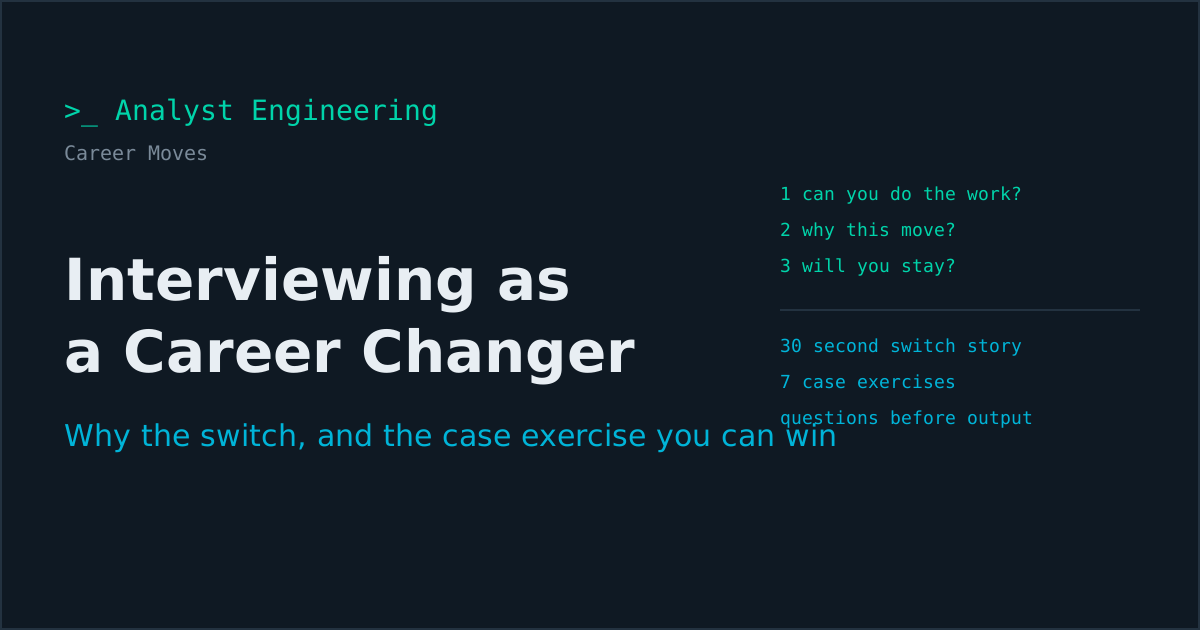
- Interviewers test a career changer on three things: can you do the work now, why this move, and will you stay.
- The answer to 'Why the switch?' should take about 30 seconds, describe a pull toward analysis rather than a push away from the old job, and end on evidence you have already produced.
- The case exercise is where career changers win, because it measures the work directly and experienced candidates often under-prepare for it.
- In every case exercise, ask clarifying questions before producing anything. Developers and senior professionals most often fail elicitation cases by designing a solution in the first two minutes.
- A career changer's first analyst offer usually lands in the junior band, about US$65k to US$85k or C$58k to C$72k for a business analyst in a large city, so decide your floor before the pay question comes.
Interviewers test a career changer on three things: can you do the work now, why this move, and will you stay. The first is answered by the case exercise, and that is where switchers win, because a 45 minute exercise measures the work directly and experienced candidates often under-prepare for it. The other two are answered by a 30 second “why the switch” story and an honest view of level and pay.
I sat on a panel for a junior BA role at a bank where one candidate, a former pharmacist, took four minutes to answer “Why the switch?” She covered her degree, two jobs, a difficult manager, and a course she had taken. By the time she reached the analysis work, the panel had written “unclear motivation” in the notes. In the case exercise she was the best of the day: she asked about exceptions before she wrote a single story. She did not get the role. The panel could not get past the first four minutes.
The fix was not more experience. It was structure: a short answer, then evidence. For the questions analyst interviews actually ask, what each one tests, and how to answer from real work, the BA and Technical BA Interview Guide is the one I would read first.
What do interviewers test when you change careers?
Interviewers test three things, and every question in the loop maps to one of them.
| What they are asking themselves | Evidence that answers it | Where it shows up |
|---|---|---|
| Can you do the work now? | A case exercise done well, a portfolio piece | Case exercise, technical round, “walk me through” |
| Why this move? | A pull story with a trigger and actions already taken | ”Why the switch?”, “Tell me about yourself” |
| Will you stay? | Months of preparation, a realistic view of level and pay | ”Why the pay cut?”, “Where do you see yourself?” |
A career changer loses on the second and third far more often than on the first. Experienced candidates lose on the first more often than they expect.
How do you answer “Why the switch?”
Answer in about 30 seconds, describe a pull toward analysis rather than a push away from the old job, and end on evidence. The shape:
In payments operations, I kept ending up in the defect calls, explaining to developers what the rules actually meant. I realised that translation was the part of the job I was best at. Over the last six months I have built three pieces of analyst work, including an API gap register and a SQL investigation of duplicate refunds, and I would like to walk you through one.
The trigger, the realisation, the evidence, and an invitation. Nothing about the old manager, the old salary, or burnout.
How do you answer “You have no BA experience”?
Agree with the fact and challenge the conclusion with evidence:
That is right, I have not held the title. What I have done is write the triage guide our team used for failed payments, which cut escalations by about a third, and run 45 UAT scenarios for a billing release. I would be glad to walk you through either.
How do you answer “Why should we hire you over an experienced BA?”
Name what the experienced BA does not bring, then remove the risk:
An experienced BA will know the techniques faster than I do. I bring eight years inside the process your system supports, so I will ask the questions your users would ask. On the techniques, here is the spec I wrote for my portfolio.
How do you answer “Are you overqualified?” after 40?
Treat it as a question about staying and about being managed by someone younger, and answer both directly:
I am choosing this level deliberately, because I want to learn the craft properly. I have worked for managers younger than me before and it went well. My plan is to be at mid level in two years, not to run the team.
The full route for later career switchers is in becoming a business analyst at 40 or 50.
How do you answer “Why are you taking a pay cut?”
Show that you decided it before the interview, not during it:
I planned for it. I have looked at the bands for this role and the next level, and I have modelled the next three years. The mid level band is where I expect to be, and I would rather take the step now than keep waiting.
Which case exercises come up in analyst interviews?
Seven exercises cover most analyst interview loops. Every one rewards the same first move: clarify before you produce.
| Exercise | What it tests | First move | Typical time |
|---|---|---|---|
| Elicit requirements for X | Questioning, scope, exceptions | Ask who, why now, and what fails today | 20 to 30 minutes |
| Write user stories with acceptance criteria | Slicing, testable criteria | Confirm the user and the outcome | 20 to 30 minutes |
| Review this spec | Spotting gaps and contradictions | Read for missing unhappy paths | 30 minutes |
| Design test cases from a rule | Boundaries, combinations | Turn the rule into conditions | 20 to 30 minutes |
| Write a SQL query | Data reasoning | Restate the question as rows and columns | 15 to 30 minutes |
| Read an API response | Contracts, status codes | Say what the client should do next | 10 to 20 minutes |
| Prioritise a backlog | Trade-offs, saying no | Ask for the goal and the deadline | 20 to 30 minutes |
How do you approach a user story exercise?
Confirm the user and the outcome, then write one story with three to five testable criteria. Brief: “Customers want to freeze their card in the app.”
As a cardholder who has misplaced my card, I want to freeze it in the app, so that no new payments can be authorised while I look for it.
Given an active card, when I freeze it, then new authorisations are declined and I see the card as frozen. Given a frozen card, when a recurring merchant payment arrives, then it is declined (confirm with the business: some banks allow it). Given a frozen card, when I unfreeze it, then authorisations resume within one minute.
The bracketed note is what wins the exercise: it shows you found an open question instead of guessing. The difference between a story and a spec is in user story versus specification.
How do you approach an elicitation case?
Ask five questions before you draw or write anything: who uses it, why now, how it works today, what goes wrong today, and how we will know it worked. Then summarise the scope back in one sentence and ask what is out of scope.
How do you approach a test design exercise?
Turn the rule into conditions and build a decision table. Rule: “A transfer over C$10,000 to a payee added in the last 30 days needs a second approval.”
| Amount over C$10,000? | Payee added in last 30 days? | Second approval? |
|---|---|---|
| Yes | Yes | Required |
| Yes | No | Not required |
| No | Yes | Not required |
| No | No | Not required |
Then add the boundaries the table hides: exactly C$10,000.00, C$10,000.01, and a payee added exactly 30 days ago. Saying “the rule does not say whether 30 days is inclusive, I would ask” is worth more than a fifth row. The same method applied to APIs is in API test cases.
How do you approach a SQL or API exercise?
Restate the question as rows and columns before you type. “Find payments refunded more than once”:
SELECT payment_id, COUNT(*) AS refund_count
FROM refunds
GROUP BY payment_id
HAVING COUNT(*) > 1;
Then say what you would check next: whether partial refunds are legitimate duplicates. The patterns interviewers use are in SQL for analysts. For an API response, say what the status means and what the client should do: a 409 means a conflict with the current state, a 422 means the request was understood but failed validation, and each needs a different message to the user, as covered in HTTP status codes explained. To practise reading a real contract against rules, Mission 01 of the Labs takes about an hour, and a free account saves your progress and unlocks the solution.
How do you approach a spec review or a backlog?
For a spec, read for what is missing: unhappy paths, error messages, limits, and who owns each decision. For a backlog, ask for the goal and the deadline, then apply MoSCoW prioritisation and state the reason for every Won’t. Case studies for each exercise, with the artifacts to bring, are in the BA Interview Prep Pack.
How do you build STAR stories from a previous career?
Build four to six STAR stories (Situation, Task, Action, Result) from your previous career, each mapped to an analyst competency.
| Previous career situation | Analyst competency it proves |
|---|---|
| A teacher redesigning an assessment rubric | Writing testable criteria |
| A nurse fixing a shift handover | Process analysis and exceptions |
| An operations analyst finding a recurring failure | Root cause analysis with data |
| A retail manager rolling out a new till system | UAT, training, and change |
| A developer pushing back on a vague ticket | Elicitation and scope |
Keep each story under two minutes, with the result as a number. Pull them from the bullets you wrote in your role change CV, and link each one to a piece in your analyst portfolio where you can.
What should you ask the interviewer?
Ask three questions that show you understand delivery and that tell you whether you will be supported:
- What does a good first 90 days look like in this role?
- Who reviews the analyst’s work before it reaches developers?
- What went wrong on the last release, and what did the team change?
How do you handle the salary question as a career changer?
Decide your floor before the interview, and anchor on the posted range where one exists. The junior bands are where most switchers land.
| Role (base salary) | US (USD) | Canada (CAD) | UK (GBP) | Eurozone (EUR) |
|---|---|---|---|---|
| Business analyst, junior | 65k to 85k | 58k to 72k | 32k to 42k | 38k to 48k |
| Business analyst, mid | 85k to 110k | 72k to 90k | 42k to 55k | 48k to 60k |
| Technical BA, junior | 75k to 95k | 65k to 80k | 38k to 48k | 42k to 52k |
| QA analyst, junior | 55k to 72k | 50k to 62k | 28k to 36k | 34k to 42k |
Base salary, permanent, large city, 2026, indicative (US major metros; Toronto, Montréal, Vancouver, Calgary; London; Paris, Amsterdam, Frankfurt, Dublin).
When domain expertise transfers directly, such as a nurse into health technology or an accountant into finance systems, push for the top of the junior band or the low mid band, and say why. A useful line: “Given the posted range and the domain knowledge I bring, I am looking at the upper part of that range.” The scripts for the offer stage are in how analysts negotiate a raise or an offer.
To verify, check posted ranges where pay transparency laws apply (New York, California, Colorado, Washington, Illinois, and other US states; British Columbia; Ontario since January 1, 2026, for employers with 25 or more employees; EU member states as they implement Directive (EU) 2023/970), ITJobsWatch in the UK, the Robert Half, Hays, and Michael Page salary guides, Levels.fyi, and two people one level above you.
What does a career change interview look like in real cases?
The cases below are composites of moves I have watched on delivery teams, with details changed.
Hannah: a teacher in London who aced the user story exercise
Hannah taught secondary science in London on about £44k. She spent eight weeks preparing: two portfolio pieces, then 20 user story drills with a timer. In her second interview loop, at an insurer, the exercise was “customers want to update their address online”. She asked who the customer was, whether a policy change was triggered, and what happened to documents already in the post, then wrote four stories with criteria. The panel said her questions were better than those of the experienced candidates. She was offered a junior BA role at £41k, a small cut. What she would do differently: rehearse “why the switch” out loud earlier, because her first loop stalled there.
Arjun: a developer in Toronto who over-solutioned the elicitation case
Arjun was a mid developer at a fintech in Toronto on C$108k, targeting technical BA roles. His first elicitation case was “the bank wants customers to dispute a card transaction in the app”. Within two minutes he was drawing services and a queue. The feedback: strong technically, did not find out what the business needed. For the next loop he practised a rule: five questions and a one sentence scope summary before any diagram. He was offered a mid technical BA role at a bank at C$97k, a cut of about 10 percent that he accepted for the move into banking domain work. What he would do differently: practise elicitation with a non-technical friend playing the stakeholder. His route is covered in from developer to business analyst.
How do you prepare for a career change interview in four weeks?
Four weeks of deliberate practice covers the three tests.
- Week 1: the story. Write and time your “why the switch” answer and the four difficult-question scripts. Artifact: five answers under 45 seconds each, recorded once.
- Week 2: the exercises. Do one exercise from the table each day with a timer. Artifact: seven completed exercises with your open questions listed.
- Week 3: the stories. Write five STAR stories from your previous career with a number in each result. Artifact: one page of stories mapped to competencies.
- Week 4: mock loops. Two full mock interviews with someone who hires analysts. Artifact: a list of the three answers you changed afterwards.
If you have no portfolio yet, the Become a Technical Analyst track gives you three pieces to talk through, and the full switching route is in how to switch careers into business analysis.
What mistakes cost career changers the offer?
- A four minute “why the switch”. Thirty seconds, then evidence.
- Criticising the old career. It reads as a push, and pushes do not stay.
- Producing before asking. Every case exercise rewards questions first.
- Hiding the gaps. Saying “I would ask the business whether 30 days is inclusive” is a strength, not a weakness.
- No number in the pay answer. Vague answers get the bottom of the band.
The takeaway
Interviewers test whether you can do the work, why you are moving, and whether you will stay. Answer “why the switch” in 30 seconds with a pull and evidence, practise the seven case exercises until asking questions first is automatic, build STAR stories from your first career, and decide your pay floor before the call. The wider map of moves is on the career paths page, and a self-check against the role is in the technical analyst skill matrix.
For every question type and how to answer it from real work, start with the BA and Technical BA Interview Guide. If you are earlier in the search, Land Your First Job runs week by week from applications to day 90. For a mock interview with feedback, book a 1:1 Tech BA Coaching Call. Grab the free downloads, or browse everything at The Tech BA Toolkit. More on the craft lives in the Business Analyst hub.
Ahmed is a Senior Technical Business Analyst with 10+ years in banking and payments. He builds practical guides and tools for analysts at The Tech BA Toolkit.
Tags: Career Growth, Business Analysis, Interviews, Career Change, Testing
About the author
Analyst Engineering is written by Ahmed, a Senior Technical Business Analyst with 10+ years of banking and payments delivery experience: ISO 20022 and SWIFT messaging, payments API integration, Kafka event validation, and production support. Every article comes from real delivery work, and each one is reviewed and updated as tools and standards change.
Related articles
- Rewriting Your CV for an Analyst Role Change: Before and After Bullets That Get Interviews Rewrite your CV for an analyst role change: bullets as artifact plus outcome plus number, before and after pairs, ATS rules, and CV norms in four markets.
- The Analyst Portfolio: How to Show Work When Your Work Is Confidential How to build an analyst portfolio when your real work is confidential: 3 to 5 pieces, public or synthetic data, the right pieces per role, and a 5 minute pitch.
- How Analysts Negotiate a Raise or an Offer: Scripts, Evidence, and Numbers How analysts negotiate an offer or a raise: word-for-word scripts, an evidence file with numbers, timing, non-salary items, and US, Canada, UK, and EU norms.
- Becoming a Business Analyst at 40 or 50: Your First Career Is the Advantage A business analyst career change at 40 or 50 works when you target your own domain and enter at mid band: the roles that value experience, ageism, and money.
Go deeper on this
Not ready to buy? The free downloads are a no-cost place to start, and every article here stays free.
Free account
Practice on the Labs, keep your progress
A free account, no password: an email link signs you in. It saves your steps and self-assessments on the Labs, shows your missions on a dashboard, unlocks the solutions, and, if you tick the box, sends you new missions and articles when they ship.
Your email is used to sign you in. Nothing else, unless you ask. Privacy.