The Analyst Who Can Send an API Request: Why Hands-On API Skill Is Your Edge
Written by Ahmed at Analyst Engineering, a Senior Technical Business Analyst with 10+ years in banking and payments delivery.
Key takeaways
- An analyst who can send an API request replaces 'I think the system does this' with 'I checked, here is the response', which shortens the question-to-answer loop from days to minutes.
- Hands-on API skill pays off in seven recurring moments: refinement, requirement writing, defect reports, production triage, vendor evaluation, test data setup, and demos.
- The analyst's edge is not out-coding developers or out-automating test engineers; it is knowing which request matters and what the correct business answer is, then proving it directly.
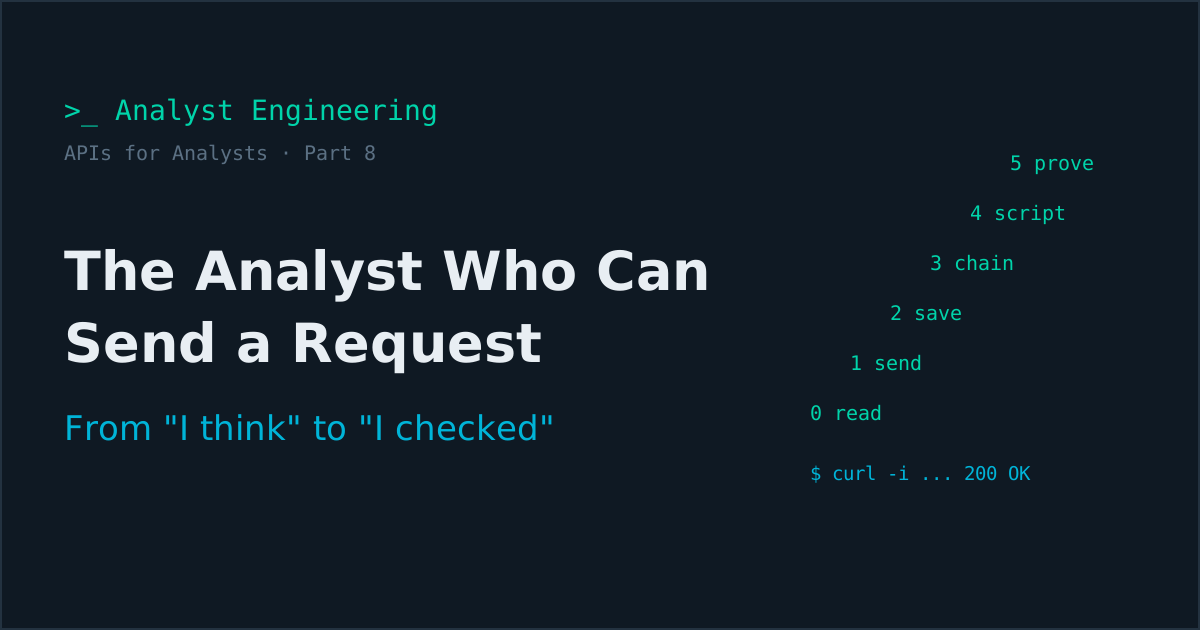
- API skill grows in seven levels: read the docs, send one request, save a collection with environments, chain requests, script tests and data, build proofs of concept and demos, and harden APIs through design review, security testing, and CI.
- Access carries responsibility: analysts should use read-only or sandbox credentials, never write to production, keep personal data out of collections and tickets, and keep secrets out of files.
The analyst who can send an API request replaces “I think the system does this” with “I checked, here is the response.” That single capability shortens the loop between question and answer from days to minutes, and it changes how requirements, defects, investigations, and decisions get made. It is the most practical technical edge an analyst can build, and it takes weeks, not years.
Hands-on API skill gives an analyst an edge because the business rules, validations, and statuses they specify all live behind APIs. An analyst who can send, chain, and script requests verifies behavior directly: they settle refinement questions live, write requirements from observed behavior, attach reproducible requests to defects, check real state during production incidents, evaluate vendor APIs with evidence, set up test data in seconds, and build demos that end debates. None of that requires becoming a developer.
APIs for Analysts, part 8 of 8. Previous: Part 7, API proof of concept and demos. Start from the beginning with Part 1, what is an API, or see the series overview.
This is the capstone of the series: why the skill matters, what it looks like at each level, how to use it safely, how to show it, and a 30-day plan that links every part. I have coached analysts through exactly this transition, and the pattern is consistent: the first request feels like a technical milestone, and a month later it simply feels like how analysis is done.
Why does sending an API request change an analyst’s value?
Because it changes where answers come from.
Without the skill, every question about system behavior goes through someone else. “Does the payments API return the creditor name on the status response?” becomes a message to a developer, who is in a sprint, who answers tomorrow, possibly from memory. Multiply that by the dozens of questions in a single feature and the analyst becomes the slowest link in the delivery chain, through no fault of their own.
With the skill, the same question takes two minutes: open the collection, send the status request, read the response. The answer is not an opinion; it is the system’s actual behavior, with a response to attach.
| Analyst who asks | Analyst who checks | |
|---|---|---|
| Time to answer | Hours to days | Minutes |
| Quality of answer | Someone’s recollection | Observed behavior |
| Cost to others | A developer’s interrupted focus | None |
| Artifact produced | A chat message | A saved, replayable request |
| Credibility in the room | ”I’ll find out" | "It doesn’t; here’s the response” |
The last row matters more than it looks. Developers extend trust quickly to analysts who show up with a request and a response. It signals that the analyst has done the work before asking, which is also the heart of working well with developers.
Where does hands-on API skill actually pay off?
In seven moments that recur on every delivery team.
1. Refinement: settling questions in the room
The team debates whether the existing customer API already returns the address fields a new feature needs. Instead of parking the question, you send the request on the shared screen. It returns addressLine as a single unstructured string. The story splits into two right there, because structured address parsing is its own piece of work, the exact problem behind the ISO 20022 structured address deadline. Refinement that settles questions with evidence is what refinement that actually refines describes.
2. Requirements: writing from observed behavior
You specify that a field is optional. You send a request without it and get a 400. Either your requirement is wrong or the implementation is; both are worth knowing before testing starts. Observed behavior also exposes the details documents miss: whether null and absent are treated differently, whether enums are case-sensitive, whether a 201 really means stored. That is how API requirements become precise.
3. Defect reports: reproducible in one click
A defect that says “payment status is wrong” costs a developer an hour to reproduce. A defect with the request, the response, the trace ID from the response header, and the expected result costs them five minutes. It also cannot be closed as “cannot reproduce”. Good defect triage depends on exactly this kind of evidence.
4. Production triage: checking real state
During an incident, the screen says a payment is pending while the customer insists money left their account. With read access, you query the payment by ID and see it is ACSC with a settlement timestamp, so the problem is the screen’s status mapping, not the payment. That single request redirects the whole investigation. It is the API half of how a technical BA investigates a failed payment, alongside logs and SQL.
5. Vendor evaluation: evidence over brochures
The vendor’s slides say “full refund support”. Your seven failure requests in their sandbox show the refund reason is a three-value enum and there is no refund reversal. The steering committee sees a worksheet backed by responses, as described in how to analyze an API, and the negotiation changes.
6. Test data: seconds instead of screens
UAT needs forty customers in specific states. Through the UI that is an afternoon of clicking. Through the API with a data file, it is one collection run. The time saved goes into the scenarios that matter in user acceptance testing.
7. Demos and proofs of concept: ending debates
When a decision stalls on whether something is feasible, a two-day POC and a twenty-minute demo with a live failure case settle it, as Part 7 shows. Few things raise an analyst’s standing faster than being the person who turned a month of opinion into a decision.
What does the API skill ladder look like?
Seven levels. Each one is useful on its own, so you get value from the first week.
| Level | You can | You can now say | Learn it in |
|---|---|---|---|
| 0. Read | Read API docs and an OpenAPI contract | ”The contract says the field is optional.” | Reading an API contract |
| 1. Send | Send a request with curl or a client, read status, headers, body | ”I checked: it returns 422 with this code.” | Part 1: what is an API |
| 2. Save | Build a collection with environments, inherited auth, safe secrets | ”Here’s the collection, switch to SIT and run it.” | Part 2: first collection |
| 3. Chain | Capture values and pass them through a flow | ”This runs the whole payment lifecycle with fresh data.” | Part 6: chaining and scripts |
| 4. Script and derive | Write tests, data-driven runs, derived test cases | ”40 cases, one command, four documentation findings.” | Part 5: API test cases |
| 5. Prove and teach | Build POCs and demos, document APIs for others | ”Here’s the evidence; the decision is yours.” | Part 4 and Part 7 |
| 6. Harden and lead | Review designs, manage breaking changes, test authorization, gate releases in CI | ”The v1 endpoint skips the v2 authorization check; here is the failing test.” | Design review, security testing, API tests in CI |
Most analysts who get to level 2 find level 3 comes quickly, because once a collection exists, copying IDs between requests by hand becomes annoying enough to motivate the script. Where this ladder sits within the full five-hat skill set is mapped in the technical analyst skill matrix.
What is the analyst’s edge compared with developers and QA engineers?
It is not competing with them. A developer will always know the code better, and a test automation engineer will always build a better framework. The analyst’s edge is the combination nobody else on the team holds: knowing which request matters and what the correct business answer is, and being able to prove it directly.
A developer tests that an invalid IBAN returns 422. A test engineer automates that check across environments. The analyst knows that for a closed account the correct asynchronous outcome is a rejection with reason AC04, not AC01, because one is repairable by the customer and the other is not, and that the customer message must differ. Then the analyst sends the request and checks. Domain judgment plus direct verification is a combination that makes teams faster, which is the core argument of business analyst vs technical business analyst: the difference is verification.
It also changes career options. Analysts with hands-on API skill move naturally toward solutions architecture, test architecture, and product roles on technical products, because each of those needs someone who can reason about systems and prove claims about them. The routes are laid out in career paths.
What guardrails keep an analyst safe with API access?
Access is a responsibility, and handling it well is part of what earns more of it.
- Sandbox and test environments by default. Production access is for reading during investigations, and only when granted.
- Read-only credentials wherever possible. Ask for the narrowest scope that answers your questions.
- Never send write requests to production. No exceptions for “just checking”. A POST in production is a change, and changes go through change control.
- No personal data in collections, screenshots, tickets, or AI tools. Use test data, and redact real responses before sharing.
- No secrets in files.
.envor a vault, never a collection or environment that gets committed or synced. The details are in API keys, PATs, and OAuth tokens. - No load testing without agreement. A loop of requests against a shared test environment can break it for everyone.
- Tell the team what you are running. A shared collection run in SIT creates data other people will see.
How do you show this skill on a CV and in interviews?
Describe outcomes, not tools. “Used Postman” says nothing. These say a lot, adapted with your real numbers:
- “Built a Bruno collection covering the payment initiation API’s happy path, rejections, and idempotency, adopted by QA as the regression seed for SIT.”
- “Derived API test cases from the OpenAPI contract, identifying documentation gaps resolved in refinement before development started.”
- “Ran a two-day API proof of concept on a vendor refund API; the evidence pack informed the vendor selection decision.”
- “Reduced defect reproduction time by attaching replayable requests and trace IDs to every API defect.”
In interviews, expect a question like “How would you verify that a payment status endpoint behaves as specified?” The strong answer walks through it concretely: read the contract, set up an environment, send the happy path, derive and send the failure cases, check the asynchronous outcome, check that rejected requests left no side effects, and report differences against the specification with the requests attached. That answer demonstrates levels 0 to 4 in ninety seconds.
A 30-day plan to go from zero to a working collection
One focused hour a day, using public APIs first and your own project’s test environment second.
| Week | Do this | Read |
|---|---|---|
| 1. Send | Send the GitHub and httpbin requests with curl. Install Bruno or Postman. Watch your own application’s Network tab and Copy as cURL one request in a test environment. | Part 1, Part 2, JSON for analysts |
| 2. Save and analyze | Build the GitHub collection with two environments and a .env secret. Pick one API your project depends on and fill in the capability and data sections of an analysis worksheet. | Part 2, Part 3, HTTP status codes |
| 3. Document and test | For one endpoint on your project, write the error catalogue and derive test cases from its contract. Take any cases you cannot fill in to refinement. | Part 4, Part 5, negative test design |
| 4. Chain and show | Build the Stripe sandbox chain end to end, then chain one real flow on your project. Demo it in a sprint review in five minutes, including one failure case. | Part 6, Part 7 |
By day 30 you have a working collection on your real project, a set of derived test cases, at least one documentation finding, and a demo your team has seen. That is a visible change in how you work, and people notice it faster than you expect.
The APIs for Analysts series
- What is an API and how it works
- Your first API collection in Bruno and Postman: requests, environments, variables, and secrets
- How to analyze an API: capability, data, behavior, limits, and change
- How to document an API: the sections consumers need, OpenAPI, and the error catalogue
- How to write API test cases: deriving a complete suite from one endpoint
- Chaining API requests with JavaScript: variables, scripts, polling, and a full Stripe flow
- API proof of concept and demos: POCs and demos that settle decisions
- The analyst who can send a request (you are here)
Beyond the core series, the APIs for Analysts learning path organizes companion articles by level: the API glossary and troubleshooting failed requests for beginners, webhooks and GraphQL at intermediate level, and API design review, versioning and breaking changes, API security testing, and API tests in CI for advanced analysts.
The takeaway
An analyst who can send an API request stops relaying questions and starts producing evidence. The payoff shows up in refinement, requirements, defect reports, production triage, vendor evaluation, test data, and demos, and it compounds because every saved request becomes an asset the team reuses. The edge is not out-coding developers; it is domain judgment plus direct verification. Climb the ladder one level at a time, keep to the guardrails, describe outcomes rather than tools, and follow the 30-day plan to turn this series into a working collection on your own project.
If you want someone in your corner while you do it, book a 1:1 Tech BA Coaching Call: we can map your 30 days against your actual project, review your first collection, or prepare the API questions for your next interview. If you prefer to go at your own pace, The Complete Tech BA Bundle collects every guide, including API documentation and API testing, and the free downloads are a no-cost place to start.
Ahmed is a Senior Technical Business Analyst with 10+ years in banking and payments. He builds practical guides and tools for analysts at The Tech BA Toolkit.
Tags: Business Analysis, API, Career, Technical Analyst, Postman
About the author
Analyst Engineering is written by Ahmed, a Senior Technical Business Analyst with 10+ years of banking and payments delivery experience: ISO 20022 and SWIFT messaging, payments API integration, Kafka event validation, and production support. Every article comes from real delivery work, and each one is reviewed and updated as tools and standards change.
Related articles
- What Is an API? How APIs Actually Work, Explained for Analysts What an API is and how one works, for analysts: request and response, methods, headers, auth, status codes, and a real GitHub API call you can send today.
- Business Analyst vs Technical Business Analyst: The Difference Is Verification A business analyst describes intended behavior; a technical BA verifies it against the running system. What separates the roles and how to cross the gap.
- The Technical Analyst Skill Matrix: 25 Skills, Five Hats, Three Levels A self-assessment matrix of 25 skills across the five technical analyst hats, with three levels per skill and where to build each one. Original to this site.
- You Don't Understand the System Until You Test It Why testing a payment flow end to end teaches you the system and the UX better than any diagram: microservices, Kafka, the database, logs, and pain.002.
Free account
Practice on the Labs, keep your progress
A free account, no password: an email link signs you in. It saves your steps and self-assessments on the Labs, shows your missions on a dashboard, unlocks the solutions, and, if you tick the box, sends you new missions and articles when they ship.
Your email is used to sign you in. Nothing else, unless you ask. Privacy.