API Security Testing for Analysts: The OWASP API Top 10 as Test Cases
Written by Ahmed at Analyst Engineering, a Senior Technical Business Analyst with 10+ years in banking and payments delivery.
Key takeaways
- Most risks in the OWASP API Security Top 10 (2023) are authorization and business logic failures, which analysts are well placed to test because they know the roles, ownership rules, and flows the API must enforce.
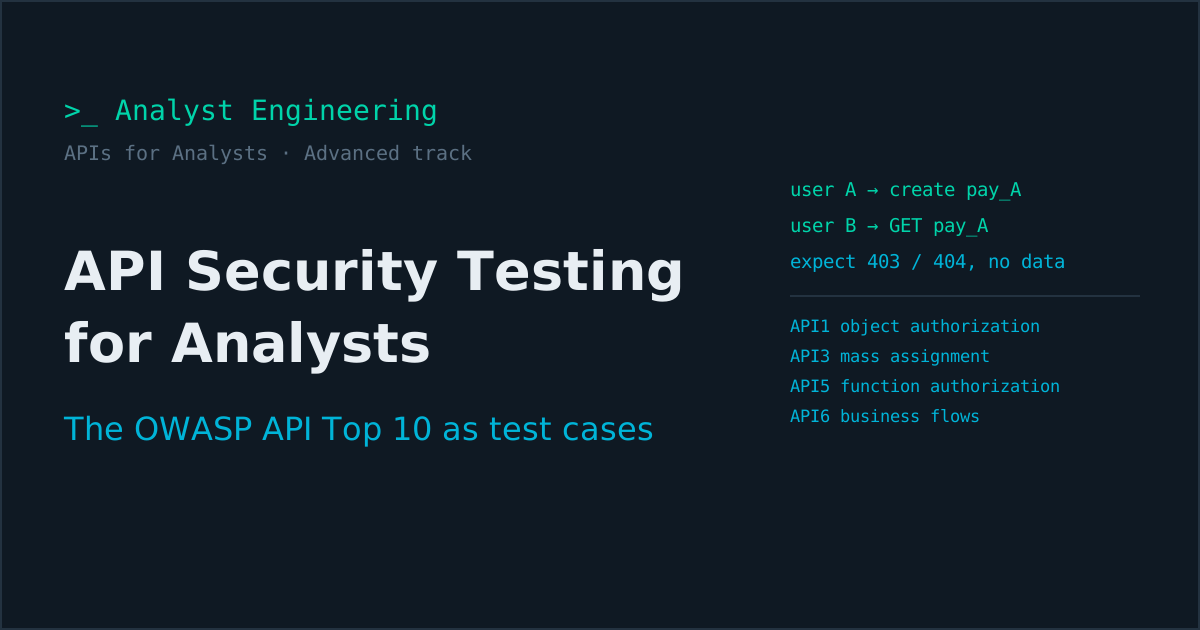
- The core technique for API authorization testing is two test identities: create a resource as user A, then attempt to read, change, or delete it as user B, and assert the API refuses without revealing data.
- Broken object level authorization, requesting another user's object by changing its ID, is ranked API1 in the OWASP API Security Top 10 2023 and should be tested on every endpoint that takes an identifier.
- Mass assignment tests send server-owned fields such as status, role, or fee in a request body and assert they are ignored or rejected, never applied.
- API security testing by analysts must stay inside written authorization: approved test environments, test identities and synthetic data, coordination with the security team, and no scanning of systems or third parties you do not own.
API security testing for analysts means proving that the API enforces the rules the business specified: who may see which object, which fields, which functions, and how often. That maps almost exactly onto the OWASP API Security Top 10 (2023), where most risks are authorization and business logic failures rather than exotic exploits. Analysts know those rules better than anyone, and can test most of them with Bruno or Postman and two test users.
To test API security as an analyst: get written authorization and an approved test environment; create at least two test identities with different ownership and roles; then turn each OWASP API Security Top 10 risk into test cases. Request user A’s objects with user B’s token (API1), break and misuse credentials (API2), look for exposed sensitive fields and try to set server-owned ones (API3), push limits (API4), call admin functions as a normal user (API5), abuse business flows (API6), probe URL-accepting fields only with security team approval (API7), and check configuration, old versions, and third-party trust (API8 to API10).
APIs for Analysts, advanced track. Builds on Part 5, API test cases and Part 6, chaining with JavaScript. Full learning path: APIs for Analysts.
What are the rules of engagement for analyst security testing?
Read this section before sending a single request. Security testing without permission is not testing, and in regulated industries it can be a disciplinary or legal matter.
- Written authorization first. Agree the scope, environments, and dates with the system owner and the security team.
- Approved test environments only. Never production, unless the security team explicitly runs a controlled exercise that includes you.
- Test identities and synthetic data. No real customer data, no borrowed colleague credentials.
- Only systems you are authorized to test. Never probe third-party APIs, including a vendor’s sandbox, beyond their published terms.
- No scanners, fuzzers, or load tools unless the security team owns and schedules them.
- Report privately through the agreed process, with tokens and data redacted. A security finding does not go in a public channel.
Scope matters too. What follows is functional security testing: verifying specified authorization and business rules at the API. Penetration testing and vulnerability research remain the security team’s work, and the best outcome of an analyst’s security tests is often a better-targeted brief for them.
Why are analysts well placed to test API security?
Because the most common API vulnerabilities are not about cryptography; they are about rules. Can a corporate user see another company’s payments? Can a maker approve their own payment? Can a client set their own fee? Can a refund exceed the original payment? Those are requirements questions first. The analyst wrote, or can read, the roles, the ownership model, and the four-eyes rules, so the analyst knows which request should fail.
How do you set up for API authorization testing?
Two identities minimum, three for role tests.
| Identity | Tenant or owner | Role | Purpose |
|---|---|---|---|
| User A | Company A | Maker | Creates the objects under test |
| User B | Company B | Maker | Attempts to access A’s objects |
| User A2 | Company A | Viewer | Tests function-level limits within the same tenant |
In Bruno or Postman, hold each token in its own variable, never in files, and capture object IDs created by user A:
security-tests/
├── environments/sit.yml          # baseUrl; tokens come from .env
├── 00-setup/
│   └── create-payment-as-user-a.yml   # captures paymentIdA
├── 10-object-authorization/
├── 20-authentication/
├── 30-property-authorization/
├── 40-resource-limits/
├── 50-function-authorization/
└── 60-business-flows/
Setting the token per request is one line in a pre-request script:
// Bruno: act as user B for this request
req.setHeader("Authorization", `Bearer ${bru.getVar("tokenUserB")}`);
What are the OWASP API Security Top 10 risks, and how do you test each?
API1:2023 Broken Object Level Authorization
The risk: the API checks that the caller is authenticated but not that they may access this object. Change an ID, get someone else’s data.
| Test | Expected |
|---|---|
GET /payments/{paymentIdA} as user B | 403 or 404; no payment data in the body |
PATCH or POST /payments/{paymentIdA}/cancel as user B | Refused; payment unchanged when re-read as user A |
| List endpoints as user B with filters naming A’s IDs or references | A’s objects never returned |
Nested routes: /accounts/{accountIdA}/transactions as user B | Refused |
IDs in bodies, not just paths: a refund for paymentIdA created by user B | Refused |
test("user B cannot read user A's payment", function () {
  expect([403, 404]).to.include(res.getStatus());
  const body = res.getBody() || {};
  expect(body).to.not.have.property("instructedAmount");
  expect(body).to.not.have.property("debtor");
});
Test every endpoint that takes an identifier, in paths, query parameters, and bodies. BOLA ranks first because it is common and trivially exploitable. It also appeared as TC-34 in Part 5 for exactly that reason.
API2:2023 Broken Authentication
The risk: weaknesses in how the API establishes identity.
| Test | Expected |
|---|---|
| No token | 401 |
| Expired token | 401 |
| Token with one character changed in its signature | 401 |
| Token issued for another environment | 401 |
| Token sent in a query string instead of the header | Not accepted |
| Repeated failed logins or token requests | Lockout or throttling per the requirements |
| Token after logout or revocation | 401 |
API3:2023 Broken Object Property Level Authorization
The risk: the caller may access the object, but not every property. Two forms: excessive data exposure in responses, and mass assignment in requests.
| Test | Expected |
|---|---|
| Read own payment as a viewer role | Restricted fields such as internal risk notes or full account numbers absent or masked |
Create a payment with "status": "ACSC" in the body | Field ignored or request rejected; payment starts in its initial status |
Update a profile with "role": "admin" | Ignored or rejected |
Create a payment with "fee": "0.00" | Ignored; fee calculated by the server |
| Compare response fields against the documented schema | No undocumented fields leaking internal data |
Mass assignment is the security side of a design principle from API design review: server-owned fields must not be writable.
API4:2023 Unrestricted Resource Consumption
The risk: no effective limits on request size, frequency, or cost.
| Test | Expected |
|---|---|
?limit=100000 on a list | Capped at the documented maximum |
| Oversized request body | 413 or a clear validation error |
| Burst beyond the documented rate limit | 429 with Retry-After |
| Expensive operations such as exports or reports repeated quickly | Limited or queued |
| Very long strings in every text field | Rejected by length validation |
Keep bursts small and agreed with the environment owner. The goal is to confirm limits exist, not to degrade a shared test environment.
API5:2023 Broken Function Level Authorization
The risk: a user can call functions intended for another role.
| Test | Expected |
|---|---|
Viewer calls POST /payments | 403 |
Maker calls POST /payments/{id}/approve for their own payment | 403: four-eyes rule enforced at the API |
Regular user calls /admin/... endpoints discovered in documentation or the browser Network tab | 403 |
Same path, different method: GET allowed, DELETE attempted | 403 or 405 |
The own-approval case is the analyst’s test. Segregation of duties is a business control; whether the API enforces it or only the screen hides the button is exactly what this proves.
API6:2023 Unrestricted Access to Sensitive Business Flows
The risk: a legitimate flow can be automated or repeated in ways that harm the business, without breaking any single rule.
| Test | Expected |
|---|---|
| Partial refunds whose total exceeds the original payment | Refused once the remaining amount is reached |
| Many small-value payments to new beneficiaries in quick succession | Velocity controls trigger per requirements |
| Beneficiary added and paid immediately, bypassing a cooling-off period | Cooling-off enforced by the API |
| Promotional or fee-waiver flows repeated per account | Limited per the business rule |
These tests come straight from business rules and fraud controls, which is why they are the most analyst-specific category in the list.
API7:2023 Server Side Request Forgery
The risk: the API fetches a URL supplied by the client, such as a webhook URL, a logo URL, or a document link, and can be tricked into calling internal addresses.
Identify every field that accepts a URL. Then, only with the security team’s explicit approval and in their chosen environment, verify that URLs pointing to internal or loopback addresses are rejected, that only allowed schemes such as https are accepted, and that redirects are not followed to disallowed destinations. Probing cloud metadata or internal network addresses is an area where the security team should design or run the test with you.
API8:2023 Security Misconfiguration
| Test | Expected |
|---|---|
Trigger a 500 or malformed request | No stack traces, SQL, framework names, or internal hostnames in the body |
Plain http:// request | Refused or redirected; never served over plain HTTP |
| Cross-origin request headers | Access-Control-Allow-Origin not * on authenticated endpoints |
OPTIONS and unusual methods | Only intended methods enabled |
| Response headers | No detailed server version banners |
API9:2023 Improper Inventory Management
The risk: forgotten API versions, undocumented endpoints, and non-production environments that are less protected.
- Call the previous version (
/v1/...) of endpoints that have a/v2: do the same authorization tests pass there? - Compare endpoints seen in the browser’s Network tab against the published contract: any undocumented ones?
- Check whether test environments reachable by partners contain real data.
Old versions are the classic gap: controls added to v2 that were never back-ported. API versioning and breaking changes covers retiring them properly.
API10:2023 Unsafe Consumption of APIs
The risk: your system trusts data from third-party APIs more than user input.
Use a mock of the third-party API, such as a Prism mock from its OpenAPI file with edited examples, to return oversized fields, unexpected types, script content in text fields, redirects, and timeouts. Your system should validate, sanitize, and fail safely, exactly as it would for user input. Mock-driven testing is covered in Part 7.
How do you automate authorization tests across endpoints?
BOLA and function-level tests share one shape: an endpoint, an identity, an expected refusal. That is a data file.
[
  { "caseId": "SEC-01", "method": "GET",  "path": "/v1/payments/{{paymentIdA}}",        "actor": "tokenUserB",  "expect": [403, 404] },
  { "caseId": "SEC-02", "method": "POST", "path": "/v1/payments/{{paymentIdA}}/cancel", "actor": "tokenUserB",  "expect": [403, 404] },
  { "caseId": "SEC-03", "method": "POST", "path": "/v1/payments/{{paymentIdA}}/approve","actor": "tokenUserA",  "expect": [403] },
  { "caseId": "SEC-04", "method": "POST", "path": "/v1/payments",                       "actor": "tokenUserA2", "expect": [403] }
]
A before-request script sets the method, the interpolated URL, and the actor’s token from the row; a tests script asserts the status is in expect and that no protected fields appear. Adding an endpoint to the security suite becomes adding a line, which is how coverage keeps pace with the API. The data-driven mechanics are shown in full in Part 5, and running the suite on every build in API tests in CI.
How do you report an API security finding?
Privately, precisely, and without spreading the weakness.
ID: SEC-03   Severity (proposed): High   Environment: SIT   Date (UTC): 2026-09-15
Rule: Maker cannot approve own payment (REQ-PAY-044, four-eyes control)
Observed: POST /v1/payments/{id}/approve by the creating maker returned 200;
          payment moved to APPROVED.
Expected: 403 with SELF_APPROVAL_NOT_ALLOWED; status unchanged.
Evidence: Request and response attached, tokens redacted. Trace ID: a1b2c3d4.
Scope note: UI hides the approve button for the maker; the API does not enforce it.
The scope note is often the most valuable line: it tells everyone the control existed only in the screen.
The APIs for Analysts learning path
Beginner: What is an API · API glossary · JSON for analysts · HTTP status codes · Your first collection · Why did my API request fail? · Reading an API contract
Intermediate: Analyze an API · Document an API · API test cases · Chaining and scripts · Webhooks · GraphQL
Advanced: POCs and demos · API design review · Versioning and breaking changes · API security testing (you are here) · API tests in CI
The takeaway
The OWASP API Security Top 10 (2023) is mostly a list of authorization and business logic failures, which makes it a natural test design framework for analysts. Work inside written authorization, set up at least two test identities, and turn each risk into cases: other users’ objects, broken credentials, exposed and writable properties, missing limits, role bypass, abusable business flows, and, with the security team, URL fetching, configuration, old versions, and third-party trust. Automate the repeatable authorization checks from a data file, and report findings privately with the rule, the evidence, and whether the control lived only in the UI.
For the test design discipline behind these cases, see API Testing and QA Mastery for BAs. Want help scoping an authorization test suite for your own API? Book a 1:1 Tech BA Coaching Call.
Ahmed is a Senior Technical Business Analyst with 10+ years in banking and payments. He builds practical guides and tools for analysts at The Tech BA Toolkit.
Tags: API Security, OWASP, Authorization Testing, QA, Payments
About the author
Analyst Engineering is written by Ahmed, a Senior Technical Business Analyst with 10+ years of banking and payments delivery experience: ISO 20022 and SWIFT messaging, payments API integration, Kafka event validation, and production support. Every article comes from real delivery work, and each one is reviewed and updated as tools and standards change.
Related articles
- How to Write API Test Cases: 40 Tests Derived From One Endpoint How to write API test cases from the contract: a six-source derivation method, 40 worked cases for one payment endpoint, and data-driven automation in Bruno.
- Negative Test Design: Engineering the Unhappy Path How to design negative tests systematically: boundary values, invalid inputs, state violations, and failure injection. The unhappy path is where the real defects live.
- API Keys, PATs, and OAuth Tokens: The Analyst's Guide to Credentials The difference between an API key, a personal access token, and an OAuth token, how to scope and rotate them, and where they belong across an analyst toolchain.
- API Design Review: The Analyst's Checklist Before the Contract Is Frozen How analysts review an API design before build: domain naming, state changes, money and dates, error model, pagination, idempotency, and a worked review.
Free account
Practice on the Labs, keep your progress
A free account, no password: an email link signs you in. It saves your steps and self-assessments on the Labs, shows your missions on a dashboard, unlocks the solutions, and, if you tick the box, sends you new missions and articles when they ship.
Your email is used to sign you in. Nothing else, unless you ask. Privacy.