Defect Triage: The Meeting Where Analysts Earn Their Seat
Written by Ahmed at Analyst Engineering, a Senior Technical Business Analyst with 10+ years in banking and payments delivery.
Key takeaways
- Triage is a classification problem with money attached, and the analyst owns exactly one axis of it: what the defect costs the business if it ships unfixed.
- Three questions settle almost any defect: is it a defect or a change, what happens if it ships, and is there a workaround. The third one converts a blocker into an inconvenience more often than teams expect.
- Defect versus change request is a budget and process question, not a blame question, and the honest third answer is that the specification was ambiguous, which is an analyst finding worth recording rather than arguing away.
- Shipping a known defect is legitimate when it is a decision: written down, impact stated, workaround documented, owner named, and operations told before go-live rather than after the first call.
Defect triage is a classification problem with money attached. Engineering capacity is finite, defects arrive faster than they can be fixed, and someone has to decide the order. QA can tell you what a defect does to the system. Only you can say what it does to the business, and that is the one input the meeting cannot proceed without.
Triage is where analysts who have spent the project writing documents suddenly become indispensable, and it is also where analysts who skipped the domain work get found out. The question on the table is never technical. It is “how bad is this really”, and answering it requires knowing what the business does with the thing that is broken.
This is how to run your side of that meeting. It follows directly from working with QA, where severity and priority are introduced as separate axes; here they meet a deadline. The payments domain knowledge that makes the impact calls possible is the subject of Break Into Banking.
What is triage actually deciding?
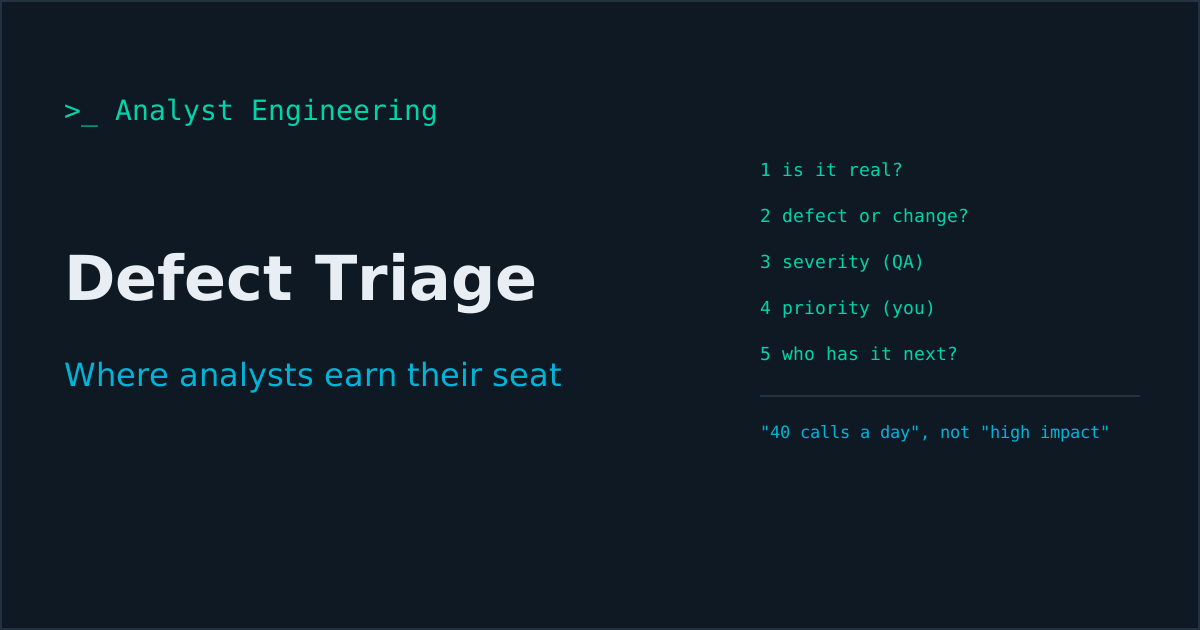
Five things per defect, in this order. Running them out of order is why triage meetings overrun.
- Is it real? Reproducible, or an environment or data artefact.
- Is it a defect or a change request? Does the system disagree with the specification, or with someone’s expectation.
- What is the severity? Technical impact, owned by QA.
- What is the priority? Business urgency, owned by you.
- Who has it next, and by when?
Most stalled triage meetings are stuck on step two while pretending to discuss step four. Settling the classification first, quickly and without defensiveness, is what keeps the meeting to its slot.
Three questions that settle almost anything
“Is it a defect or a change?” The system either disagrees with the specification or it does not. Go and read the specification in the meeting rather than arguing from memory. This takes ninety seconds and ends most disputes, and when the specification turns out to be silent or ambiguous, that is the answer, not a failure to find one.
“What happens if this ships?” The question that produces the priority. Push for specifics and refuse the abstract answer. Not “customers would be confused” but “every customer who submits a payment above the limit sees the wrong error message, so they call the contact centre, and we get roughly forty of those a day.”
“Is there a workaround?” The most under-asked question in triage and the one that most often changes the answer. A defect with a clean workaround that operations can execute is not a release blocker; it is an inconvenience with a cost you can quantify. A defect with no workaround, in a flow that runs at volume, is a blocker regardless of severity. Ask it about every candidate blocker.
How do you assess business impact?
Priority is your call, and the way to make it defensible is to stop describing the defect and start describing the consequence. Four dimensions do it.
Who is affected and how many. Every customer, one internal team, one client, an edge case that occurs twice a year. Volume is the first multiplier and it is usually knowable.
What it costs when it happens. A customer calls, so it costs a contact centre handling time. Operations repairs a payment by hand, so it costs minutes multiplied by daily volume. A payment settles incorrectly, so it costs money and a correction process. Money, time, and risk are the three currencies, and every impact reduces to one of them.
Whether it is recoverable. A wrong screen label is annoying and reversible. A payment sent to the wrong beneficiary is a recall process, a customer relationship problem, and possibly a loss. In payments this dimension dominates the others, because the industry’s defining constraint is that a settled payment cannot be silently undone.
Whether it touches a control or an obligation. This is the one non-domain people miss, and the one that reorders the list. A defect that changes what a regulatory control sees is not ranked by how it looks. The truncated debtor name that feeds sanctions screening is the standard example: cosmetic on screen, control effectiveness in substance.
Write the impact as one sentence in the defect. “Forty calls a day to the contact centre” travels through a triage meeting intact. “High business impact” does not survive contact with anyone who was not in the room.
Defect or change request?
The distinction decides which budget pays and which process applies, so it matters commercially, and it acquires heat for exactly that reason. Keep it a classification question rather than a blame question and it stays fast.
| Situation | Classification | What happens next |
|---|---|---|
| Spec says reject with AC01, system rejects with AC04 | Defect | Fix in this release, no discussion needed |
| Spec says reject, business now wants repair routing | Change request | Change control, prioritised against other work |
| Spec is silent on partial settlement, system does something odd | Analyst finding | Decide the behaviour, then it becomes a change |
| Spec is ambiguous, developer picked a defensible reading | Analyst finding | Clarify the spec, then classify the work |
| System matches spec, but the flow is unusable | Change request | Real feedback, needs a business decision |
The two middle rows are the ones teams handle badly. The instinct is to force them into defect or change, because those are the two boxes the tool offers, and the choice determines who absorbs the cost. Naming the third category honestly costs some composure and it is the professional move. It also gives you data: a pattern of ambiguity findings in one area tells you something specific about how those requirements were written, which is worth more to you than winning the individual argument.
Row five deserves its own note. “Works as specified but is unusable” is legitimate feedback and often the most valuable thing to come out of a test cycle, since the person operating the system has learned something no document anticipated. It is a change request, and it should be raised as one with the impact stated rather than dismissed because the specification was met. That is the same signal user acceptance testing exists to catch, arriving early.
How do you write a defect the team can act on?
Analysts raise defects too, and a badly written one wastes a developer’s afternoon before being closed as not reproducible. Five parts.
Title: Payment above daily limit rejected with the wrong reason code

What I did:
  Submitted a EUR 75,000 credit transfer for customer C-4471,
  whose daily limit is EUR 50,000. Environment SIT2, 2026-09-06 10:14.

What I saw:
  Payment rejected, status RJCT, reason code AC01, customer message
  "Account number incorrect".

What I expected:
  Rejection with reason code AM02 and the limit exceeded message.

Source of expectation:
  REQ-114, functional spec v2.3 section 4.2. Scheme reason code
  reference: AM02 is the limit case, AC01 is the account number case.

Business impact:
  The customer is told their account number is wrong when their
  account is fine. They will correct a field that is not the problem,
  resubmit, and fail again. Roughly 40 limit rejections per day across
  the corporate channel, so ~40 avoidable contact centre calls daily.
The two parts that make it actionable are the cited source and the impact. Without the citation it is your opinion against the developer’s, and those get resolved by seniority rather than evidence. Without the impact, triage has to reconstruct the consequence, which either takes meeting time or produces a guess. Getting the reason code right in the first place is the reason code mapping problem, and it is a good illustration of why the domain knowledge and the defect quality are the same skill.
Include the exact data you used. A defect nobody can reproduce gets closed whether or not it is real, and “a large payment” is not reproducible.
How do you defer a defect on purpose?
Every real release ships known defects. What separates a professional release from a negligent one is whether that was a decision.
A deferral is a decision when it has all five of these:
It is written down as a known defect with an identifier, not left in a QA tool nobody reads after go-live.
The impact is in plain language. Whoever reads this in three months, during an incident, needs to recognise it in ten seconds.
A workaround is documented and the people who will use it have seen it. A workaround that exists only in the head of the analyst who left is not a workaround.
Someone owns the fix with a date. Deferred without an owner means never, and everyone in the room knows it, which corrodes trust in the whole process.
Operations and support are told before go-live. This is the one that gets skipped under time pressure and it is the one that hurts. A support team that learns about a known defect from an angry customer will not believe your next release notes. Telling them beforehand converts the same defect into a handled situation, which is precisely the production support readiness that go-live depends on.
Deferred defects feed straight into the go/no-go decision, and the quality of your deferral records is what makes that meeting either a five-minute review or a two-hour reconstruction.
What goes wrong in triage?
Arrival order becomes priority. The list is worked top to bottom and the top is whatever was raised first. Re-rank by impact at the start of every session.
The loudest voice sets priority. A senior stakeholder’s irritation about a screen outranks a data integrity defect. Your job is to put the business impact of both on the table in the same units. It is uncomfortable exactly once.
Severity is used as priority. The tool sorts by severity, so the high severity items get fixed and the low severity compliance defect sits at the bottom. If your team does this, say the words out loud: these are different axes with different owners.
Nobody owns the specification question. Defects that hinge on what the requirement meant bounce between QA and development for days. That is your call to make, in the meeting, and you should make it there rather than taking it away.
Triage happens too rarely. Weekly triage during an active test phase means a defect can sit for six days before anyone decides whether it blocks. Daily and short beats weekly and long when testing is running hot.
The takeaway
Triage classifies defects under a deadline, and the analyst owns one axis: what it costs the business if it ships. Work the five decisions in order, is it real, is it a defect or a change, what is the severity, what is the priority, who has it next, and settle the classification before debating the ranking.
Assess impact by who is affected and how many, what each occurrence costs in money, time, or risk, whether it is recoverable, and whether it touches a control or an obligation. Write that as one concrete sentence in the defect, because “high impact” does not survive the meeting and “forty calls a day” does. Ask about a workaround every time, since it converts more blockers into inconveniences than teams expect.
When the specification turns out to be ambiguous, name that honestly instead of forcing it into defect or change. And when you defer, make it a decision: written down, impact in plain language, workaround documented, owner and date named, and operations told before go-live rather than after the first call.
Start with Break Into Banking for the domain knowledge that makes impact calls defensible, and API Testing and QA Mastery for BAs for the testing discipline that produces good defects, or browse everything at The Tech BA Toolkit.
Ahmed is a Senior Technical Business Analyst with 10+ years in banking and payments. He builds practical guides and tools for analysts at The Tech BA Toolkit.
Tags: QA, Business Analysis, Delivery, Defect Management, Collaboration
About the author
Analyst Engineering is written by Ahmed, a Senior Technical Business Analyst with 10+ years of banking and payments delivery experience: ISO 20022 and SWIFT messaging, payments API integration, Kafka event validation, and production support. Every article comes from real delivery work, and each one is reviewed and updated as tools and standards change.
Related articles
- Working With QA: A Field Guide for Analysts Who Do Not Test QA finds where the system disagrees with the spec, and you wrote the spec. An untestable requirement is an analyst defect. How to be the partner QA needs.
- The Go/No-Go Call: Making a Release Decision Defensible A go decision is made under uncertainty. The analyst's job is to make it explicit, not make it disappear. The readiness dimensions and the evidence.
- Reason Code Mapping: From Error to Customer Message How to map payment reason codes to causes and customer messages: ISO 20022 codes like AC04, internal errors, and the mapping that prevents support incidents.
- User Acceptance Testing: What UAT Proves That QA Cannot What user acceptance testing is, how UAT differs from SIT and QA testing, who writes the scenarios, and the entry and exit criteria that make a UAT cycle real.
Newsletter
Subscribe
Practical, no-fluff playbooks for technical analysts who analyze, code, test, and support. New articles straight to your inbox.
No spam. Unsubscribe anytime.