Bank, Consultancy, Product Company, or Public Sector? How Employer Type Shapes Analyst Pay
Written by Ahmed at Analyst Engineering, a Senior Technical Business Analyst with 10+ years in banking and payments delivery.
Key takeaways
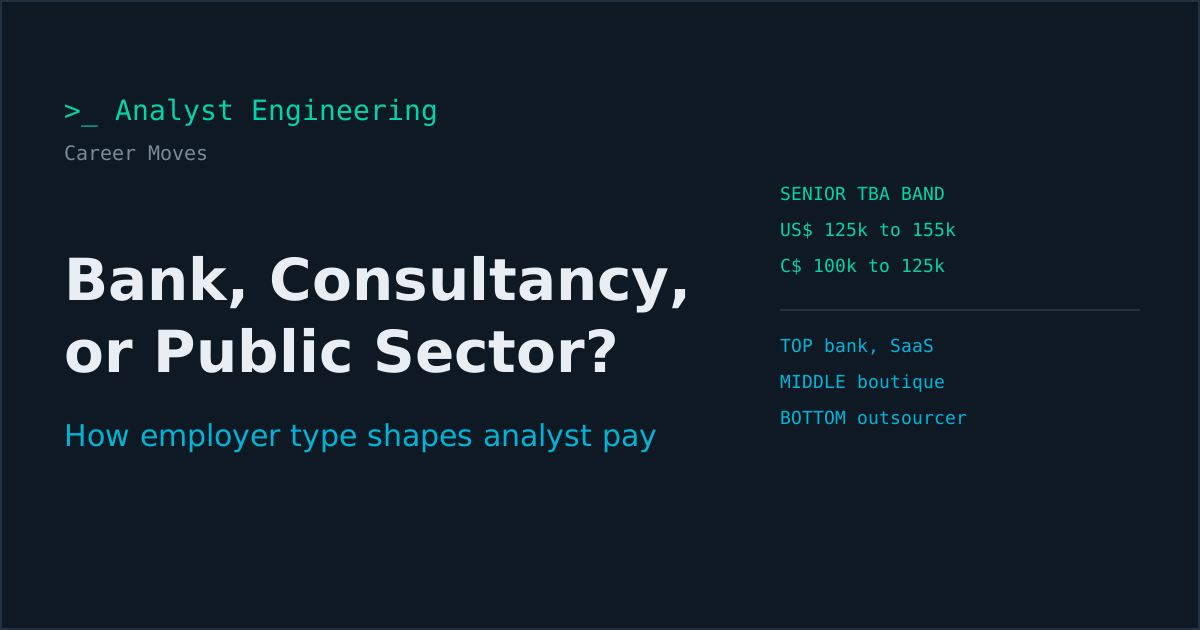
- Employer type moves an analyst's pay within a band as much as experience does: the same senior technical BA sits near the bottom of the US$125k to US$155k band at an IT outsourcer and near the top at a bank or product company.
- Banks and insurers pay analysts in the middle to top of the band, and banking in New York or London typically adds 10 to 20 percent; public sector pays bottom to middle but often adds a defined benefit pension and high job security.
- Big consultancies pay bottom to middle at analyst and consultant grades but teach fastest; the common exit is to a client, such as a bank, after two to four years.
- Price fintech equity at zero when comparing offers, and compare the whole package: base, bonus, pension, benefits, and the probability the job exists in two years.
- Remote roles for US companies from Canada or Europe often pay 20 to 40 percent below the US band, and the gap varies widely by company, contractor or employer of record set-up, and role.
Employer type moves an analyst’s pay within a band about as much as experience does. The same senior technical BA who sits near the bottom of the US$125k to US$155k band at an IT outsourcer usually sits near the top at a bank or product company, and banking in New York or London adds another 10 to 20 percent. Public sector pays the bottom to middle of the band but often adds a defined benefit pension and security; fintech startups pay bottom to middle base plus equity you should value at zero; big consultancies pay bottom to middle early and teach fastest.
On an ISO 20022 programme at a bank in Montréal, I sat for a year between two analysts doing almost the same work. One was a bank employee with a bonus, a pension, and eight years of payments knowledge. The other was placed by an IT services firm, billed to the bank at a healthy day rate, and paid a salary well under the bank analyst’s. Same desk, same pacs.008 mappings, same defects. The difference in their pay had nothing to do with skill and everything to do with who signed their contract.
Employer type is the lever most analysts never pull deliberately. Banking is where I have seen it pay most reliably, and Break Into Banking covers the complete route into banking and payments as a BA, including the domain knowledge that unlocks premium pay.
How do employer types compare for analysts?
Each employer type positions analysts differently within the same 2026 band. The table uses the bands from the analyst salary guide.
| Employer type | Position in the band | Bonus and equity | Pension and benefits | Job security | Learning speed |
|---|---|---|---|---|---|
| Banks and insurers | Middle to top; +10 to 20 percent in New York or London banking | Annual discretionary bonus common | Strong; some legacy defined benefit plans | Medium to high, with periodic restructuring | Medium, deep domain |
| Big consultancies (Big Four, Accenture-style) | Bottom to middle at analyst and consultant grades | Modest performance bonus | Good | Medium: utilisation and bench time matter | Fastest breadth |
| Boutique consultancies | Middle, top in a niche such as payments or Salesforce | Variable, sometimes profit share | Thinner | Depends on two or three clients | Fast, deep in the niche |
| IT services and outsourcers | Bottom | Small | Standard | Tied to client contracts | Depends on the client |
| Product and SaaS companies | Middle to top | Equity (stock units at public companies) | Good | Medium: layoffs in downturns | Fast on product, data, and APIs |
| Fintech startups | Bottom to middle base | Options of uncertain value | Thinner | Lowest | Very fast, wide scope |
| Public sector, government, crown corporations | Bottom to middle; crown corporations often middle | Rare | Often defined benefit pension, strong benefits | Highest | Slow in technology, deep in process and policy |
What is the analyst role actually like at each employer type?
The title is the same everywhere; the work is not.
Banks and insurers
A bank BA works on one or two long programmes: an ISO 20022 migration, core banking replacement, regulatory reporting, or claims platforms at insurers. Expect heavy governance, detailed functional specifications, traceability, and user acceptance testing. Technical BAs who can read payment messages and APIs sit at the top of the band here. The usual way in is from a consultancy or IT services placement at the same bank, or from operations inside it.
Big consultancies
At a Big Four or Accenture-style firm, the analyst runs workshops, current and future state maps, fit-gap analysis, and slide decks across several clients a year, often configuring ERP or CRM platforms as a functional consultant. Pay rises fastest at manager grade. The common exit is to a client after two to four years, usually at a higher base. Read your contract’s non-solicitation clause before you talk to a client about a job.
Boutique consultancies
Boutiques sell a niche: payments, Salesforce, data platforms, a regulation. Analysts are hands-on specialists, often technical BAs or functional consultants billed as experts. Pay sits in the middle of the band, higher in a scarce niche, and depends on the firm’s two or three biggest clients staying.
IT services and outsourcers
Outsourcers place analysts at client sites as staff augmentation. The work can be excellent, but the employer’s grid caps pay, usually at the bottom of the band, because the firm’s margin sits between your salary and the client’s day rate. The standard exit is direct hire by the client or by a competitor of the client that values the same domain.
Product and SaaS companies
Product companies often call the role product analyst, solutions analyst, or fold it into the product owner. The work leans towards data, APIs, and user outcomes, with less documentation and more experiments. Base sits in the middle to top of the band, with equity on top at public companies. Interviews usually include a case or take-home exercise.
Fintech startups
A fintech BA does everything: requirements, testing, operations, vendor integrations, and compliance evidence. Learning is the fastest of any employer type, and security the lowest. Base is bottom to middle of the band; value the options at zero when comparing offers.
Public sector, government, and crown corporations
Public sector BAs work on modernisation programmes, procurement, and policy-driven change, often alongside consultants. Base sits at the bottom to middle of the band, while defined benefit pensions (such as the Canadian federal public service plan or the UK civil service scheme), benefits, and security are the strongest anywhere. Canadian crown corporations often pay closer to the middle and keep the pension.
How much does employer type change analyst pay?
At the same level, employer type usually decides whether you sit at the bottom, middle, or top of the band. Indicative 2026 base salary, permanent roles, large cities, excluding bonus, equity, and pension:
| Role, senior level | US (USD) | Canada (CAD) | UK (GBP) | Eurozone (EUR) |
|---|---|---|---|---|
| Business analyst | 110k to 135k | 90k to 110k | 55k to 72k | 60k to 75k |
| Technical BA | 125k to 155k | 100k to 125k | 65k to 85k | 65k to 82k |
| Functional analyst / ERP consultant (mid to senior) | 90k to 145k | 78k to 120k | 48k to 78k | 52k to 80k |
| Systems analyst | 115k to 140k | 98k to 120k | 58k to 75k | 62k to 78k |
Read each band as the range from an outsourcer or public sector employer at the bottom to a bank or product company at the top. For a senior technical BA in the US, that is the difference between about US$125k and US$155k before any bonus, and more in New York banking. Certified SAP, Oracle, Salesforce, and Workday functional specialists, common at consultancies, sit 10 to 20 percent above the functional band. The base comparison understates the public sector, where a defined benefit pension is worth a meaningful share of salary, and overstates fintech, where security is lowest.
Verify before you decide: posted ranges in pay transparency jurisdictions (New York, California, Colorado, Washington, Illinois, British Columbia, and Ontario since January 1, 2026 for employers with 25 or more employees, and EU member states as they implement Directive (EU) 2023/970), the annual Robert Half, Hays, and Michael Page guides, ITJobsWatch in the UK, Levels.fyi for companies with equity, and two people one level above you at the employer type you are considering.
How does remote work for a US company from Canada or Europe pay?
Remote roles for US companies from Canada or Europe often pay 20 to 40 percent below the US band for the role, and the gap varies widely by company, role, and set-up. Three set-ups are common:
- Location-based pay tiers. The company employs you through a local entity and prices the role to a Canadian or European tier.
- Employer of record (EOR). A provider such as Deel, Remote, or Oyster employs you locally on the company’s behalf, with local payroll, benefits, and employment law, while you work for the US company.
- Independent contractor. You invoice the company, in Canada usually through a CCPC (Canadian-controlled private corporation) and in France through portage salarial or a SASU. You carry your own benefits, pension, and tax; in Canada, a contract that looks like employment risks the Personal Services Business rules.
As a contractor, compare the rate with local contract norms, not with a US salary: a senior Canadian technical BA replacing a C$110k salary needs a floor around C$80 to C$95 an hour, and the math is in Going Contract as an Analyst. If you are also changing country, sequence the moves; restarting your analyst career in a new country covers that route.
What do real moves between employer types look like?
The cases below are composites of moves I have watched on delivery teams, with details changed.
Lucas: from a Big Four consultancy to a bank in London
Lucas was a senior consultant at a Big Four firm in London on £58k, placed for eighteen months at a bank’s payments programme. He had become the person the bank’s own team asked about the SEPA and CHAPS flows. His non-solicitation clause barred him from joining that client for six months, so he applied to an open senior BA posting at a different bank with the same payment schemes. It took three months. He joined at £68k plus an annual bonus, inside the senior BA band of £55k to £72k and 17 percent above his consultancy salary. What he would do differently: build his domain depth deliberately in year one instead of discovering it by accident.
Émilie: from public sector to a fintech and back in Montréal
Émilie was a mid BA at a public agency in Montréal on C$78k with a defined benefit pension. She joined a payments fintech at C$90k plus options, the top of the mid band, and in eighteen months learned more about APIs, webhooks, and incident handling than in five years before. A funding round failed, the team was cut, and the options were worth nothing. She returned to the public sector as a senior BA at C$95k, near the bottom of the C$90k to C$110k senior band but with the pension back, and became the lead analyst on a digital services API project because of what the fintech taught her. What she would do differently: value the options at zero from the start and count the pension she gave up.
How do you choose and change employer type in 90 days?
- Week 1: weight your priorities. Score pay, security, pension, learning speed, and remote flexibility from 1 to 5. Artifact: a one-line ranking.
- Week 2: price the whole package. For your current job and two target types, add base, typical bonus, pension, and benefits, with equity at zero. Artifact: a comparison sheet.
- Weeks 2 to 4: map your skills to the target. Score yourself with the Technical Analyst Skill Matrix and check the target’s rung on the career paths. Artifact: a gap list of three skills.
- Weeks 3 to 8: build proof in the target’s language. Banks want domain and control; product companies want data and APIs; consultancies want structured workshops. Complete a mission in the Labs, such as Analyze a Payment API; a free account saves your progress and unlocks the worked solutions. Artifact: a write-up for your portfolio.
- Weeks 6 to 10: rewrite and rehearse. Adapt your CV to the target type and practise its interview style. The BA and Technical BA Interview Guide covers what each common question tests and how to answer from real work. Artifact: a tailored CV and three stories.
- Weeks 8 to 12: apply and negotiate. Artifact: an offer compared on the whole package, negotiated with the scripts in How Analysts Negotiate a Raise or an Offer.
What mistakes do analysts make when choosing an employer type?
- Comparing base only. A public sector pension and a bank bonus are both real money.
- Counting startup equity as salary. Most options never pay out.
- Staying at an outsourcer after the client values you more than your employer does. That gap is money.
- Ignoring non-solicitation clauses when moving from a consultancy to a client.
- Treating a US remote offer as a US salary without pricing currency, benefits, and your own tax obligations.
- Choosing learning speed when you need security, or the reverse, without saying it out loud.
The takeaway
Employer type decides where you sit in your band: outsourcers and public sector near the bottom, big consultancies bottom to middle, boutiques and product companies middle to top, banks middle to top with a further premium in New York and London. Pensions, bonuses, equity, and security change the real value of each. Choose on the whole package and on what you need for the next two years, and see the Analyst Career Moves map and the highest paying domains for the moves that stack with it.
If banking is the target, start with Break Into Banking. To compare two offers or plan a move with someone who has worked on both sides, book a 1:1 Tech BA Coaching Call. Pick up the free downloads, or browse everything at The Tech BA Toolkit. More on the role lives in the Business Analyst hub and the Functional Analyst hub.
Ahmed is a Senior Technical Business Analyst with 10+ years in banking and payments. He builds practical guides and tools for analysts at The Tech BA Toolkit.
Tags: Business Analysis, Salary, Consulting, Banking, Career Growth
About the author
Analyst Engineering is written by Ahmed, a Senior Technical Business Analyst with 10+ years of banking and payments delivery experience: ISO 20022 and SWIFT messaging, payments API integration, Kafka event validation, and production support. Every article comes from real delivery work, and each one is reviewed and updated as tools and standards change.
Related articles
- Analyst Salaries in 2026: Realistic Pay by Role, Level, and Country Realistic 2026 analyst pay by role and level in the US, Canada, UK, and Eurozone: BA, technical BA, QA, SDET, data, architecture, product, and contract rates.
- How Analysts Negotiate a Raise or an Offer: Scripts, Evidence, and Numbers How analysts negotiate an offer or a raise: word-for-word scripts, an evidence file with numbers, timing, non-salary items, and US, Canada, UK, and EU norms.
- The Highest Paying Domains for Business Analysts: Where Domain Knowledge Becomes Pay The domains that pay business analysts most in 2026, from payments and capital markets to ERP and healthcare IT: why each pays, the premium, how to break in.
- Going Contract as an Analyst: Day Rates, Structures, and the Math in Four Markets Analyst contract rates in 2026 for the US, Canada, UK, and eurozone, the structures (1099, CCPC, IR35, portage), and the floor-rate math behind real take-home.
Go deeper on this
Not ready to buy? The free downloads are a no-cost place to start, and every article here stays free.
Free account
Practice on the Labs, keep your progress
A free account, no password: an email link signs you in. It saves your steps and self-assessments on the Labs, shows your missions on a dashboard, unlocks the solutions, and, if you tick the box, sends you new missions and articles when they ship.
Your email is used to sign you in. Nothing else, unless you ask. Privacy.