From Analyst to Analytics Engineer: The Most Natural Technical Move, With Real Numbers
Written by Ahmed at Analyst Engineering, a Senior Technical Business Analyst with 10+ years in banking and payments delivery.
Key takeaways
- Analytics engineering is the most natural technical move for an analyst: SQL and business definitions stay at the centre, and dbt, Git, testing, and dimensional modelling are added around them.
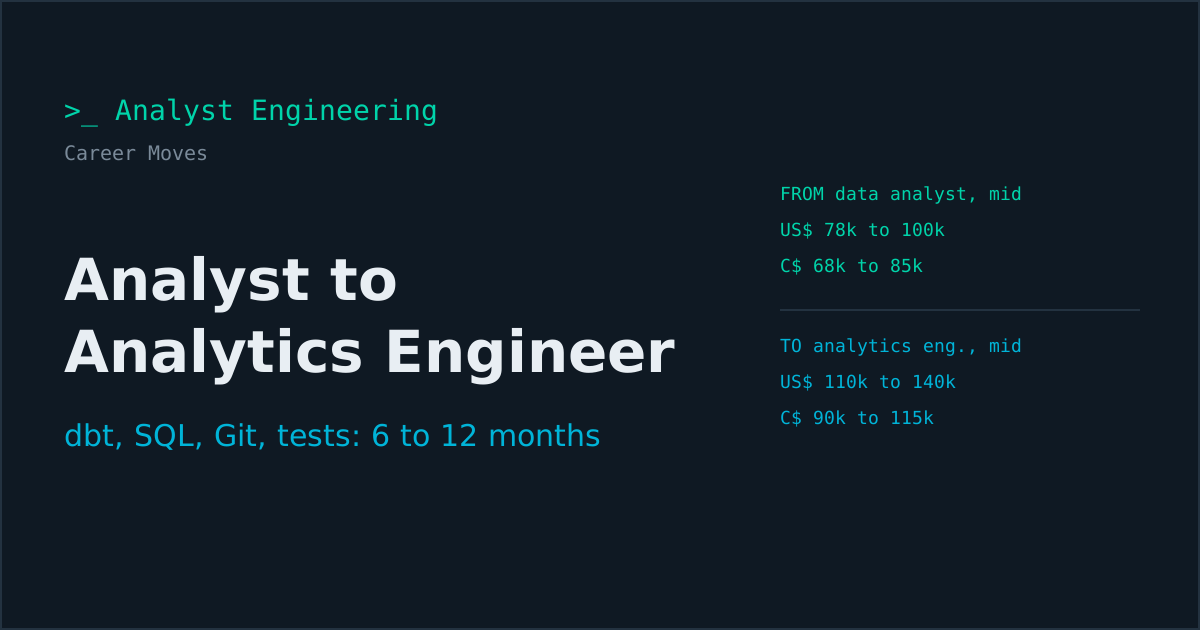
- A data analyst moving to analytics engineering typically gains 20 to 40 percent at the same level. In a large US city in 2026, a mid data analyst earns about US$78k to US$100k base and a mid analytics engineer about US$110k to US$140k.
- Most analysts make the move to analytics engineer in 6 to 12 months, learning in this order: advanced SQL, dimensional modelling, dbt with tests and docs, Git and code review, one cloud warehouse, and orchestration basics.
- Analysts who already argue over what a metric means are good analytics engineers, because the job is turning an agreed definition into a tested, documented model that everyone reads from.
- A business analyst or technical BA moving into analytics engineering is often hired at the junior or mid band and can take a short-term cut; the move pays for data analysts first.
Analytics engineering is the most natural technical move for an analyst: you keep SQL and business definitions at the centre and add dbt, Git, testing, and dimensional modelling. For a data analyst the move typically pays 20 to 40 percent more at the same level: in a large US city in 2026, a mid data analyst earns about US$78k to US$100k base and a mid analytics engineer about US$110k to US$140k. Most analysts make it in 6 to 12 months, and the ones who already argue over what “active customer” means tend to be the best at it.
On a finance data programme at a bank, three dashboards showed three different figures for monthly net fee revenue. Each was built by a capable analyst, each used a slightly different rule for reversed fees and intra-group transfers, and the finance controller had stopped trusting any of them. The person who fixed it was a former business analyst who had moved to analytics engineering the year before. She wrote the definition down, got finance to sign it, built one dbt model with tests for every rule in the definition, and pointed all three dashboards at it. The argument ended in two sprints.
That is the job: an agreed definition turned into a tested, documented model that everyone reads from. The foundation is SQL well past dashboard level, and SQL for Business Analysts is where I would tighten it before touching dbt.
What does the move to analytics engineer actually look like?
The move changes what you ship. An analyst ships answers; an analytics engineer ships the tables those answers come from, with tests and documentation, through code review. Data engineer vs analytics engineer covers the boundary with data engineering in detail.
| Dimension | Data analyst or BA | Analytics engineer | Data engineer |
|---|---|---|---|
| What you ship | Queries, dashboards, requirements | dbt models, tests, documentation | Pipelines, ingestion, infrastructure |
| Main language | SQL, some Python or Excel | SQL in dbt, Jinja, YAML | Python, SQL, orchestration code |
| Where work lives | BI tool, notebooks, Confluence | Git repository, pull requests | Git repository, cloud services |
| Judged on | Right answer, delivered on time | Correct, tested, trusted models | Reliable, scalable, cost-controlled data |
| Typical failure | A wrong join in one report | An untested model many reports depend on | A pipeline that silently drops records |
| Closest stakeholders | Business users | Analysts and finance or product owners | Platform and source system teams |
Why are analysts with definitions discipline good at analytics engineering?
Because the hardest part of analytics engineering is not dbt syntax; it is agreeing what a number means and encoding that agreement so it cannot drift. Analysts who have maintained a data dictionary or traced a figure through data lineage already think in grain, sources, and rules. Engineers who arrive from software often write elegant models of the wrong definition. Analysts rarely make that mistake.
Many analytics engineering projects start by replacing a spreadsheet model that finance or operations has run for years. Reading that logic accurately is step zero, and Excel for Business Analysts helps when the workbook you inherit is the real specification.
How much does an analytics engineer earn compared with an analyst?
A data analyst gains about 20 to 40 percent by moving to analytics engineering at the same level; a BA or technical BA often lands roughly flat or takes a short-term cut. The table shows indicative 2026 base salary for permanent roles in large cities, excluding bonus and equity.
| Role and level | US (USD) | Canada (CAD) | UK (GBP) | Eurozone (EUR) |
|---|---|---|---|---|
| Data analyst, mid | 78k to 100k | 68k to 85k | 40k to 52k | 46k to 58k |
| Business analyst, mid | 85k to 110k | 72k to 90k | 42k to 55k | 48k to 60k |
| Technical BA, mid | 95k to 125k | 80k to 100k | 50k to 65k | 52k to 65k |
| Analytics engineer, junior | 90k to 110k | 75k to 90k | 45k to 55k | 48k to 58k |
| Analytics engineer, mid | 110k to 140k | 90k to 115k | 55k to 70k | 58k to 72k |
| Analytics engineer, senior | 140k to 170k | 110k to 135k | 70k to 90k | 72k to 88k |
| Data engineer, mid to senior | 120k to 175k | 95k to 140k | 60k to 95k | 60k to 90k |
US figures are major metros; New York, Chicago, Boston, and the Bay Area sit at or above the top of each band, and smaller metros run 10 to 20 percent lower. UK figures are London; outside London is roughly 15 to 20 percent lower.
The honest reading. For a mid data analyst, the move is the best-paid technical step available: going from the US$78k to US$100k band to the US$110k to US$140k band is a real jump once you are hired at mid level. For a mid BA without dbt experience, the first offer is often at the junior analytics engineer band, which is roughly flat. For a mid or senior technical BA, that junior band is a cut, sometimes of 10 percent or more, and the gain only arrives after a year of production work. Data engineering is the further step, at US$120k to US$175k for mid to senior, and it asks for Python, orchestration, and infrastructure on top.
To verify, read posted ranges where the law requires them: New York City and New York State, California, Colorado, Washington, Illinois, and several other US states; British Columbia since November 2023 and Ontario since January 1, 2026 for employers with 25 or more employees; and EU countries as member states implement the Pay Transparency Directive (EU) 2023/970. In the UK, ITJobsWatch shows rates for “dbt” and “analytics engineer” as keywords. The annual Robert Half, Hays, and Michael Page guides, and Levels.fyi for tech employers with equity, are useful cross-checks. Then ask two people one level above you what their band is.
What skills does an analytics engineer need, and in what order?
Learn them in this order, because each one depends on the previous. Analysts who start with dbt before modelling build tidy projects with the wrong grain.
| Order | Skill | What “good enough to be hired” looks like | Start here |
|---|---|---|---|
| 1 | Advanced SQL | Window functions, CTEs, incremental logic, deduplication | SQL window functions for analysts |
| 2 | Dimensional modelling | Facts, dimensions, grain, type 2 history | Star vs snowflake schema, slowly changing dimensions |
| 3 | dbt with tests and docs | Sources, staging, marts, generic and custom tests, docs site | Reading a dbt DAG |
| 4 | Git and code review | Branches, pull requests, reviewing someone else’s model | Git for analysts |
| 5 | A cloud warehouse | Snowflake, BigQuery, or Databricks, cost and layering basics | Snowflake vs BigQuery, lakehouse vs data warehouse, medallion architecture |
| 6 | Orchestration basics | Scheduled dbt jobs, dependencies, alerting on failure | Airflow vs Dagster |
Python is useful but not first. Most analytics engineering interviews test SQL live, then modelling on a whiteboard, then a dbt take-home.
What should an analytics engineering portfolio project contain?
A portfolio project should look like a small production dbt repository, not a tutorial. This is the specification I give analysts I coach:
- A public dataset with messy parts. The NYC Taxi and Limousine Commission trip records or one of the BigQuery public datasets both work, because they have duplicates, late records, and changing reference data.
- A layered dbt project. Sources with freshness checks, staging models that only rename and cast, intermediate models for business logic, and marts with one fact table and at least two dimensions at a stated grain.
- Tests that mean something. Unique and not null on every key, relationships between facts and dimensions, accepted values on status fields, and one custom test for a business rule.
- One type 2 dimension. A dbt snapshot that keeps history on something that changes.
- A generated docs site. Every model and column described, published so a reviewer can click through the lineage graph.
- A README with decisions. Why this grain, why incremental or not, what you would change at ten times the volume, and what the tests do not catch.
- A Git history with pull requests. Small commits and self-reviewed pull requests, because interviewers read history.
The analyst portfolio covers how to present work like this when your day job is confidential.
How do you move from analyst to analytics engineer in 6 to 12 months?
Run the learning and the work side by side, one artifact per step.
- Months 1 and 2: advanced SQL and modelling. Redesign one dataset you use at work as a star schema, with the grain written above each table. Artifact: a model diagram and a one-page grain document.
- Month 3: dbt locally. Install dbt Core against DuckDB or a free warehouse trial and build the staging layer of your portfolio project. Artifact: sources, staging models, and ten passing tests.
- Month 4: Git and review. Put the project on GitHub and work only through pull requests. Ask one engineer to review one of them. Artifact: a repository with a readable history and one external review.
- Month 5: marts, history, docs. Add the fact table, dimensions, one snapshot, and the docs site. Artifact: a published docs site and the README with decisions.
- Month 6: bring it to work. Rebuild one recurring report as a tested dbt model, or the SQL equivalent if your team has no dbt yet. The BA Automation Guide covers automating the analyst workflow, and this is the step where it pays. Artifact: one report whose logic lives in version control, and one test that caught a real problem.
- Months 7 to 12: apply and interview. Target roles that say “analytics engineer” or “dbt” and prepare for a live SQL test, a modelling exercise, and a take-home. Artifact: three interview loops and a reworked README after each.
The Labs train the investigation half of the job. Following one payment across topics, consumers, and a dead letter queue in Mission 02: Validate an Event Flow is lineage work under pressure, and the full Become a Technical Analyst track gives you written findings to show. A free account saves progress and unlocks the solutions.
What does the move look like in real cases?
The cases below are composites of moves I have watched on delivery teams, with details changed. Pay figures are base salary for permanent roles.
Arjun, a BA at a Canadian bank in Toronto
Arjun was a senior BA on C$98k writing data requirements for the finance data platform. He took over the source-to-target mappings for general ledger reconciliation, then asked to build the dbt models himself under an engineer’s review. Ten months later the finance data team moved him into an analytics engineer role at C$105k, inside the mid band of C$90k to C$115k. That is about 7 percent, not 30, because he started from a BA salary.
What he would do differently: he learned dbt before dimensional modelling and rebuilt his first mart twice. Grain first, tools second.
Lotte, a data analyst in Amsterdam
Lotte was a mid data analyst on €52k at an e-commerce company where dbt already existed but nobody on the analytics side touched it. She took ownership of the marketing models, added tests that exposed a duplicate order issue, and built the portfolio project above in parallel. Eight months in, a scale-up hired her as an analytics engineer on €66k, inside the mid band of €58k to €72k, about 27 percent more.
What she would do differently: write the README decisions from day one. Every interview asked “why did you model it that way?”, and her early answers were improvised.
Tom, a technical BA in London
Tom was a senior technical BA on £70k who enjoyed SQL and moved to a mid analytics engineer role on £65k, a deliberate cut. The work was good, but after fourteen months he realised he missed workshops, trade-offs, and being the person the business called. He returned to a senior technical BA role on the data platform at £75k, with dbt now on his CV.
What he would do differently: try a two-month secondment first. The skills were never the problem; the shape of the day was.
What mistakes stall the move to analytics engineering?
- Learning dbt syntax before modelling. A tidy project with the wrong grain is still wrong.
- A portfolio with no tests and no README. Interviewers open the tests folder and the README first.
- Ignoring Git until the interview. A repository with one giant commit tells the reviewer you have never worked in a team codebase.
- Chasing every tool. Spark, Kafka, and Kubernetes can wait. SQL, modelling, and dbt get you hired.
- Presenting as a data engineer. Analytics engineering roles hire for modelling and definitions; claiming pipeline skills you do not have invites the wrong interview.
- Moving for money alone. If your best days are in workshops, the analytics engineering day will feel long, and the premium does not fix that.
The takeaway
Analytics engineering keeps the analyst’s core, SQL and definitions, and adds the engineering discipline that makes numbers trustworthy: dbt, tests, documentation, Git, and dimensional modelling. For data analysts it is the best-paid technical step, about 20 to 40 percent at the same level. For BAs and technical BAs it is a strong move with a possible short-term cut. Six to twelve months, one artifact per step, and a portfolio that reads like production work are enough. If you are deciding between routes, compare it with the move from data analyst to business analyst, the technical BA plan, and the move to software developer; which certifications are worth it covers dbt and Snowflake credentials, and the analyst salary guide and career paths show the full picture.
For the SQL that analytics engineering builds on, start with SQL for Business Analysts. If you want your portfolio project or move plan reviewed, book a 1:1 Tech BA Coaching Call. The free downloads are a no-cost starting point, and everything else is at The Tech BA Toolkit. More on the coding side of the analyst role lives in the Developer Analyst hub.
Ahmed is a Senior Technical Business Analyst with 10+ years in banking and payments. He builds practical guides and tools for analysts at The Tech BA Toolkit.
Tags: Analytics Engineering, dbt, Data Modelling, Career Growth, SQL
About the author
Analyst Engineering is written by Ahmed, a Senior Technical Business Analyst with 10+ years of banking and payments delivery experience: ISO 20022 and SWIFT messaging, payments API integration, Kafka event validation, and production support. Every article comes from real delivery work, and each one is reviewed and updated as tools and standards change.
Related articles
- Data Engineer vs Analytics Engineer: Who Does What in the Data Team Data engineers build the pipelines and platforms that move data; analytics engineers model it in the warehouse so it means something. The split, explained.
- Data Analyst to Business Analyst: From Answering Questions to Shaping Systems Data analyst to business analyst: what transfers, what you must learn, realistic 2026 pay in four markets, three composite cases, and a six month plan.
- The Analyst Portfolio: How to Show Work When Your Work Is Confidential How to build an analyst portfolio when your real work is confidential: 3 to 5 pieces, public or synthetic data, the right pieces per role, and a 5 minute pitch.
- Analyst Salaries in 2026: Realistic Pay by Role, Level, and Country Realistic 2026 analyst pay by role and level in the US, Canada, UK, and Eurozone: BA, technical BA, QA, SDET, data, architecture, product, and contract rates.
Go deeper on this
Not ready to buy? The free downloads are a no-cost place to start, and every article here stays free.
Free account
Practice on the Labs, keep your progress
A free account, no password: an email link signs you in. It saves your steps and self-assessments on the Labs, shows your missions on a dashboard, unlocks the solutions, and, if you tick the box, sends you new missions and articles when they ship.
Your email is used to sign you in. Nothing else, unless you ask. Privacy.