Which Analyst Certifications Are Worth It? CBAP, CCBA, ISTQB, PSPO, and Cloud, Ranked by Return
Written by Ahmed at Analyst Engineering, a Senior Technical Business Analyst with 10+ years in banking and payments delivery.
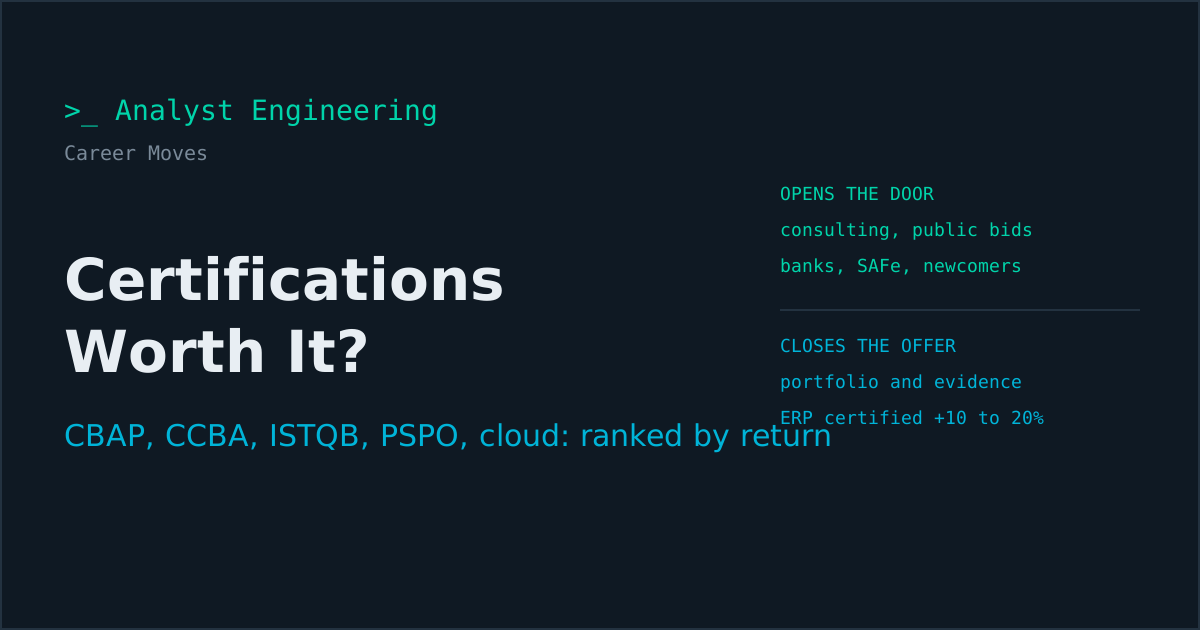
Key takeaways
- Certifications open the door in some markets and close almost no offers: consultancies, public sector bids, regulated employers, SAFe shops, and newcomers without local references are where they move pay.
- Product companies rarely screen on analyst certifications; they ask for artifacts, and a senior analyst with a strong portfolio gains little from a CBAP at a SaaS employer.
- A certification adds pay mainly by getting you into a better-paid band, not by carrying a premium of its own; SAP, Oracle, Salesforce, and Workday certified functional specialists are the exception, sitting 10 to 20 percent above the functional analyst band.
- For a QA analyst, ISTQB Foundation plus demonstrable automation is the certification route that pays most, because it supports a move to SDET worth 25 to 40 percent at the same level.
- Before paying for any certification, count how many of 20 real job ads in your target market mention it; if fewer than one in four do, build an artifact instead.
Analyst certifications are worth it in specific markets, not everywhere. IIBA CCBA and CBAP, ISTQB, PSPO, and SAFe move pay mainly at consultancies, on public sector bids, at banks and insurers, in SAFe shops, and for newcomers without local references. Product companies rarely care. A certification usually adds pay by getting you into a better-paid band rather than carrying its own premium; the clearest exception is certified SAP, Oracle, Salesforce, and Workday functional specialists, who sit 10 to 20 percent above the functional analyst band. Certifications open the door; portfolio and evidence close the offer.
A few years ago I screened CVs for two openings in the same month. The first was a consultancy bid for a provincial government programme, where the tender scored “CBAP or CCBA” and “ISTQB Foundation” per named resource. Candidates without them could not be put forward, however good they were. The second was a technical BA seat at a fintech. Nobody on the panel looked at the certifications line. We asked every candidate the same question: show me something you built and what changed because of it.
Same market, same month, opposite answers. That is why “is it worth it?” has no single answer, and why this article ranks certifications by return per role and per employer type rather than by prestige. If your market is one where IIBA credentials do open doors, the CCBA Certification Study Guide covers the knowledge areas, techniques, practice questions, and a study plan.
When does a certification actually move analyst pay?
A certification moves pay when someone in the hiring chain has to justify you to a third party who cannot judge your work directly. Five situations account for almost all of the return:
- Consultancies and public sector bids. Tenders often score named certifications per resource. A certified analyst is billable on more bids.
- Regulated employers. Banks, insurers, and large healthcare organisations use certifications as screening filters, especially in HR-led hiring.
- Newcomers and visa holders. Without local references, a recognised credential gives a recruiter something to verify. Restarting your analyst career in a new country covers the rest of that problem.
- SAFe shops. Enterprises running the Scaled Agile Framework often require SAFe role certification for product owners and release train roles.
- A role switch without the title. A QA analyst moving to automation or a support analyst moving to BA can use a certification to signal intent while the portfolio catches up.
A certification does not move pay at most product companies, at scale-ups, or for senior analysts whose track record is visible. Those employers hire on artifacts and interviews. How employer type shapes analyst pay explains why the same CV lands differently at a bank and a SaaS company.
Which analyst certifications give the best return, by role?
The table ranks each certification by typical career return for four roles. High means it regularly changes screening outcomes or supports a paid move; Low means it rarely changes an outcome on its own.
| Certification | Business analyst | Technical BA | QA analyst | Product owner |
|---|---|---|---|---|
| IIBA ECBA | Low to medium (entry only) | Low | Low | Low |
| IIBA CCBA | High in banks, consulting, public sector | Medium | Low | Low |
| IIBA CBAP | High for senior consulting and public sector | Medium | Low | Low |
| ISTQB Foundation | Low | Medium | High | Low |
| ISTQB Advanced | Low | Low | Medium (leads, test managers) | Low |
| Scrum.org PSPO | Medium | Low | Low | High |
| Scrum.org PSM | Low | Low | Low | Medium |
| Scrum Alliance CSPO or CSM | Medium | Low | Low | Medium |
| SAFe (POPM, Agilist) | High in SAFe shops only | Medium in SAFe shops | Low | High in SAFe shops |
| AWS Cloud Practitioner or Azure Fundamentals | Low | Medium | Low | Low |
| AWS Solutions Architect Associate | Low | High (if you use it) | Medium | Low |
| dbt or Snowflake certification | Low | Medium (data platforms) | Low | Low |
| Domain (ISO 20022, CAMS, CII, LOMA) | High in that domain | High in that domain | Medium in that domain | Medium |
Read the last row carefully. In a regulated domain, a domain credential often beats a second generic analyst certification, because it proves the knowledge that takes longest to learn on the job.
Which certifications are worth it, one by one?
Are the IIBA certifications (ECBA, CCBA, CBAP) worth it?
The International Institute of Business Analysis (IIBA) runs the three core BA certifications, and they are worth it where job ads name them. ECBA (Entry Certificate in Business Analysis) needs no BA work experience and helps career changers pass HR screening, little more. CCBA (Certification of Capability in Business Analysis) requires prior BA work experience and is the best value for a mid BA in banking, insurance, consulting, or government. CBAP (Certified Business Analysis Professional) requires more experience than CCBA and helps senior BAs on consulting bids and public sector programmes. Experience rules change, so check the current IIBA requirements before you plan. Exam and membership fees together typically run in the hundreds of US dollars; check current IIBA pricing. Study time is roughly one to two months for ECBA, two to three for CCBA, and three to six for CBAP. IIBA also offers specialist certifications in agile analysis, business data analytics, and cybersecurity analysis; they help most where the employer already speaks IIBA language.
Is ISTQB worth it for QA and testing roles?
ISTQB (International Software Testing Qualifications Board) Foundation is worth it for QA analysts in Europe, in consultancies, and in banks, where many job ads list it. It has no prerequisite, the exam fee is modest, and four to eight weeks of study is typical; check current prices with your national board. ISTQB Advanced (Test Analyst, Technical Test Analyst, Test Manager) requires Foundation and helps QA leads and test managers more than individual contributors. For a QA analyst aiming at SDET (software development engineer in test), Foundation plus real automation work is the combination that pays; QA Analyst to Automation Engineer has the full plan.
PSPO, PSM, CSPO, or CSM: which Scrum certification is worth it?
Scrum.org PSPO (Professional Scrum Product Owner) and PSM (Professional Scrum Master) are online exams with no mandatory course, so they are cheaper and prove you passed a demanding assessment. Scrum Alliance CSPO (Certified Scrum Product Owner) and CSM (Certified ScrumMaster) require a two-day course, which costs more; CSPO is awarded on completion and CSM adds a short online test. For a BA moving toward product ownership, PSPO is the better value; for a BA who will never run ceremonies, PSM adds little. Check current prices on both sites.
Is SAFe certification worth it?
SAFe (Scaled Agile Framework) certification is worth it only if you work in, or target, an enterprise that runs SAFe, and there it is often mandatory for product owner and release train roles. SAFe certifications generally require a paid course plus an exam, usually two to four days of training. Outside SAFe organisations it carries little weight, and some product companies read it as a signal of heavy process.
Are AWS and Azure certifications worth it for analysts?
Cloud fundamentals exams (AWS Certified Cloud Practitioner, Microsoft Azure Fundamentals) are cheap, take two to six weeks, and help a technical BA follow architecture discussions. They rarely change pay alone. AWS Solutions Architect Associate is worth it for a technical BA or systems analyst who actually works on cloud integrations, because it supports a later move toward architecture. Without hands-on use, it fails at the first follow-up question in an interview.
Are data certifications like dbt and Snowflake worth it?
The dbt Analytics Engineering certification and Snowflake SnowPro Core help analysts moving toward data platforms show they know the tool, but hiring managers weigh a public dbt project more. Treat them as a complement to the move from analyst to analytics engineer, not a substitute for the portfolio.
Are domain certifications worth more than analyst certifications?
In regulated domains, often yes. ISO 20022 training from Swift or a payments association helps analysts on payments migrations. CAMS (Certified Anti-Money Laundering Specialist, from ACAMS) is a recognised credential for analysts on AML and financial crime systems. In insurance, CII qualifications (Chartered Insurance Institute, mainly UK) and LOMA designations (life insurance, mainly North America) signal domain knowledge that takes years to absorb. Costs and study time vary widely; check current prices with each body.
How much does a certification add to analyst pay?
A certification adds pay mainly by moving you into a better-paid band. The table shows the bands a certification most often helps you reach, as indicative 2026 base salary for permanent roles in large cities, excluding bonus and equity.
| Role and level | US (USD) | Canada (CAD) | UK (GBP) | Eurozone (EUR) |
|---|---|---|---|---|
| Business analyst, junior | 65k to 85k | 58k to 72k | 32k to 42k | 38k to 48k |
| Business analyst, mid | 85k to 110k | 72k to 90k | 42k to 55k | 48k to 60k |
| QA analyst, mid | 72k to 92k | 62k to 80k | 36k to 48k | 42k to 52k |
| SDET, mid | 100k to 130k | 85k to 110k | 50k to 65k | 55k to 68k |
| Functional analyst or ERP consultant, mid to senior | 90k to 145k | 78k to 120k | 48k to 78k | 52k to 80k |
US figures are major metros, with New York, Chicago, Boston, and the Bay Area at or above the top of each band. UK figures are London. SAP, Oracle, Salesforce, and Workday certified functional specialists sit 10 to 20 percent above the functional analyst band, the one place where a certification carries a direct premium.
The honest reading: a CCBA can be the difference between a junior and a mid BA offer for a newcomer. An ISTQB Foundation alone does not move a QA analyst’s pay, but with automation it supports a move worth 25 to 40 percent. A CBAP for a senior BA at a product company is usually worth nothing in pay.
To verify, read posted ranges where the law requires them: New York City and New York State, California, Colorado, Washington, Illinois, and several other US states; British Columbia since November 2023 and Ontario since January 1, 2026 for employers with 25 or more employees; and EU countries as member states implement the Pay Transparency Directive (EU) 2023/970. In the UK, ITJobsWatch shows how often a certification appears in ads and the rates attached. The annual Robert Half, Hays, and Michael Page guides are useful cross-checks. Then ask two people one level above you what their band is.
What does a certification do in real careers?
The cases below are composites of moves I have watched on delivery teams, with details changed. Pay figures are base salary for permanent roles.
Nadia, a newcomer BA in Toronto
Nadia arrived in Toronto with five years of BA experience in banking abroad and took a payments operations role at C$58k while she job hunted. Recruiters could not verify her experience and her CV kept failing screening at the big banks. She passed CCBA in four months, rewrote her CV with the certification in the first line, and added one sanitised requirements pack from her previous job. Within two months she landed a mid BA role at a bank at C$76k, inside the band of C$72k to C$90k.
What she would do differently: start the CCBA before arriving. The certification got her past screening; the requirements pack got her the offer.
Rob, a senior BA at a SaaS company in Denver
Rob was a senior BA on US$122k, inside the senior BA band of US$110k to US$135k, and spent five months of evenings on CBAP, hoping it would unlock a lead role. It made no difference. The lead role went to a colleague who had run the analysis for a pricing migration and could show the before and after. Rob’s pay moved only with the annual adjustment.
What he would do differently: spend those five months on SQL and product analytics. At a product company, the evidence of impact is the credential.
Mei, a QA analyst in London
Mei was a mid QA analyst on £42k, inside the band of £36k to £48k, testing a banking web platform by hand. She passed ISTQB Foundation in six weeks, then spent seven months building Playwright tests for her own team’s regression pack. Nine months after starting, she moved to a mid SDET role at £56k, inside the band of £50k to £65k, about 33 percent more.
What she would do differently: nothing about ISTQB, but she would stop listing it first. The interviewer spent ten seconds on the certification and forty minutes on her test repository.
How do you choose and use a certification in 90 days?
Treat the certification as a door opener with a portfolio behind it. Each step produces something you can point to.
- Week 1: count the market. Read 20 real job ads for your target role and city and tally every certification named. Artifact: the tally.
- Week 2: decide. Pursue a certification only if at least one ad in four names it, or your employer type bids on tenders that score it. Otherwise build an artifact instead. Artifact: a one-line decision with the reason.
- Weeks 3 to 10: study with a work artifact per topic. For every technique you study, produce one real example from your job: a decision table, a process map, a test design. Artifact: the exam booked and eight work examples.
- Weeks 11 and 12: sit the exam and update the CV. Put the certification next to the artifacts it supports, not alone at the top. Artifact: a revised CV and LinkedIn profile.
- Day 90: add a portfolio piece. Complete one mission from the Labs, ideally the Become a Technical Analyst track, so you can show applied analysis alongside the credential. A free account saves your progress and unlocks the solutions. The analyst portfolio covers how to present confidential work.
The certification gets you the interview; the interview is where the offer is decided. The BA and TBA Interview Guide covers the questions BA and technical BA interviews ask, what each tests, and how to answer from real work.
What mistakes do analysts make with certifications?
- Collecting instead of building. Three certifications and no artifacts reads as someone who studies instead of delivers.
- Buying the course your market does not ask for. A two-day CSPO course is money wasted if your target ads name PSPO or nothing.
- Using CBAP to escape a stalled role at a product company. The stall is about visible impact, and a certification does not create it.
- Taking a cloud associate exam with no cloud work. The first follow-up question exposes it.
- Leading the CV with the certification. Put evidence first and the credential beside it.
- Treating the exam as the learning. Interviewers ask for an example of the technique, not its definition.
The takeaway
Certifications open the door in some markets: consultancies, public sector bids, regulated employers, SAFe shops, and for newcomers without local references. Portfolio and evidence close the offer everywhere. Count the job ads before you pay, pair every certification with an artifact, and pick domain credentials over a second generic one when you work in a regulated industry. For the technical route beyond certification, read how to become a technical business analyst, and see career paths for where each credential fits.
If CCBA is the right door for your market, start with the CCBA Certification Study Guide. If you want help deciding whether a certification is worth it for your next move, book a 1:1 Tech BA Coaching Call. The free downloads are a no-cost starting point, and everything else is at The Tech BA Toolkit. More on the role lives in the Business Analyst hub.
Ahmed is a Senior Technical Business Analyst with 10+ years in banking and payments. He builds practical guides and tools for analysts at The Tech BA Toolkit.
Tags: Business Analysis, Certification, Career Growth, Quality Assurance, Agile
About the author
Analyst Engineering is written by Ahmed, a Senior Technical Business Analyst with 10+ years of banking and payments delivery experience: ISO 20022 and SWIFT messaging, payments API integration, Kafka event validation, and production support. Every article comes from real delivery work, and each one is reviewed and updated as tools and standards change.
Related articles
- Bank, Consultancy, Product Company, or Public Sector? How Employer Type Shapes Analyst Pay How employer type shapes analyst pay: banks, Big Four and boutique consultancies, outsourcers, SaaS, fintech, and public sector on pay, bonus, and security.
- The Analyst Portfolio: How to Show Work When Your Work Is Confidential How to build an analyst portfolio when your real work is confidential: 3 to 5 pieces, public or synthetic data, the right pieces per role, and a 5 minute pitch.
- Restarting Your Analyst Career in a New Country: Canada, the UK, the EU, and the US Restarting an analyst career in Canada, the UK, the EU, or the US: why the first role is often a level down, how local proof wins it back, and pay per market.
- QA Analyst to Automation Engineer (SDET): The Skills, the Timeline, and the Pay Gap Manual QA to SDET pays 25 to 40 percent more at the same level. The stack to learn, a 6 to 12 month plan with artifacts, the AI angle, and three real moves.
Go deeper on this
Not ready to buy? The free downloads are a no-cost place to start, and every article here stays free.
Free account
Practice on the Labs, keep your progress
A free account, no password: an email link signs you in. It saves your steps and self-assessments on the Labs, shows your missions on a dashboard, unlocks the solutions, and, if you tick the box, sends you new missions and articles when they ship.
Your email is used to sign you in. Nothing else, unless you ask. Privacy.