Data Analyst to Business Analyst: From Answering Questions to Shaping Systems
Written by Ahmed at Analyst Engineering, a Senior Technical Business Analyst with 10+ years in banking and payments delivery.
Key takeaways
- A data analyst explains what happened; a business analyst specifies what the system should do next. The move from data analyst to business analyst is a change of verb, from explaining to specifying.
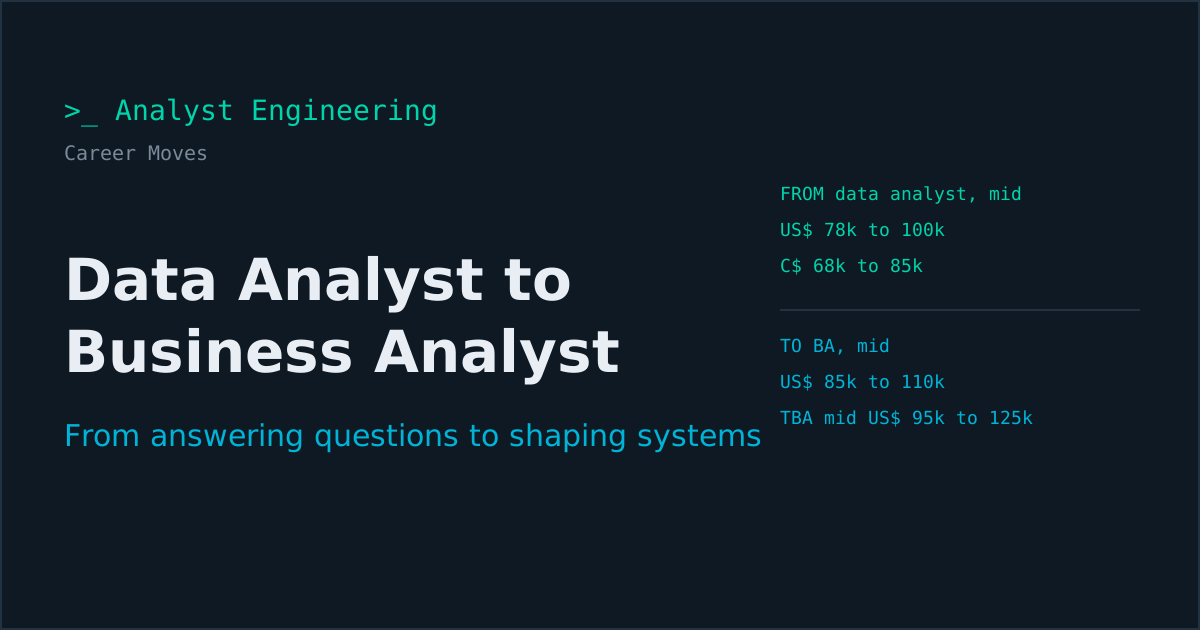
- At the same level, data analyst and business analyst pay is roughly similar: in a large US city in 2026, a mid data analyst earns about US$78k to US$100k base and a mid business analyst about US$85k to US$110k.
- The move pays most when it lands in a technical business analyst seat, where SQL is the reason you are hired and a mid technical BA earns about US$95k to US$125k base in a large US city.
- SQL, data quality instincts, and definitions discipline transfer directly; requirements writing, process mapping, API and integration thinking, and user acceptance testing are the new skills.
- A data analyst who enjoys modelling and pipelines more than workshops should go to analytics engineering instead, which pays about 20 to 40 percent more than data analysis at the same level.
A data analyst answers questions about what happened; a business analyst shapes what the system should do next. The move from data analyst to business analyst is mostly a change of verb, from explaining to specifying, and pay is roughly similar at the same level: in a large US city in 2026, a mid data analyst earns about US$78k to US$100k base and a mid business analyst about US$85k to US$110k. The move pays most when it lands in a technical business analyst seat, where your SQL becomes the reason you are hired and a mid technical BA earns about US$95k to US$125k.
On a payments data migration a few years ago, the best requirement in the room came from someone who was not a business analyst. A reporting analyst had been asked for a dashboard of rejected payments by reason code. Instead of building it, she brought a query to refinement showing that 11 percent of rejects had no reason code at all, because the upstream system dropped the field whenever an operator set the status by hand. That was not a reporting problem. It was a missing requirement, and she wrote it up as one: the field, the rule, five example rows, and the test that would prove the fix.
She joined the BA team six months later. Most data analysts I have watched make this switch did it the same way: they stopped handing over the answer and started handing over the change the answer implied. The part they had to learn was the writing, turning a finding into a requirement a developer can build and QA can test. That path, from a one-line business request to a specification with banking examples, is what From Vague BR to Functional Requirements walks through.
What does the move from data analyst to business analyst actually look like?
The move changes your time horizon and your audience. A data analyst works on data that already exists and is judged on whether the number is right. A business analyst works on behaviour that does not exist yet and is judged on whether the change was built, tested, and adopted as intended.
| Dimension | Data analyst | Business analyst |
|---|---|---|
| Core question | What happened, and why? | What should the system do, and how will we know it works? |
| Main output | Queries, dashboards, analysis decks | Requirements, process maps, acceptance criteria, UAT scripts |
| Who reads your work | Business consumers of the numbers | Business, developers, QA, architects, operations |
| Time horizon | The past, up to yesterday’s load | The next release and the one after |
| Success signal | The number is trusted and used | The change ships, passes UAT, and is adopted |
| Daily tools | SQL, Power BI or Tableau or Looker, Python, Excel | Jira, Confluence, diagrams, SQL, Bruno or Postman |
| Typical failure | A wrong join nobody catches | A missing rule nobody asked about |
Look at the bottom row. Data analysts are trained to catch the silent error, and the silent error in requirements is the missing rule. That instinct is the most valuable thing you bring.
What transfers from data analysis to business analysis?
Four things transfer directly, and hiring managers notice them.
- SQL. Most BAs cannot query the database that proves or disproves a requirement. You can, and on day one you will answer in minutes what other BAs file tickets for. If your SQL stops at joins and aggregates, SQL for analysts and SQL window functions for analysts cover the queries a BA runs to check duplicates, sequences, and state changes.
- Data quality instincts. Nulls, duplicates, grain, late-arriving records, and timezone boundaries are where requirements quietly break. You already look for them.
- Definitions discipline. A data analyst who has fought over what “active customer” means is ready to own a data dictionary, which is a requirements artifact in disguise.
- Lineage thinking. Knowing where a number comes from, the way data lineage traces it, is the same skill as knowing which system a requirement touches.
What do data analysts have to learn to become business analysts?
Five things are new, and each has a concrete artifact.
- Requirements writing. A requirement states a rule, its inputs, its outputs, and its exceptions in words a developer can build from. From business requirement to functional spec shows the decomposition.
- Process mapping. As-is and to-be flows, with the system of record for each step and the hand-offs where work waits.
- API and integration thinking. Your data arrived from somewhere. A BA needs to read the contract that sent it. Start with what an API is, then read one real contract for a feed you already use.
- User acceptance testing. Writing scenarios from the business rule, running them with users, and deciding what counts as a defect. User acceptance testing explains what UAT proves that QA cannot.
- Delivery cadence. Refinement, sprint planning, and release decisions. You stop working to a request queue and start working to a release date.
If you want a grounded picture of the whole role before you commit, What Is a Business Analyst covers what a BA does, the skills the job rewards, and the paths out of it.
Does a business analyst earn more than a data analyst?
At the same level, only slightly. The premium comes from the technical BA title and from regulated domains, not from the BA title alone. The table shows indicative 2026 base salary for permanent roles in large cities, excluding bonus and equity.
| Role and level | US (USD) | Canada (CAD) | UK (GBP) | Eurozone (EUR) |
|---|---|---|---|---|
| Data analyst, mid | 78k to 100k | 68k to 85k | 40k to 52k | 46k to 58k |
| Data analyst, senior | 100k to 125k | 85k to 105k | 52k to 68k | 58k to 72k |
| Business analyst, mid | 85k to 110k | 72k to 90k | 42k to 55k | 48k to 60k |
| Business analyst, senior | 110k to 135k | 90k to 110k | 55k to 72k | 60k to 75k |
| Technical BA, mid | 95k to 125k | 80k to 100k | 50k to 65k | 52k to 65k |
| Technical BA, senior | 125k to 155k | 100k to 125k | 65k to 85k | 65k to 82k |
US figures are major metros; New York, Chicago, Boston, and the Bay Area sit at or above the top of each band, and smaller metros run 10 to 20 percent lower. UK figures are London; outside London is roughly 15 to 20 percent lower. Banking and capital markets in New York or London typically add 10 to 20 percent.
Here is the honest reading. A mid data analyst moving to a mid BA role is roughly flat, with a small gain at best. A senior data analyst who accepts a mid BA title to get in the door often takes a short-term cut, and I have seen people do this when they did not need to. The move that pays is data analyst to technical BA: a mid data analyst at US$90k moving to a mid technical BA at US$110k is a real step, and it is the seat where your SQL counts. The other lever is domain. Regulatory reporting, payments, and risk data pay above the general BA band, which the highest paying domains for analysts covers in detail.
To verify for your market, read posted ranges where the law requires them: New York City and New York State, California, Colorado, Washington, Illinois, and several other US states; British Columbia since November 2023 and Ontario since January 1, 2026 for employers with 25 or more employees; and EU countries as member states implement the Pay Transparency Directive (EU) 2023/970. In the UK, ITJobsWatch shows permanent and contract rates by skill keyword. The annual Robert Half, Hays, and Michael Page salary guides and Levels.fyi for tech employers are useful cross-checks. Then ask two people one level above you what their band is.
When should a data analyst go to analytics engineering instead?
Go to analytics engineering if the part of your job you love is the model, not the meeting. Analytics engineering keeps you in SQL, adds dbt, Git, and tests, and pays about 20 to 40 percent more than data analysis at the same level. Business analysis moves you away from the keyboard and toward workshops, trade-offs, and sign-offs.
A quick test: if your best hours last month went into restructuring a messy model, read From Analyst to Analytics Engineer. If they went into working out what the business actually needed, stay here.
What about moving from business analyst to data analyst?
The reverse move makes sense for a BA who has discovered they prefer evidence to negotiation. At the same level it is usually flat or a small cut, because the data analyst bands sit slightly below the BA bands. Most BAs who want more time in data do better by going technical BA with strong SQL, or by aiming straight at analytics engineering.
What does the move look like in real cases?
The cases below are composites of moves I have watched on delivery teams, with details changed. Pay figures are base salary for permanent roles and sit inside the indicative 2026 bands above.
Maya, a Power BI analyst at a retailer in Toronto
Maya was a mid data analyst on C$74k building sales and inventory dashboards. When the retailer started moving reporting to a new cloud data platform, she volunteered to document the metric definitions for the migration, then wrote the source-to-target mapping for the sales data mart and ran UAT on the rebuilt reports. Seven months later she moved internally to a business analyst role on the data platform team at C$84k, inside the mid BA band of C$72k to C$90k.
What she would do differently: she did BA work for four months before anyone called it that. She would have asked for the title at month three with the mapping and UAT results in hand. Changing role inside your company is the cheapest move an analyst can make, but only if you ask.
Conor, a marketing analyst in Dublin
Conor was a mid data analyst on €49k building campaign segmentation and attribution reports. During a CRM migration, he mapped the lead-to-customer process as-is and to-be, wrote user stories with acceptance criteria for consent capture under the General Data Protection Regulation (GDPR), and tested the segment rules in the new CRM against his old queries. Nine months in, he landed a CRM business analyst role at a software company on €55k, inside the mid BA band of €48k to €60k.
What he would do differently: his first interview stalled on “walk me through a process you mapped end to end.” He had the map but described the dashboards instead. He would lead with the process map and the stories, and mention SQL only as the way he verified them.
Daniel, a reporting analyst at a bank in New York
Daniel was a senior data analyst on US$104k producing liquidity and capital reports. He traced the lineage of every report line back to the general ledger and the trade systems, wrote the data requirements for a new regulatory feed, and learned to read the API contract that delivered positions from the trading platform. Ten months later he joined another bank as a regulatory reporting technical BA on US$135k, inside the senior technical BA band of US$125k to US$155k, with the New York banking premium on top of the base range.
What he would do differently: learn the regulation earlier. His second interview was a line-by-line reading of reporting instructions, and he had only ever read them through the data. The domain knowledge was the interview.
How do you move from data analyst to business analyst in six months?
Do it on your current project, one artifact a month. Each artifact is something you can show in an interview with the confidential details removed.
- Month 1: turn one finding into a requirement. Take an anomaly you already found and write it as a functional requirement: the rule, inputs, outputs, exceptions, three example rows, and the acceptance criteria. Artifact: one requirement a developer could build from without asking you a question.
- Month 2: map one process your data describes. Draw the as-is flow behind your main dataset, with the system of record for each step and the point where each field is created. Artifact: a process map and a list of three steps where data goes wrong.
- Month 3: own the definitions for one feed. Build the data dictionary and source-to-target mapping for one table the business depends on. Artifact: a dictionary with owners, allowed values, and the rules for nulls.
- Month 4: read one API contract. Find the API or file interface that feeds your data and map its fields to your tables. List every field that is optional in the contract but required by the business. Artifact: a gap list. To practise on a realistic contract, Mission 01: Analyze the Payments API is the first step of the Become a Technical Analyst track; a free account saves your progress and unlocks the solutions.
- Month 5: run UAT for one change. Write the scenarios from the business rule, run them with the users, and log the defects with evidence. Artifact: UAT scripts, results, and a defect log.
- Month 6: package the evidence and ask. Put the five artifacts in a two-page pack, rewrite your CV around them using before and after bullets for a role change, and ask your manager for the title or apply out. Artifact: the pack and one conversation.
The SQL you use in months three to five is different from dashboard SQL: it checks rules, finds exceptions, and reconciles two systems. SQL for Business Analysts is written for that seat, and it is where to tighten your queries if you want to move straight to the technical BA title. If you want the technical version of this plan with the pay jump that goes with it, read How to Become a Technical Business Analyst.
What mistakes stall the move from data analyst to business analyst?
- Leading with dashboards in BA interviews. Hiring managers want requirements, process maps, and UAT evidence. A dashboard is proof you can report, not proof you can specify.
- Answering before asking. A data analyst’s reflex is to open the query editor. A BA’s first move is to ask what decision the change supports and who will act on it.
- Writing requirements as queries. Putting SQL in a specification hides the rule. Write the rule in words, and attach the query as evidence.
- Taking a big cut for a junior title. A senior data analyst rarely needs to accept a junior BA offer. Aim for mid BA or technical BA and bring evidence.
- Avoiding integration. Even a BA on a data platform has to read the interfaces that feed it. Skipping APIs caps you at reporting requirements.
- Treating UAT as reconciliation. Matching numbers is one check. UAT also covers workflow, permissions, and error handling.
The takeaway
The move from data analyst to business analyst is a change of verb: from explaining what happened to specifying what should happen next. SQL, data quality instincts, and definitions discipline transfer on day one; requirements, process mapping, API reading, and UAT take about six months on your current project. Pay is roughly similar at the same level, so aim for the technical BA seat or a regulated domain, where the premium is real. If you prefer modelling to meetings, analytics engineering is the better move, and the complete map of analyst career moves and career paths show where each route leads.
For the queries a BA uses to check rules and reconcile systems, start with SQL for Business Analysts. If you want a second pair of eyes on your move plan or your CV, book a 1:1 Tech BA Coaching Call. The free downloads are a no-cost place to start, and everything else is at The Tech BA Toolkit. More on the role itself lives in the Business Analyst hub.
Ahmed is a Senior Technical Business Analyst with 10+ years in banking and payments. He builds practical guides and tools for analysts at The Tech BA Toolkit.
Tags: Business Analysis, Data Analytics, Career Change, SQL, Banking
About the author
Analyst Engineering is written by Ahmed, a Senior Technical Business Analyst with 10+ years of banking and payments delivery experience: ISO 20022 and SWIFT messaging, payments API integration, Kafka event validation, and production support. Every article comes from real delivery work, and each one is reviewed and updated as tools and standards change.
Related articles
- From Analyst to Analytics Engineer: The Most Natural Technical Move, With Real Numbers How analysts become analytics engineers: dbt, SQL, Git, tests, and modelling in 6 to 12 months, realistic 2026 pay in four markets, and a portfolio spec.
- How to Become a Technical Business Analyst: The Six Month Plan and the Pay Jump How to become a technical business analyst: SQL, APIs, logs, and scripting in six months on your project, one artifact a month, and a 10 to 20 percent pay jump.
- Analyst Career Moves: The Complete Map for Switching In, Moving Up, and Earning More Every analyst career move on one map: switching in, going more or less technical, moving up, and earning more, with timelines, pay deltas, and real cases.
- Changing Role Inside Your Company: The Cheapest Career Move an Analyst Can Make An internal move is the cheapest analyst career change: 3 to 9 months, usually no pay cut. The step plan, the move proposal, and how to ask for a regrade.
Go deeper on this
Not ready to buy? The free downloads are a no-cost place to start, and every article here stays free.
Free account
Practice on the Labs, keep your progress
A free account, no password: an email link signs you in. It saves your steps and self-assessments on the Labs, shows your missions on a dashboard, unlocks the solutions, and, if you tick the box, sends you new missions and articles when they ship.
Your email is used to sign you in. Nothing else, unless you ask. Privacy.