Lead the Team or Stay Technical? Head of Business Analysis vs Principal Analyst
Written by Ahmed at Analyst Engineering, a Senior Technical Business Analyst with 10+ years in banking and payments delivery.
Key takeaways
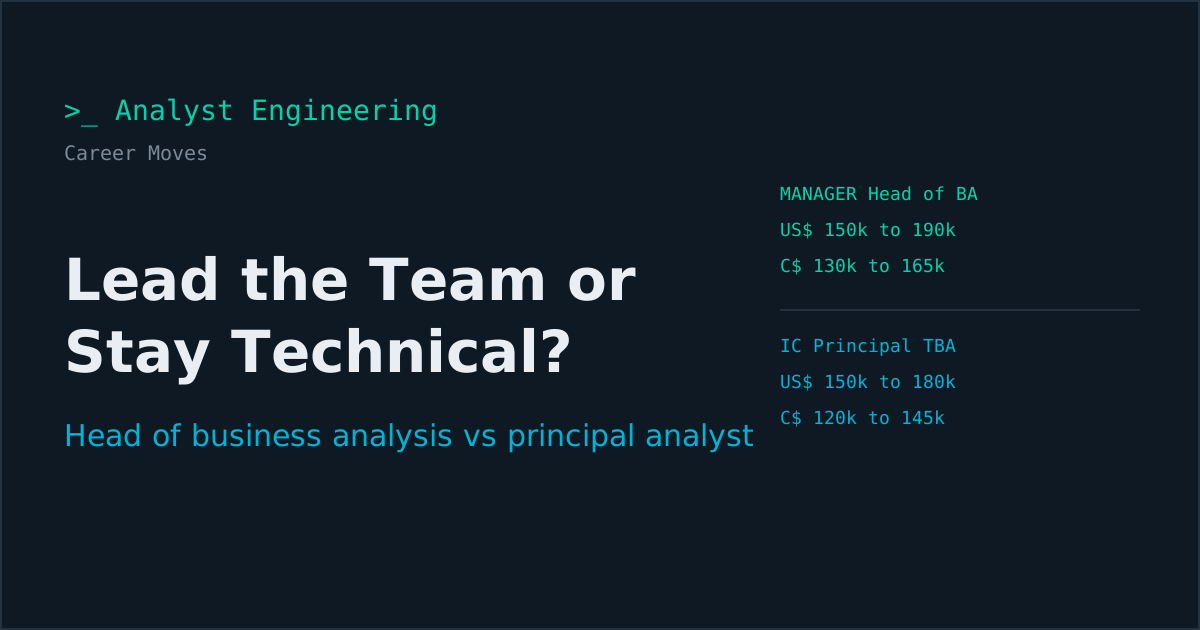
- At the top of the analyst ladder, pay converges: a head of business analysis earns about US$150k to US$190k base and a principal technical BA about US$150k to US$180k, so the choice between them is about the work, not the money.
- A head of business analysis spends most of the week on hiring, one-to-ones, performance reviews, capacity planning, and standards; in my experience analysis itself shrinks to 10 to 20 percent of the time.
- A principal analyst is paid to take the hardest cross-team problems, act as design authority on specifications, and raise the standard by example, without line management.
- Many organizations have no principal analyst level above lead BA, so an analyst who wants to stay technical must either propose the level with a written scope or move to an employer that has it.
- You can trial management without committing by leading a small team for one release, running the BA community of practice, or formally mentoring two juniors, and each of these is reversible.
At senior level every analyst meets the same fork: manage people as a head of business analysis or practice manager, or stay an individual contributor as a principal analyst, lead technical BA, or staff-level analyst. Pay converges at the top (a head of business analysis earns about US$150k to US$190k base, a principal technical BA about US$150k to US$180k), so the decision is about the work you want to do all day. Many organizations have no principal analyst track, so if you want to stay technical you may need to create the level or move to an employer that has it.
I once sat on a hiring panel for a head of business analysis at a bank. There were two internal candidates. One was the strongest analyst on the floor, the person every squad called when an ISO 20022 mapping went wrong at month end. The other was a good analyst who had quietly run the BA community of practice for two years, onboarded six new hires, and written the review checklist half the practice used.
We hired the second. The first was disappointed for about a month, then relieved: the job we described in the final interview (hiring, calibration, headcount, one-to-ones) was not the job she wanted. She wanted the hard problems, and at that bank there was no level above lead BA to hold them. Both tracks end up setting standards, one by policy and one by example, and a shared library of real deliverables helps either way. The BA Deliverables Template Pack holds 20 real deliverables from banking projects, including specs, test cases, and process maps, which is a practical starting point for a practice standard.
What is the difference between a head of business analysis and a principal analyst?
A head of business analysis is accountable for the analysts: who is hired, how they grow, where they are deployed, and how good the practice’s work is on average. A principal analyst is accountable for the analysis: the hardest problems, the cross-team designs, and the specifications nobody else can sign off. One multiplies through people; the other multiplies through judgment and example.
| Dimension | Head of BA or practice manager | Principal analyst or lead TBA |
|---|---|---|
| Accountable for | The people and the practice | The hardest analysis and its quality |
| Typical week | Hiring, one-to-ones, reviews, capacity, stakeholders | Cross-team analysis, design reviews, incidents, mentoring |
| Time doing analysis | 10 to 20 percent, in my experience | 60 to 80 percent |
| Main artifacts | Capacity plan, career framework, standards, hiring loop | Cross-system specs, context diagrams, design decisions |
| Success looks like | Analysts grow, stay, and are asked for by name | Hard programmes ship without surprises |
| Feedback loop | Months to years | Days to weeks |
| Main risk | Losing your technical edge | No level exists above lead |
| Next step | Director of delivery or change, head of product operations | Solutions or enterprise architect, distinguished analyst |
What does a head of business analysis do all day?
A head of business analysis spends most of the week on people and capacity. Hiring: job descriptions, interview loops, and saying no to good candidates who do not fit. One-to-ones: weekly with each direct report, often 6 to 12 of them. Performance reviews and calibration: defending ratings in a room with other managers. Capacity planning: a quarterly sheet of demand from programmes against the analysts you have, and the argument about which squad goes without. Standards: templates, a review checklist, a definition of ready, and onboarding.
Analysis itself shrinks. In my experience a head of BA reviews work and resolves escalations, but writes almost none of it.
What does a principal analyst do all day?
A principal analyst spends most of the week on the problems that cross team boundaries. The hardest problems: the payment flow that touches five systems, the reconciliation redesign, the migration mapping with regulatory consequences. Design authority: signing off specifications and joining API design reviews with the architects. Cross-team analysis: the system context diagram and end-to-end flows that no single squad owns. Mentoring without line management: pairing, reviewing, and setting the standard by what you produce.
The role sits close to architecture, and many principals eventually move there; the boundary is covered in systems analyst vs solutions architect and the move in from systems analyst to solutions architect.
How much does a head of business analysis earn compared with a principal analyst?
A head of business analysis and a principal analyst earn roughly the same at the top of the ladder. The table shows indicative 2026 base salary for permanent roles in large cities, excluding bonus and equity.
| Role | US (USD) | Canada (CAD) | UK (GBP) | Eurozone (EUR) |
|---|---|---|---|---|
| Technical BA, senior | 125k to 155k | 100k to 125k | 65k to 85k | 65k to 82k |
| Business analyst, lead | 130k to 160k | 105k to 130k | 70k to 90k | 72k to 90k |
| Technical BA, lead or principal | 150k to 180k | 120k to 145k | 80k to 100k | 78k to 95k |
| Head of business analysis or practice manager | 150k to 190k | 130k to 165k | 85k to 115k | 85k to 110k |
Read it honestly. The management band has a higher ceiling, most visibly in Canada (C$165k against C$145k) and London (£115k against £100k), and management roles more often carry a larger bonus. But the bottom of both bands is the same, and a principal at the top of the band out-earns a new head of BA at the bottom. If you would take management only for the extra 10 percent at the ceiling, the two years it takes to get good at the job will cost more than that in energy.
US figures are major metros; New York, Chicago, Boston, and the Bay Area sit at or above the top of each band. UK figures are London; elsewhere runs roughly 15 to 20 percent lower. Verify before you negotiate: posted ranges in pay transparency jurisdictions (New York, California, Colorado, Washington, Illinois, British Columbia, Ontario since January 1, 2026 for employers with 25 or more employees, and EU countries as member states implement the Pay Transparency Directive), ITJobsWatch in the UK, the annual Robert Half, Hays, and Michael Page guides, Levels.fyi for product companies, and two people one level above you. The full picture by role is in the analyst salary guide for 2026, and how employer type shifts these bands is in bank, consultancy, product company, or public sector.
Which track would you be good at?
You are likely to be good at the track whose frustrations you can tolerate, not only the one whose rewards you like. Use these signals, then check yourself against the technical analyst skill matrix or the roadmap.
What signals suggest you would be a good analyst manager?
- You already have informal one-to-ones: juniors come to you with career questions, not only work questions.
- You notice when someone is struggling before they say so.
- You get real satisfaction from someone else’s success, even when nobody credits you.
- You can wait months to see whether a decision worked.
- You want to fix the system of work: onboarding, templates, how analysts are allocated.
- You can have a hard conversation about performance without avoiding it for three weeks.
What signals suggest you should stay an individual contributor?
- Your best days are the ones where you cracked a problem nobody else could.
- Context switching across eight topics a day drains you.
- You would rather write the specification than review five of them.
- You are the person pulled into incidents and design reviews by name.
- You are drawn toward architecture, data, or deeper technical work.
How can you try management without committing?
You can trial management through four reversible experiments, each lasting one release or one quarter.
- Lead a small team for one release. Two or three analysts on a programme, with you allocating the work and running a weekly check-in.
- Run the BA community of practice for six months. Monthly sessions, a shared review checklist, and one standard the practice adopts.
- Mentor two juniors formally. Written goals, monthly check-ins, and a review at the end of the quarter.
- Run one hiring loop. Write the job description, design the case exercise, interview, and make the recommendation.
If these drain you, you have learned something cheaply. If you look forward to them more than to your own analysis, management is worth trying for real. For heads of BA who need an onboarding path for juniors, the Become a Technical Analyst track in the Labs gives new analysts mission-based practice on a realistic payments system, and a free account saves their progress and unlocks the solutions.
How do you create a principal analyst track where none exists?
You create a principal analyst track by proposing it in writing with a scope, a sponsor, and a pilot. Most organizations lack the level not because they rejected it but because nobody wrote it down.
- Write a one-page scope. Name the level, the domains or systems where you would be design authority, the cross-team outcomes expected, and how success is measured.
- Map it to an existing grade. Anchor it on the principal engineer or solutions architect grade, not on the BA grid, so the pay band has room.
- Find a sponsor outside the BA line. The head of architecture or a CIO direct report usually sees the gap first.
- Ask for a 12 month pilot with a review date, so nobody has to approve a permanent change up front.
- Show evidence from the last year: two or three cross-team problems you already solved, with outcomes.
If the answer is no, move. Product companies with staff levels, consultancies, and large banks with principal grades already have the level.
What do real decisions at the manager or principal fork look like?
The cases below are composites of moves I have watched on delivery teams, with details changed. Pay is base salary, permanent, large city, 2026, indicative.
Why did a senior technical BA in Toronto go back to individual contributor work?
Marcus was a senior technical BA at a Toronto bank, earning C$120k. When his manager left, he was promoted to head of business analysis for the payments division at C$145k, with eleven analysts. Within six months his calendar was one-to-ones, calibration sessions, and headcount negotiations. He estimated he spent 5 percent of his time on analysis, and the hardest part was a performance review for a former peer.
After 18 months he moved to a principal technical BA role at another bank at C$140k, a small cut. What he would do differently: trial management first through the community of practice, and negotiate a written return path before accepting.
How did a lead business analyst in London build a principal role at an insurer?
Hannah was a lead business analyst at a London insurer, earning £82k. There was no individual contributor level above lead. She wrote a one-page scope for a principal analyst: design authority for the policy administration and claims integrations, cross-team analysis for the platform migration, and mentoring for four senior analysts. The head of architecture sponsored a 12 month pilot.
It took seven months from first draft to approval. The role was confirmed at £95k. What she would do differently: anchor the band on the architecture grades from the start. Her first draft pegged the level to the BA grid, which capped it at £88k, and she lost two months renegotiating.
What does it look like when a business analyst genuinely loves management?
Lauren was a senior business analyst at a Boston asset manager, earning US$135k. She ran the BA community of practice for a year, then became BA lead for four analysts at US$155k. Three years later she became head of business analysis at US$185k, with a practice of fourteen. She loves hiring and building a practice, and she still reviews one specification a week to stay close to the work.
What she would do differently: learn headcount and budget planning before taking the lead role, because her first capacity plan was rejected by finance.
What is a six month plan to decide between manager and principal?
A six month plan runs one experiment on each track and ends with a written decision. Each step produces an artifact.
- Month 1: log your energy. Tag two weeks of your calendar as energizing or draining. Artifact: a one-page self-assessment with the patterns.
- Month 2: run a management experiment. Mentor two juniors formally. Artifact: a mentoring plan with goals and a review.
- Month 3: run a principal experiment. Own the analysis for one cross-team change. Artifact: an end-to-end flow and context diagram signed off by the architects.
- Month 4: set a standard. Write the review checklist or template the practice adopts. For analysts heading toward the principal track, the AI Ops Bundle for Technical BAs is the bundle I point to when someone will be setting how a team of technical analysts uses AI. Artifact: the adopted standard.
- Month 5: talk to your manager. Bring the evidence. If no principal level exists, bring the one-page proposal. Artifact: the proposal or the agreed next role.
- Month 6: decide and negotiate. Artifact: written scope, pay, and, for management, a return path. The negotiation scripts for analysts help here.
What mistakes stall the move at the manager or principal fork?
- Taking management because it is the only promotion on offer. Ask for the principal level first; you may get it.
- Believing you will keep doing analysis half the time. You will not. Plan for 10 to 20 percent.
- Accepting management with no return path. Put it in writing.
- Becoming a principal with no written scope. Without one you are a senior analyst who gets the hard tickets.
- Pegging a principal proposal to the BA grid. Anchor it on architecture or engineering grades.
- Managing former peers without a reset conversation. Have it in week one.
- Staying an individual contributor and refusing to mentor. A principal who does not multiply is a senior analyst with a better title.
If you are earlier in the ladder, junior to senior business analyst covers what each level expects, and the career paths page shows every route. For a leadership route with less people management, see business analyst to delivery manager.
The takeaway
The head of business analysis and principal analyst tracks pay about the same at the top, so choose the work: people, capacity, and standards on one side; the hardest cross-team problems and design authority on the other. Trial management reversibly before committing, negotiate a return path if you take it, and if your organization has no principal level, write the one-page proposal before you write your resignation.
For a practical base for practice standards, start with the BA Deliverables Template Pack. If you want to talk through your own fork or draft a principal proposal together, book a 1:1 Tech BA Coaching Call. The free downloads are a no-cost starting point, and everything else is in The Tech BA Toolkit. More on senior analyst work lives in the Business Analyst hub and the Systems Analyst hub.
Ahmed is a Senior Technical Business Analyst with 10+ years in banking and payments. He builds practical guides and tools for analysts at The Tech BA Toolkit.
Tags: Business Analysis, Leadership, Career Growth, Management, Systems Analysis
About the author
Analyst Engineering is written by Ahmed, a Senior Technical Business Analyst with 10+ years of banking and payments delivery experience: ISO 20022 and SWIFT messaging, payments API integration, Kafka event validation, and production support. Every article comes from real delivery work, and each one is reviewed and updated as tools and standards change.
Related articles
- Business Analyst to Delivery Manager or Scrum Master: The Less Technical Leadership Route BA to delivery manager, project manager, or scrum master: what transfers, what is new, pay in four markets, and why delivery manager is the durable target.
- From Systems Analyst to Solutions Architect: What the Promotion Actually Requires Senior systems analyst to solutions architect pays 15 to 25 percent more, usually after 8 to 12 years. The ADRs, NFRs, cloud cert, and design reviews it takes.
- Junior to Senior Business Analyst: What Changes at Each Level and What Gets You Promoted What changes from junior to mid, senior, and lead business analyst: scope, trust, the artifacts that prove each level, 2026 pay bands, and a promotion case.
- Bank, Consultancy, Product Company, or Public Sector? How Employer Type Shapes Analyst Pay How employer type shapes analyst pay: banks, Big Four and boutique consultancies, outsourcers, SaaS, fintech, and public sector on pay, bonus, and security.
Go deeper on this
Not ready to buy? The free downloads are a no-cost place to start, and every article here stays free.
Free account
Practice on the Labs, keep your progress
A free account, no password: an email link signs you in. It saves your steps and self-assessments on the Labs, shows your missions on a dashboard, unlocks the solutions, and, if you tick the box, sends you new missions and articles when they ship.
Your email is used to sign you in. Nothing else, unless you ask. Privacy.