Business Analyst to Delivery Manager or Scrum Master: The Less Technical Leadership Route
Written by Ahmed at Analyst Engineering, a Senior Technical Business Analyst with 10+ years in banking and payments delivery.
Key takeaways
- Moving from business analyst to delivery manager is a move from what to how and when: you stop owning the definition of the work and start owning the plan, the money, and the escalations.
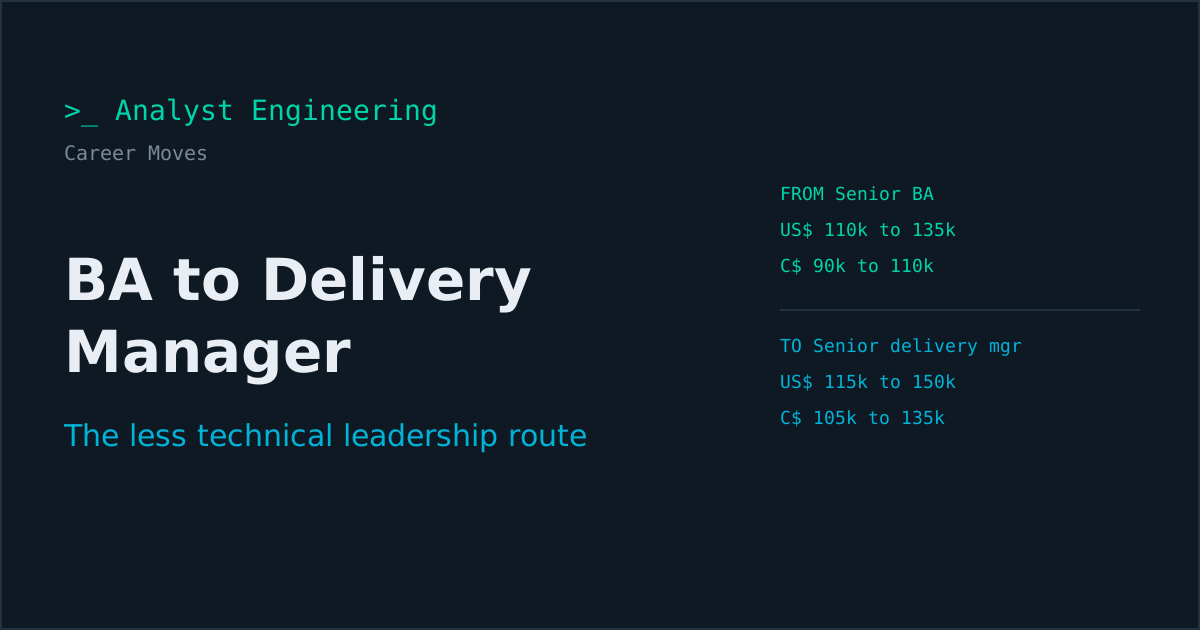
- Pay for a mid delivery manager (about US$90k to US$120k base) is roughly comparable to a mid business analyst; the upside arrives at senior level, where delivery managers earn about US$115k to US$150k.
- Standalone scrum master roles have thinned out since 2023 as teams merged the role into engineering managers and delivery leads, which makes delivery manager the more durable target for a BA.
- Facilitation, RAID thinking, and stakeholder management transfer directly from business analysis; budget, forecasting, vendor management, people conflict, and escalation are the genuinely new skills.
- A senior technical BA who moves into delivery management can take a pay cut, because the senior technical BA band overlaps or exceeds the senior delivery manager band in most markets.
Moving from business analyst to delivery manager, project manager, or scrum master is a move from owning what gets built to owning how and when it gets delivered. Pay at mid level is roughly comparable (a mid delivery manager earns about US$90k to US$120k base), and the upside arrives at senior level, about US$115k to US$150k. Standalone scrum master roles have thinned out since 2023, so delivery manager is the more durable target for a business analyst who wants a less technical leadership route.
The night before a payments platform cutover, our vendor’s release slipped by six hours. I was the analyst, so my job was to confirm which test scenarios we could still run in the shortened window. The delivery manager’s job was everything else: call the vendor’s account lead, renegotiate the cutover window with operations, rebook the weekend support rota, brief the steering committee, and decide at 2 a.m. whether the rollback plan still held.
I remember thinking I could do her job. I could do about half of it: the RAID log, the facilitation, the stakeholder calls. The other half, the budget, the vendor contract, and telling a tired developer he was coming in on Sunday, is the part nobody on the analyst side practises. Delivery managers also live in the tracking tool, and reporting that stakeholders trust starts there: Jira for Business Analysts covers Jira from the analyst’s seat, which is where most delivery managers learned it.
What does the move from business analyst to delivery manager actually look like?
The move from business analyst to delivery manager changes your core question from “what exactly is needed?” to “how and when will it ship, and what is stopping it?”. A business analyst owns the definition of the work. A delivery manager owns the plan, the flow of work through the team, the budget, the dependencies on other teams and vendors, and the escalations when any of those break.
| Dimension | Business analyst | Delivery or project manager | Scrum master |
|---|---|---|---|
| Core question | What exactly is needed? | How and when will it ship? | Is the team working well? |
| Owns | Requirements, scope detail, acceptance | Plan, forecast, budget, risks, vendors | Process, ceremonies, impediments |
| Main artifacts | Specs, stories, process maps | RAID log, forecast, burn report, release plan | Retro actions, flow metrics, working agreements |
| Hardest conversation | ”That is out of scope." | "We will miss the date, here are three options." | "This team keeps skipping its own agreements.” |
| Measured by | Nobody had to ask what you meant | Predictable delivery within budget | Team health and flow over time |
What transfers from business analysis to delivery management?
Three things transfer directly. Facilitation: if you run workshops and refinement sessions that actually refine, you already run the meetings a delivery manager runs. RAID thinking: analysts spot risks, assumptions, issues, and dependencies all day; a delivery manager writes them down with an owner and a date. Stakeholder management: you already know who needs to hear what, and in which order.
Two analyst habits transfer less obviously. Traceability, the discipline behind a requirements traceability matrix, becomes your answer to “is it done?” at release time. And the working relationships you built with developers and with QA are what let you read a team’s real status behind the green on the dashboard.
What is genuinely new for a business analyst becoming a delivery manager?
Five things are genuinely new, and they are why the role pays more at senior level.
- Budget. Burn rate per sprint, forecast at completion, and the conversation when the forecast exceeds the approved amount.
- Forecasting. Predicting a date from throughput data (items finished per week over the last ten weeks) instead of from estimates and optimism.
- Vendor management. Statements of work, change requests, service level agreements, and invoices that do not match what was delivered.
- People conflict. Two senior developers who will not review each other’s code, or a tester who is quietly burned out.
- Escalation. Raising a problem to a steering committee early, in writing, with options, before it becomes a surprise.
Why is delivery manager a more durable target than scrum master?
Delivery manager is the more durable target because it carries accountabilities that cannot be folded into another role: budget, vendors, and cross-team dependencies. This is a practitioner observation rather than a statistic: since 2023 I have watched banks and product companies merge standalone scrum master roles into engineering managers, product owners, or delivery leads, or stretch one scrum master across three or four teams. The facilitation work did not disappear; it was redistributed. A scrum master role is still a reasonable stepping stone, but plan to add budget and vendor experience early.
How much does a delivery manager earn compared with a business analyst?
A delivery manager earns roughly the same as a business analyst at mid level and more at senior level. The table shows indicative 2026 base salary for permanent roles in large cities, excluding bonus.
| Role | US (USD) | Canada (CAD) | UK (GBP) | Eurozone (EUR) |
|---|---|---|---|---|
| Business analyst, mid | 85k to 110k | 72k to 90k | 42k to 55k | 48k to 60k |
| Business analyst, senior | 110k to 135k | 90k to 110k | 55k to 72k | 60k to 75k |
| Project or delivery manager, mid | 90k to 120k | 85k to 110k | 50k to 65k | 50k to 65k |
| Project or delivery manager, senior | 115k to 150k | 105k to 135k | 65k to 85k | 62k to 80k |
| Scrum master or agile coach | 95k to 130k | 85k to 115k | 50k to 70k | 50k to 68k |
| Technical BA, senior | 125k to 155k | 100k to 125k | 65k to 85k | 65k to 82k |
The honest reading: a mid business analyst who becomes a mid delivery manager usually gains a little, more so in Canada and the UK, where the delivery manager band starts higher. A senior business analyst moving into a senior delivery manager role gains more at the top of the band than at the bottom. A senior technical BA is the exception: the senior technical BA band overlaps or exceeds the senior delivery manager band, so that move is often flat or a cut, and you make it for the work, not the money.
US figures are major metros; smaller metros run 10 to 20 percent lower. UK figures are London; elsewhere runs roughly 15 to 20 percent lower, and public sector usually sits below private. Verify before you negotiate: posted ranges in pay transparency jurisdictions (New York, California, Colorado, Washington, Illinois, British Columbia, Ontario since January 1, 2026 for employers with 25 or more employees, and EU countries as member states implement the Pay Transparency Directive), ITJobsWatch in the UK, the annual Robert Half, Hays, and Michael Page guides, and two people one level above you. The full picture is in the analyst salary guide for 2026.
Which certifications help a business analyst become a delivery manager?
Certifications help at the screening stage in some markets and matter little after that. PRINCE2 (Projects in Controlled Environments) appears in UK public sector and enterprise ads often enough to be worth the Foundation level. PMP (Project Management Professional, from the Project Management Institute) helps for project manager titles in North American banks and requires documented project leadership experience, so it follows the move rather than enabling it. PSM I (Professional Scrum Master, from Scrum.org) is quick and inexpensive, and signals little on its own. The full ranking by return is in which analyst certifications are worth it.
What do real moves from business analyst to delivery manager look like?
The cases below are composites of moves I have watched on delivery teams, with details changed. Pay is base salary, permanent, 2026, indicative.
How did a business analyst in Birmingham become a public sector delivery manager?
Grace was a mid-level business analyst on a UK public sector digital team in Birmingham, earning £44k. When the team’s delivery manager was stretched across two teams, Grace took over the RAID log, sprint planning, and the fortnightly show and tell. Over six months she added a throughput forecast that the service owner started quoting, and took PRINCE2 Foundation because every internal ad listed it.
It took ten months. She moved into a delivery manager role at £50k, about plus 14 percent. What she would do differently: ask for budget exposure earlier. Her first interview question was how she had managed a supplier, and she had only watched someone else do it.
How did a business analyst in Calgary go from scrum master to delivery lead?
Ravi was a mid business analyst at an energy company in Calgary, earning C$84k. He passed PSM I, ran ceremonies for his own squad for four months, and moved internally to scrum master at C$92k. Two years later a reorganization merged the scrum master roles into delivery leads, one per three squads. Because he had volunteered to own the vendor change requests for his squad’s integration partner, he was one of two scrum masters offered the new role, at C$118k.
Total time from BA to delivery lead: about two and a half years. What he would do differently: treat scrum master as a stepping stone from day one and ask for budget and vendor work in the first six months, not by luck.
Why did a business analyst in Paris step back from chef de projet?
Camille was a business analyst at a Paris insurer, earning €52k. She accepted a chef de projet (project manager) role at €56k, about plus 8 percent. Within three months she was spending more than half her week on steering committee packs, budget reconciliation, supplier invoices, and chasing timesheets. The analysis she enjoyed now belonged to someone else.
After fourteen months she moved to a senior business analyst role at another insurer at €60k, more than the chef de projet salary. What she would do differently: ask to shadow the current chef de projet’s calendar for a week before accepting. The admin load was visible in advance to anyone who looked.
The reverse route is common too, and it has its own logic: project manager to business analyst (and back) covers when that switch makes sense.
What is a realistic plan to move from business analyst to delivery manager?
A realistic plan takes six months inside your current job and produces one delivery artifact per step. Ask your current delivery manager or project manager to hand you each piece; most are glad to.
- Weeks 1 to 4: own the RAID log. Artifact: a RAID log with an owner and a date on every line, reviewed weekly. If your team documents in Confluence, Confluence for Business Analysts covers building pages stakeholders actually read.
- Weeks 5 to 8: forecast from data. Artifact: a forecast for the next release based on the last ten weeks of throughput, stated as a range with a confidence level, compared against the date everyone assumed.
- Weeks 9 to 12: run the ceremonies. Artifact: retro actions tracked to closure, with the percentage actually closed after four sprints.
- Month 4: shadow the budget. Artifact: a monthly burn report with forecast at completion against the approved budget.
- Month 5: own one vendor change request. Artifact: the change request with scope, cost, schedule impact, and your recommendation.
- Month 6: run a release decision. Artifact: a go/no-go pack using the structure of a defensible go/no-go call, with the decision and who signed it.
Then use the internal move playbook: an internal delivery manager seat is far easier to win than an external one when you have no delivery manager title yet. If you want to package these artifacts cleanly, the BA Deliverables Template Pack holds 20 real deliverables from banking projects, including specs, test cases, and process maps, that show the analyst side of the evidence.
Should a delivery manager keep any technical skill?
A delivery manager should keep enough technical skill to tell a real blocker from a vague one. When a developer says an integration is “nearly done”, the delivery manager who can read the failing test or the error in the log escalates the right thing at the right time. The Labs are a free way to keep that edge: the duplicate refund investigation is exactly the incident you will be escalating one day. A free account saves your progress and unlocks the solutions.
What mistakes stall the move from business analyst to delivery manager?
- Becoming the meeting scheduler. Booking ceremonies and updating tickets is not delivery management. Own a forecast and a risk, or you are an administrator.
- Keeping the BA job on the side. If you still write every spec, nobody sees you as the delivery lead, and you burn out doing two jobs.
- Choosing scrum master as the destination. The role has been merged away in too many organizations since 2023 to bet a career on it.
- Collecting certificates before evidence. A PSM I without a release you ran is a line on a CV, not a reason to hire.
- Reporting green until it is red. A status that flips from green to red in one week tells your sponsor you were not looking.
- Avoiding the money. Delivery managers who never touch the budget stay mid level.
If you are still deciding between leadership routes, compare this one with business analyst to product manager and the manager versus principal fork, and see all routes on the career paths page.
The takeaway
Business analyst to delivery manager is the less technical leadership route, and it is a sound one. Pay is comparable at mid level and better at senior level, the analyst skills of facilitation, RAID thinking, and stakeholder management carry straight over, and the new skills (budget, forecasting, vendors, conflict, escalation) are learnable inside your current job in about six months. Aim at delivery manager rather than scrum master, and if you are a senior technical BA, check the numbers first, because the move may cost you money.
To get fluent in the tool delivery managers report from, start with Jira for Business Analysts. If you want help turning your six months of evidence into a CV and an internal pitch, book a 1:1 Tech BA Coaching Call. The free downloads are a no-cost starting point, and everything else is in The Tech BA Toolkit. More on the analyst side of delivery lives in the Business Analyst hub.
Ahmed is a Senior Technical Business Analyst with 10+ years in banking and payments. He builds practical guides and tools for analysts at The Tech BA Toolkit.
Tags: Business Analysis, Delivery Management, Project Management, Scrum, Career Growth
About the author
Analyst Engineering is written by Ahmed, a Senior Technical Business Analyst with 10+ years of banking and payments delivery experience: ISO 20022 and SWIFT messaging, payments API integration, Kafka event validation, and production support. Every article comes from real delivery work, and each one is reviewed and updated as tools and standards change.
Related articles
- Project Manager to Business Analyst (and Back): When the Switch Makes Sense and What It Pays Project manager to business analyst, or BA to PM: what each role owns, what each must learn, pay at the same level, signs of the wrong seat, and real cases.
- Business Analyst to Product Manager: The Real Route Through Product Owner Most BAs reach product manager through product owner. What changes, what it pays in four markets, the skills to add, and a six month plan with artifacts.
- Lead the Team or Stay Technical? Head of Business Analysis vs Principal Analyst Head of business analysis or principal analyst? What each does all day, pay in four markets, how to trial management, and how to create a principal track.
- The Go/No-Go Call: Making a Release Decision Defensible A go decision is made under uncertainty. The analyst's job is to make it explicit, not make it disappear. The readiness dimensions and the evidence.
Go deeper on this
Not ready to buy? The free downloads are a no-cost place to start, and every article here stays free.
Free account
Practice on the Labs, keep your progress
A free account, no password: an email link signs you in. It saves your steps and self-assessments on the Labs, shows your missions on a dashboard, unlocks the solutions, and, if you tick the box, sends you new missions and articles when they ship.
Your email is used to sign you in. Nothing else, unless you ask. Privacy.