Project Manager to Business Analyst (and Back): When the Switch Makes Sense and What It Pays
Written by Ahmed at Analyst Engineering, a Senior Technical Business Analyst with 10+ years in banking and payments delivery.
Key takeaways
- A project manager owns time, cost, and delivery risk; a business analyst owns what gets built and whether it is right. The switch is about which of those problems you want to own.
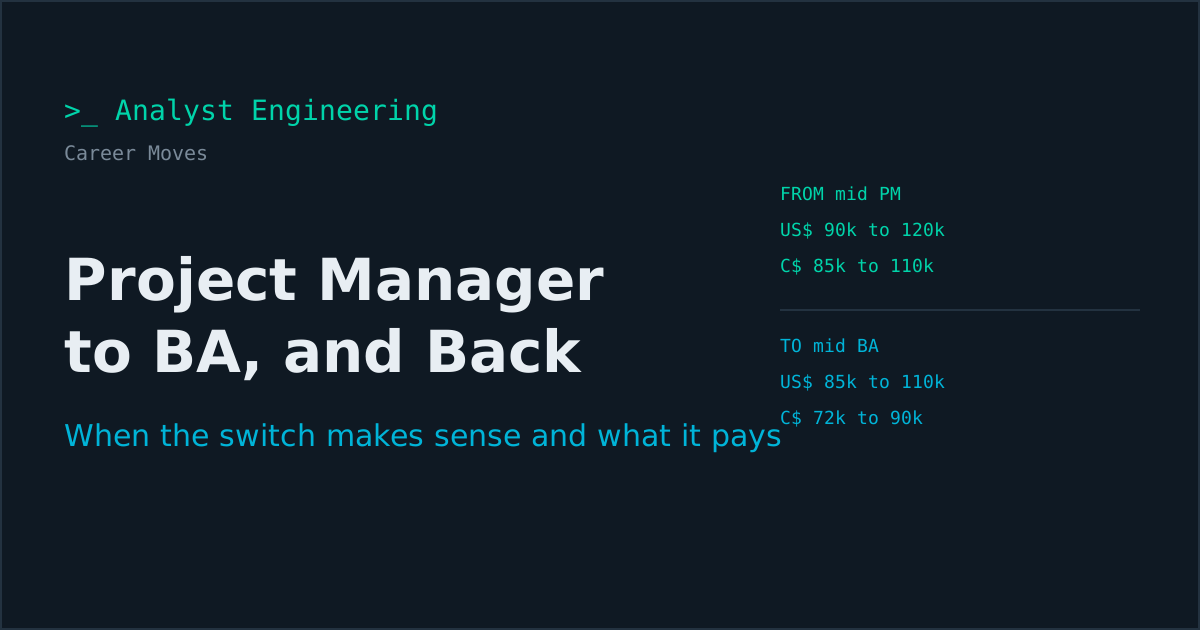
- Pay is roughly comparable at the same level: a mid delivery manager in a US major metro earns US$90k to US$120k base and a mid business analyst US$85k to US$110k, so the move is decided by the work, not the money.
- PMO analysts gain the most from moving into business analysis, because they already know the delivery process and move into a role with a higher ceiling and a clearer craft.
- A project manager moving to BA must learn requirements depth, process and data modelling, testing, and basic SQL; a BA moving to PM must learn estimation, RAID logs, budget, and vendor management.
- If you keep rewriting other people's requirements as a PM, or keep chasing status updates as a BA, you are in the wrong seat, and the signal is worth acting on within a year.
A project manager owns time, cost, and delivery risk; a business analyst owns what gets built and whether it is right. Pay is roughly comparable at the same level (a mid delivery manager in a US major metro earns US$90k to US$120k base, a mid business analyst US$85k to US$110k), so switching between project manager and business analyst is a decision about which problems you want to own, not about money. PMO (project management office) analysts gain the most from the move into analysis, and BAs who move to PM should do it for the delivery work, not the title.
On a card payments program I worked on, the project manager was brilliant at her job. The plan was always current, vendors delivered on time, and steering committees ended early. But every Thursday she sat with me for an hour, rewriting acceptance criteria. She was right about most of them. After the third month she said: “I think I am in the wrong chair.” A year later she was a senior BA on the same program, and the plan was run by someone who liked plans.
I have also watched the opposite: a strong BA promoted to project manager who spent his days chasing status updates and his evenings reading the specs he was no longer allowed to write. Both seats are skilled. Picking the wrong one is expensive. If you are a PM moving toward analysis, the core craft to learn is turning a one-line business request into a spec a developer can build, which is what From Vague BR to Functional Requirements walks through with banking examples.
What is the difference between a project manager and a business analyst?
The difference between a project manager and a business analyst is what each one is accountable for. The PM is accountable for delivering the agreed scope on time and on budget, with risks managed. The BA is accountable for the scope being the right scope, precise enough to build and test.
| Dimension | Project or delivery manager | Business analyst |
|---|---|---|
| Owns | Time, cost, delivery risk | What gets built and whether it is right |
| Core question | When will it be done, and what is in the way? | What exactly must it do, and why? |
| Key artifacts | Plan, RAID log (risks, assumptions, issues, dependencies), budget, status report | Requirements, process models, acceptance criteria, traceability |
| Success measure | Delivered on time, on budget, risks controlled | Built right, accepted by the business, few defects traced to requirements |
| When scope changes | Assesses impact on plan and cost | Assesses impact on the solution and the other requirements |
| Talks to most | Sponsors, vendors, team leads | Business users, developers, QA, architects |
| Meetings they run | Steering, status, risk reviews | Workshops, refinement, UAT planning |
| At the release gate | Owns the plan to go live | Owns the evidence that the requirements are met |
At the release gate the two meet. The go/no-go decision needs both: the PM’s view of readiness and the BA’s evidence that what was asked for was built.
Scrum masters sit in between: they own the team’s process rather than the plan. The broader delivery route out of analysis, including scrum master, is in business analyst to delivery manager or scrum master.
How do project manager and business analyst pay compare?
Project manager and business analyst pay are roughly comparable at the same level, with PM bands a little higher in most markets. The figures below are indicative 2026 base salaries for permanent roles in large cities, excluding bonus.
| Role | US (USD) | Canada (CAD) | UK, London (GBP) | Eurozone (EUR) |
|---|---|---|---|---|
| Business analyst, junior | 65k to 85k | 58k to 72k | 32k to 42k | 38k to 48k |
| Business analyst, mid | 85k to 110k | 72k to 90k | 42k to 55k | 48k to 60k |
| Business analyst, senior | 110k to 135k | 90k to 110k | 55k to 72k | 60k to 75k |
| Technical BA, senior | 125k to 155k | 100k to 125k | 65k to 85k | 65k to 82k |
| Project or delivery manager, mid | 90k to 120k | 85k to 110k | 50k to 65k | 50k to 65k |
| Project or delivery manager, senior | 115k to 150k | 105k to 135k | 65k to 85k | 62k to 80k |
| Scrum master or agile coach, mid to senior | 95k to 130k | 85k to 115k | 50k to 70k | 50k to 68k |
The honest reading:
- In the US and the Eurozone the bands nearly match. A mid PM and a mid BA are within about 5 to 10 percent of each other at the band midpoints.
- In Canada and London the PM band sits higher at mid level, by roughly 15 to 20 percent at the midpoints. A mid PM in Toronto moving to a mid BA role will usually take a cut.
- Technical BA closes the gap. A senior technical BA at US$125k to US$155k overlaps fully with a senior project manager at US$115k to US$150k.
- PMO analysts gain the most. PMO analyst pay varies too much to band reliably, but the roles I have seen sit at or below the junior to mid BA bands, so moving into a BA role is usually a raise with a higher ceiling.
- Banking in New York or London typically adds 10 to 20 percent to both roles.
To verify for your market, read posted ranges where the law requires them: New York, California, Colorado, Washington, Illinois, and several other US states; British Columbia since November 2023; Ontario since January 1, 2026 for employers with 25 or more employees; and EU countries as member states implement the Pay Transparency Directive. In the UK, ITJobsWatch shows rates by keyword. The Robert Half, Hays, and Michael Page annual guides are good cross-checks, and so is asking two people one level above you. All bands are in the analyst salary guide for 2026.
What must a project manager learn to become a business analyst?
A project manager moving to business analysis must learn four things, and most of them are about depth:
- Requirements depth. A PM knows a requirement exists; a BA knows its business rules, data, exceptions, and acceptance criteria. Start with the difference between the two main documents in BRD vs FRD, then the decomposition in from business requirement to functional spec.
- Modelling. Process maps with exceptions, not just swimlanes of happy paths, plus basic data models and state diagrams.
- Testing. Deriving tests from requirements and proving coverage with a requirements traceability matrix. PMs often know the matrix as a governance artifact; a BA builds it.
- Basic SQL. Enough to check a rule against real data and answer a question without waiting for a report. SQL for analysts covers the queries that matter.
PMs with a PMP (Project Management Professional) certification often want a BA credential to show the switch on paper. The IIBA CCBA (Certification of Capability in Business Analysis) is the usual choice for someone with a few years of requirements exposure; The CCBA Certification Study Guide covers the knowledge areas, techniques, practice questions, and a study plan. Whether it is worth it for you is weighed in which analyst certifications are worth it.
What must a business analyst learn to become a project manager?
A business analyst moving to project management must learn the four things BAs usually hand to someone else:
- Estimation. Not story points for a sprint, but effort and duration for a release with dependencies, and the confidence range around them.
- RAID logs. Risks, assumptions, issues, and dependencies, owned and reviewed weekly, with escalation paths.
- Budget. Forecast against actuals, the cost of a change request, and what to cut when the money runs short.
- Vendor management. Statements of work, milestones, acceptance of deliverables, and the conversation when a vendor misses a date.
The BA advantage in PM is that you can read a change request and see its real impact on the solution. The risk is that you keep doing the analysis yourself and neglect the plan.
What are the signs you are in the wrong seat?
The clearest sign you are in the wrong seat is which part of the job you do when nobody is watching.
Signs a project manager should be a BA:
- You rewrite the team’s acceptance criteria because they are vague.
- You enjoy the requirements workshop and dread the steering committee.
- You find yourself in refinement asking the questions the BA should have asked.
- Status reporting feels like overhead rather than the job.
Signs a BA should be a PM:
- You chase dependencies and dates because nobody else does, and you are good at it.
- You care more about whether the release lands than about the precision of the rule.
- Vendors and sponsors trust your forecasts.
- Writing the fifth version of a spec feels like a delay rather than the work.
What does the switch look like in real cases?
The cases below are composites of moves I have watched on delivery teams, with details changed.
Amira: PMO analyst in London to business analyst
Start: PMO analyst at a bank, £40k, three years running governance packs, RAID consolidation, and resource plans across a change portfolio. What she built (9 months): a current state process map for a regulatory reporting change, the requirements traceability matrix for the same release, and the acceptance criteria for four stories, reviewed by the lead BA. First role: business analyst on the bank’s regulatory change team, an internal move. New pay: £50k, in the mid BA band, a gain of 25 percent. What she would do differently: stop producing the portfolio packs in parallel for six months. She did both jobs and nearly burned out.
Greg: project manager in Dallas to business analyst
Start: senior project manager at an insurer, US$128k, tired of status reporting and steering decks. What he built (5 months): the functional spec for a claims intake change he was also managing, a process model of the exceptions, and a set of SQL checks against the claims database he learned to write for the purpose. First role: senior business analyst on a different program at the same insurer. New pay: US$122k, inside the senior BA band, a cut of about 5 percent. What he would do differently: go for a technical BA role. His SQL was good enough within a year, and the senior technical BA band would have meant a raise, not a cut.
Luc: BA in Montréal to project manager, and back
Start: senior BA on a payments platform, C$98k. What he did: took a senior project manager role at C$115k. Eighteen months later, tired of budget reviews and vendor escalations, he moved back. Return role: senior technical BA on an ISO 20022 program at C$116k, inside the band, so the round trip cost him nothing in pay. What he would do differently: act as delivery lead for one quarter before changing title. He would have learned within weeks that he missed the analysis.
What is the plan to move from project manager to business analyst?
A project manager can build the BA evidence in about six months on a live project if each step leaves an artifact. Before starting, score yourself on the technical analyst skill matrix and look at the roadmap; the other routes into and out of analysis are on the career paths page.
- Weeks 1 to 2: choose the target. Business analyst, functional analyst on a packaged platform, or technical BA. Artifact: a target statement and your three weakest skills.
- Month 1: write one functional spec. Pick a change on your own project and write the rules, data, and acceptance criteria. Ask the BA to review it. Artifact: a reviewed spec section.
- Month 2: model a process. Map the current and target state for one process, including exceptions and volumes. Artifact: the two maps with a list of changes.
- Month 3: build a traceability matrix. Link every requirement in one release to its tests and results. Artifact: the matrix, with gaps found.
- Month 4: learn basic SQL. Answer one business question from real data. Artifact: the query and the answer you gave.
- Months 5 to 6: own a story through refinement, then move. Present your artifacts to the BA lead and ask about openings; the internal route is usually cheapest, as covered in changing role inside your company. Artifact: a story you owned from request to ready, and an agreed move.
PMs know Jira as a tracking tool; BAs use it to hold the requirement itself: stories, acceptance criteria, links to tests. Jira for Business Analysts covers Jira from the analyst’s side of the board.
How can a project manager practise analysis without changing roles first?
A project manager can practise analysis on a realistic system outside work and keep the output as evidence. The Labs are missions on a fictional payments platform. Start with Analyze a payment API, where you read a contract against requirements and business rules and produce a gap register. PMs tend to rank the gaps well by delivery risk; the practice is writing each one precisely enough that the API team can answer it in one line.
The missions follow the Become a Technical Analyst track. A free account saves your progress and unlocks the solutions and self-assessment.
What mistakes stall the move between PM and BA?
- Running the analysis like a project. A spec is not done because the date arrived. PMs moving to BA often ship requirements on time and incomplete.
- Keeping the PM job on the side. Doing the plan and the analysis at once means neither gets done well, and your manager keeps seeing you as the PM.
- Staying shallow. A process map with no exceptions and no data is a PM’s map. Go one level deeper than feels necessary.
- Moving to PM for the title. BAs who move for status and not for the delivery work usually come back within two years, as Luc did.
- Ignoring the product route. Some BAs who feel boxed in want product, not project, management; compare with business analyst to product manager before you choose.
The takeaway
Switching between project manager and business analyst is a choice about which problem you want to own: delivery, or the rightness of what is delivered. Pay is roughly comparable at the same level, with PM bands a little higher in Canada and London and the technical BA band closing the gap. PMO analysts have the most to gain from moving into analysis. Whichever direction you go, test the seat with real work before you change the title.
For the craft a PM needs most, turning a vague request into a buildable spec, start with From Vague BR to Functional Requirements. If you want help deciding which seat fits and building the plan, book a 1:1 Tech BA Coaching Call. The free downloads are a good first step, and everything else is at The Tech BA Toolkit. More on the role lives in the Business Analyst hub and the Functional Analyst hub.
Ahmed is a Senior Technical Business Analyst with 10+ years in banking and payments. He builds practical guides and tools for analysts at The Tech BA Toolkit.
Tags: Business Analysis, Project Management, Career Change, Delivery, Banking
About the author
Analyst Engineering is written by Ahmed, a Senior Technical Business Analyst with 10+ years of banking and payments delivery experience: ISO 20022 and SWIFT messaging, payments API integration, Kafka event validation, and production support. Every article comes from real delivery work, and each one is reviewed and updated as tools and standards change.
Related articles
- Business Analyst to Delivery Manager or Scrum Master: The Less Technical Leadership Route BA to delivery manager, project manager, or scrum master: what transfers, what is new, pay in four markets, and why delivery manager is the durable target.
- Which Analyst Certifications Are Worth It? CBAP, CCBA, ISTQB, PSPO, and Cloud, Ranked by Return Which analyst certifications are worth it in 2026: CBAP, CCBA, ISTQB, PSPO, SAFe, cloud, data, and domain credentials ranked by career return for each role.
- Business Analyst to Product Manager: The Real Route Through Product Owner Most BAs reach product manager through product owner. What changes, what it pays in four markets, the skills to add, and a six month plan with artifacts.
- Junior to Senior Business Analyst: What Changes at Each Level and What Gets You Promoted What changes from junior to mid, senior, and lead business analyst: scope, trust, the artifacts that prove each level, 2026 pay bands, and a promotion case.
Go deeper on this
Not ready to buy? The free downloads are a no-cost place to start, and every article here stays free.
Free account
Practice on the Labs, keep your progress
A free account, no password: an email link signs you in. It saves your steps and self-assessments on the Labs, shows your missions on a dashboard, unlocks the solutions, and, if you tick the box, sends you new missions and articles when they ship.
Your email is used to sign you in. Nothing else, unless you ask. Privacy.