Restarting Your Analyst Career in a New Country: Canada, the UK, the EU, and the US
Written by Ahmed at Analyst Engineering, a Senior Technical Business Analyst with 10+ years in banking and payments delivery.
Key takeaways
- Most experienced analysts who move country land their first local role one level below their previous title, and plan to recover that level within 12 to 24 months.
- The lever for a newcomer analyst is local proof: a local reference, local certification or domain knowledge, and the vocabulary local job ads actually use.
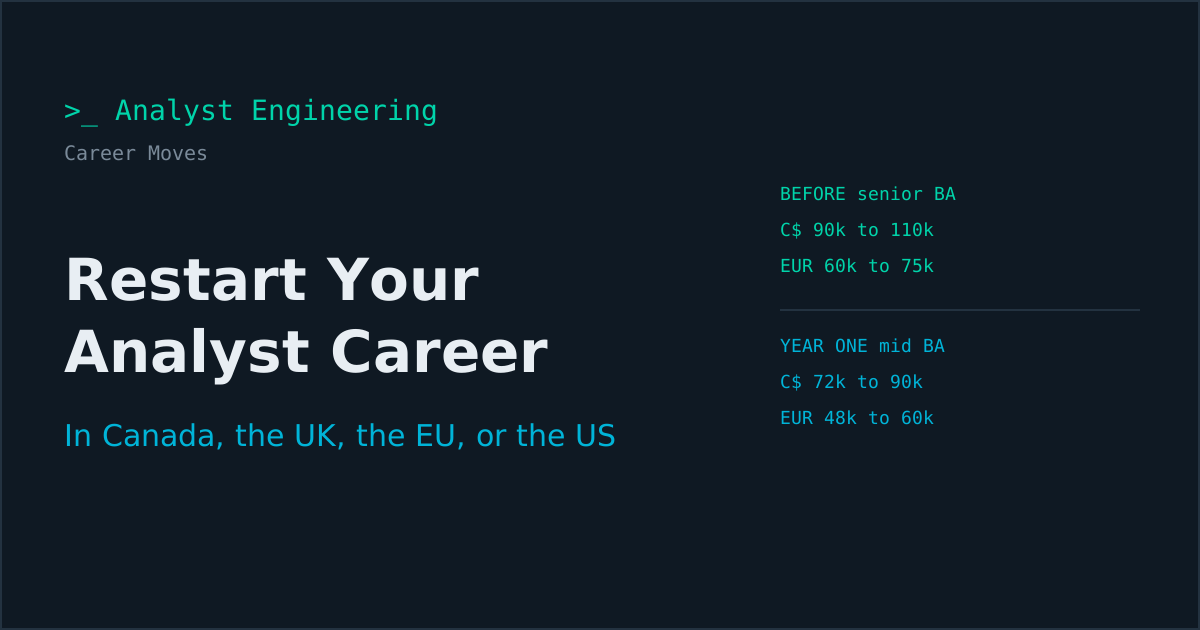
- A senior business analyst who restarts at mid level in Canada moves from the C$90k to C$110k band to the C$72k to C$90k band in year one, a gap that a promotion case built from day one usually closes.
- Agency contract roles are the most reliable foot in the door for newcomer analysts in Canada and the UK, because agencies place people on skills and a short contract produces the local reference employers ask for.
- CV norms differ by market: a photo and date of birth are still common in parts of the EU, and never belong on a CV for the US, Canada, or the UK.
Most experienced analysts who restart their career in Canada, the UK, the EU, or the US land their first local role one level below their previous title, and the realistic plan is to recover that level within 12 to 24 months. For a senior business analyst in Canada, that means a first role in the mid band of C$72k to C$90k rather than the senior band of C$90k to C$110k (base salary, permanent, large city, 2026, indicative). The lever that shortens the step down is local proof: a local reference, local certification or domain knowledge, and the vocabulary local job ads actually use.
I have interviewed a lot of newcomers for analyst roles on banking teams in Montréal. One of them had twelve years on core banking and card systems at a large North African bank. He answered the requirements questions better than anyone else that week. He did not get the offer. The debrief took thirty seconds: strong, but no references we could call and nothing local on the CV.
Six months later he joined the same bank through an agency contract, and a year after that he was the senior BA the team relied on. Nothing about his skill changed in between. What changed was proof the hiring manager could verify. For the week by week job search around it, including how to describe experience employers cannot check, Land Your First Job has the templates and the plan.
This article is general career information, not immigration or legal advice. Visa and work permit rules change often and depend on your situation. Check the official government source and a licensed immigration lawyer or regulated consultant for your case.
What does restarting an analyst career in a new country actually look like?
Restarting looks like doing the same analyst work under a new set of trust signals. The specs, test cases, and defect triage are identical in Toronto, London, Dublin, and Chicago; what changes is how employers judge whether you can do them.
| What you had at home | What the new market asks for | How to close the gap |
|---|---|---|
| Senior title and a long track record | A local reference who can vouch for recent work | A short agency contract, a volunteer project, or a bridging program placement |
| Deep domain knowledge in local systems and rules | The local equivalents (Interac and Payments Canada in Canada, Faster Payments in the UK, SEPA in the EU, ACH and Fedwire in the US) | Learn the local rails and regulators and name them on your CV |
| A CV in your home format | Local format, local job ad vocabulary | Rewrite against 30 local postings |
| Professional network | Local network | 10 to 20 informational conversations in the first 90 days |
| Language used at work at home | Working language of the local employer | Language certification, or target English-first hubs |
Technical skill transfers best: an API contract, a SQL query, and an ISO 20022 message read the same everywhere. That is why a portfolio built on the Labs works as local proof.
How much do analysts earn in each market, and how big is the step down?
The step down for a newcomer is usually one level for the first role. The table shows indicative 2026 base salaries for permanent roles in large cities, excluding bonus.
| Role and level | US (USD) | Canada (CAD) | UK, London (GBP) | Eurozone (EUR) |
|---|---|---|---|---|
| Business analyst, senior | 110k to 135k | 90k to 110k | 55k to 72k | 60k to 75k |
| Business analyst, mid | 85k to 110k | 72k to 90k | 42k to 55k | 48k to 60k |
| QA analyst, senior | 90k to 115k | 78k to 98k | 48k to 62k | 52k to 65k |
| QA analyst, mid | 72k to 92k | 62k to 80k | 36k to 48k | 42k to 52k |
| Systems analyst, mid | 90k to 115k | 78k to 98k | 45k to 58k | 50k to 62k |
For a senior BA in Canada, the first-year cost of the step down is roughly C$15k to C$20k. In the eurozone, Germany, the Netherlands, and Ireland sit in the upper half of each band, France, Spain, and Italy in the lower half, and Southern Europe lower still. Outside London, UK pay runs roughly 15 to 20 percent lower.
To verify, use posted ranges: New York City and New York State, California, Colorado, Washington, Illinois, and several other US states require them; British Columbia (since November 2023) and Ontario (since January 1, 2026, for employers with 25 or more employees) require expected pay in public postings; the EU Pay Transparency Directive (EU) 2023/970, with a transposition deadline of 7 June 2026, requires pay information to applicants before interview as member states implement it. In the UK, use ITJobsWatch. Cross-check with the annual Robert Half, Hays, and Michael Page guides, and ask two people one level above you what the band is. The full table is in the 2026 analyst salary guide.
How do you restart an analyst career in Canada?
You restart in Canada by solving the “Canadian experience” problem first: employers are rarely asking whether you can do the job, but whether anyone local will vouch for you.
The Canadian experience barrier. Ontario’s job posting rules, in force since January 1, 2026, stop employers covered by them from listing Canadian experience as a requirement in public postings, and require expected pay in the posting for employers with 25 or more employees. The preference still exists in screening, so plan around it rather than argue with it.
Bridging programs. Colleges and settlement agencies run bridging and mentoring programs for internationally trained professionals, and in Toronto organizations such as ACCES Employment and TRIEC’s mentoring program are ones analysts use. Their real value is a local mentor and a warm introduction.
The bilingual advantage. In Montréal, most banking and insurance analyst roles expect working French, and many federal government roles in Ottawa are designated bilingual. If you speak both, put it in your CV headline.
Contract roles through agencies. Canadian banks and insurers fill many analyst roles through staffing agencies, at about C$60 to C$85 an hour for a BA and C$75 to C$110 for a technical BA. Most experienced contractors are incorporated as a CCPC (Canadian-controlled private corporation), but newcomers often start on the agency’s payroll. A six-month contract is the fastest route to a Canadian reference. The rate math and the Personal Services Business risk are covered in going contract as an analyst.
How do you restart an analyst career in the UK?
You restart in the UK by confirming your right to work, learning the contract market, and using ITJobsWatch to speak the local vocabulary. Every UK employer must check right to work before you start, so state your status plainly on the CV; if you need sponsorship, target employers that hold a sponsor licence.
The contract market and IR35. UK analyst contracting pays about £350 to £550 a day for a BA and £450 to £700 for a technical BA, with London banking up to about £750. IR35, the off-payroll working rules, decides whether a contract is taxed like employment. For medium and large private sector clients, the client makes that determination. An inside IR35 role is usually paid through an umbrella company with employment taxes deducted; an outside IR35 role is usually billed through your own limited company. If your visa ties you to a sponsor, contracting through your own company is usually not an option.
ITJobsWatch. Search your skills on ITJobsWatch to see which keywords appear in UK permanent and contract ads and at what rates.
How do you restart an analyst career in the EU?
You restart in the EU by matching the country to your languages first. Language requirements vary more than anything else:
- Dublin: English by default, strong in payments, fintech, and funds.
- Amsterdam: English widely used in fintech, payments, and tech; Dutch helps in banks and the public sector.
- Berlin: startups often work in English; banks, insurers, and public employers expect German.
- Luxembourg: banking and funds work in English, with French or German valued.
- Paris, Frankfurt’s banks, Madrid, Milan, Lisbon’s banks: local language expected in most analyst roles, though Lisbon has English-first tech hubs at lower pay.
Work authorization runs through national permits or the EU Blue Card, with salary thresholds that differ by country, so confirm the route for your target country before you apply. As member states implement the Pay Transparency Directive, employers must share pay information before interview.
How do you restart an analyst career in the US?
You restart in the US by being precise about work authorization, because it filters applications before anyone reads your experience. Most US analyst roles go to people who already hold work authorization: citizens, green card holders, and some spouses and students with work permits. Employer sponsorship for analyst roles exists but is limited; the H-1B visa is capped and allocated by lottery, and many ads state that the employer does not sponsor. Intra-company transfers move people who already work for a multinational. Some Canadian and Mexican citizens use TN status, which covers a listed set of professions; whether a specific analyst role qualifies depends on the duties and your qualifications. Get qualified legal advice for your case.
How should a CV differ between Canada, the UK, the US, and the EU?
A CV should follow the target market’s norms, and the biggest differences are photo, age, and length.
| Market | Photo | Date of birth, marital status | Typical length |
|---|---|---|---|
| US | Never | Never | 1 to 2 pages |
| Canada | Never | Never | 2 pages |
| UK | Never | Never | 2 pages |
| Germany | Still common, increasingly optional | Sometimes | 2 pages, often tabular |
| France | Common, optional | Rarely | 1 to 2 pages |
| Ireland, Netherlands | Uncommon | No | 2 pages |
Whatever the market, use a local phone number and local job ad vocabulary. Rewriting your CV for a role change shows before and after bullets.
What does a successful restart look like?
The cases below are composites of moves I have watched on delivery teams, with details changed. Pay sits inside the 2026 indicative bands.
Case 1: a senior BA from Morocco restarting in Montréal
Youssef had nine years as a BA on cards and core banking at a bank in Casablanca, on a senior salary that did not convert meaningfully into Canadian dollars. He arrived in Montréal with permanent residence, French and English, and no Canadian reference. He spent two months learning the Canadian rails (Interac, Lynx, and the ISO 20022 migration at Payments Canada) and finished the Analyze the Payments API mission. An agency placed him on a nine-month BA contract at a bank at C$68 an hour, which converted into a permanent mid BA role at C$86k. Twenty months after arriving he was promoted to senior BA at C$100k. What he would do differently: put “bilingual French and English, cards and payments” in his CV headline from day one; he had buried it in the last line.
Case 2: a QA analyst from India restarting in Toronto
Priya had six years of manual and API testing for a banking software vendor in Pune and held the ISTQB Foundation certificate, which transfers everywhere. After 150 generic applications and two calls in three months, she changed approach: rewrote her CV against 30 Toronto postings, built a small Postman collection against a public API, and joined a mentoring program that introduced her to a QA lead at an insurer. She landed a mid QA analyst role at C$72k after five months, one level below her previous seniority. She is now targeting senior QA at C$78k to C$98k or an automation role. What she would do differently: skip the generic applications entirely and start with the mentor introductions.
Case 3: a BA from Brazil choosing between Lisbon and Dublin
Camila was a BA on retail banking and instant payments in São Paulo for seven years and already held EU citizenship through family. Lisbon was easier on language, but Southern European pay sits below the eurozone bands. She chose Dublin, spent three months learning SEPA and European payments vocabulary (read SEPA Credit Transfer for the basics), and landed a mid BA role at a payments company at €56k, in the upper half of the €48k to €60k band. What she would do differently: apply to Dublin firms with Latin American expansion plans first, where Portuguese and Pix experience were an advantage rather than a footnote.
What is the plan for the first 90 days and the first two years?
Each step produces an artifact.
- Weeks 1 and 2: map local vocabulary. Collect 30 job ads for your target role and city. Artifact: a list of the 25 terms, tools, rails, and regulators that repeat.
- Weeks 3 and 4: localize the CV. Local format, local vocabulary, work authorization stated plainly. Artifact: a two page CV reviewed by one local analyst.
- Month 2: build local proof. A bridging or mentoring program, one local certification or domain course, and two Labs missions from the Become a Technical Analyst track. A free account saves your progress and unlocks the solutions. Artifact: a portfolio page, built as in the analyst portfolio guide.
- Months 2 and 3: local network. Ten informational conversations with analysts at target employers. Artifact: a tracker with names, notes, and one follow-up each.
- Months 3 and 4: agencies and contracts. Register with three agencies that place analysts in your domain and accept a short contract if it comes first. Artifact: a signed role and a local reference by month 6.
- Months 12 to 24: recover the level. Keep a running file of outcomes from day one and ask for the promotion criteria in writing at your first review. Artifact: a promotion case with five measured outcomes.
Interviews in a new market test local norms as much as skill: structured behavioural questions and a case exercise. The BA and Technical BA Interview Guide covers the questions, what each one tests, and how to answer from real work. Interviewing as a career changer covers the case exercise.
What mistakes stall a restart in a new country?
- Mass-applying in your home CV format. Hundreds of applications with a photo, a date of birth, and home-market vocabulary get filtered before a human reads them.
- Refusing the step down. Holding out for a senior title with no local reference often costs a year. One level down with a promotion plan usually costs less.
- Ignoring the domain translation. “Worked on RTGS migration” means little until you name the local equivalent. Learn the local rails.
- Hiding your languages. A bilingual analyst in Montréal or Ottawa, or a Portuguese speaker in a firm with Brazilian clients, is rarer than any certification.
If your background is banking, the domain transfers better than anything else, and Break Into Banking maps the banking and payments route and the domain knowledge that unlocks premium pay in any market.
The takeaway
Restarting an analyst career in a new country usually means one level down for the first role and 12 to 24 months to recover it. The work travels; trust does not, so build local proof on purpose. In Canada, use the bilingual advantage and agencies. In the UK, understand IR35 before you price a contract. In the EU, pick the city by language. In the US, be precise about work authorization.
For the job search plan and templates, start with Land Your First Job. If you want a second opinion on your CV for a specific market or a plan to recover your level, book a 1:1 Tech BA Coaching Call. The free downloads help with a first local portfolio piece, and the rest is at The Tech BA Toolkit. More on the role lives in the Business Analyst hub and the Systems Analyst hub.
Ahmed is a Senior Technical Business Analyst with 10+ years in banking and payments. He builds practical guides and tools for analysts at The Tech BA Toolkit.
Tags: Business Analysis, Career Change, Immigration, Banking, Career Growth
About the author
Analyst Engineering is written by Ahmed, a Senior Technical Business Analyst with 10+ years of banking and payments delivery experience: ISO 20022 and SWIFT messaging, payments API integration, Kafka event validation, and production support. Every article comes from real delivery work, and each one is reviewed and updated as tools and standards change.
Related articles
- Rewriting Your CV for an Analyst Role Change: Before and After Bullets That Get Interviews Rewrite your CV for an analyst role change: bullets as artifact plus outcome plus number, before and after pairs, ATS rules, and CV norms in four markets.
- Going Contract as an Analyst: Day Rates, Structures, and the Math in Four Markets Analyst contract rates in 2026 for the US, Canada, UK, and eurozone, the structures (1099, CCPC, IR35, portage), and the floor-rate math behind real take-home.
- Interviewing as a Career Changer: How to Answer "Why the Switch?" and the Case Exercise How career changers pass analyst interviews: scripts for why the switch and no experience, the seven common case exercises, STAR stories, and the pay question.
- Analyst Salaries in 2026: Realistic Pay by Role, Level, and Country Realistic 2026 analyst pay by role and level in the US, Canada, UK, and Eurozone: BA, technical BA, QA, SDET, data, architecture, product, and contract rates.
Go deeper on this
Not ready to buy? The free downloads are a no-cost place to start, and every article here stays free.
Free account
Practice on the Labs, keep your progress
A free account, no password: an email link signs you in. It saves your steps and self-assessments on the Labs, shows your missions on a dashboard, unlocks the solutions, and, if you tick the box, sends you new missions and articles when they ship.
Your email is used to sign you in. Nothing else, unless you ask. Privacy.