SEPA Credit Transfer: The Rulebook Layer Above ISO 20022
Written by Ahmed at Analyst Engineering, a Senior Technical Business Analyst with 10+ years in banking and payments delivery.
Key takeaways
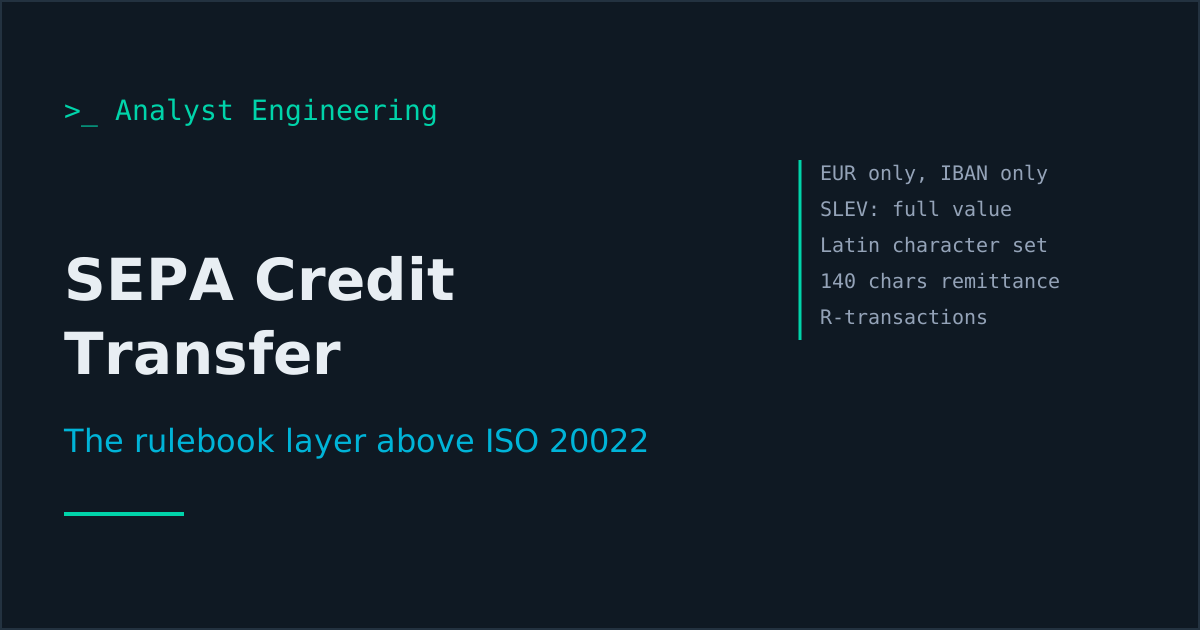
- SEPA is a rulebook, not a message format. It sits above ISO 20022 and narrows it: euro only, IBAN only, SLEV charges only, a restricted character set, and a tightly constrained subset of the fields the standard offers.
- SLEV is the only permitted charge bearer and it means the beneficiary receives the full amount, with each party charged by its own bank. Treating SLEV as a synonym for SHAR and allowing deduction is a rulebook breach and a customer-visible defect.
- The SEPA character set is the defect that reaches production most often. A perfectly valid name containing a character outside the permitted Latin set is schema-valid and scheme-rejected, and it only appears once real customer names arrive.
- R-transactions are the whole exception vocabulary: reject before settlement, return after, refund for direct debits, and recall when the originator asks for the money back. Each has a different initiator, window, and message, and specifying only the happy path leaves the majority of the operational work undefined.
- The rulebook changes on a published cycle. A programme that treats the SEPA implementation guidelines as a one-off input rather than a versioned dependency with an owner will drift out of compliance without anyone noticing.
SEPA is a rulebook, not a format. It sits above ISO 20022 and narrows it: euro only, IBAN only, SLEV charges only, a restricted Latin character set, and a constrained field subset. A message can be perfectly valid ISO 20022 and entirely non-compliant with SEPA, which is the sentence to put in front of any team that has only read the schema.
A developer shows you a pacs.008 that validates cleanly against the schema. The customer name is Müller. The charge bearer is SHAR. The remittance field holds 180 characters of invoice detail.
Every one of those is a scheme rejection, and none of them is a schema error. This opens the scheme track of The ISO 20022 Reference, after the field-by-field track closed with sanctions screening.
What is SEPA, precisely?
The Single Euro Payments Area is a set of schemes defined by rulebooks published by the European Payments Council, under which euro payments between adhering payment service providers work the same way regardless of which country in the area they cross.
The core schemes:
- SCT: SEPA Credit Transfer, the standard euro credit transfer.
- SCT Inst: SEPA Instant Credit Transfer, covered in the next article.
- SDD Core: SEPA Direct Debit for consumers.
- SDD B2B: SEPA Direct Debit between businesses, with different refund rights.
Each rulebook is accompanied by implementation guidelines that specify the ISO 20022 usage in detail. That is the crucial relationship: the rulebook is a layer above the standard, and it is the layer that rejects you. This is the four layers model in its most familiar European instance.
The constraints that matter
Seven, and they cover most of what a team gets wrong.
1. Euro only. Other currencies are outside the scheme. A payment in Swedish krona between two accounts in the SEPA area is not a SEPA payment.
2. IBAN identification. Accounts are identified by IBAN. The BIC requirement was progressively removed for payments within the area, which is why systems still demanding a BIC are imposing a requirement the scheme dropped, usually because a legacy validation was never revisited.
3. SLEV charges only. This is the one that causes real customer harm when misread. SLEV means charges follow the scheme rules, and the SEPA rule is that the beneficiary receives the full amount, with each party charged separately by its own bank. No deduction from the principal, by anyone.
Teams that treat SLEV as “basically SHAR” build deduction logic into a scheme that forbids it. The beneficiary receives short, and the payment is both a rulebook breach and a complaint. See ISO 20022 charges for the full comparison.
4. Restricted character set. SEPA limits content to a defined Latin character set. This is the single most common production defect in SEPA implementations, and it deserves its own section below.
5. Remittance limits. Unstructured remittance is capped at 140 characters, and structured remittance usage is constrained by the implementation guidelines. Corporates who expect to send full invoice detail need to be told this early rather than at user acceptance testing. Remittance information covers the alternatives, including RF creditor references, which work well in SEPA precisely because the space is tight.
6. Defined execution times. The scheme sets a maximum execution time in business days, with the beneficiary normally credited by the next business day after the originator is debited. Bank cut-off times decide which business day a payment enters, which is why a Friday afternoon submission behaves differently from a Tuesday morning one, and why “it took three days” is usually a cut-off question rather than a scheme failure.
7. A constrained field subset. Many ISO 20022 fields are simply not used. Intermediary agents are not relevant, because the clearing and settlement mechanism handles routing. Sending fields the guidelines exclude is a rejection.
The character set defect, in detail
It escapes testing almost every time, so it is worth being explicit about the mechanism.
SEPA restricts payment content to a limited Latin character set: the basic letters, digits, and a small set of punctuation. Characters entirely normal in European names fall outside it.
Müller      -> outside the permitted set
Mueller     -> acceptable
Ó Súilleabháin -> outside
O Suilleabhain -> acceptable
Bjørn       -> outside
Bjorn       -> acceptable
Why it reaches production: test data is built from placeholder names, which are ASCII. Every test passes. Real customer records arrive containing the actual names of actual Europeans, and payments start rejecting.
The fix is a documented transliteration rule, applied consistently at a defined point in the flow, and owned rather than improvised. The decisions it must settle:
- Which character maps to what.
ütoueor tou? Both are defensible and you must pick one, because inconsistency between two systems produces two different names for one customer, which then breaks matching and screening. - Where transliteration happens: at capture, at message construction, or at the gateway. Only one place, or you get double transliteration.
- What happens to a character with no mapping.
And the test data has to contain real-shaped names. One of the highest-value things an analyst can do on a SEPA programme is replace the ASCII placeholder test set with names carrying diacritics from several languages, before go-live rather than after.
R-transactions: the part that is actually most of the work
Happy-path SEPA is simple. The exception vocabulary is where the operational effort lives, and specifications routinely cover a fraction of it.
| Type | Who initiates | When | Typical cause |
|---|---|---|---|
| Reject | Bank or clearing mechanism | Before settlement | Invalid IBAN, format failure, account closed |
| Return | Beneficiary bank | After settlement | Account closed, beneficiary deceased, account blocked |
| Refund | Payer (direct debits) | Within the scheme window | Unauthorised or disputed collection |
| Recall | Originator | After settlement | Duplicate, wrong amount, wrong beneficiary |
| Reversal | Originator (direct debits) | Defined window | Collection sent in error |
The distinction that matters commercially: a recall is a request, not an instruction. The originator asks for the money back, and the beneficiary bank is not obliged to return it, particularly if the beneficiary has spent it or disputes the claim. Systems built on the assumption that a recall retrieves funds will disappoint a customer who was told their money is coming back.
Each of these carries a reason code, and mapping those codes to causes and to customer-facing messages is a real deliverable. Reason code mapping covers the method, and returns, reversals, and recalls covers the ISO 20022 message mechanics across schemes.
Specify, for each R-transaction type: who can initiate it, the time window, the message used, the reason codes permitted, what happens to the customer’s funds meanwhile, and what the customer is told. That is a table, and producing it is usually the single most useful week an analyst spends on a SEPA project.
The rulebook is a versioned dependency
This is the governance point that quietly decides whether you stay compliant.
EPC rulebooks and implementation guidelines are released on a published cycle, with effective dates announced in advance. Changes range from clarifications to new mandatory behaviors.
A programme that downloads the guidelines once, builds against them, and moves on will drift. Nobody notices until a change becomes mandatory and your messages stop being accepted.
Treat it as a dependency with an owner:
- One named person watches for new releases and effective dates.
- Each release is assessed for impact against your implementation, producing a list of changes rather than a general reassurance.
- The assessment feeds the backlog with real lead time before the effective date.
- Your context pack holds the current version, dated, so nobody is working from a copy someone saved in 2024.
This is unglamorous and it is the difference between a compliant implementation and one that was compliant.
What to test
- Every permitted R-transaction, end to end, asserting the customer-visible outcome and the reason code.
- Names with diacritics from at least four languages, asserting consistent transliteration across every system that touches the name.
- A
SLEVpayment, asserting the beneficiary receives the full amount with no deduction anywhere in the flow. - Remittance at 140 characters, at 141, and containing restricted characters.
- An IBAN with wrong check digits, rejected before submission rather than by the scheme.
- A payment submitted either side of the bank cut-off, asserting the resulting execution date.
- A non-euro amount and a non-SEPA country, both refused with a clear reason.
Derive the full set with the six-source method in how to write pacs.008 test cases, using the implementation guidelines as the primary source rather than the base schema.
The takeaway
SEPA is a rulebook layer above ISO 20022 that narrows almost everything: euro only, IBAN only, SLEV charges with full value to the beneficiary, a restricted Latin character set, 140 characters of unstructured remittance, and a constrained field subset. Valid ISO 20022 is not the same as valid SEPA, and the schema is the one layer that will never tell you so.
Spend your specification effort on the R-transactions, because that is where the operational work is, and on the transliteration rule, because that is the defect that reaches production. Then put a named owner on the rulebook release cycle.
Next: SEPA Instant and the ten second rule, where the same scheme family removes the luxury of time. The full map is on The ISO 20022 Reference.
Ahmed is a Senior Technical Business Analyst with 10+ years in banking and payments. He builds practical guides and tools for analysts at The Tech BA Toolkit.
Tags: SEPA, ISO 20022, Payments, Banking, Functional Analysis
About the author
Analyst Engineering is written by Ahmed, a Senior Technical Business Analyst with 10+ years of banking and payments delivery experience: ISO 20022 and SWIFT messaging, payments API integration, Kafka event validation, and production support. Every article comes from real delivery work, and each one is reviewed and updated as tools and standards change.
Related articles
- SEPA Instant: The Ten Second Rule and What It Breaks How SCT Inst changes payment design: a ten second end-to-end limit, 24/7/365 availability, irrevocability, and the screening and liquidity problems that follow.
- ISO 20022 Charges: DEBT, CRED, SHAR, and the ChrgsInf Block The charge bearer codes in a pacs.008, what each one obliges every agent in the chain to do, and how ChrgsInf records who actually took what.
- Reading an ISO 20022 Usage Guideline: The Four Layers That Decide Your Field Rules A field can be optional in ISO 20022, mandatory in CBPR+, forbidden by your correspondent, and absent from your database. How to build the net rule matrix.
- Verification of Payee: The Check That Runs Before the Payment How Verification of Payee works: the name and IBAN check, the four possible outcomes, what the payer sees, and the design decisions that make or break it.
Free account
Practice on the Labs, keep your progress
A free account, no password: an email link signs you in. It saves your steps and self-assessments on the Labs, shows your missions on a dashboard, unlocks the solutions, and, if you tick the box, sends you new missions and articles when they ship.
Your email is used to sign you in. Nothing else, unless you ask. Privacy.