Moving to a Less Technical Role: Business Architect, Change Lead, and Consultant Routes
Written by Ahmed at Analyst Engineering, a Senior Technical Business Analyst with 10+ years in banking and payments delivery.
Key takeaways
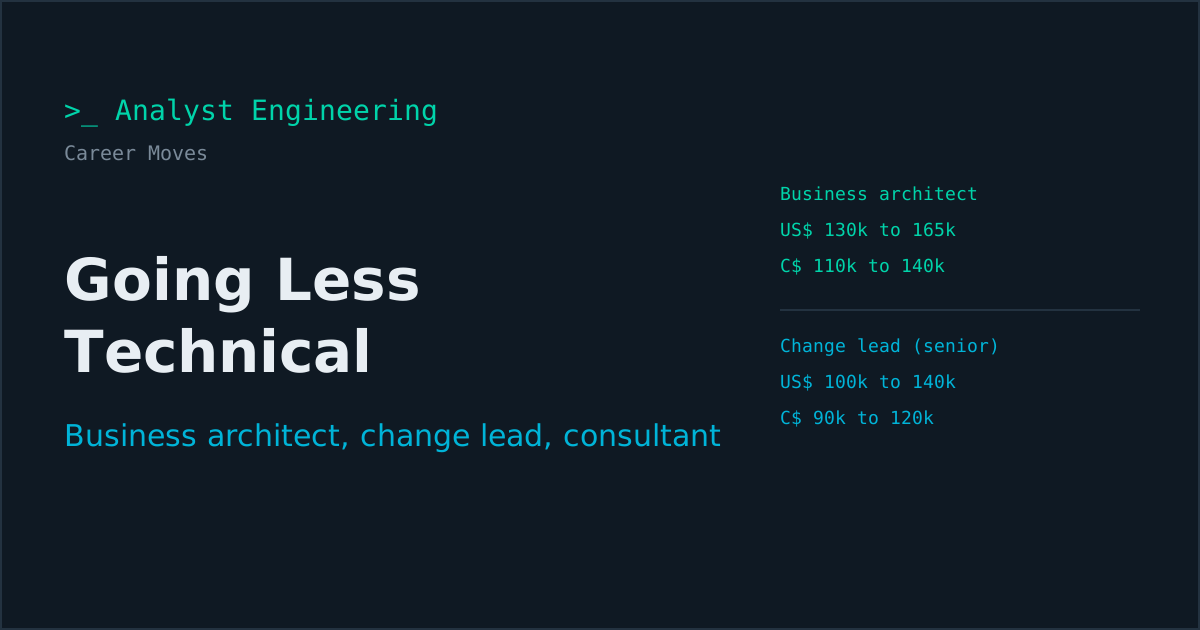
- Business architect is the one less technical role that usually holds or raises pay for a senior technical analyst, at about US$130k to US$165k base for a senior business architect in US major metros.
- Change lead roles pay about US$100k to US$140k base at senior level, which is roughly flat for a QA lead and a clear cut for a senior developer or senior technical BA.
- Moving from technical BA work to a role priced like general business analysis usually reverses the 10 to 20 percent premium the technical skills earned.
- Keeping a thin technical edge, reading an API contract, querying data, and following a sequence diagram, is what keeps a less technical role on the higher pay band and in front of the interesting work.
- Burnout and boredom need different fixes: burnout from on-call and context switching is often solved by changing the conditions of a technical role, while boredom with the technical content itself is a real reason to move.
Technical analysts, developers, and QA leads who want less technical work have six realistic routes: business architect, change manager or change lead, process improvement, management consulting, customer success or product marketing for technical products, and compliance or risk. Only some of them hold pay. A senior business architect earns about US$130k to US$165k base, which usually matches or beats a senior technical BA; a senior change lead earns about US$100k to US$140k, which is a cut for most senior technical people. Keeping a thin technical edge is what protects your pay after the move.
A technical BA I coached in Montréal told me she was done with technical work. She wanted “something with people, not log files”. Two questions later it turned out she had been on the production support rota for three years, woken up for payment incidents twice a month, and had not had a quiet quarter since the ISO 20022 migration started. She did not hate technical work. She hated the conditions she was doing it in.
That conversation is why this article starts with diagnosis before destinations. Some people genuinely want less technical work, and for them the routes below are real and some pay well. Others need a different rota, not a different career. If you are reconsidering what an analyst career can look like from the outside in, What Is a Business Analyst covers what the job rewards and the paths out of it, which is a useful map before you pick one.
Which less technical roles can a technical analyst move into?
A technical analyst can move into six less technical roles without starting over, and the right one depends on which part of your current job you want to keep. The table compares them.
| Role | What you do | Technical depth needed | Pay band (senior, base, indicative) | Who it suits |
|---|---|---|---|---|
| Business architect | Capability maps, value streams, target operating models, roadmaps from strategy to change | Low to medium: read architecture, do not build it | US$130k to US$165k, C$110k to C$140k | Senior TBAs and systems analysts who like the big picture |
| Change manager or change lead | Impact assessments, training, communications, business readiness, adoption | Low | US$100k to US$140k, C$90k to C$120k | QA leads and BAs who enjoyed UAT and people |
| Process improvement (Lean Six Sigma) | Process mapping, waste removal, DMAIC projects (define, measure, analyze, improve, control) | Low, but strong on data | Close to the business analyst band at the same level | Analysts from operations who like measurable fixes |
| Management consultant | Diagnosis, recommendations, workshops, decks | Low | Wide range by firm tier; check posted ranges | Strong communicators who want variety and can travel |
| Customer success or product marketing for technical products | Onboarding customers, renewals, positioning, explaining the product | Medium: explain an API to a customer | Usually below the senior technical BA band, with variable pay | Developers and TBAs who like customers more than code |
| Compliance or risk analyst | Controls, regulatory mapping, control testing, audit evidence | Low to medium | Close to the business analyst band, higher in banking | Analysts in regulated domains who like rules and evidence |
What changes day to day when you move to a less technical role?
The biggest daily change is the horizon and the evidence. A technical analyst works in days and proves things with a query, a log line, or a passing test. A business architect or change lead works in quarters and proves things with alignment: an operating model the executive committee signed, an adoption rate after go-live. Fewer things are provably right, more things are negotiated, and the feedback loop gets longer.
What carries over is more than people expect. A fit-gap analysis is a business architect’s daily bread at capability level. A system context diagram becomes the first slide of every target state. Process mapping with BPMN generated with AI is half of process improvement. And decision tables are the fastest way a compliance analyst can prove a control covers every case.
Which less technical roles pay the same or more, and which cost money?
Business architect is the less technical role that most often pays the same or more; change lead, process improvement, and compliance usually cost senior technical people money. The table shows indicative 2026 base salary for permanent roles in large cities, excluding bonus.
| Role | US (USD) | Canada (CAD) | UK (GBP) | Eurozone (EUR) |
|---|---|---|---|---|
| Technical BA, senior | 125k to 155k | 100k to 125k | 65k to 85k | 65k to 82k |
| Software developer, senior | 140k to 180k | 120k to 155k | 75k to 100k | 70k to 90k |
| QA lead | 110k to 135k | 95k to 115k | 60k to 78k | 62k to 78k |
| Business analyst, senior | 110k to 135k | 90k to 110k | 55k to 72k | 60k to 75k |
| Business architect, senior | 130k to 165k | 110k to 140k | 70k to 95k | 70k to 90k |
| Change manager or change lead, senior | 100k to 140k | 90k to 120k | 55k to 80k | 55k to 75k |
The honest reading. A senior technical BA who becomes a business architect is usually flat or up. A QA lead who becomes a change lead is roughly flat. A senior developer who becomes a change lead takes a real cut, often 20 percent or more at the midpoint. A senior technical BA who moves into a role priced like general business analysis, which is where process improvement and most compliance roles sit, gives back the 10 to 20 percent premium that the technical skills earned.
US figures are major metros; smaller metros run 10 to 20 percent lower. UK figures are London; elsewhere runs roughly 15 to 20 percent lower. Verify before you move: posted ranges in pay transparency jurisdictions (New York, California, Colorado, Washington, Illinois, British Columbia, Ontario since January 1, 2026 for employers with 25 or more employees, and EU countries as member states implement the Pay Transparency Directive), ITJobsWatch in the UK, the annual Robert Half, Hays, and Michael Page guides, and two people one level above you in the target role. The full comparison is in the analyst salary guide for 2026.
Why does keeping a thin technical edge protect your pay?
A thin technical edge protects pay because it keeps you eligible for the less technical work that sits closest to systems, which is the better paid half. A business architect who can read an API catalogue and a data model gets the core banking transformation; one who cannot gets the capability heat map nobody uses. A change lead who understands a cutover plan gets the migration programme. “Thin” means you can still read an API contract, run a query, follow a sequence diagram, and tell whether a functional specification actually covers the business rule. You do not need to write code or run tests any more.
Is it burnout or boredom? How do you tell before you move?
Burnout comes from the conditions of the work, boredom from the content, and they need different fixes. Diagnose which one you have before you change careers, because a career change does not fix a rota.
| Signal | Points to burnout (conditions) | Points to boredom or mismatch (content) |
|---|---|---|
| What drains you | On-call, incident nights, constant context switching | Reading specs, logs, or code even on a calm week |
| A quiet quarter would | Restore you | Bore you further |
| A new domain with the same work would | Not help | Maybe help |
| You envy | People with predictable hours | People doing different kinds of work |
| Likely fix | Change team, rota, or employer, keep the role | Change role |
The simplest test is a two-week energy log: tag each block in your calendar as draining or energizing, and look at what the draining blocks have in common. If exhaustion is affecting your health, talk to a doctor or your employee assistance programme before making any career decision.
What do real moves to less technical roles look like?
The cases below are composites of moves I have watched on delivery teams, with details changed. Pay is base salary, permanent, 2026, indicative.
How did a technical BA in Montréal become a business architect?
Émilie was a senior technical BA at a Montréal bank, earning C$115k. During the ISO 20022 programme she volunteered to build the capability map for the payments division, then a capability-level fit-gap against the target platform, and a one-page target state that the programme director used in every steering committee. She stepped off the production support rota at the same time.
It took twelve months. She moved to a business architect role at another financial institution at C$128k, about plus 11 percent. What she would do differently: start the capability map a year earlier. Her technical edge, the ability to read the integration catalogue and the data model, is what the hiring manager asked about most.
How did a QA lead in Manchester become a change manager at a bank?
Dan was a QA lead in Manchester, earning £58k. He led user acceptance testing for a branch system rollout and, because nobody else did, wrote the business readiness checklist and the training plan for 40 branches. He then tracked adoption for three months after go-live and presented the numbers. He took the APMG Change Management Foundation because most ads in his area listed it.
It took nine months. He moved to a change manager role at a bank in Manchester at £60k, roughly flat, with a better route to change lead. What he would do differently: measure adoption from the first rollout. The number, not the training materials, is what got him the interview.
Why did a developer in Austin move to customer success and then back to technical analysis?
Kevin was a senior developer in Austin, earning US$150k. After two years of on-call for a card processing platform, he moved to a customer success engineer role at a payments API company, on a lower base than his developer salary plus a variable component tied to renewals. He liked the customers. He missed the systems, and the variable pay depended on accounts he could not influence.
After fourteen months he moved to a senior technical BA role at US$140k, with no on-call rota. What he would do differently: diagnose first. His problem was burnout from on-call, not boredom with technical work, and a technical role without a rota would have fixed it without the detour. The developer to analyst move is covered in from developer to business analyst.
How do you pivot to a less technical role without starting over?
You pivot without starting over by producing one artifact of the target role inside your current job, in your current domain. Here is a six month plan.
- Weeks 1 to 2: diagnose. Artifact: a two-week energy log and one paragraph stating what you want less of and more of.
- Month 1: pick the target from real ads. Read 20 job ads for the role in your city. Artifact: a skills gap table listing each requirement, your evidence, and the gap.
- Month 2: produce one artifact of the target role. A capability map for business architecture, a change impact assessment for change, a process map with measured waste for process improvement, or a controls matrix for compliance. The AI-augmented analyst workflow shows how to draft these faster. AI for the Non-Technical Senior Analyst covers using AI in senior analyst work without writing code, which is what most of these roles look like day to day.
- Month 3: take one credential only if the ads demand it. Lean Six Sigma Green Belt for process improvement, APMG Change Management or Prosci for change, a business architecture certification for business architect. Artifact: the certificate plus the project you applied it to.
- Month 4: ask for a hybrid role. “Change lead for the migration” or “business architect for payments” inside your current programme. Use the internal move playbook. Artifact: the agreed scope.
- Months 5 to 6: keep the edge and apply. Rewrite your CV around the new artifacts. Keep one technical practice a month: a mission in the Labs, such as validating an event flow, keeps your technical reading current, and a free account saves your progress and unlocks the solutions.
If you are moving from QA specifically, from QA tester to business analyst covers the adjacent route. If what you want is leadership rather than less technical content, compare business analyst to delivery manager and the manager versus principal fork.
What mistakes stall a move to a less technical role?
- Changing careers to fix a rota. If on-call is the problem, change the team first.
- Dropping every technical skill. The thin edge is what keeps you on the better paid half of the less technical market.
- Leaving your domain. Domain knowledge is what transfers. A payments TBA is a credible payments business architect and an unknown retail consultant.
- Taking a junior title in the new field. Ask for a hybrid or senior-with-ramp role; your delivery experience counts.
- Collecting certificates before a project. A Black Belt without a measured improvement is a line on a CV.
- Choosing by title prestige. Check the hours, travel, and utilization targets of consulting before you accept them.
If you want to understand the analyst hats from a less technical angle, what is a functional analyst is a useful reference, and the career paths page shows every route. For a self-check on what you would keep, use the technical analyst skill matrix.
The takeaway
Less technical does not have to mean less pay. Business architect usually holds or raises pay for a senior technical analyst; change lead is roughly flat for a QA lead and a cut for most senior technical people; process improvement and compliance give back the technical premium. Diagnose burnout versus boredom first, stay in your domain, keep a thin technical edge, and produce one artifact of the target role before you apply.
For a clear view of what analyst roles reward and where they lead, start with What Is a Business Analyst. If you want help diagnosing your own situation or choosing a route, book a 1:1 Tech BA Coaching Call. The free downloads are a no-cost starting point, and everything else is in The Tech BA Toolkit. More on the business side of analysis lives in the Business Analyst hub and the Functional Analyst hub.
Ahmed is a Senior Technical Business Analyst with 10+ years in banking and payments. He builds practical guides and tools for analysts at The Tech BA Toolkit.
Tags: Business Analysis, Business Architecture, Change Management, Career Change, Career Growth
About the author
Analyst Engineering is written by Ahmed, a Senior Technical Business Analyst with 10+ years of banking and payments delivery experience: ISO 20022 and SWIFT messaging, payments API integration, Kafka event validation, and production support. Every article comes from real delivery work, and each one is reviewed and updated as tools and standards change.
Related articles
- Business Analyst to Delivery Manager or Scrum Master: The Less Technical Leadership Route BA to delivery manager, project manager, or scrum master: what transfers, what is new, pay in four markets, and why delivery manager is the durable target.
- Lead the Team or Stay Technical? Head of Business Analysis vs Principal Analyst Head of business analysis or principal analyst? What each does all day, pay in four markets, how to trial management, and how to create a principal track.
- From Developer to Business Analyst: Trading Code for Scope Without Losing Your Edge Moving from software developer to business analyst: the real pay cut, why technical BA or systems analyst is the better target, what transfers, and a plan.
- What Is a Functional Analyst? The Bridge Between Business and Build A functional analyst turns business intent into precise, testable system behavior. Here is what the role does in banking and payments, and how it differs from a BA.
Go deeper on this
Not ready to buy? The free downloads are a no-cost place to start, and every article here stays free.
Free account
Practice on the Labs, keep your progress
A free account, no password: an email link signs you in. It saves your steps and self-assessments on the Labs, shows your missions on a dashboard, unlocks the solutions, and, if you tick the box, sends you new missions and articles when they ship.
Your email is used to sign you in. Nothing else, unless you ask. Privacy.