Technical Business Analyst Interview Questions: 20 Real Questions With Model Answers
Written by Ahmed at Analyst Engineering, a Senior Technical Business Analyst with 10+ years in banking and payments delivery.
Key takeaways
- A technical business analyst interview tests three things: can you get the data yourself (SQL, APIs, logs), can you reason about a system end to end (payments, events, failures), and can you turn what you find into testable requirements.
- The strongest answer to almost every technical BA question follows the same order: restate the question, ask one clarifying question, answer, then say what you would check next.
- For an API that returns 422, check the error body first, then the contract, then reproduce the call in Postman, then search the logs by correlation ID. Guessing at the cause before reading the error body is the most common weak answer.
- A safe-to-retry POST is tested by sending the same request twice with the same idempotency key and proving only one side effect happened, the way Stripe documents its Idempotency-Key header.
- The question that decides most technical BA interviews is the last one: show an artifact you built on your current system and say what changed because of it.
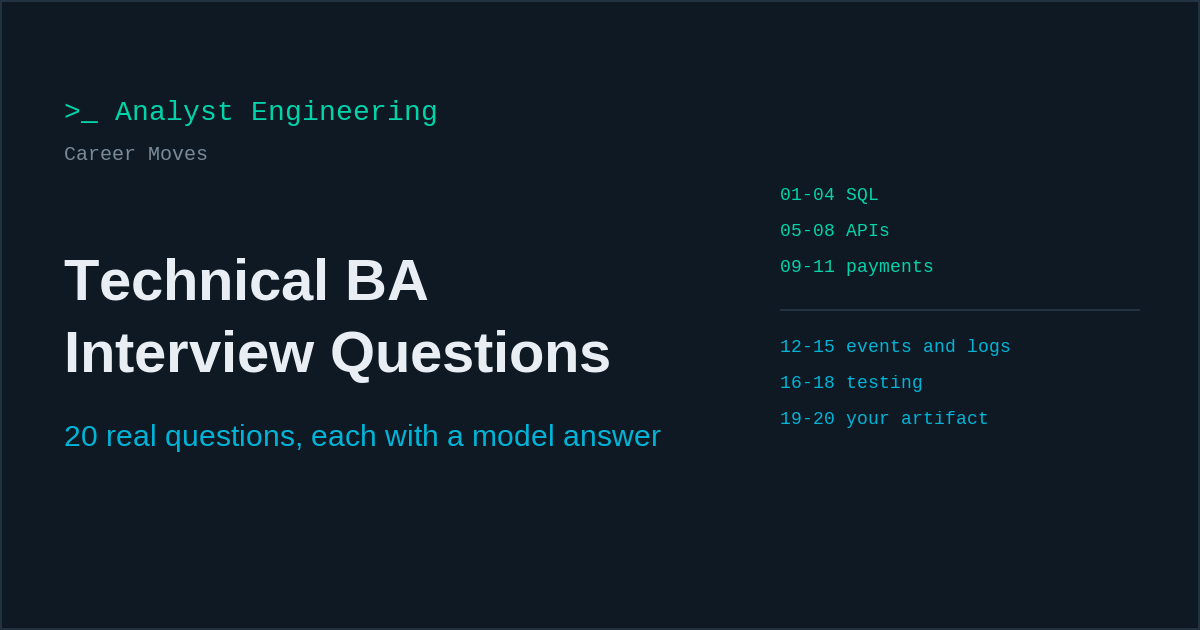
Technical business analyst interview questions test whether you can get the evidence yourself and turn it into requirements. In practice that means six areas: SQL, APIs, payments, events, logs, and testing, plus one behavioural question about an artifact you built. Below are 20 real questions I have asked or been asked in technical BA loops at banks and payment processors, each with what it tests, a model answer, and the weak answer that loses the room.
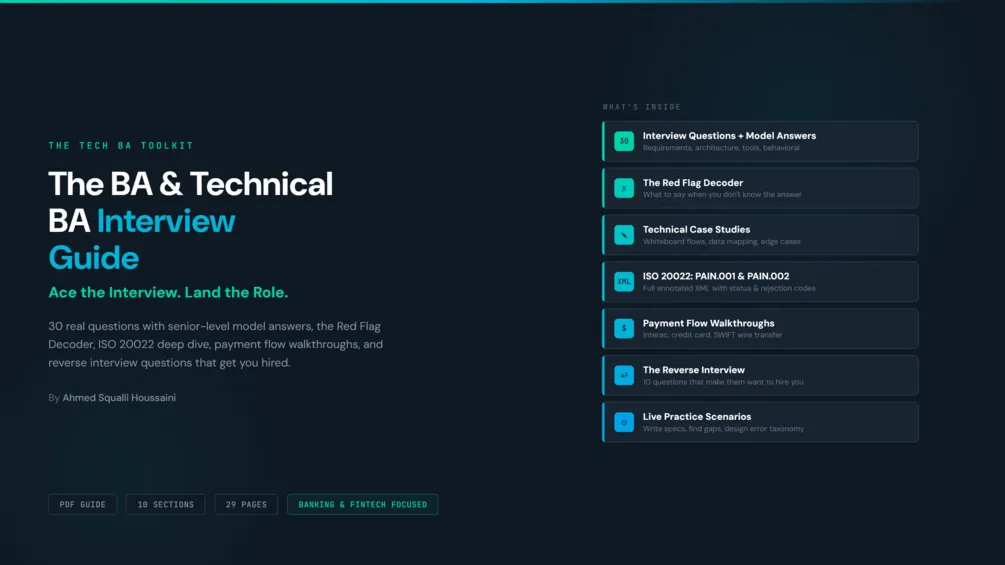
One pattern works for almost every question here: restate the question, ask one clarifying question, answer, then say what you would check next. The model answers below follow it. If you want the full bank of questions with longer model answers, case studies, and the ISO 20022 deep dive, the BA and Technical BA Interview Guide is where I would start.
What does a technical business analyst interview test?
A technical BA interview tests three capabilities, and every question below maps to one of them:
- Getting the data yourself. Can you write the query, call the API, and read the log without waiting for a developer?
- Reasoning about a system end to end. Can you follow a payment or an event across services and say where it can fail?
- Turning findings into testable requirements. Can you write acceptance criteria, boundaries, and non-functional requirements that a tester can prove?
The difference from a business analyst loop is the first point. A BA is asked how they would find out; a technical BA is asked to find out, live. The role itself is described in what a technical business analyst does.
SQL questions
1. Write a query that finds customers with more than one active account.
What it tests: GROUP BY with HAVING, and whether you ask what “active” means.
Model answer: “First, does active mean a status value, or an account with a transaction in the last 90 days? Assuming a status column:”
SELECT customer_id, COUNT(*) AS active_accounts
FROM accounts
WHERE status = 'ACTIVE'
GROUP BY customer_id
HAVING COUNT(*) > 1
ORDER BY active_accounts DESC;
“Next I would check whether joint accounts appear once per holder, because that changes the count.”
Weak answer: filtering the count in WHERE instead of HAVING, or not asking what active means.
2. How would you find duplicate payments sent within five minutes of each other?
What it tests: window functions, and a real production problem.
Model answer: “Same customer, same payee, same amount, close in time. LAG compares each payment with the previous one in the same group:”
SELECT *
FROM (
  SELECT payment_id, customer_id, payee_id, amount, created_at,
         LAG(created_at) OVER (
           PARTITION BY customer_id, payee_id, amount
           ORDER BY created_at
         ) AS previous_at
  FROM payments
) p
WHERE previous_at IS NOT NULL
  AND created_at - previous_at <= INTERVAL '5 minutes';
“Then I would ask the business whether a customer paying the same bill twice on purpose is legitimate, because the rule decides what the query should flag.” The window function patterns are in SQL window functions for analysts.
Weak answer: a self-join with no time bound, which flags every repeat payment ever made.
3. Find orders that have no payment. Then tell me what goes wrong if you add a filter on the payment table.
What it tests: LEFT JOIN, and the most common join bug in reporting.
Model answer:
SELECT o.order_id
FROM orders o
LEFT JOIN payments p ON p.order_id = o.order_id
WHERE p.order_id IS NULL;
“If I then add WHERE p.status = 'SETTLED', I silently turn it into an inner join, because rows with no payment have a NULL status. The filter belongs in the ON clause.”
Weak answer: using NOT IN on a column that can contain NULL, which returns nothing at all.
4. Two systems disagree on yesterday’s payment total. How do you reconcile them?
What it tests: structured thinking before SQL.
Model answer: “Compare counts and sums by day first, then by status, to find where the gap starts. Then match record by record on the shared reference with a FULL OUTER JOIN, which gives three groups: in A only, in B only, and in both with different amounts. Then I check the usual causes: time zone cut-off at midnight, reversed or returned payments counted in one system only, and currency conversion.” The full method is in reconciliation design.
Weak answer: jumping to a row-level join on millions of rows before narrowing down the day and status.
API questions
5. What is the difference between a 401 and a 403, and why does it matter for requirements?
What it tests: whether you know status codes carry meaning a user sees.
Model answer: “401 means the caller is not authenticated: no token, or an expired one, so the client should log in again. 403 means the caller is authenticated but not allowed: retrying will not help, so the message should explain the permission. Some APIs return 404 instead of 403 on purpose; GitHub returns 404 for a private repository you cannot access, so it does not reveal that the repository exists. That is a requirement decision, and I would write it down.” More in HTTP status codes explained.
Weak answer: “both mean access denied”.
6. This API call returned a 422. What do you check, and in what order?
What it tests: method, not memory.
Model answer: “422 means the request was understood but failed validation. In order: one, read the error body, because a good API names the field and the rule. Two, compare the request with the contract: required fields, formats, enums, lengths. Three, reproduce it in Postman with the smallest payload that fails. Four, if the contract says the request is valid, search the logs with the correlation ID and raise it as a contract gap, because then either the spec or the code is wrong.” How to read a contract like this is in how to analyze an API.
Weak answer: guessing the cause before reading the error body.
7. How would you test that a POST request is safe to retry?
What it tests: idempotency, which every payment API depends on.
Model answer: “A network timeout leaves the client not knowing whether the payment was created, so it retries. Stripe solves this with an Idempotency-Key header: the same key returns the original result instead of creating a second charge. My tests: send the same request twice with the same key and prove one side effect and an identical response; send it twice with different keys and prove two; reuse a key with a different body and prove it is rejected; and confirm how long keys are kept, since Stripe documents that keys can be removed after at least 24 hours.” The full test set is in idempotency testing.
Weak answer: “check that the second call returns 200”, which passes even when the payment was duplicated.
8. Here is an endpoint in a contract. What is missing?
What it tests: reading for gaps.
Model answer: “I read for what is not there: error responses beyond 200, field limits and formats, authentication scopes, idempotency on the POST, pagination on the list, rate limits, and versioning. Then I ask who owns each decision, because a gap with no owner is the one that reaches production.” The checklist is in reading an API contract.
Weak answer: commenting only on naming style.
Payments questions
9. A customer says a payment left their account but never arrived. Walk me through your investigation.
What it tests: end-to-end reasoning on a real incident.
Model answer: “First, the identifiers: amount, date, the end-to-end ID, and the UETR if it went cross-border, because that is how every system finds the same payment. Then I follow the status messages: did we send it, did the next bank accept it, was it rejected or returned. A pain.002 or pacs.002 with RJCT and a reason code tells me why; a pacs.004 means it was returned. If nothing came back, I check holds such as sanctions screening and the cut-off time. I give the customer a status and a date, not a guess.” The full walkthrough is how a technical BA investigates a failed payment.
Weak answer: “I would ask the developers to look at it.”
10. What is the difference between pain.001 and pacs.008?
What it tests: ISO 20022 basics for payments roles.
Model answer: “pain.001 is the customer credit transfer initiation: a company or person instructing their own bank. pacs.008 is the FI to FI customer credit transfer: the bank sending the payment on to the next bank. The status replies follow the same split: pain.002 back to the customer, pacs.002 between banks.” See pain versus pacs in ISO 20022 and the payment message flows.
Weak answer: treating them as two versions of the same message.
11. A payment is rejected with reason code AC01. What does the requirement need to say?
What it tests: turning a standard into user-facing behaviour.
Model answer: “AC01 means incorrect account number. The requirement needs three things: the message the customer sees, in plain words and without blaming them; whether the payment can be corrected and resent or must be recreated; and what happens to the money, which should be released or never debited. I would build a table for the common codes, such as AC01, AC04 for a closed account, and AM04 for insufficient funds, with one row per code.” The code list is in ISO 20022 reason codes.
Weak answer: showing the raw code to the customer.
Events and integration questions
12. How do you test a Kafka event?
What it tests: whether you can validate asynchronous behaviour.
Model answer: “Kafka started at LinkedIn as a log for high volume events, and it delivers at least once by default, so I test for that. I consume the topic and check the schema and mandatory fields, the key, because the key decides the partition and ordering is only guaranteed within a partition, duplicates, because consumers must handle the same event twice, and the failure path to the dead letter topic. For speed I put a small consumer behind a REST endpoint and assert in Postman.” The method is in Kafka validation with Postman and Kafka testing.
Weak answer: “I check the event appears in the topic.”
13. What is a dead letter queue, and what requirement does it need?
What it tests: whether you think about failure ownership.
Model answer: “A dead letter queue holds messages that failed processing too many times. On AWS SQS, a redrive policy moves a message to the DLQ after maxReceiveCount failed receives. The requirement it needs: who is alerted, how fast, how a message is inspected, how it is replayed, and what the customer sees meanwhile. A DLQ nobody watches is a silent data loss.” More in dead letter queues.
Weak answer: describing the DLQ without saying who owns it.
Logs and incident questions
14. Here is a log line. What do you read in it?
What it tests: comfort with production evidence.
Model answer: “Timestamp and time zone, level, service name, correlation ID, and the message. The correlation ID is the important part: I search every service’s logs for it to rebuild the request’s path, then put the lines in time order to see where it stopped.” The method is in reading production logs.
Weak answer: reading only the message text.
15. A production incident starts. What do you do in the first 30 minutes as the analyst?
What it tests: judgment under pressure.
Model answer: “Three things: impact, timeline, communication. Impact: which customers, which products, how many, and whether money is affected. Timeline: when it started and what changed just before, such as a release or a config change. Communication: a short status for the incident lead every 15 minutes. I do not root-cause alone or propose a fix in the channel; I give the engineers clean evidence.” See reading logs during a major incident.
Weak answer: “I would start debugging the code.”
Requirements and testing questions
16. Turn “customers should be able to cancel a payment” into acceptance criteria.
What it tests: elicitation before writing.
Model answer: “First the questions: cancel until when, which payment types, and what happens to the money and the notification. Assuming scheduled payments cancellable until the cut-off:”
Given a scheduled payment that has not reached the 16:00 cut-off
When the customer cancels it
Then the payment status becomes CANCELLED
And no debit is made
And the customer receives a cancellation confirmation

Given a scheduled payment that has passed the 16:00 cut-off
When the customer tries to cancel it
Then the cancel action is not available
And the customer sees when the payment will be sent
“I would also flag the open question of what happens at exactly 16:00.” More in user story versus specification.
Weak answer: writing one criterion for the happy path.
17. Design test cases for a C$10,000 daily transfer limit.
What it tests: boundaries and the rules hidden behind them.
Model answer: “Boundaries: C$9,999.99, C$10,000.00, and C$10,000.01. Then the hidden rules: is the limit per calendar day or rolling 24 hours, in which time zone, do cancelled or failed transfers count, and is it per customer or per account. Each answer adds rows to a decision table.” The technique is in decision tables and API test cases.
Weak answer: testing only above and below the limit.
18. How would you write a performance requirement?
What it tests: measurable non-functional requirements.
Model answer: “Measurable, with a load and a percentile: ‘The payment status endpoint responds in under 300 ms at the 95th percentile at 200 requests per second, measured in the performance environment.’ I avoid ‘fast’ and averages, because an average hides the slow tail customers actually feel.” See non-functional requirements.
Weak answer: “the system should be fast.”
Behavioural questions for technical BAs
19. Tell me about a requirement you got wrong.
What it tests: honesty and what you changed afterwards.
Model answer: a short STAR story with a real cost and a real fix. For example: “I specified a payee name field as 70 characters because the old system allowed it. The downstream format truncated it, and payments were held for name mismatch. I traced it from the logs, wrote the truncation rule, and since then I check every field length against every system it passes through.” That exact class of bug is in ISO 20022 data truncation.
Weak answer: a story where the mistake was someone else’s.
20. Show me an artifact you built on your current system, and tell me what changed because of it.
What it tests: everything above, in one answer.
Model answer: bring one: a query notebook, a Postman collection, a decision table, or a traced incident. Say the problem, what you built, and the measured change: “This collection replaced a 30 minute manual check per release with a 5 second run; the team now runs it on every deployment.” If your current role gives you nothing to show, the Labs produce write-ups set in a realistic payments system, and a free account saves your progress and unlocks the worked solutions.
Weak answer: describing what the team did, with no artifact of your own.
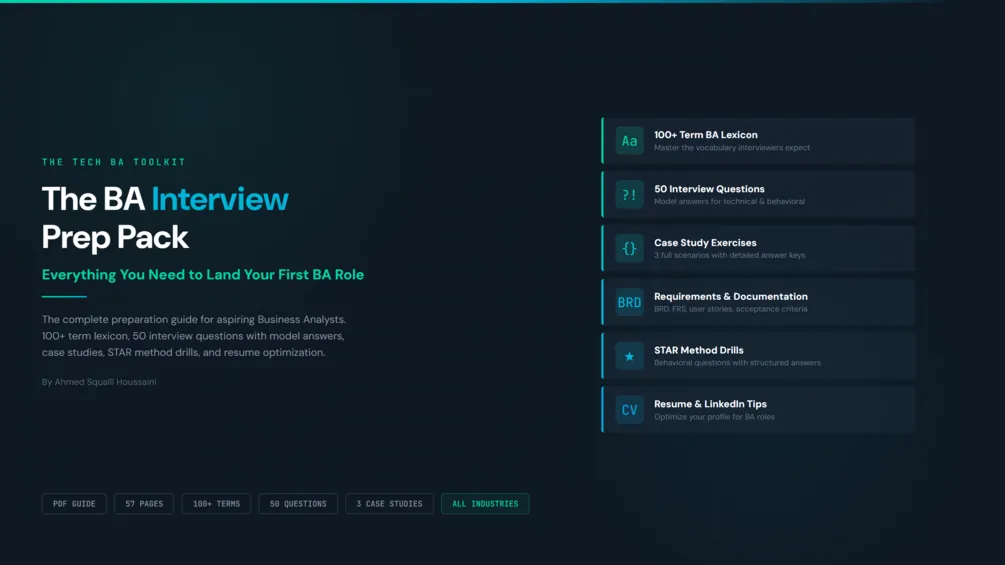
This last question decides most technical BA interviews. Case studies for the scenario questions, with the artifacts to bring, are in the BA Interview Prep Pack. For a free start, 5 Real BA Interview Questions + Model Answers is a short sampler of the full guide.
How should you answer a technical question you do not know?
Say what you know, say how you would find the rest, and name who you would ask. “I have not configured that, but I know what it is for, and I would check the queue settings and ask the platform team” scores better than a confident guess. Interviewers are testing your method, and a wrong guess delivered with confidence is the answer that worries them most.
How do you prepare for a technical BA interview in one week?
Produce answers instead of reading about them:
- Day 1: write the four SQL queries above against a sample database.
- Day 2: call a public API in Postman and trigger a 401, a 404, and a 422 on purpose.
- Day 3: trace one payment on paper through pain.001, pacs.008, and pacs.002.
- Day 4: rewrite one vague requirement from your project as Given, When, Then.
- Day 5: prepare two STAR stories and one artifact you can show.
- Day 6: run a mock interview aloud, timed.
- Day 7: rest, and reread your artifact.
If you are changing careers rather than moving up, the case exercises and the “why the switch” answer are covered in interviewing as a career changer, and the six month skills plan is in how to become a technical business analyst.
The takeaway
Technical business analyst interviews reward method over memory. Restate, ask one question, answer, and say what you would check next. Write the SQL, read the 422, trace the payment, and bring one artifact you built yourself. Most candidates can define these terms; the ones who get the offer show they have used them.
For every question type with longer model answers, three technical case studies, and full pain.001 and pain.002 XML, start with the BA and Technical BA Interview Guide. If you also want the technical skills behind the answers, The Complete Tech BA Bundle includes the Interview Guide with the Technical Skills Guide, the Prompt Toolkit, and the BR to FR guide: four guides for CAD 49.99 instead of 109.96. For a mock interview with feedback, book a 1:1 Tech BA Coaching Call. Grab the free downloads, or browse everything at The Tech BA Toolkit. More on the craft lives in the Business Analyst hub.
Ahmed is a Senior Technical Business Analyst with 10+ years in banking and payments. He builds practical guides and tools for analysts at The Tech BA Toolkit.
About the author
Analyst Engineering is written by Ahmed, a Senior Technical Business Analyst with 10+ years of banking and payments delivery experience: ISO 20022 and SWIFT messaging, payments API integration, Kafka event validation, and production support. Every article comes from real delivery work, and each one is reviewed and updated as tools and standards change.
Related articles
- How to Become a Technical Business Analyst: The Six Month Plan and the Pay Jump How to become a technical business analyst: SQL, APIs, logs, and scripting in six months on your project, one artifact a month, and a 10 to 20 percent pay jump.
- Interviewing as a Career Changer: How to Answer "Why the Switch?" and the Case Exercise How career changers pass analyst interviews: scripts for why the switch and no experience, the seven common case exercises, STAR stories, and the pay question.
- SQL for Analysts: Query the State, Find the Truth The SQL a technical analyst actually needs: SELECT, WHERE, JOIN, GROUP BY, and reading state during analysis and testing. Not for reports: for finding truth.
- How a Technical BA Investigates a Failed Payment How a technical business analyst investigates a failed payment: the questions, the tools, and following one transaction from the complaint to the root cause.
Go deeper on this
Not ready to buy? The free starter kit is a no-cost place to start, and every article here stays free.
Free account
Practice on the Labs, keep your progress
A free account, no password: an email link signs you in. It saves your steps and self-assessments on the Labs, shows your missions on a dashboard, unlocks the solutions, and, if you tick the box, sends you new missions and articles when they ship.
Your email is used to sign you in. Nothing else, unless you ask. Privacy.