From an AI Note Taker in Teams to Real Artifacts: The Meeting Pipeline
Written by Ahmed at Analyst Engineering, a Senior Technical Business Analyst with 10+ years in banking and payments delivery.
Key takeaways
- A recording is not a record. The value is not the transcript, it is the four extractions from it: decisions that were actually made, actions with named owners, requirement candidates, and contradictions nobody noticed in the room.
- Consent and retention come first. Announce recording, know how long the transcript is kept and who can read it, and never record a conversation about a person, a supplier negotiation, or an incident with customer data on screen.
- The single instruction that makes a transcript summary trustworthy is 'do not guess': if the meeting did not name an owner or a date, the output must say OWNER NOT NAMED rather than producing a tidy fiction.
- Contradiction detection is the extraction humans cannot do. In a ninety-minute workshop somebody says two incompatible things forty minutes apart and nobody notices; a model reading the whole transcript at once catches it every time.
- Send the follow-up within the hour, while everyone still remembers. Speed is what converts a transcript into agreement: a perfect summary three days later gets corrected by memory, and an adequate one at 16:40 gets confirmed.
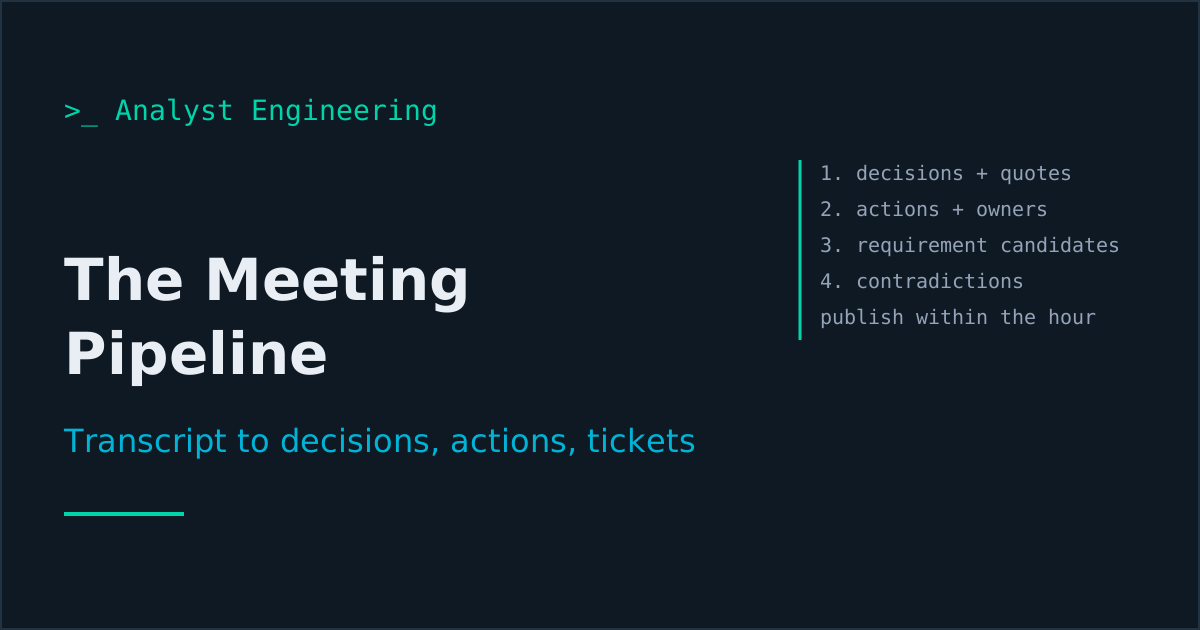
A recording is not a record. Run four extractions over the transcript instead of asking for a summary: decisions traced to quoted lines, actions with named owners or an explicit OWNER NOT NAMED, requirement candidates with what is still undefined, and contradictions with both sides quoted. Handle consent and retention first, review before publishing, and send within the hour.
You have just finished a ninety-minute requirements workshop. Eleven people, four workstreams, and somewhere in there the cut-off time changed and two people are now building against different assumptions.
Before AI note takers, the analyst’s job in that room was split badly: half of your attention on the conversation, half on writing fast enough. This is part seven of The AI Analyst, and it is the part that returns your attention to the room. The transcript happens without you. What you do with it is the actual work.
What does an AI note taker actually give you?
Depends on the tool, and the distinction matters.
A transcript is the raw text with speaker attribution and timestamps. Microsoft Teams produces this natively; so does Zoom, Google Meet, and every dedicated note taker. This is the valuable artifact, because it is the evidence.
A recap is the tool’s own automatic summary: Copilot in Teams, Zoom AI Companion, Otter, Fireflies, Granola. These are getting good at the generic shape (topics, action items) and are still weak at the analyst shape, because they do not know what a decision means on your programme, what your definition of ready is, or which of the eleven people is allowed to decide anything.
The pipeline in this article uses the transcript as the input and replaces the recap with four extractions you control. Keep the tool’s recap if you like it; it is a free second opinion. But do not ship it as your minutes, because the generic recap will confidently list “discuss cut-off time with operations” as an action item assigned to nobody, and that is precisely the thing you needed to nail down.
Consent, retention, and the meetings you do not record
Get this settled before you turn anything on, because it is the part that ends careers rather than the part that wastes time.
Announce it. At the start, out loud: “this is being recorded and transcribed.” Not in the invite where nobody reads it. Participants need a real chance to object, and some will, and that is legitimate.
Know the retention. How long does your organization keep Teams transcripts, and who can read them? In most tenants the answer is longer than people assume, and the transcript is discoverable in a legal hold. A workshop where somebody says “we know that control has been broken since March” is now a durable record of that statement. That is not an argument against recording; it is an argument for knowing.
Do not record these: conversations about an individual’s performance or conduct, supplier or contract negotiations, anything with legal privilege, incident calls where production data will be on screen or read aloud, and anything a participant has objected to. Regulated environments should check with compliance before making recording the default, not after.
The transcript is classified data. It contains whatever people said, which on a payments programme routinely includes customer names and account references read out during an incident recap. All five never-paste classes from the guardrails apply to a transcript exactly as they apply to a document, and the transcript is the one people forget.
The four extractions
Do not ask for a summary. A summary is one blended artifact you have to read entirely to trust. Four targeted extractions each have a different verification method, and three of them are checkable in seconds.
Extraction 1: decisions
Here is a transcript of a 90 minute requirements workshop: [paste
or attach]

Extract DECISIONS only: things the group actually settled.

For each:
- the decision, in one sentence
- the exact quote that shows it was settled, with the speaker
- who made it, if the transcript shows authority
- anything attached to it (a date, a condition, a caveat)

Exclusions:
- If it was discussed but not settled, it is not a decision.
- If someone proposed it and nobody agreed, it is not a decision.
- If you are unsure, put it in a PROBABLY NOT SETTLED list instead.

Do not add decisions that were not discussed.
The exclusions carry the weight. Left alone, a model turns a strongly-worded suggestion into a decision, because in text they look identical. The quote requirement is what lets you check: you read eleven quotes, you know which two are wrong, and it took ninety seconds.
Extraction 2: actions
Extract ACTIONS from the same transcript.

Table: task | owner | date | quote showing it was accepted

Rules:
- If the transcript does not name an owner, write OWNER NOT NAMED.
- If no date, write NO DATE.
- If someone volunteered but no one confirmed, mark it TENTATIVE.
- Never infer an owner from who was talking about the topic.
That last rule is the specific failure. The person discussing a topic most is usually not the person who owns the action, and a model will assign it to them every time because that is the statistical pattern. Forcing OWNER NOT NAMED turns a tidy fiction into an accurate document with visible holes, and the holes are why you send the follow-up.
Extraction 3: requirement candidates
Extract REQUIREMENT CANDIDATES: anything in this transcript that
describes how the system should behave.

For each:
- the behavior, phrased as a testable statement
- the quote it came from
- UNDEFINED: what this leaves unspecified (which field, what value,
  what happens on the failure path, which system does it)

Use only field names and status values from the attached context
pack. If the transcript names a concept with no field in the pack,
write UNDEFINED IN SOURCE.

Do not write requirements that the transcript does not support.
Attach the context pack here. This is the extraction that most needs grounding, because a requirement is where invented field names do real damage, and it flows directly into your specification. The UNDEFINED list per requirement is the agenda for the next session, and it is typically twice as long as anyone expected, which is the honest picture of where you actually are.
Extraction 4: contradictions
Find CONTRADICTIONS in this transcript: any two statements that
cannot both be true.

Quote both, with speakers and approximate timestamps.

Then compare the transcript against the attached specification and
the attached design page, and list anything said in this meeting
that conflicts with those documents.

Do not resolve anything. List and quote.
This is the extraction no human can do, and it is the reason the whole pipeline is worth building. Over ninety minutes, somebody says the cut-off is 15:30 at minute 12 and 16:00 at minute 51, and eleven people including you do not notice, because human attention does not work across an hour. A model reading the whole thing at once catches it every time.
The cross-check against existing documents is the second half of the value. The meeting agreed something that contradicts a constraint agreed six weeks ago in a different workstream. That is the most expensive kind of finding and the easiest one to surface with this flow.
Then you review it, because you were in the room
The model heard words. You were there. You know things the transcript does not contain:
- Tone. The difference between “yeah, fine” meaning agreement and “yeah, fine” meaning this is not over.
- Authority. Whether the person who said it can actually decide it.
- The room. Who went quiet, which is usually where the risk is.
- Compression of negation. Models flatten “we looked at that and decided against it” into “we decided that” more often than any other error. Read every decision for reversed polarity specifically.
Three minutes of review over four extractions. Then it is yours, and your name goes on it.
Publishing: page, tickets, and vault
Now the pipeline connects to everything else in the series.
Confluence page. The meeting notes page with the four sections. Use the marked generated region and the draft-approve-write pattern from part six, so the page carries its source and is reversible.
Jira actions. Each action becomes a ticket, labelled ai-drafted, and assigned to the named owner. Anything marked OWNER NOT NAMED does not become a ticket. It becomes a line in your follow-up email asking who owns it, because creating an unowned ticket is how a backlog fills with work nobody is doing.
Requirement candidates go to refinement, not to the backlog. They are candidates. Refinement that actually refines is where they either become real or die, and the UNDEFINED list is your agenda for that session.
Contradictions go in an email, today, to the two people who disagreed, quoting both. Not in the page where they will be read next month.
Your vault. The decisions and the contradictions go into your own notes, which is part eight, because in fourteen months somebody will ask why the cut-off is 15:30 and the person who can answer instantly is the one who kept a searchable record.
Send it within the hour
This is the operational point that matters more than any prompt.
A follow-up at 16:40 the same afternoon gets confirmed, because everyone still remembers and correcting it is cheap. The same document three days later gets argued with, because memory has reorganised itself into something more flattering and now you are negotiating rather than recording.
The pipeline makes the hour achievable: four extractions take about four minutes, review takes three, publishing takes three. Ten minutes, and you have converted a meeting into agreement while the agreement is still warm. Before AI note takers I managed this maybe one time in five. Now it is the default, and the compounding effect on a programme is larger than anything else in this series, because the cost of an undocumented decision is measured in weeks.
If you want the full set of analyst artifacts these extractions feed into, from workshop notes through to specifications, Real-World BA Deliverables has twenty templates worth grounding the prompts on.
What this does not replace
The analyst in the room. It replaces the transcription, which was never your contribution.
What remains is the part that was always the job: noticing that a stakeholder agreed reluctantly, asking the question that exposes the undefined failure path, recognising that the decision just made breaks a constraint from another workstream, and chasing the action nobody wants. If you are not writing everything down, you are more present for all four, which is a productivity gain that never shows up in a tool’s marketing because it is not measurable in minutes saved.
There is also a quiet trap. When transcripts are cheap, people stop preparing, on the grounds that it will all be captured. Capture is not preparation. A workshop with no agenda produces a transcript of eleven people discovering what the workshop was about, and no extraction fixes that.
The takeaway
Turn a meeting into artifacts with four extractions, not a summary: decisions traced to quotes, actions with explicit OWNER NOT NAMED where the room did not say, requirement candidates with their UNDEFINED list, and contradictions with both sides quoted. Handle consent and retention before you record anything, treat the transcript as classified data, and review everything yourself because you were there and the model was not.
Then publish inside the hour: page, owned tickets, contradictions by email, decisions into your own notes. That last one is part eight, where all of this becomes a second brain that can answer a question fourteen months later. The full path is on The AI Analyst.
Ahmed is a Senior Technical Business Analyst with 10+ years in banking and payments. He builds practical guides and tools for analysts at The Tech BA Toolkit.
Tags: Business Analysis, Artificial Intelligence, Requirements, Meetings, Productivity
About the author
Analyst Engineering is written by Ahmed, a Senior Technical Business Analyst with 10+ years of banking and payments delivery experience: ISO 20022 and SWIFT messaging, payments API integration, Kafka event validation, and production support. Every article comes from real delivery work, and each one is reviewed and updated as tools and standards change.
Related articles
- Letting AI Write to Jira and Confluence Without Losing Control The write side of an AI connection: what to automate, what never to, the approval pattern, the dedicated account, and how to keep generated tickets owned by a human.
- AI for Analysts: Start Here, From a Blank Prompt to Usable Output The beginner's start for analysts using AI: four first wins (sharper questions, stakeholder emails, meeting follow-ups, vague tickets) and the review discipline.
- Your Second Brain, Answered by AI: Obsidian Plus a Model That Reads Your Vault Point an AI assistant at your Obsidian vault so fourteen months of notes answer questions directly, and structure the vault so the answers are traceable and correct.
- Refinement That Actually Refines: Turning a Story Into Something Buildable The output of refinement is not an estimate, it is decisions closed. What to bring, how to split a story without knowing the code, and what ready means.
Free account
Practice on the Labs, keep your progress
A free account, no password: an email link signs you in. It saves your steps and self-assessments on the Labs, shows your missions on a dashboard, unlocks the solutions, and, if you tick the box, sends you new missions and articles when they ship.
Your email is used to sign you in. Nothing else, unless you ask. Privacy.