ISO 20022 Remittance Information: Structured, Unstructured, and RF References
Written by Ahmed at Analyst Engineering, a Senior Technical Business Analyst with 10+ years in banking and payments delivery.
Key takeaways
- Unstructured remittance is a single free-text field, commonly capped at 140 characters by scheme guidelines, and it is the reason accounts receivable teams still reconcile by hand. Structured remittance carries referenced document type, number, date, and amount as separate elements a machine can match on.
- An RF creditor reference under ISO 11649 is a check-digit-protected reference the creditor generates and the debtor quotes back unchanged. It is the highest-value change most billers can make, because a valid RF reference matches an invoice automatically with no fuzzy logic.
- Structured and unstructured are mutually exclusive in most usage guidelines: you populate one or the other, not both. Systems that emit both, or concatenate structured data into the unstructured field, are the most common source of remittance defects.
- Remittance data is the first thing truncated on a non-native hop, because legacy formats have far less room. If your value proposition depends on rich remittance surviving end to end, you must prove the whole route is native before you promise it.
- Never parse the unstructured field to populate structured elements. A parser that reads 'INV 4471 CR NOTE 88' and invents a structured block produces confident, wrong reconciliation, and the creditor has no way to tell which entries were parsed.
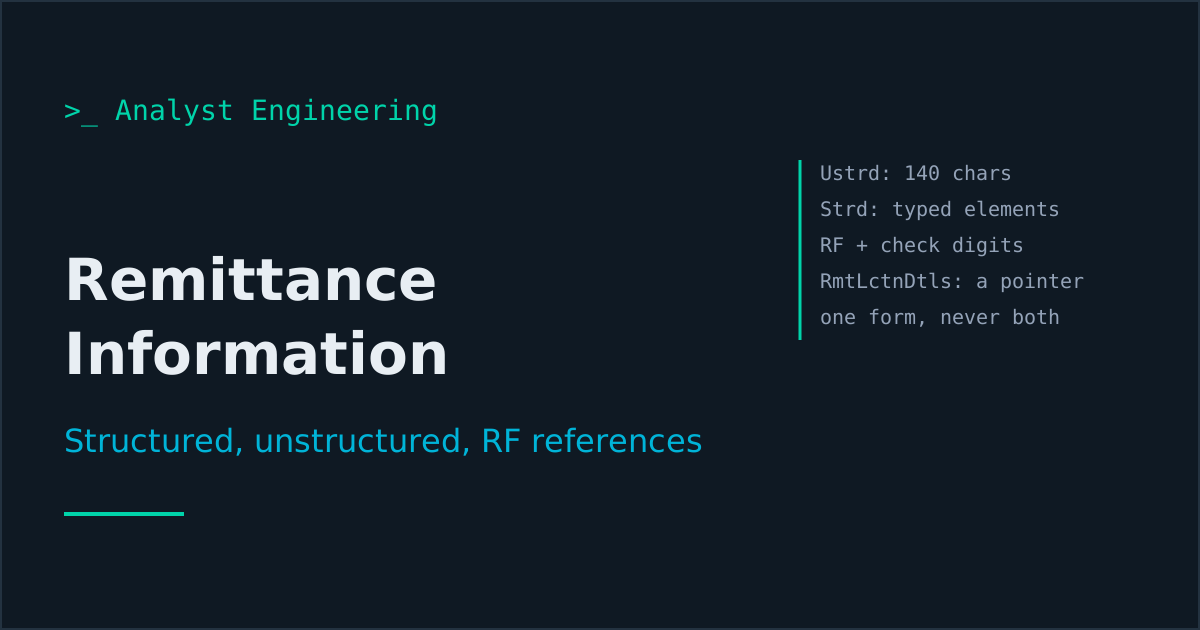
Unstructured remittance is free text, commonly capped at 140 characters, and it is why accounts receivable teams still match payments by hand. Structured remittance carries document type, number, date, and amount as separate elements. An ISO 11649 RF creditor reference is the cheapest route to automatic matching. Use one or the other, never both, and never parse one into the other.
A corporate treasurer receives 47,320.00 EUR. The remittance field says PAYMENT MARCH. Somewhere in their ledger are nine open invoices from this customer that could combine to that figure, two of which have partial credit notes.
Someone will spend forty minutes on this, today, and again tomorrow. Rich remittance data is the single most commonly cited business benefit of ISO 20022, and it is the one most often lost in implementation.
This is the remittance article in the field-by-field track of The ISO 20022 Reference, following purpose codes.
What are the two forms of remittance information?
RmtInf offers two mutually exclusive shapes.
Unstructured (Ustrd) is free text. The debtor writes whatever they want. Scheme guidelines commonly cap it at 140 characters, and some allow repetition or more space. It carries no meaning a machine can rely on.
Structured (Strd) breaks the same information into typed elements, repeatable per referenced document:
RfrdDocInf: referenced document information, holding type (CINVcommercial invoice,CRENcredit note,DEBNdebit note, and others), the document number, and the related date.RfrdDocAmt: the amounts tied to that document, covering due amount, discount applied, credit note amount, remitted amount.CdtrRefInf: the creditor reference, which is where an RF reference lives.AddtlRmtInf: additional free text, for the residue that does not fit a typed element.
The difference in outcome is stark. Unstructured requires a human or a fuzzy matcher. Structured can be matched to open items automatically, including partial settlements and credit notes, because the amounts are attached to the document they belong to.
Most usage guidelines require one or the other, not both. Systems that emit both, or that stuff structured data into the unstructured field as a delimited string, are the most common source of remittance defects, and they are usually built that way because a legacy interface needed the flat version and nobody removed it afterwards.
The RF creditor reference, and why it is the cheapest win
CdtrRefInf can carry a creditor reference in the ISO 11649 RF format. The shape:
RF 18 539007547034
│  │  │
│  │  └── up to 21 characters, the creditor's own reference
│  └────── two check digits
└───────── literal RF
The creditor generates it, prints it on the invoice, and the debtor quotes it back unchanged in the payment. Because of the check digits, any system can validate the reference before trusting it, using the same modulo 97 arithmetic that validates an IBAN.
That check digit is what makes the difference between “probably this invoice” and “this invoice.” A valid RF reference identifies exactly one open item, so matching is a lookup rather than a heuristic. No fuzzy logic, no tolerance windows, no manual queue.
For most billing organisations this is the highest-return change available, and it is largely a change to invoice templates and reference generation rather than to payment infrastructure. If your programme is looking for a demonstrable ISO 20022 benefit to show a steering committee, the accounts receivable auto-match rate before and after RF adoption is a number that moves visibly.
Note the asymmetry worth explaining to the business: the creditor issues the reference, the debtor quotes it. So the benefit accrues to the creditor, while the effort of quoting it correctly sits with the debtor. That is why adoption needs a commercial conversation, not just a technical one.
Where rich remittance actually goes to die
Remittance is the first casualty of a non-native hop.
The mechanism is simple: a rich structured block carrying four referenced documents with amounts has nowhere to go in a format that offers a few short lines. So it is compressed into free text, or truncated, or dropped. The payment settles correctly and the reconciliation benefit evaporates, silently, at a hop nobody in your programme controls.
This is the truncation ledger problem, and remittance is its most expensive instance, because the business case for the migration was frequently built on exactly this data surviving.
The analyst obligation here is honesty about the route. Before anyone promises a corporate client that their beneficiaries will receive full invoice detail:
- Confirm every hop on the intended corridors is ISO 20022 native.
- Where it is not, state what is lost and get that accepted in writing.
- Never let the value proposition be “ISO 20022 carries rich data” without the qualifier “end to end, on native routes.”
Domestic schemes where you control both ends are where the benefit is real and immediate. Long correspondent chains are where it is aspirational.
Do not parse free text into structured fields
Same prohibition as purpose codes, for the same reason, and it is more tempting here because the text often looks parseable.
A debtor sends INV 4471 CR NOTE 88 LESS 2PCT. A parser can produce a plausible structured block: commercial invoice 4471, credit note 88, discount 2 percent. It will be right often enough to feel like a success.
The problem is that the creditor receiving the structured block cannot tell which entries were supplied and which were inferred. Structured remittance carries an implicit claim: the debtor asserted this. Once a parser is in the chain, that claim is false, and the creditor’s automatic matching is now trusting a guess. When it is wrong, it posts a payment against the wrong invoice, which is worse than not matching at all because it corrupts the ledger rather than filling a queue.
If a debtor sends unstructured text, pass it through as unstructured. The real fix is upstream: get the debtor to send structured data, or get the creditor to issue RF references so the debtor has something unambiguous to quote. Both are onboarding conversations, not code.
Remittance location: when the data will not fit
There is a third option people forget. RmtLctnDtls lets the payment carry a pointer to remittance details held elsewhere, with a method and an address: a URI, an email address, or a postal address.
This exists for the case where the remittance advice is genuinely too large for any payment message, which is normal for a payment settling four hundred invoices. Rather than truncating, the payment says where the full advice can be retrieved.
It is underused, partly because it requires the creditor to be able to fetch and process the advice. But for high-volume business-to-business relationships it solves a problem that no field length increase ever will, and it is worth raising when a client complains that 140 characters cannot possibly carry their remittance.
What to specify and what to test
Specification:
- Whether each product sends structured or unstructured, and the hard rule that it is never both.
- The net character limit per scheme, taken from the guideline rather than assumed to be 140.
- Whether you validate an inbound RF reference’s check digits, and what happens when they fail. Passing through an invalid RF reference defeats its purpose.
- What happens to structured remittance on a route that cannot carry it, and who signs off on that loss.
- An explicit prohibition on parsing unstructured into structured.
- Whether remittance location is supported, and how the creditor retrieves the advice.
Test conditions:
- Structured remittance with multiple referenced documents, proving each survives to the beneficiary with its amounts attached.
- A valid RF reference matching automatically, asserting the matched invoice rather than the presence of the field.
- An RF reference with deliberately wrong check digits, which must be caught.
- Unstructured text at the limit, one character over, and containing characters the scheme restricts.
- A payment crossing a hop known to be non-native, asserting the documented loss rather than a surprise.
- Structured and unstructured both populated, which must be rejected by your own validation before the scheme sees it.
The character-set case is worth extra attention. Remittance is free text, so it attracts accented characters, currency symbols, and occasionally emoji, and schemes restrict the permitted character set. That is a XML traps style failure: schema-valid, scheme-rejected.
The takeaway
Unstructured remittance is free text that a human has to interpret. Structured remittance attaches amounts to the documents they settle, which is what makes automatic matching possible. An ISO 11649 RF creditor reference is the cheapest route to a real auto-match rate, because its check digits turn a guess into a lookup.
Use one form or the other, never both. Prove the route is native before promising rich data survives. Never parse free text into structured fields, because the creditor cannot tell an inference from an assertion, and a wrongly matched payment is worse than an unmatched one.
Next: reading a camt.053, the statement where all of this remittance data either arrives usable or does not. The full map is on The ISO 20022 Reference.
Ahmed is a Senior Technical Business Analyst with 10+ years in banking and payments. He builds practical guides and tools for analysts at The Tech BA Toolkit.
Tags: ISO 20022, Payments, Banking, Reconciliation, Functional Analysis
About the author
Analyst Engineering is written by Ahmed, a Senior Technical Business Analyst with 10+ years of banking and payments delivery experience: ISO 20022 and SWIFT messaging, payments API integration, Kafka event validation, and production support. Every article comes from real delivery work, and each one is reviewed and updated as tools and standards change.
Related articles
- ISO 20022 Purpose Codes: Purp, CtgyPurp, and What They Drive Downstream Purpose code vs category purpose in ISO 20022: who reads each, the codes that change routing and treatment, and why a wrong SALA costs a payroll run.
- The ISO 20022 Truncation Ledger: What Rich Data Actually Loses in Transit ISO 20022 carries rich structured data, and every non-native hop quietly degrades it. The field-by-field loss ledger, and how to specify what you accept losing.
- Reading a camt.053: The Bank Statement an Analyst Can Reconcile How a camt.053 is structured: balance types, entries, entry details, bank transaction codes, and the references that let you match a statement line to a payment.
- Reconciliation Design: Proving Two Systems Agree How to design reconciliation between systems: matching keys, break detection, tolerance, timing, and exception handling. The control that proves the money is right.
Free account
Practice on the Labs, keep your progress
A free account, no password: an email link signs you in. It saves your steps and self-assessments on the Labs, shows your missions on a dashboard, unlocks the solutions, and, if you tick the box, sends you new missions and articles when they ship.
Your email is used to sign you in. Nothing else, unless you ask. Privacy.