MT101 to pain.001: Payment Initiation Relay Over SWIFT, Field by Field
Written by Ahmed at Analyst Engineering, a Senior Technical Business Analyst with 10+ years in banking and payments delivery.
Key takeaways
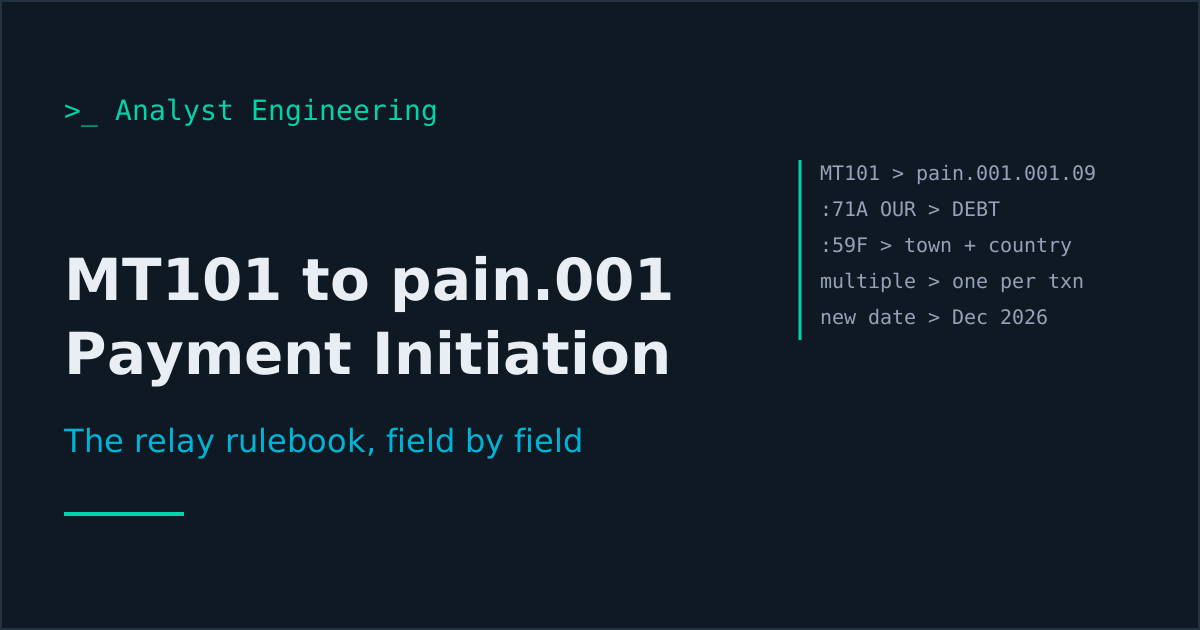
- Interbank MT101 (request for transfer) is being replaced by the CBPR+ pain.001 (Customer Credit Transfer Initiation, version pain.001.001.09) under SWIFT's ISO 20022 Payment Initiation Relay rulebook, which banks accede to as forwarding agent, debtor agent, or both.
- The end of coexistence planned for November 2026 is not being enforced: after SWIFT's August 2026 deferral of Standards Release 2026 payments changes, MT101 single and multiple instructions remain supported between banks, the RMA bootstrap planned for 3 October 2026 did not happen, and a new compliance date is expected in December 2026.
- The CBPR+ pain.001 is a single-instruction message in the relay flow. An MT101 with several transactions has no direct equivalent and becomes several pain.001 messages, which changes batching, references, and status reporting.
- Corporates sending MT101 through SCORE (Swift for Corporates) are outside the interbank end of coexistence, but structured address requirements apply on every channel once they take effect: at least town name and country in their own elements, using field 59F in MT101 or the structured postal address in pain.001.
- The migration risk sits in the mapping: field 23E instruction codes, field 71A charges, field 33B and 36 FX details, and remittance in field 70 each move into different pain.001 elements, and each is a test case.
Interbank MT101 is being replaced by the CBPR+ pain.001 (version pain.001.001.09) under SWIFT’s ISO 20022 Payment Initiation Relay rulebook. The November 2026 end of coexistence is not being enforced after SWIFT’s August 2026 deferral, and a new date is expected in December 2026. That buys time for the real work: a one-to-many field mapping, single-instruction messages instead of batches, structured addresses, and a test pack that proves nothing gets lost in the relay.
The MT101 is the message treasurers love and banks tolerate. A corporate with accounts at ten banks sends requests for transfer to one bank, which relays them to the bank holding each account. It runs on bilateral agreements, a terse format, and field 23E codes that every bank interprets slightly differently. Moving it to ISO 20022 is overdue and, compared with pacs.008, under-documented.
This article is in the migration section of The ISO 20022 Reference. PAIN vs pacs explains why customer-to-bank and bank-to-bank messages differ. Here the focus is the specific move from MT101 to pain.001 over SWIFT.
What does MT101 do, and what replaces it?
An MT101 is a request for transfer: an instruction to debit an ordering customer’s account and pay a beneficiary. It travels in two settings:
- Corporate to bank, over Swift for Corporates (SCORE). The corporate sends the MT101 straight to the bank holding the account.
- Bank to bank (the relay). The corporate sends its requests to one bank, the forwarding agent, which relays each one to the debtor agent, the bank where the account is held.
The ISO 20022 replacement is the pain.001 Customer Credit Transfer Initiation in both settings, with the pain.002 status report coming back. But the rules differ:
| Setting | Today | ISO 20022 | Covered by the CBPR+ end of coexistence? |
|---|---|---|---|
| Corporate to bank (SCORE) | MT101 over FIN | pain.001 over FINplus under SCORE+ usage guidelines | No. MT101 in SCORE continues |
| Bank to bank (relay) | MT101 over FIN under bilateral agreements | CBPR+ pain.001.001.09 under the Payment Initiation Relay rulebook | Yes, date being reset |
The relay is the part with a deadline, so it is the focus below.
What is the Payment Initiation Relay rulebook?
SWIFT’s ISO 20022 Payment Initiation Relay rulebook is the business framework for relaying pain.001 between banks. It succeeds the framework that governed MT101 relay: SWIFT publishes interpretation notes explaining how the rulebook applies alongside the older service level master agreement and request for transfer schedule during coexistence.
What it means operationally:
- Accession. A bank accedes through an eForm and declares its BICs, readiness dates, and the roles each BIC supports: forwarding agent, debtor agent, or both.
- The directory. SWIFT’s online directory lists acceded banks with their accession, change, and termination status. Before you send a pain.001 relay to a debtor agent, you check it has acceded in the debtor agent role. That check belongs in your routing, not in a spreadsheet.
- The default path. SWIFT says that for most banks, acceding to the rulebook is the default way to have a business framework in place, rather than bilateral contracts per counterparty.
What are the dates now?
Current as of October 2026.
| Date | What was planned | What happened |
|---|---|---|
| November 2025 | In-flow translation of interbank pain.001 to MT101 for receivers not ready | Live since November 2025 |
| 3 October 2026 | RMA bootstrap to enforce the end of coexistence | Will not take place (ING, 1 September 2026) |
| November 2026 | End of coexistence: MT101 with multiple transactions rejected (NAK), MT101 single converted to pain.001 by contingency processing, with extra FIN validation and fees | Not enforced. MT101 single and multiple remain supported between banks |
| December 2026 | (not in the original plan) | New compliance date expected, per SWIFT’s CBPR+ guidance as reported by ING |
| Early 2027 | (not in the original plan) | SWIFT may consider a new bootstrap based on adherence to the rulebook, as an incentive to adopt pain.001 |
| November 2027 | Ancillary messages (pain.002, camt.055, camt.029) adopted bilaterally by this date | Unchanged in public sources |
The deferral comes from SWIFT’s 27 August 2026 decision to defer all payments changes in Standards Release 2026 and phase the other planned payments changes separately. Banks are still asked to keep moving: ING is migrating its counterparties to pain.001.001.09, and J.P. Morgan reports receiving CBPR+ pain.001 since November 2025.
What changes for the corporate and for the bank?
For the corporate, on the relay path, very little at first: it still sends requests to its forwarding agent. What changes is the data it must supply. A pain.001 has room for a structured debtor and creditor, structured remittance, purpose codes, an end-to-end identification that survives to the beneficiary’s statement, and a UETR. The pain.002 that comes back tells it precisely what happened. Corporates that keep sending MT101 to their forwarding agent need that agent to map it, which is where data gets lost.
For the forwarding agent, the job becomes a transformation: receive the corporate’s request (MT101, pain.001, a host-to-host file, or an API call), validate it against the CBPR+ usage guideline, and relay one pain.001 per transaction to the debtor agent.
That last part is the structural change. The CBPR+ pain.001 relay is a single-instruction message. An MT101 could carry several transactions, and ING’s mapping table lists MT101 multiple with “no MX equivalent”. A forwarding agent that receives a ten-transaction request sends ten pain.001 messages. Your reference scheme, duplicate checks, status aggregation, and the batch versus single booking logic downstream all have to cope.
For the debtor agent, the incoming request is richer and stricter. It executes the transfer, usually as a pacs.008, and reports status back with a pain.002. The ancillary messages (pain.002 for status, camt.055 to cancel, camt.029 to answer) are bilateral today and due by November 2027.
How does MT101 map to pain.001?
Field by field, for the fields that matter. The XML paths are relative to the pain.001 Customer Credit Transfer Initiation.
| MT101 field | Content | pain.001 element | Watch out for |
|---|---|---|---|
| :20 | Sender’s reference | GrpHdr/MsgId and PmtInf/PmtInfId | One MT101 becomes several messages: derive unique ids traceable to the original |
| :21R | Customer specified reference | PmtInf/PmtInfId or a reference agreed bilaterally | Often used for the corporate’s batch reference |
| :28D | Message index / total | No equivalent | Chaining of MT101 messages disappears |
| :50C / :50L | Instructing party | GrpHdr/InitgPty | |
| :50G / :50H / :50F | Ordering customer and account | PmtInf/Dbtr and PmtInf/DbtrAcct | Structured debtor name and address |
| :52a | Account servicing institution | PmtInf/DbtrAgt | The debtor agent that must have acceded |
| :51A | Sending institution | GrpHdr/FwdgAgt | The forwarding agent role |
| :30 | Requested execution date | PmtInf/ReqdExctnDt/Dt | |
| :25 | Authorisation | No direct equivalent | Signature handling moves outside the message |
| :21 | Transaction reference | CdtTrfTxInf/PmtId/InstrId | Point to point |
| (none) | CdtTrfTxInf/PmtId/EndToEndId and UETR | New: carried unchanged to the beneficiary | |
| :21F | FX deal reference | CdtTrfTxInf/XchgRateInf/CtrctId | |
| :23E | Instruction code (URGP, CHQB, INTC, PHON, OTHR…) | PmtTpInf (service level, category purpose) or InstrForDbtrAgt / InstrForCdtrAgt | Agree a mapping table per code; free-text 23E narratives are the classic loss |
| :32B | Currency and amount | CdtTrfTxInf/Amt/InstdAmt with Ccy | |
| :33B and :36 | Original ordered amount and exchange rate | Amt/EqvtAmt and XchgRateInf | Which currency is fixed must survive |
| :56a | Intermediary | CdtTrfTxInf/IntrmyAgt1 | |
| :57a | Account with institution | CdtTrfTxInf/CdtrAgt | |
| :59 / :59A / :59F | Beneficiary | CdtTrfTxInf/Cdtr and CdtrAcct | Structured or hybrid address |
| :70 | Remittance information (4x35) | CdtTrfTxInf/RmtInf | Room for structured references after migration |
| :77B | Regulatory reporting | CdtTrfTxInf/RgltryRptg | Country-specific codes |
| :71A | Details of charges (OUR, SHA, BEN) | ChrgBr (DEBT, SHAR, CRED) | See charges |
| :25A | Charges account | PmtInf/ChrgsAcct |
Three mapping rules deserve their own requirement.
- 23E is a decision table, not a field. Write it as a decision table: each code, its ISO 20022 destination, and what happens to codes with narrative text. URGP and the service level, INTC and category purpose, PHON and OTHR into instructions for the agent: each needs an explicit row.
- Charges translate, they do not copy. OUR becomes DEBT, SHA becomes SHAR, BEN becomes CRED. A mapper that passes the three-letter MT code fails schema validation at best.
- FX must keep which side is fixed. In an MT101 with :33B and :36, the ordered amount and the rate tell the debtor agent which currency the customer fixed. In pain.001, InstdAmt and EqvtAmt express the same choice differently. Get it wrong and the beneficiary receives the right amount in the wrong currency, which is a payment defect, not a format defect. Amounts and FX covers the two amounts.
How do structured addresses affect MT101 and pain.001?
SWIFT’s guidance for corporates is the same on every channel, MT101 over SCORE, pain.001 over SCORE+, or a bank’s proprietary channel: when the requirement applies, the beneficiary address must have at least town name and country as structured elements. In MT101 that means field 59 option F, which carries the address in numbered lines with the town and country identified. In pain.001 it means the structured postal address, or the hybrid form with town and country structured and up to two address lines.
Two caveats as of October 2026. The November 2026 date was deferred, and ING reports that unstructured addresses in interbank MT101 remain supported for now. And if the beneficiary bank is identified by BIC, no bank address is needed. The full picture, and why corporates should still collect structured beneficiary addresses in their ERP now, is in structured addresses.
For the forwarding agent, this creates an awkward requirement: a corporate may send a 59F address that is hybrid, and the onward pain.001 must keep the structure it was given, not flatten it back into address lines. Test it.
If you are writing the forwarding agent’s requirements from a one-line brief like “support pain.001 relay”, From Vague BR to Functional Requirements shows the method, and Break Into Banking covers the corporate banking flows behind it.
What should you test?
| # | Scenario | Expected result |
|---|---|---|
| 1 | Single-transaction MT101 from a corporate, relayed as pain.001 | All mapped fields present, CBPR+ validation passes |
| 2 | MT101 with five transactions | Five pain.001 messages, each with a unique MsgId traceable to the original :20 and :21 |
| 3 | Each 23E code in use | Lands in the agreed element per the decision table |
| 4 | 23E with narrative text | Narrative preserved in the agreed instruction element, not dropped |
| 5 | :71A OUR, SHA, BEN | ChrgBr DEBT, SHAR, CRED |
| 6 | :33B and :36 present | Fixed-currency side preserved, beneficiary receives the intended amount |
| 7 | Beneficiary with 59F hybrid address | Town and country structured in the pain.001, no flattening |
| 8 | Remittance at the 4x35 limit | Complete in RmtInf, no truncation |
| 9 | Debtor agent not acceded to the rulebook | Relay blocked before sending, clear error to operations |
| 10 | Debtor agent rejects | pain.002 RJCT with reason code mapped back to the corporate |
| 11 | Same request submitted twice | Duplicate detected, second relay not sent |
| 12 | Debtor agent executes | Resulting pacs.008 carries the same EndToEndId and UETR, so the corporate can reconcile |
| 13 | Receiver not ready, in-flow translation to MT101 | Translated MT101 accepted by the receiver, and the truncation is documented |
Case 12 is the one that justifies the migration. With MT101, a corporate rarely saw its own reference again once the debtor agent turned the request into a payment. With pain.001 and a UETR, the request, the pacs.008, the status reports, and the beneficiary’s statement all share identifiers. If your test does not prove that, the migration has changed the format and kept the old blind spot. The same field-by-field assertion discipline as the pacs.008 test cases applies.
The Analyze a Payment API lab practises the same skill on a payment initiation contract: finding the fields that disappear between what the client sends and what the system executes.
The takeaway
Interbank MT101 is moving to the CBPR+ pain.001 under SWIFT’s Payment Initiation Relay rulebook. The November 2026 end of coexistence is not being enforced after the August 2026 deferral, and a new date is expected in December 2026, so use the time. Accede to the rulebook, check counterparties in the directory, and build the mapping as a set of explicit decisions: single-instruction messages instead of batches, a 23E decision table, translated charge codes, FX that keeps its fixed side, and addresses that keep their structure. Then prove with tests that the corporate’s identifiers survive from request to statement, because that traceability is what MT101 never gave anyone.
For the wider migration, read the MT to ISO 20022 mapping. The full map is on The ISO 20022 Reference.
Ahmed is a Senior Technical Business Analyst with 10+ years in banking and payments. He builds practical guides and tools for analysts at The Tech BA Toolkit.
Tags: ISO 20022, CBPR+, MT101, Payment Initiation, Corporate Banking
About the author
Analyst Engineering is written by Ahmed, a Senior Technical Business Analyst with 10+ years of banking and payments delivery experience: ISO 20022 and SWIFT messaging, payments API integration, Kafka event validation, and production support. Every article comes from real delivery work, and each one is reviewed and updated as tools and standards change.
Related articles
- PAIN vs pacs in ISO 20022: The Difference Every Payments Analyst Should Know PAIN vs pacs explained: why pain.001 is not pacs.008, how pain.002 and pacs.002 mirror it, where camt fits, and how ISO 20022 splits customer and bank.
- ISO 20022 Structured Addresses: The Deferred November 2026 Deadline SWIFT, the EPC, and CHAPS deferred the November 2026 ban on unstructured addresses. What structured and hybrid addresses are and how to migrate anyway.
- MT to ISO 20022: The Message Mapping Every Payments Analyst Needs Which ISO 20022 message replaces each SWIFT MT: MT103 to pacs.008, MT202 to pacs.009, MT940 to camt.053, and the traps in the mapping. A reference table.
- Bulk Payments in ISO 20022: Batching, BatchBooking, and What Arrives How pain.001 batching works: the three-level structure, BatchBooking, how a batch becomes statement entries, and what happens when one payment fails.
Go deeper on this
Not ready to buy? The free downloads are a no-cost place to start, and every article here stays free.
Free account
Practice on the Labs, keep your progress
A free account, no password: an email link signs you in. It saves your steps and self-assessments on the Labs, shows your missions on a dashboard, unlocks the solutions, and, if you tick the box, sends you new missions and articles when they ship.
Your email is used to sign you in. Nothing else, unless you ask. Privacy.