The ISO 20022 XML Traps: Why a Schema-Valid Message Still Gets Rejected
Written by Ahmed at Analyst Engineering, a Senior Technical Business Analyst with 10+ years in banking and payments delivery.
Key takeaways
- Schema validation and scheme acceptance are two different tests: the XSD proves a message is well formed, and most rejections come from rules the XSD cannot express, so passing local validation tells you almost nothing about acceptance.
- The namespace declares the exact message version, so a body built to one version inside another version's namespace is rejected before a single business rule is evaluated.
- ISO 20022 schemas use ordered sequences, so a message with every correct element in the wrong order is invalid, and an empty element is not the same as an absent one: omit what you do not have.
- The two highest-value tests are a maximum fill and a minimum fill message validated in the pipeline, plus a corpus of known-bad files that must fail, because a validator nobody tests can silently stop validating.
An ISO 20022 message can be perfectly valid against its XSD and still be rejected by the scheme, because the schema checks structure while the rules that matter are textual. Underneath that, a second category of failure has nothing to do with business rules at all: the wrong namespace, elements in the wrong order, an empty element where you meant an absent one, a currency written as a child element, a header that disagrees with the document it accompanies.
Analysts are usually taught ISO 20022 at the business level: message families, field meanings, code lists. That is the right place to start and it leaves a gap, because a large share of the defects on a migration are not business defects. They are serialisation defects, and they produce a specific and demoralising pattern: the message looks right, your tool accepts it, the scheme rejects it with a terse code, and nobody on the call can see what is wrong by reading it.
This is the layer underneath the usage guideline. You do not need to write the parser, but you do need to recognise these failures on sight, because you will be the person asked what is wrong with the message. The broader technical fluency this depends on is the subject of The Technical Skills Guide for BAs.
What are the two validation stages?
Almost every confusing rejection resolves once you separate them.
Stage one, schema validation. The XSD checks that elements exist, are in the right order, appear the permitted number of times, and match their data types and patterns. It is mechanical, local, fast, and you can run it yourself.
Stage two, scheme validation. The receiving scheme applies the usage guideline: restricted code lists, conditional mandates, cross-field consistency, character set restrictions, and network rules. Most of these cannot be expressed in an XSD at all.
The practical consequence is that “it validates” is an ambiguous sentence and you should stop accepting it in a defect triage. Ask which stage. A message that passes stage one and fails stage two has a business rule problem and the guideline names it. A message that fails stage one has one of the problems below, and the error is usually precise once you know how to read it.
Which XML traps actually cause rejections?
Seven, in rough order of how often I have seen them.
The namespace declares the version
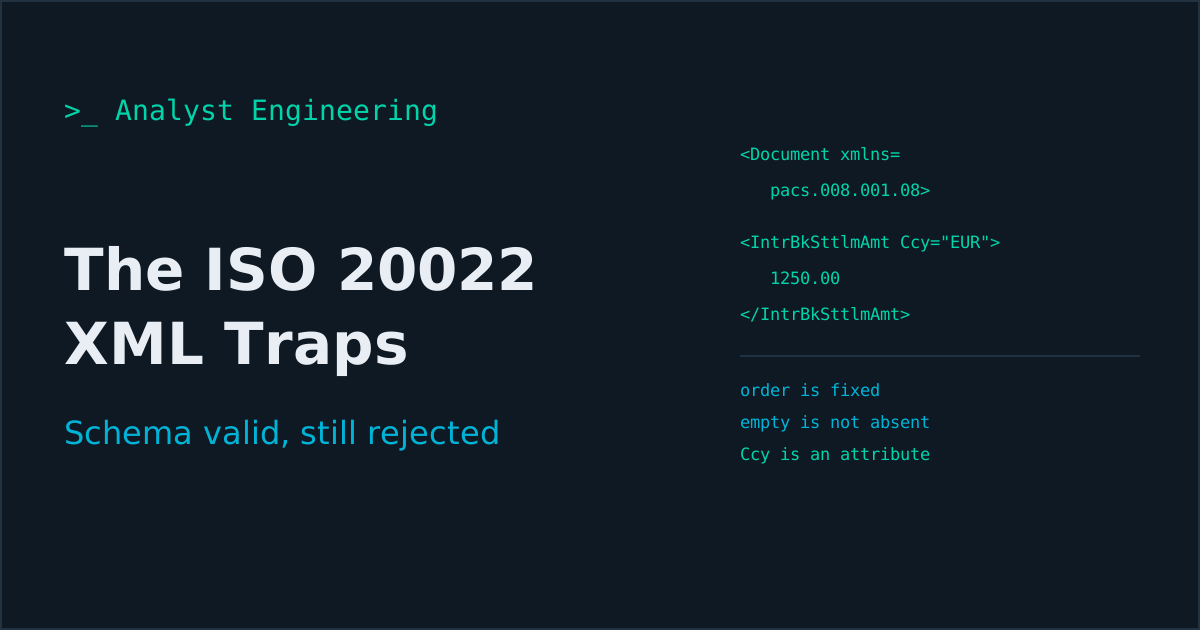
<Document xmlns="urn:iso:std:iso:20022:tech:xsd:pacs.008.001.08">That URN is not decoration, it is the contract. It states exactly which message definition version the body claims to be. Build a body to a newer version and declare an older namespace, and the message fails at stage one on elements the older version does not define. Get the namespace right and the body wrong in the other direction, and it fails on missing mandatory elements.
Two sub-traps. A default namespace applies to descendant elements, so an element inserted by a tool without inheriting it silently lands in no namespace and is invalid. And a prefixed style, <Doc:Document xmlns:Doc="...">, is equivalent to the default style: the prefix is arbitrary, the URN is what counts. Reviewers who match on the prefix rather than the URN raise false defects.
The header and the document must agree
A SWIFT-style ISO 20022 transmission is two documents: the Business Application Header, head.001, and the business message. The header carries the sender, the receiver, the message definition identifier, and the business message identifier.
<AppHdr xmlns="urn:iso:std:iso:20022:tech:xsd:head.001.001.02">
  <Fr>...</Fr>
  <To>...</To>
  <BizMsgIdr>BNKAGB2L-20260905-000417</BizMsgIdr>
  <MsgDefIdr>pacs.008.001.08</MsgDefIdr>
  <CreDt>2026-09-05T09:14:22+02:00</CreDt>
</AppHdr>
The classic failure is MsgDefIdr disagreeing with the document’s namespace, which happens the moment a system is upgraded to a new message version and the header construction is left behind. The second classic is confusing BizMsgIdr in the header with MsgId in the group header. They are different identifiers at different layers, and whether they must match is a scheme rule, not a general one. That distinction belongs with the rest of the identifier taxonomy.
Element order is fixed
ISO 20022 schemas use ordered sequences. Every element correct, in the wrong order, is invalid.
<PmtId>
  <InstrId>INSTR-77120</InstrId>
  <EndToEndId>INV-2026-1188</EndToEndId>
  <TxId>TXN-BNKAGB2L-99031</TxId>
  <UETR>7f4c1a20-9e6b-4d31-8a55-2c9d10bb4e77</UETR>
</PmtId>
Move UETR above TxId and the schema rejects it. This bites hardest where a message is assembled from a map or dictionary, because serialisation order then follows insertion order rather than the schema. It is also why hand-editing a captured message to reproduce a defect so often produces a different defect.
Empty is not absent
<PstlAdr>
  <TwnNm></TwnNm>
  <Ctry>BE</Ctry>
</PstlAdr>
An empty TwnNm is present with a zero length value, which fails the minimum length constraint on the type. An absent TwnNm is simply not there, which is fine if the element is optional. Systems that build XML from a record with null fields produce empty elements by default, and the fix is to omit rather than to emit. Say this explicitly in the specification, because “populate the town name where available” is read by a developer as “always emit the element”.
Amounts carry the currency as an attribute
<IntrBkSttlmAmt Ccy="EUR">1250.00</IntrBkSttlmAmt>Not <Ccy>EUR</Ccy> as a child. The decimal separator is a period, there are no thousands separators, and there is no sign. The permitted number of decimal places is driven by the currency, so a currency with no minor unit must not carry decimals: a JPY amount of 1250.00 is a rejection where 1250 is correct. This is one of the few traps where an analyst can write a genuinely useful test case without any XML knowledge at all: a payment in a zero-decimal currency, asserted end to end.
Code or proprietary, never both
Many elements offer a choice between a standard code and a proprietary value.
<Purp>
  <Cd>SALA</Cd>
</Purp>
The schema models this as a choice, so supplying both <Cd> and <Prtry> is invalid, and supplying a code outside the base enumeration fails at stage one while a code outside the scheme’s restricted subset fails at stage two. Two different rejections, same looking symptom, and knowing which stage tells you whether to fix the code list or the guideline mapping.
Dates and date-times are different types
CreDtTm is a date and time. IntrBkSttlmDt is a date only. Sending 2026-09-05T00:00:00 where a date is expected is invalid, and so is sending a bare date where a timestamp is expected. Where a timestamp is used, check whether your guideline requires a UTC offset, because a naive local time is a common rejection and an even more common source of one-day-out settlement date defects across timezones.
What about encoding and character sets?
Two separate constraints that get conflated, and the distinction matters when you are triaging.
Encoding is how bytes become characters. ISO 20022 messages are UTF-8, and a byte order mark at the start of the file breaks some parsers even though the XML itself is fine. If a message fails at the very first character with an unhelpful error, suspect a BOM or a stray blank line before the declaration.
Character set is which characters the scheme accepts. The XSD type usually permits a wide repertoire, and the usage guideline restricts it, commonly to a Latin subset. So Müller can be schema valid and scheme invalid at the same time, which is exactly the confusing combination that sends people in circles. This is also a data quality question rather than a formatting one, because the substitution your system performs to comply is a character folding loss with consequences for name matching.
The third member of this family is XML escaping. A creditor named Smith & Sons must be serialised as Smith & Sons. Any builder using string concatenation rather than a proper XML library will eventually produce a malformed document from a customer name, and the test case is a party name containing an ampersand, an angle bracket, and an apostrophe.
How do you validate in a pipeline?
Make schema validation a build step, so a message that cannot pass stage one never reaches a test environment.
xmllint --noout --schema pacs.008.001.08.xsd message.xmlfrom lxml import etree
schema = etree.XMLSchema(etree.parse("pacs.008.001.08.xsd"))
doc = etree.parse("message.xml")
if not schema.validate(doc):
for error in schema.error_log:
print(f"line {error.line}: {error.message}")
raise SystemExit(1)That runs in a second and catches every trap in this article except the scheme-level ones. Wire it into the pipeline beside your API collection run and both halves of the message contract are gated.
Then keep four reference artifacts under version control, and treat them as deliverables rather than as scratch files.
A maximum fill message. Every element populated at its maximum permitted length, with end markers in long values so truncation anywhere downstream is visible at a glance.
A minimum fill message. Only mandatory elements, each at its shortest legal value. This catches consumers that assume optional elements are always present, which is the defect that appears in production when a genuinely sparse payment arrives.
A known-bad corpus. One file per trap: wrong namespace, reordered elements, empty element, currency as a child, both code and proprietary, bare date in a timestamp element, unescaped ampersand. Each must fail validation, and the test asserts that it fails. This is the part teams skip, and it is the only thing that proves the validator is still validating. A validation step that has been silently disabled passes every good message perfectly.
A captured real message, redacted, from your own outbound flow. It settles arguments about what your system actually emits, which no document can. Redact the identifiers and parties before it leaves your machine, for the reasons in API keys, PATs, and OAuth tokens.
What should an analyst actually take from this?
Not the ability to write a parser. Three things.
Read a rejection and know which stage failed. A stage one error names an element and a constraint, and it is a build defect. A stage two error names a guideline rule, and it is a mapping or sourcing defect. Routing the defect to the right team on the first attempt saves a day per occurrence, and on a migration there are a lot of occurrences.
Write the specification so these traps cannot happen. Say “omit the element when no value is available” rather than “populate where available”. State the currency precision rule. State whether the header identifier must match the group header identifier. Each of those sentences prevents a class of defect, and this is exactly the precision a functional specification exists to provide.
Own the reference messages. The maximum fill, minimum fill, and known-bad corpus are analyst artifacts. They encode the field rules from your net rule matrix in an executable form, they are the fastest onboarding material a new team member can get, and they outlive every person on the programme.
The takeaway
Schema validation and scheme acceptance are different tests, and most rejections come from rules the XSD cannot express, so “it validates” is an ambiguous statement worth challenging in every triage. Underneath the business rules sits a second class of failure that is pure serialisation: the namespace declares the exact message version, ISO 20022 schemas use ordered sequences so element order is fixed, an empty element is not an absent one, the currency is an attribute on the amount and its precision follows the currency, code and proprietary are a choice rather than a pair, and dates and timestamps are distinct types.
Encoding and character set are separate constraints, so a name can be schema valid and scheme invalid at once, and any builder using string concatenation will eventually be defeated by a customer called Smith and Sons. Put schema validation in the pipeline, keep a maximum fill and a minimum fill message under version control, and keep a known-bad corpus that must fail, because that corpus is the only thing that proves your validator is still doing its job.
Start with The Technical Skills Guide for BAs for the technical foundations and API Testing and QA Mastery for BAs for the validation and test discipline, or browse everything at The Tech BA Toolkit.
Ahmed is a Senior Technical Business Analyst with 10+ years in banking and payments. He builds practical guides and tools for analysts at The Tech BA Toolkit.
Tags: ISO 20022, XML, QA, Payments, Testing
About the author
Analyst Engineering is written by Ahmed, a Senior Technical Business Analyst with 10+ years of banking and payments delivery experience: ISO 20022 and SWIFT messaging, payments API integration, Kafka event validation, and production support. Every article comes from real delivery work, and each one is reviewed and updated as tools and standards change.
Related articles
- Reading an ISO 20022 Usage Guideline: The Four Layers That Decide Your Field Rules A field can be optional in ISO 20022, mandatory in CBPR+, forbidden by your correspondent, and absent from your database. How to build the net rule matrix.
- Which ISO 20022 Identifier Do You Trace On? MsgId, InstrId, EndToEndId, TxId, and UETR Five identifiers travel with every payment and only one survives the whole chain. Which to trace on, reconcile on, deduplicate on, and never use as a key.
- JSON for Analysts: Read the Payload Fluently How an analyst reads JSON: objects, arrays, nesting, and types. Understand API payloads, event messages, and config without asking a developer. Practical, not theory.
- How to Write pacs.008 Test Cases for an ISO 20022 Migration A field-by-field guide to writing pacs.008 test cases: mandatory fields, structured data, validation, reason codes, and the pacs.002 responses that prove each case.
Newsletter
Subscribe
Practical, no-fluff playbooks for technical analysts who analyze, code, test, and support. New articles straight to your inbox.
No spam. Unsubscribe anytime.