Payments Canada for Analysts: Lynx, ACSS, and the Real-Time Rail
Written by Ahmed at Analyst Engineering, a Senior Technical Business Analyst with 10+ years in banking and payments delivery.
Key takeaways
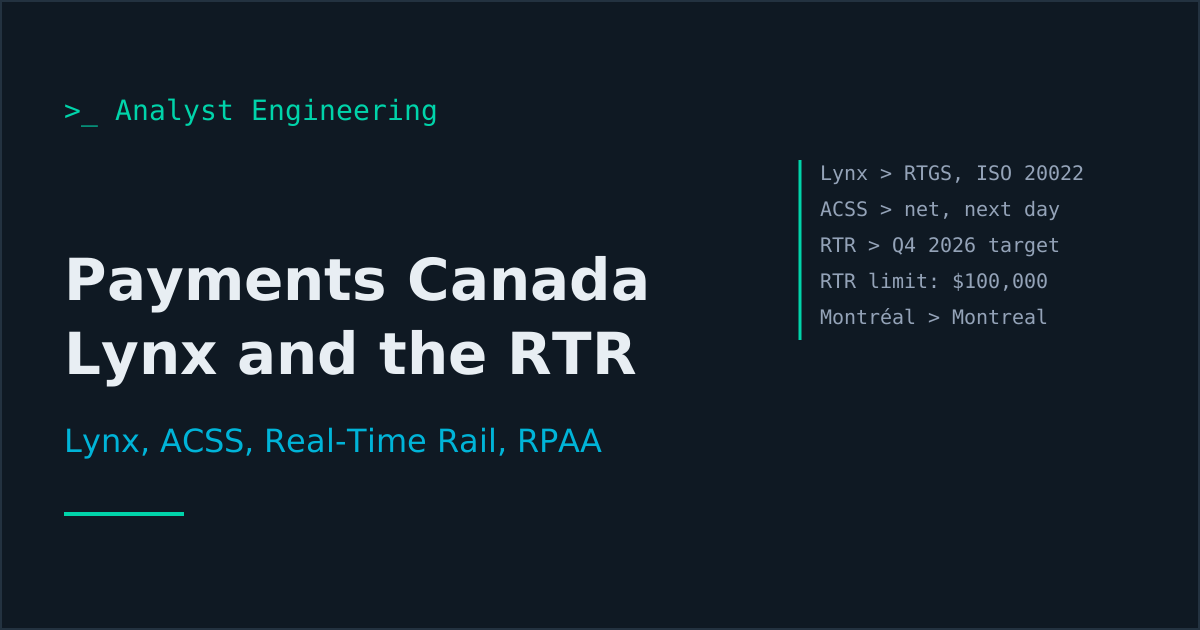
- Canada runs two payment systems today and is launching a third: Lynx for high-value wires (RTGS, ISO 20022 since March 2023), the ACSS for retail batch items settled net the next morning at the Bank of Canada, and the Real-Time Rail, targeted for Q4 2026.
- The Real-Time Rail launches with a $100,000 system transaction limit, mandatory centralized fraud services, 24/7/365 clearing and settlement, and a sequenced onboarding that migrates Interac e-Transfer clearing and settlement in two phases through 2027.
- Lynx and the Real-Time Rail use different character sets. Lynx limits text to the Latin FIN-X set, so Montréal becomes Montreal on the wire; the Real-Time Rail supports UTF-8. The same French name can therefore arrive in two different spellings depending on the rail.
- Since 8 September 2025, payment service providers under the Retail Payment Activities Act must have operational risk, incident response, and funds safeguarding frameworks in place, supervised by the Bank of Canada, and registered PSPs can now apply for Payments Canada membership.
- The Real-Time Rail's published launch message set is narrow: head.001, pacs.008, pacs.002, pacs.028, and three admi messages. Its pacs.002 uses ACWP to mean accepted by the instructed agent, not accept without posting as on FedNow and RTP.
Canada runs Lynx for high-value wires (real-time gross settlement on ISO 20022 since March 2023) and the ACSS for retail batch payments settled net the next morning, and is launching the Real-Time Rail in Q4 2026 with a $100,000 limit, mandatory central fraud services, and phased migration of Interac e-Transfer settlement through 2027. The Bank of Canada now supervises payment service providers under the Retail Payment Activities Act. And for anyone handling French names: Lynx strips accents, the Real-Time Rail keeps them.
I live in Montréal, and the defect I would test for first on any Canadian payments change is not a limit or a cut-off. It is a supplier such as “Boulangerie Côté-Lévesque inc.” that leaves one rail as Boulangerie Cote-Levesque inc. while the customer’s invoice system holds the accented original, so an automated match that worked for months stops working the day a routing rule moves the payment to a different system.
That is a small example of the general rule: Canadian payments are one standard, three systems, and the differences between them are exactly where defects live. This piece sits in the scheme track of The ISO 20022 Reference, alongside RTGS on ISO 20022 and the US comparison in FedNow vs RTP.
What payment systems does Payments Canada run?
Payments Canada is a public purpose organization that owns and operates the national systems and writes their by-laws and rules. Current as of October 2026:
| Lynx | ACSS | Real-Time Rail (RTR) | |
|---|---|---|---|
| Role | High-value wires | Retail batch (cheques, direct deposits, pre-authorized debits, bill payments) | Real-time retail payments |
| Model | Real-time gross settlement | Net settlement, previous day’s balances settled the next business morning at the Bank of Canada | Real-time exchange, clearing, and settlement |
| Status | Live since August 2021; ISO 20022 since March 2023 | Live since 1984 | Launch targeted Q4 2026 |
| Messaging | ISO 20022 over Swift | Payments Canada standards; ISO 20022 messages available for automated funds transfer | ISO 20022 only |
| Hours | Monday to Friday, closed on statutory holidays | Monday to Friday, closed on statutory holidays | 24/7/365 |
| 2025 activity | 13.6 million items, $93.3 trillion | 10.6 billion items, $10 trillion | Not yet live |
The ACSS (with the US dollar Bulk Exchange) carries 99 percent of the daily volume Payments Canada clears and 13 percent of the value. Lynx is the reverse: few payments, most of the value, and it is the system the Bank of Canada uses to implement monetary policy. The Bank designates Lynx as systemically important under the Payment Clearing and Settlement Act.
Where does Interac e-Transfer fit? Today Canada has fast exchange for consumer transfers but not real-time clearing and settlement in the same system; Payments Canada’s own FAQ draws exactly that distinction. The RTR is the first system to do both.
How did Lynx move to ISO 20022?
In two releases, which is the useful lesson.
Release one, August 2021. Lynx replaced the Large Value Transfer System (LVTS) with a new risk model and new technology, still on the legacy message formats.
Release two, March 2023. ISO 20022. Payments Canada deployed the technology in November 2022, then postponed activation to March 2023 when Swift moved the start of the CBPR+ cross-border migration, so Canadian banks would switch with the global community rather than ahead of it. That is a deliberate choice of coexistence alignment over a domestic deadline, and it is worth copying when your rail sits under a cross-border one.
The Lynx core message set is small:
| Message | Lynx use |
|---|---|
| head.001.001.02 | Business application header on every message |
| pacs.008.001.08 | Single customer credit transfer |
| pacs.009.001.08 (core) | Financial institution credit transfer |
| pacs.009.001.08 (cov) | Cover payment for a customer transfer |
| pacs.004.001.09 | Payment return |
| camt.053.001.08 | Statement |
Three Lynx rules catch implementers:
- One transaction per message. The number of transactions is restricted to 1. Batching is not available.
- Local instrument carries settlement behaviour.
PmtTpInf/LclInstrm/Prtryindicates the settlement mechanism and priority for every Lynx payment. Get it wrong and the payment is valid XML that settles the wrong way. - Participation is not just messaging. A Lynx participant must hold a settlement account at the Bank of Canada, be able to pledge collateral, and be a Swift member.
What are the Lynx enhanced data phases?
The current guidelines are Lynx UG2025, effective with the November 2025 release and aligned with CBPR+ SR2025. Payments Canada’s companion document (version 1.4, March 2025) adds hybrid postal addresses and carries the CBPR+ grace-period address rules over verbatim:
- If a postal address has no address line, town name and country must be present.
- A hybrid address (address lines plus other elements) needs town name and country, with at most two address lines.
- A fully unstructured address is limited to address lines of 35 characters each during the grace period.
- Name and postal address of an agent must be present together.
So Lynx follows the global structured address path rather than setting its own dates. If you track the CBPR+ timetable, which structured addresses covers, you are tracking Lynx. Check each annual Lynx release against Payments Canada’s ISO 20022 page, because Payments Canada maintains its portfolio on a yearly cycle aligned with Swift’s standards releases.
Where is the Real-Time Rail now?
The RTR has been delayed more than once, so read dates from Payments Canada directly. In October 2022 Payments Canada announced it needed revised launch timing to allow more validation and testing, and commissioned a third-party review. As of October 2026 the plan is:
| Target | Milestone |
|---|---|
| 24 August 2026 | RTR By-law (Canadian Payments Association By-law No. 10) and RTR Rules in force |
| Q3 2026 | Industry solution assurance testing with participants under way |
| Q4 2026 | Launch, with the first direct to Exchange participants |
| Q1 2027 | First Interac e-Transfer clearing and settlement migration participants |
| Q2 2027 | Additional e-Transfer migration participants |
| Q3 2027 | All participants in the initial launch phases at full transaction volumes |
What the RTR will be at launch, from Payments Canada’s own pages and the RTR ISO 20022 companion document (version 1.4, 30 May 2025):
- $100,000 system transaction limit, to be reevaluated after launch. Participants can set lower limits.
- 24/7/365 exchange and settlement, irrevocable.
- Mandatory centralized fraud services for all participants, on top of each participant’s own.
- ISO 20022 only, with a deliberately narrow launch message set: head.001.001.02, pacs.008.001.08, pacs.002.001.10, pacs.028.001.03, and admi.002, admi.004, and admi.011 for rejects and heartbeats.
- Remittance: unstructured remittance limited to three repetitions of 140 characters (420 in total); structured remittance up to 9,000 characters.
- Proxy: the creditor account must carry an account number; a proxy is optional and must be resolved to an account number before the message reaches the RTR Exchange.
- No forced deadline to join once a participant is ready.
Note what is not in that launch message set: no request for payment, no dedicated return message. If your product roadmap assumes request for payment on day one because FedNow and RTP have it, that is a gap to raise now.
And watch the status codes. In the RTR pacs.002, ACWP is populated by the instructed agent to mean “accepted by instructed agent”, ACSP means the RTR Exchange declared the payment final, and ACSC means settlement completed. On FedNow and RTP in the US, ACWP means accept without posting, a compliance hold on a settled payment. A status mapping table copied from a US implementation will be wrong here. Payment status codes covers the base meanings; the scheme decides the rest.
What does the Retail Payment Activities Act change?
The Retail Payment Activities Act (RPAA) brought payment service providers (PSPs) under Bank of Canada supervision. The Department of Finance Canada published the regulations in the Canada Gazette, Part II, on 22 November 2023, and since 8 September 2025 registered PSPs must:
- manage operational risk and respond to incidents through a documented framework,
- safeguard end-user funds,
- report incidents that have a material impact on end users, other PSPs, or certain clearing and settlement systems,
- submit an annual report.
Foreign PSPs serving people in Canada must register too. In parallel, amendments to the Canadian Payments Act that took effect in September 2025 opened Payments Canada membership to RPAA-registered PSPs, local credit unions that belong to a central, and clearing houses of designated systems. Payments Canada reported 22 new members in the first year, including Remitly, Nium, and Vancity among the six approved on 1 October 2026.
For an analyst at a fintech, that turns into two separate workstreams: RPAA compliance (risk framework, safeguarding, incident reporting) and system participation (membership first, then a technical and operational application per system). Do not let a business case assume the second follows automatically from the first; Payments Canada says plainly that membership does not guarantee access.
Consumer-driven banking, Canada’s open banking framework, is a third workstream with its own timeline. It is covered in open banking APIs for analysts.
Bilingual names and remittance: a Montréal practitioner note
This is the part nobody puts in the scheme summary, and it bites anyone who processes Québec payments.
French business names, street names, and invoice references carry accents: é, è, à, ç, ô. Lynx limits text fields to the Swift FIN-X character set, A-Z a-z 0-9 / - ? : ( ) . , ' + CR LF and space, plus an extra list of special characters (! # % & * = ^ _ { | } ~ " ; @ [ \ ] > < $) allowed in names, postal addresses, and remittance. No accented letters. The RTR, by contrast, supports UTF-8 (Unicode version 6.2).
So one fictional supplier looks like this on each rail. First the RTR pacs.008, UTF-8, accents preserved:
<Cdtr>
  <Nm>Boulangerie Côté-Lévesque inc.</Nm>
  <PstlAdr>
    <StrtNm>rue Saint-Denis</StrtNm>
    <BldgNb>4120</BldgNb>
    <PstCd>H0H 0H0</PstCd>
    <TwnNm>Montréal</TwnNm>
    <CtrySubDvsn>QC</CtrySubDvsn>
    <Ctry>CA</Ctry>
  </PstlAdr>
</Cdtr>
Then the Lynx pacs.008, FIN-X, accents transliterated:
<Cdtr>
  <Nm>Boulangerie Cote-Levesque inc.</Nm>
  <PstlAdr>
    <StrtNm>rue Saint-Denis</StrtNm>
    <BldgNb>4120</BldgNb>
    <PstCd>H0H 0H0</PstCd>
    <TwnNm>Montreal</TwnNm>
    <CtrySubDvsn>QC</CtrySubDvsn>
    <Ctry>CA</Ctry>
  </PstlAdr>
</Cdtr>
The requirements that follow:
- One transliteration rule, owned and versioned. é to e, ç to c, and the treatment of characters like œ, written down once and applied identically by every system that builds a Lynx message. Two teams with two rules produce two spellings.
- Normalise before you compare. Fraud screening, sanctions screening, duplicate detection, and reconciliation must compare accent-folded forms, or the same party looks like two different parties when a payment moves rail.
- Keep the original for display. Store the customer’s accented form and show it back; store the transliterated form as what was sent.
- Watch remittance. French invoice references and descriptions in remittance fall under the same character set on Lynx. Remittance information and the truncation ledger cover how to record what was folded or lost.
None of this is exotic. It is the same diacritics problem Verification of Payee raises for Müller and Mueller in Europe, with a second official language attached.
What should an analyst test?
- A Lynx pacs.008 with two transactions, asserting rejection (one transaction per message).
- A Lynx payment with each settlement local instrument value, asserting the intended settlement mechanism and priority.
- A Lynx hybrid address with three address lines, asserting rejection (two maximum), and one with no town name, asserting rejection.
- An RTR payment at $100,000 and at $100,000.01, asserting the system limit, and one above a lower participant limit.
- An RTR pacs.002 sequence
ACWP, thenACSP, thenACSC, asserting your status model treats ACWP as acceptance by the beneficiary’s institution, not as a hold. - An RTR payment with a proxy only, asserting it is resolved to an account number before submission.
- RTR unstructured remittance of 421 characters, asserting the rule your channel applies (reject or block at entry, never silent truncation).
- The same French-named supplier paid once over Lynx and once over the RTR, asserting reconciliation and duplicate detection match them as one party.
- A name containing œ or other characters outside a simple accent map, asserting the documented transliteration result.
- An ACSS item and an RTR payment for the same invoice on the same day, asserting the duplicate check spans rails.
These belong in regression testing for payments too, because the RTR launch is exactly the kind of change that regresses Lynx and ACSS flows nobody touched. The free Validate an event flow mission is good practice for the status-sequence cases.
If you are moving into Canadian banking and want the domain and the deliverables in one place, Break Into Banking covers it, and API Testing and QA Mastery for BAs covers turning rules like these into an automated suite.
The takeaway
Canada’s payments landscape is three systems on one standard: Lynx for high-value RTGS wires on ISO 20022 since March 2023, the ACSS for the retail batch volume settled net each morning, and the Real-Time Rail, now targeted for Q4 2026 with a $100,000 limit, mandatory central fraud services, a narrow launch message set, and phased e-Transfer migration through 2027. Read every RTR date from Payments Canada, because it has moved before.
Around the rails, the RPAA has put PSPs under Bank of Canada supervision since 8 September 2025 and opened the door to Payments Canada membership. And in a bilingual market, the character set is a requirement: Lynx folds accents, the RTR keeps them, and every system that compares names across the two has to normalise first. The rest of the scheme track is on The ISO 20022 Reference.
Ahmed is a Senior Technical Business Analyst with 10+ years in banking and payments. He builds practical guides and tools for analysts at The Tech BA Toolkit.
Tags: Payments Canada, Real-Time Rail, Lynx, ISO 20022, Systems Analysis, Banking
About the author
Analyst Engineering is written by Ahmed, a Senior Technical Business Analyst with 10+ years of banking and payments delivery experience: ISO 20022 and SWIFT messaging, payments API integration, Kafka event validation, and production support. Every article comes from real delivery work, and each one is reviewed and updated as tools and standards change.
Related articles
- RTGS on ISO 20022: T2, CHAPS, and Fedwire Compared What changes when high-value payments settle in central bank money: T2's liquidity model, CHAPS enhanced data, Fedwire's cutover, and the analyst implications.
- Which Payment Rail? Choosing Between Instant, RTGS, SEPA, and Correspondent The decision an analyst actually has to make: which payment rail fits a flow, judged on speed, finality, cost, reach, data, and what happens when it fails.
- ISO 20022 Structured Addresses: The Deferred November 2026 Deadline SWIFT, the EPC, and CHAPS deferred the November 2026 ban on unstructured addresses. What structured and hybrid addresses are and how to migrate anyway.
- ISO 20022 Remittance Information: Structured, Unstructured, and RF References How remittance information works in ISO 20022: the 140-character unstructured field, the structured block, ISO 11649 RF references, and remittance location.
Go deeper on this
Not ready to buy? The free downloads are a no-cost place to start, and every article here stays free.
Free account
Practice on the Labs, keep your progress
A free account, no password: an email link signs you in. It saves your steps and self-assessments on the Labs, shows your missions on a dashboard, unlocks the solutions, and, if you tick the box, sends you new missions and articles when they ship.
Your email is used to sign you in. Nothing else, unless you ask. Privacy.