The ISO 20022 Blast Radius: The Systems Nobody Scoped
Written by Ahmed at Analyst Engineering, a Senior Technical Business Analyst with 10+ years in banking and payments delivery.
Key takeaways
- An ISO 20022 migration changes the shape of the data every downstream system consumes, so the true scope is the payment rail plus every consumer of payment data, and the consumers are usually owned by teams who were never invited to the programme.
- Sanctions screening and transaction monitoring are the highest risk consumers, because they do not fail when the data shape changes: they keep running and silently produce different results, which is a control effectiveness problem rather than an outage.
- A warehouse modelled on MT fields encodes legacy limits as column widths, so the migration is a data model change with history, not a load change, and the coexistence period forces a canonical internal model rather than parallel MT and MX columns.
- The scoping deliverable is a downstream impact register: one row per consumer, naming the field it reads today, its new source, the change, the owner, and the test that proves it, because a system nobody named is a system nobody tested.
An ISO 20022 migration is scoped as a messaging change and lands as a data change. The rail gets a programme, a test phase, and a cutover plan. Sanctions screening, transaction monitoring, the warehouse, the regulatory reports, and the operations tooling that all read payment data get an assumption. That assumption is where migrations go wrong, because those systems do not fail when the data shape changes. They keep running and produce different answers.
Every programme I have worked on had a beautifully detailed plan for the payment rail and a single slide titled “downstream impacts, to be confirmed”. The rail is visible: it has messages, counterparties, a scheme deadline, and a testing window. The consumers are invisible because they are owned by other teams, funded by other budgets, and their failure mode is quiet.
This is the article that makes the invisible part a list. It picks up where the truncation ledger stops: that one is about what happens to the data in flight, this one is about everything that reads it once it lands. The domain grounding is in Break Into Banking.
Who actually consumes payment data?
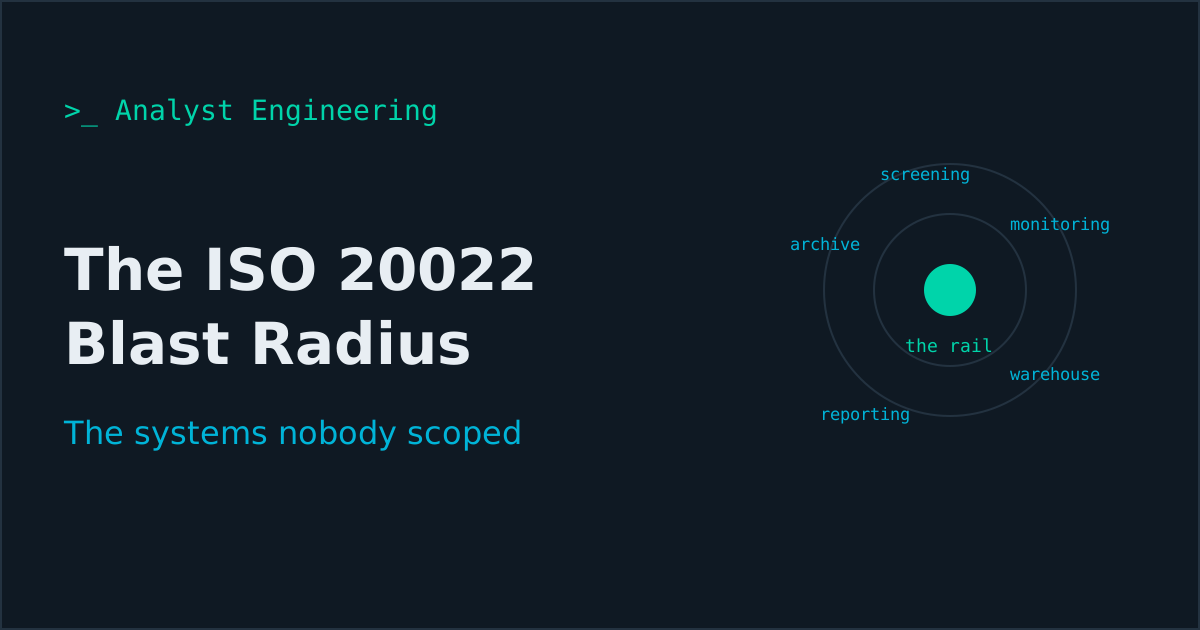
Eight consumers recur, and I have yet to see a programme that named all eight in its original scope.
| Consumer | Reads today | What changes | Risk if unscoped |
|---|---|---|---|
| Sanctions screening | Party names and addresses as free text | Structured elements, longer names, new parties | Control effectiveness changes silently |
| Transaction monitoring and fraud | Legacy-derived features | New fields, richer purpose and remittance data | Model drift, thresholds no longer calibrated |
| Data warehouse and marts | MT-shaped columns | Wider, structured, more elements | Load failures, then history that spans two shapes |
| Regulatory reporting | Fields sourced from the warehouse | New lineage for each field | Report values change without explanation |
| Customer statements and channels | Narrative built from legacy fields | Structured remittance and richer party data | Customers see a different narrative overnight |
| Operations tooling | Search and repair screens on legacy keys | New identifiers and structures | Investigations become slower at the worst moment |
| Archive and retrieval | Stored legacy messages | Larger XML, dual formats to retain | Retention and reproduction obligations missed |
| Analytics and models | Payment-derived features | Feature definitions change meaning | Quiet degradation in production models |
Read the risk column. Only one entry is an outage. The rest are wrong answers produced confidently, which is worse, because an outage gets a bridge call in ten minutes and a wrong answer gets discovered by an auditor.
Why are screening and monitoring the highest risk?
Because they are controls, and a control that changes behaviour without anyone measuring the change is a finding waiting to happen.
Sanctions screening matches names and addresses against watch lists. Three things change at once. The name it screens may now be longer and complete where it was previously truncated, which changes match scores in both directions. The address arrives as discrete elements rather than as free text lines, so a screening configuration written to scan address lines needs to be told where to look. And ultimate debtor and ultimate creditor may be present for the first time, which raises a genuine policy question, not a technical one: does your screening policy require you to screen the party on whose behalf the payment was made? That is a compliance decision, it has a right answer for your institution, and an analyst who surfaces it in design is doing the single most valuable thing available on the programme.
The correct treatment is a re-baseline rather than a test. Take a representative population, run it through screening in the legacy shape and in the ISO 20022 shape, and compare alert volumes and match reasons. You are not looking for zero difference, since a difference is expected and often an improvement. You are looking to explain the difference and to have compliance sign it off in advance.
Transaction monitoring and fraud models were tuned on features derived from legacy messages. Migration changes their inputs. A purpose code that was absent or coarse is now structured. A remittance field that was free text now has document references. A counterparty country that was buried in an address line is now its own element. None of these make a model fail. They make it drift, and a monitoring model that drifts is one that raises the wrong alerts for a period nobody can put a start date on.
The requirement here is a re-tuning window with a parallel run, and the acceptance criteria are statistical rather than functional. That is unfamiliar ground for many analysts, and it is the same problem as writing acceptance criteria for AI systems: the system is not right or wrong on a single case, so the criteria describe a distribution.
What happens to the warehouse?
The physical model breaks first and history breaks second, and only the first one is obvious.
Most payment warehouses were built when MT was the reality, so the model encodes MT limits as facts about the world. A party name column of 35 characters. Address as four text lines. No column for ultimate parties, no table for structured remittance, no place for a purpose code. Widening columns is a morning’s work. The genuine problems are these.
Grain and structure. Structured remittance is a repeating structure with document references and amounts, which is not a column, it is a child table. Adding it changes the fact table’s relationship to its details, and pretending otherwise by concatenating it into a text column throws away the exact richness the migration was for.
Party dimensions. Richer, longer, structured party data with new attributes such as country as a discrete element. If parties are a slowly changing dimension, the migration is a Type 2 event: the same real world party now has a different, better attribute set from a point in time, and reports that join on party attributes must not silently mix the two.
History across the cutover. This is the one that generates the most awkward meeting. Rows before the cutover carry legacy-shaped data, rows after carry richer data, and any report spanning the boundary is comparing two different things. A count of payments by debtor country is not comparable across the cutover if country was previously parsed out of an address line with 80 percent accuracy and is now a mandatory discrete element.
Coexistence forces a canonical model. The temptation during dual running is to add MX columns beside the MT columns and let consumers pick. That decision looks pragmatic and creates permanent duplication, since every downstream query then needs a coalesce and every analyst needs to know which is populated. The better shape is a canonical internal payment model that both formats map into, with the raw message retained. That is the medallion pattern applied to payments: keep the raw message as bronze, normalise into a canonical silver model, serve the marts from gold.
Why does reporting change even when the numbers are right?
Because lineage moves and semantics shift, and both need explaining before the cutover.
Lineage moves. Every regulatory and management report field derived from a payment message now derives from a different element. The mapping in your data lineage documentation, which an auditor may well ask to see, is stale on cutover day for every affected field. Re-pointing it is mechanical, and it is a real volume of work that nobody budgets because it does not feel like building anything.
Semantics shift. A field that was frequently empty or truncated is now complete. That changes results without any defect being present. A report of payments by purpose category where purpose was previously derivable for a third of payments and is now structured on nearly all of them will show a dramatic shift in category distribution on the day of cutover, and someone will raise it as a defect. Getting ahead of that with a note to the report owners, explaining which reports will step and why, converts an incident into an expected event.
There is a useful test for whether your programme has thought about this: ask who signs off that a regulatory report is still correct after cutover. If the answer is the payments programme, the answer is wrong, and if the answer is nobody, that is the finding.
What is the deliverable? The downstream impact register
One artifact, built in analysis, maintained through delivery. One row per consumer and field, and the columns are chosen so that a blank cell is visibly a problem.
| Consumer | Field consumed today | Source today | New source | Change | Owner | Test | Status |
|---|---|---|---|---|---|---|---|
| Sanctions screening | Debtor name | MT party line 1 | Dbtr/Nm | Up to 140 chars, complete | Financial crime | Re-baseline, alert volume comparison | In progress |
| Sanctions screening | Ultimate debtor | Not screened | UltmtDbtr/Nm | New party in scope, policy decision | Compliance | Policy sign-off then screening test | Open |
| Monitoring | Counterparty country | Parsed from address text | PstlAdr/Ctry | Discrete, reliable | Financial crime | Parallel run, threshold re-tune | Open |
| Warehouse | Remittance | Text column, 140 | RmtInf/Strd plus Ustrd | New child structure | Data engineering | Load test plus history query | In progress |
| Regulatory report R7 | Purpose category | Derived rule | Purp/Cd | Structured, coverage jumps | Regulatory reporting | Value comparison, variance note | Open |
| Operations search | Payment lookup | Legacy reference | UETR plus EndToEndId | New search keys | Payment operations | Screen test with real enquiry cases | Open |
Three things make this register work rather than becoming another abandoned spreadsheet.
Every row has a named owner outside the programme. The point of the artifact is to move an assumption into somebody’s accountability. A row owned by “the programme” is a row nobody will do.
Every row has a test, not a task. “Update screening configuration” is a task and proves nothing. “Alert volume comparison on a 30 day population, variance explained and signed” is evidence.
Open rows are visible in governance. The register goes to the steering committee as a count of open rows by owner. That single number does more for downstream readiness than any amount of narrative, because it makes an invisible workstream countable.
The traceability discipline behind this is the same one as a requirements traceability matrix, pointed at consumers instead of requirements, and the artifact templates are in Real-World BA Deliverables.
How do you test a blast radius?
By testing through the consumers, not up to the rail. Three techniques do most of the work.
End to end by consumer, not by message. A test case that ends when the pacs.008 is accepted proves the rail. The consumer-level case ends when the payment appears correctly in the warehouse, in the report, in the statement narrative, and in the operations search screen. That is a longer test with more dependencies, and it is the only one that covers the risk.
Parallel comparison, not expected values. For screening, monitoring, and reporting, the meaningful test is old system versus new system on the same population, with differences explained. Writing expected values by hand for a screening engine is not feasible; comparing two populations is.
Reproduce an old payment. Retrieve a pre-cutover payment from the archive after the migration and confirm you can still render, explain, and evidence it. Retention obligations do not pause for a migration, and the ability to produce a legacy message years later is a requirement whether or not anybody wrote it down.
One practical warning about test data. Downstream systems are exactly the ones where teams reach for production data because synthetic data does not exercise the models realistically. That instinct is right about the data and wrong about the method: mask it, and keep the structure. The shape of a payment population is what a monitoring model needs, and the real names are what your data protection obligations forbid.
The takeaway
An ISO 20022 migration is scoped as a messaging change and lands as a data change, so the real scope is the payment rail plus every system that reads payment data. Eight consumers recur: screening, monitoring and fraud, the warehouse, regulatory reporting, customer channels, operations tooling, archives, and analytics models.
The highest risk sits in the controls, because screening and monitoring do not fail when the data shape changes, they keep running and produce different results, which needs a re-baseline and a compliance sign-off rather than a test. The warehouse problem is not column widths, it is history that spans two data shapes and the temptation to keep parallel legacy and modern columns instead of one canonical model. Reporting changes even when nothing is broken, because lineage moves and coverage improves, and the report owner should hear that before the cutover.
Build the downstream impact register in analysis, give every row an owner outside the programme and a test rather than a task, and report the open count to governance. A system nobody named is a system nobody tested.
Start with Break Into Banking for the banking domain and Real-World BA Deliverables for the register and impact assessment templates, or browse everything at The Tech BA Toolkit.
Ahmed is a Senior Technical Business Analyst with 10+ years in banking and payments. He builds practical guides and tools for analysts at The Tech BA Toolkit.
Tags: ISO 20022, Migration, Systems Analysis, Data, Compliance
About the author
Analyst Engineering is written by Ahmed, a Senior Technical Business Analyst with 10+ years of banking and payments delivery experience: ISO 20022 and SWIFT messaging, payments API integration, Kafka event validation, and production support. Every article comes from real delivery work, and each one is reviewed and updated as tools and standards change.
Related articles
- The ISO 20022 Truncation Ledger: What Rich Data Actually Loses in Transit ISO 20022 carries rich structured data, and every non-native hop quietly degrades it. The field-by-field loss ledger, and how to specify what you accept losing.
- Data Lineage: Trace Every Number Back to Its Source Data lineage maps how each field flows from source through transformations to the report that shows it, enabling impact analysis, trust, and audit. With a diagram.
- Star Schema vs Snowflake Schema: Which Shape Fits Your Warehouse Star and snowflake schemas differ in one thing: whether dimensions are denormalized. What each looks like, when each fits, and how to read one. With diagrams.
- Slowly Changing Dimensions: Type 1 vs Type 2, and When History Matters What slowly changing dimensions are, how SCD Type 1 and Type 2 differ, how a Type 2 table works with valid_from and valid_to, and how to query it correctly.
Newsletter
Subscribe
Practical, no-fluff playbooks for technical analysts who analyze, code, test, and support. New articles straight to your inbox.
No spam. Unsubscribe anytime.