Cover Payments in ISO 20022: pacs.009 COV, Serial vs Cover, and the Trap
Written by Ahmed at Analyst Engineering, a Senior Technical Business Analyst with 10+ years in banking and payments delivery.
Key takeaways
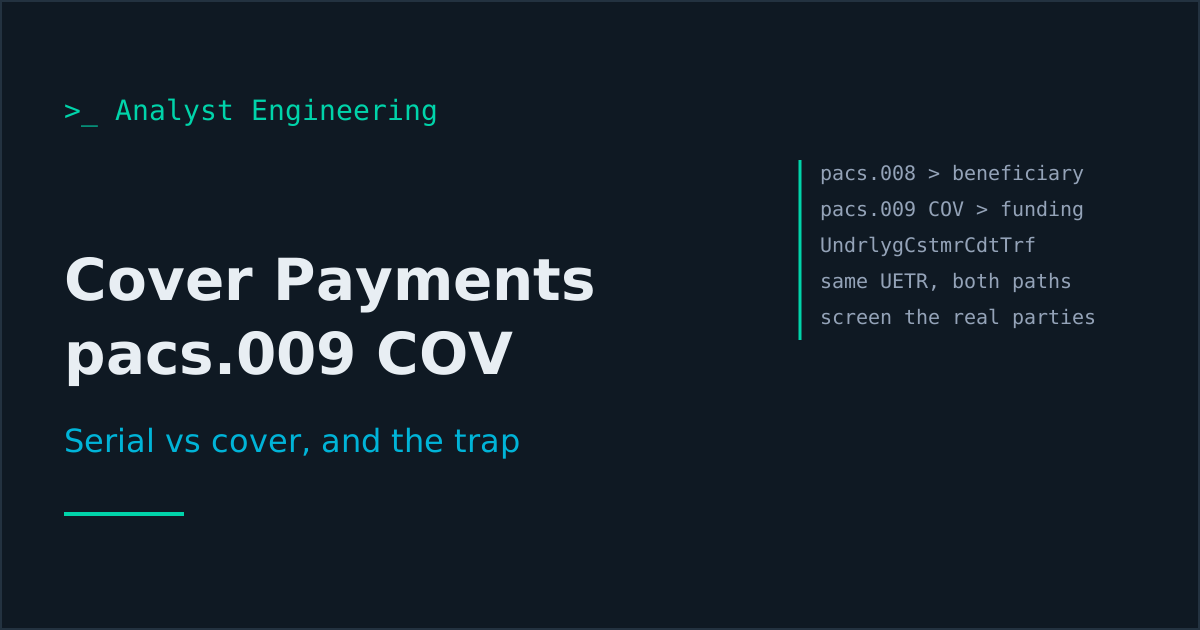
- In the cover method one payment travels as two messages on two paths: a pacs.008 direct to the beneficiary bank telling it to pay, and a pacs.009 COV through the correspondents actually moving the funds. Both must describe the same underlying transfer.
- pacs.009 COV differs from a plain pacs.009 by carrying the UndrlygCstmrCdtTrf block, which repeats the original customer transfer's parties and amounts. That block exists so correspondents can screen the real debtor and creditor rather than two banks.
- The serial method routes one message through every correspondent in turn, so each sees and can deduct from the payment. The cover method is faster for the beneficiary bank but creates a reconciliation problem, because credit and funding arrive separately and may not arrive together.
- The trap is divergence: if the pacs.008 and the pacs.009 COV carry different amounts, parties, or references, the beneficiary bank cannot match them. Both messages must carry the same UETR and the same underlying details, and validating that is a control, not a nicety.
- A beneficiary bank that credits on the pacs.008 before the cover arrives is taking credit risk deliberately. That decision belongs to a credit policy with named limits, not to a developer choosing when to post.
In the cover method one payment travels as two messages on two paths: a pacs.008 straight to the beneficiary bank, and a pacs.009 COV through the correspondents carrying the funds. The UndrlygCstmrCdtTrf block makes the cover message transparent to the correspondents. If the two messages diverge on amount, parties, or UETR, the beneficiary bank cannot pair them, and someone reconciles by hand.
A beneficiary bank has an instruction to pay 240,000 USD to a customer. It has no funds for it. Both facts are correct, and the payment is proceeding normally.
That is the cover method, and it is the arrangement that surprises analysts who learned payments on domestic schemes where instruction and settlement are the same event. This is the cover payments article in the field-by-field track of The ISO 20022 Reference, following camt.053.
Serial or cover: two ways to move the same payment
A cross-border payment between two banks with no direct relationship needs correspondents. There are two ways to arrange that.
The serial method. One message travels the chain, hop by hop:
Bank A --pacs.008--> Correspondent B --pacs.008--> Bank CEach correspondent receives the customer payment, sees the full details, may deduct charges, and forwards it. Simple, transparent, and every hop adds delay.
The cover method. The instruction and the funding split:
Bank A  ----------------pacs.008---------------->  Bank C
   |                                                  ^
   +--pacs.009 COV--> Correspondent B --pacs.009-->---+
Bank C hears about the payment directly and quickly, on the pacs.008. The money travels separately through the correspondent chain on the pacs.009 COV.
The trade is explicit. The cover method gets information to the beneficiary bank fast and keeps the customer message out of the correspondent chain. In exchange, credit and funding arrive separately, which creates a pairing problem and a credit exposure that the serial method simply does not have.
What makes a pacs.009 a COV?
A plain pacs.009 is a financial institution credit transfer: one bank moving its own money to another. Ordinary treasury activity.
A pacs.009 COV is the same message carrying one extra block: UndrlygCstmrCdtTrf, the underlying customer credit transfer. Inside it, repeated from the original pacs.008:
DbtrandCdtr: the real paying and receiving customersUltmtDbtrandUltmtCdtrwhere presentDbtrAgtandCdtrAgt- the amounts
RmtInf, where the guideline permits it
That block is the entire point of the message type, and it exists for a specific historical reason. Before MT202COV, a correspondent funding a cover payment saw only two banks. The actual debtor and creditor were invisible to it, which meant its sanctions screening was screening the wrong parties. The underlying block closed that gap, and pacs.009 COV carries the same obligation forward.
So the rule follows directly: a correspondent handling a cover message must screen the underlying parties, not just the two agents. If your screening integration reads only Dbtr and Cdtr at the top level of a pacs.009, it is screening banks and reporting a clean result on a payment it never actually examined. That is a compliance finding, and it is one of the more serious defects in this whole series.
The trap: divergence between the two messages
The beneficiary bank must pair the pacs.008 it received directly with the pacs.009 COV that funds it. The pairing relies on the two messages agreeing.
What must match:
- the UETR, which is the strongest link and should be identical across both
- the amounts
- the debtor and creditor, and the ultimate parties
- the debtor agent and creditor agent
- the references, including
EndToEndId
When they diverge, the beneficiary bank has an instruction it cannot fund and a funding it cannot attribute. Both sit in an investigation queue, someone matches them by eye on amount and name, and the payment is late.
Divergence is not exotic. It happens when the two messages are generated by different systems from different source records, when one path applies a conversion the other does not, when a repair is applied to one message only, or when a truncation rule shortens a name in one and not the other.
So build the control: before releasing a cover arrangement, validate that the pacs.008 and the pacs.009 COV agree on UETR, amounts, and parties. It is a straightforward comparison, it belongs in your own systems rather than being discovered by a correspondent, and it prevents a category of investigation that is tedious to resolve.
The credit decision nobody makes explicitly
Bank C has an instruction to pay and no funds. Does it credit the customer now?
Credit on the pacs.008. The customer gets the money quickly. Bank C is extending intraday credit to Bank A, on the expectation that the cover arrives. If it does not arrive, Bank C is exposed for the full amount.
Wait for the cover. No exposure. The customer waits, and the speed advantage of the cover method is partly given back.
Both are legitimate. What is not legitimate is the choice being made implicitly by whoever wrote the posting logic. This is a credit policy decision requiring named counterparty limits, an approval process, and a threshold above which it does not apply. When an analyst finds that a system credits on instruction and nobody can name the policy that authorised it, that is a finding to escalate rather than document.
The related specification points: what happens when the cover does not arrive within the expected window, who is alerted, at what age, and what the recovery process is. That is an operational process, and it needs an owner before go-live rather than during the first incident.
What a systems analyst must specify
- Which corridors use cover and which use serial, and who decides. This is usually driven by correspondent relationships rather than by technology.
- How the two messages are generated, and explicitly whether they come from one source record. One source record is the design that prevents divergence structurally.
- The agreement validation before release: UETR, amounts, parties.
- The pairing logic on receipt: match on UETR first, with a documented fallback, and a queue for unpaired items with an ageing rule.
- The credit policy: credit on instruction or on funding, with limits and approval.
- The screening obligation on the underlying parties, stated explicitly, because this is where the compliance risk concentrates.
- The unfunded exception process: detection, alerting, escalation, recovery.
Test conditions worth writing
- A cover pair where both messages agree, asserting the pairing succeeds on UETR.
- A pair diverging on amount, asserting the validation catches it before release.
- A pair diverging on beneficiary name, which is the subtle one, because it will pass an amount check.
- A pacs.008 arriving with no cover within the window, asserting the alert fires and the item ages correctly.
- A cover arriving with no matching pacs.008, which happens and must go somewhere sensible.
- A pacs.009 COV passed to screening, asserting the underlying debtor and creditor were screened, not the agents. Assert the parties actually submitted to the screening engine, not merely that screening was called.
- A plain pacs.009 with no underlying block, asserting it is not treated as a cover.
That screening case is the one I would put first in any review. It is easy to write a test that proves screening ran and proves nothing about what it examined, which is the difference between a test and a green light. Negative test design covers the discipline of asserting the observable thing rather than the convenient one.
The takeaway
The cover method splits a payment into an instruction and a funding, travelling different paths. The pacs.009 COV is distinguished by its UndrlygCstmrCdtTrf block, which exists so correspondents screen the real parties rather than two banks, and any screening integration that reads only the top-level agents is examining the wrong thing.
The operational risk is divergence: two messages generated separately, disagreeing on an amount or a name, leaving the beneficiary bank with an instruction it cannot fund. Validate agreement on UETR, amounts, and parties before release, and make the credit-on-instruction decision an explicit credit policy rather than a default in the posting code.
Next: sanctions screening on ISO 20022, where structured data changed the hit rate in both directions. The full map is on The ISO 20022 Reference.
Ahmed is a Senior Technical Business Analyst with 10+ years in banking and payments. He builds practical guides and tools for analysts at The Tech BA Toolkit.
Tags: ISO 20022, Payments, Correspondent Banking, Systems Analysis, Compliance
About the author
Analyst Engineering is written by Ahmed, a Senior Technical Business Analyst with 10+ years of banking and payments delivery experience: ISO 20022 and SWIFT messaging, payments API integration, Kafka event validation, and production support. Every article comes from real delivery work, and each one is reviewed and updated as tools and standards change.
Related articles
- The ISO 20022 Agent Chain: Who Routes What, and Which Agent Field to Trust DbtrAgt, CdtrAgt, IntrmyAgt1, InstgAgt, InstdAgt: the agent fields in a pacs.008, what each one means at each hop, and which ones change in transit.
- Sanctions Screening on ISO 20022: What Structured Data Changed Which ISO 20022 fields sanctions screening reads, why structured addresses cut false positives, and the screening defects an analyst finds in every migration.
- Payment Message Flows: pain, pacs, and camt End to End How payment messages flow end to end in ISO 20022: pain.001 initiation, pacs.008 interbank, pacs.002 and pain.002 status, and camt reporting. A systems analyst map.
- Reconciliation Design: Proving Two Systems Agree How to design reconciliation between systems: matching keys, break detection, tolerance, timing, and exception handling. The control that proves the money is right.
Free account
Practice on the Labs, keep your progress
A free account, no password: an email link signs you in. It saves your steps and self-assessments on the Labs, shows your missions on a dashboard, unlocks the solutions, and, if you tick the box, sends you new missions and articles when they ship.
Your email is used to sign you in. Nothing else, unless you ask. Privacy.